Kazakhstan Sanitary Paper Market Summary
The kazakhstan sanitary paper market was estimated at USD 1405 Million in 2025 and is projected to reach USD 2019 Million by 2032, growing at a CAGR of 6.3% from 2026 to 2032.
Kazakhstan Sanitary Paper Market Year-wise Growth Rate and Key Drivers
This graph highlights how the Kazakhstan Sanitary Paper Market has steadily grown over the past five years, supported by major growth factors.
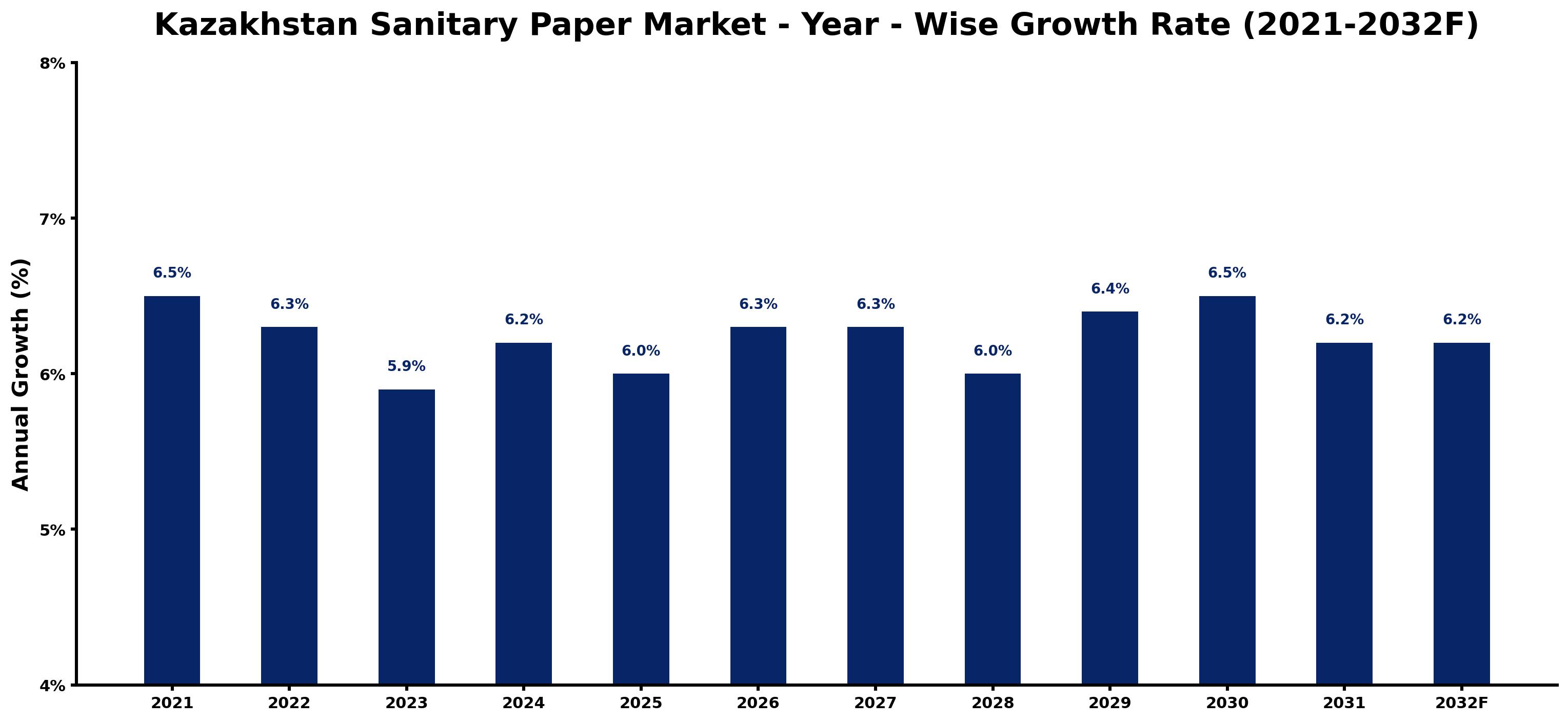
The table below presents the year wise growth rates along with the key drivers influencing the market
| Year | Growth Rate | Major Drivers |
| 2021 | 6.5% | A rebound in consumer spending bolstered sales across various hygiene product segments. |
| 2022 | 6.3% | E-commerce platforms surged, facilitating wider distribution of sanitary paper products. |
| 2023 | 5.9% | Local manufacturing initiatives began addressing demand and reducing import dependency significantly. |
| 2024 | 6.2% | Urbanization trends spurred construction, increasing the need for commercial sanitary paper supplies. |
| 2025 | 6.0% | Corporate sustainability programs promoted eco-friendly sanitary paper options among businesses. |
| 2026 | 6.3% | Increased awareness around hygiene standards led to higher consumption of sanitary products. |
| 2027 | 6.3% | Export opportunities expanded as regional demand for sanitary paper grew in neighboring countries. |
| 2028 | 6.0% | Innovative product designs emerged, attracting younger consumers to premium sanitary options. |
| 2029 | 6.4% | Partnerships between retailers and local manufacturers enhanced supply chain efficiencies significantly. |
| 2030 | 6.5% | Health crises prompted lasting shifts in hygiene behaviors, solidifying market demand stability. |
| 2031 | 6.2% | Technological enhancements in production processes improved product quality and reduced costs. |
| 2032 | 6.2% | Market consolidation trends streamlined operations, allowing for competitive pricing and expanded offerings. |
Note - Market size estimations and growth projections presented in this report are based on 6Wresearch's advanced forecasting approach, validated with industry datasets as of June 2026.
Kazakhstan Sanitary Paper Market Synopsis
The Kazakhstan Sanitary Paper Market is projected to reach 6.3% and witness significant growth during the forecast period (2026-2032). This progression is driven by an increasing awareness of health and hygiene among the populace, which, in turn, is propelling the demand for sanitary paper products across Kazakhstan. Additionally, the rising disposable incomes among consumers are expected to lead to enhanced spending on such essential products, further fueling market growth in the region.
Kazakhstan Sanitary Paper Market Growth Drivers
Several key factors are contributing to the robust growth of the Kazakhstan Sanitary Paper Market. Firstly, the heightened focus on personal hygiene has amplified the demand for sanitary products. Consumers are increasingly recognizing the importance of using quality sanitary paper, resulting in a shift towards premium products.
- The rising awareness regarding health and hygiene is significantly changing consumer behavior in Kazakhstan, leading to an uptick in demand for various sanitary paper products.
- Economic growth and a subsequent rise in disposable incomes are creating new opportunities for consumers to invest in better quality sanitary paper, thereby boosting market revenues.
- Product innovations, such as enhanced softness and improved absorbency, are attracting consumers, helping brands differentiate themselves in a competitive market.
- The expansion of retail channels, including supermarkets and hypermarkets, is increasing product accessibility, thereby encouraging further consumption of sanitary papers.
- The growth of ecommerce platforms is making it easier for consumers to purchase sanitary products online, providing an additional avenue for growth in the market.
Kazakhstan Sanitary Paper Market Trends and Opportunities
The Kazakhstan Sanitary Paper Market is witnessing several trends that present opportunities for growth. Manufacturers are increasingly focused on introducing innovative products to meet evolving consumer preferences. The integration of advanced features, such as enhanced softness and absorbency, is becoming a key competitive strategy.
- The trend towards sustainability is prompting manufacturers to explore eco-friendly materials and production processes, appealing to environmentally conscious consumers.
- Customization and personalization in product offerings are gaining traction, as consumers look for sanitary products that cater to their specific needs and preferences.
- The rise of social media and digital marketing is facilitating better consumer engagement, allowing brands to build strong relationships with their target markets.
- Increased investment in research and development is enabling companies to innovate and streamline production processes, thus reducing costs and enhancing efficiency.
- Partnerships with healthcare providers and institutions are becoming more common, as companies seek to promote awareness of the importance of sanitary products in maintaining health and hygiene.
Kazakhstan Sanitary Paper Market Challenges and Restraints
Despite the positive outlook for the Kazakhstan Sanitary Paper Market, several challenges may hinder its full potential. Fluctuations in raw material prices can adversely affect production costs and, consequently, retail prices.
- Market competition is intensifying as more players enter the sector, which may lead to price wars and impact profit margins.
- Consumer preference shifts towards alternative products may pose challenges, as natural and organic materials gain traction, potentially affecting traditional sanitary paper sales.
- Economic uncertainties and fluctuations in disposable income can impact consumer spending behavior, particularly in times of financial strain.
- Supply chain disruptions, especially in sourcing raw materials, can affect manufacturers' ability to meet growing demand.
- Regulatory compliance related to product safety and environmental standards may increase operational complexities for manufacturers.
Kazakhstan Sanitary Paper Market Government Investment and Initiatives
Government investment and initiatives play a pivotal role in shaping the Kazakhstan Sanitary Paper Market. Authorities are recognizing the importance of promoting hygiene and health standards, which often translates into supportive policies and funding programs. Public spending on health infrastructure is increasingly focused on addressing sanitary needs, thus indirectly boosting the market.
- The government is expected to implement public health campaigns that emphasize the importance of sanitary paper products, contributing to increased consumer awareness.
- Investment in textile research and development may lead to improved manufacturing processes and innovative product offerings within the sanitary paper sector.
- Regulatory frameworks are being established to ensure that sanitary paper products meet safety and environmental standards, promoting overall market integrity.
- Partnerships with international organizations to promote best practices in hygiene and sanitation can enhance local market capabilities.
- Incentives for adopting eco-friendly production methods are likely to encourage manufacturers towards sustainable practices in the sanitary paper industry.
Kazakhstan Sanitary Paper Market Latest Developments (May 2025 - June 2026)
The Kazakhstan Sanitary Paper Market is evolving, with various recent developments shaping its trajectory. Manufacturers are increasingly focusing on product development to cater more effectively to consumer preferences and expectations. Innovations during this period have been centered around enhancing product quality and sustainability, reflecting consumer demand for more environmentally friendly options.
- The introduction of new product lines with unique features, such as hypoallergenic and biodegradable options, is becoming a notable trend in response to consumer preferences.
- Increased marketing efforts aimed at educating consumers about the benefits of using quality sanitary paper are prominent.
- Collaboration between manufacturers and retailers has been strengthened to enhance product visibility and accessibility in various retail environments.
- Digitalization in sales processes is gaining traction, with technology enhancing the ecommerce platform experience for consumers.
- Sustainability initiatives are being highlighted by brands, as efforts to reduce carbon footprints and enhance recycling practices take precedence in product development strategies.
Kazakhstan Sanitary Paper Market - Key Attractiveness of the Report
- 10 Years of Market Numbers
- Historical Data Starting from 2022 to 2025
- Base Year: 2025
- Forecast Data until 2032
- Key Performance Indicators Impacting the Market
- Major Upcoming Developments and Projects
Key Highlights of the Report:
- Kazakhstan Sanitary Paper Market Outlook
- Market Size of Kazakhstan Sanitary Paper Market, 2025
- Forecast of Kazakhstan Sanitary Paper Market, 2032F
- Historical Data and Forecast of Kazakhstan Sanitary Paper Revenues & Volume for the Period 2022-2032F
- Kazakhstan Sanitary Paper Market Trend Evolution
- Kazakhstan Sanitary Paper Market Drivers and Challenges
- Kazakhstan Sanitary Paper Price Trends
- Kazakhstan Sanitary Paper Porter's Five Forces
- Kazakhstan Sanitary Paper Industry Life Cycle
- Historical Data and Forecast of Kazakhstan Sanitary Paper Market Revenues & Volume By Product Types for the Period 2022-2032F
- Historical Data and Forecast of Kazakhstan Sanitary Paper Market Revenues & Volume By Tissues And Handkerchiefs for the Period 2022-2032F
- Historical Data and Forecast of Kazakhstan Sanitary Paper Market Revenues & Volume By Table Napkins for the Period 2022-2032F
- Historical Data and Forecast of Kazakhstan Sanitary Paper Market Revenues & Volume By Toilet Paper for the Period 2022-2032F
- Historical Data and Forecast of Kazakhstan Sanitary Paper Market Revenues & Volume By Towels for the Period 2022-2032F
- Historical Data and Forecast of Kazakhstan Sanitary Paper Market Revenues & Volume By Sanitary Napkins And Tampons for the Period 2022-2032F
- Historical Data and Forecast of Kazakhstan Sanitary Paper Market Revenues & Volume By Disposable Diapers for the Period 2022-2032F
- Historical Data and Forecast of Kazakhstan Sanitary Paper Market Revenues & Volume By Application? for the Period 2022-2032F
- Historical Data and Forecast of Kazakhstan Sanitary Paper Market Revenues & Volume By Residential for the Period 2022-2032F
- Historical Data and Forecast of Kazakhstan Sanitary Paper Market Revenues & Volume By Commercial for the Period 2022-2032F
- Kazakhstan Sanitary Paper Import Export Trade Statistics
- Market Opportunity Assessment By Product Types
- Market Opportunity Assessment By Application?
- Kazakhstan Sanitary Paper Top Companies Market Share
- Kazakhstan Sanitary Paper Competitive Benchmarking By Technical and Operational Parameters
- Kazakhstan Sanitary Paper Company Profiles
- Kazakhstan Sanitary Paper Key Strategic Recommendations






































