Kazakhstan Seafood Processing Market Size, Share & Growth Rate
The Kazakhstan Seafood Processing Market was estimated at USD 333 Million in 2025 and is projected to reach USD 483 Million by 2032, growing at a CAGR of 5.5% from 2026 to 2032. This growth trajectory is largely fueled by an increase in disposable incomes among consumers, along with a shift in dietary preferences toward healthier protein sources. Coupled with a heightened awareness of seafood's health benefits, these factors present robust opportunities for market expansion.
Kazakhstan Seafood Processing Market Year-wise Growth Rate and Key Drivers
This graph highlights how the Kazakhstan Seafood Processing Market has steadily grown over the years, supported by major growth factors.
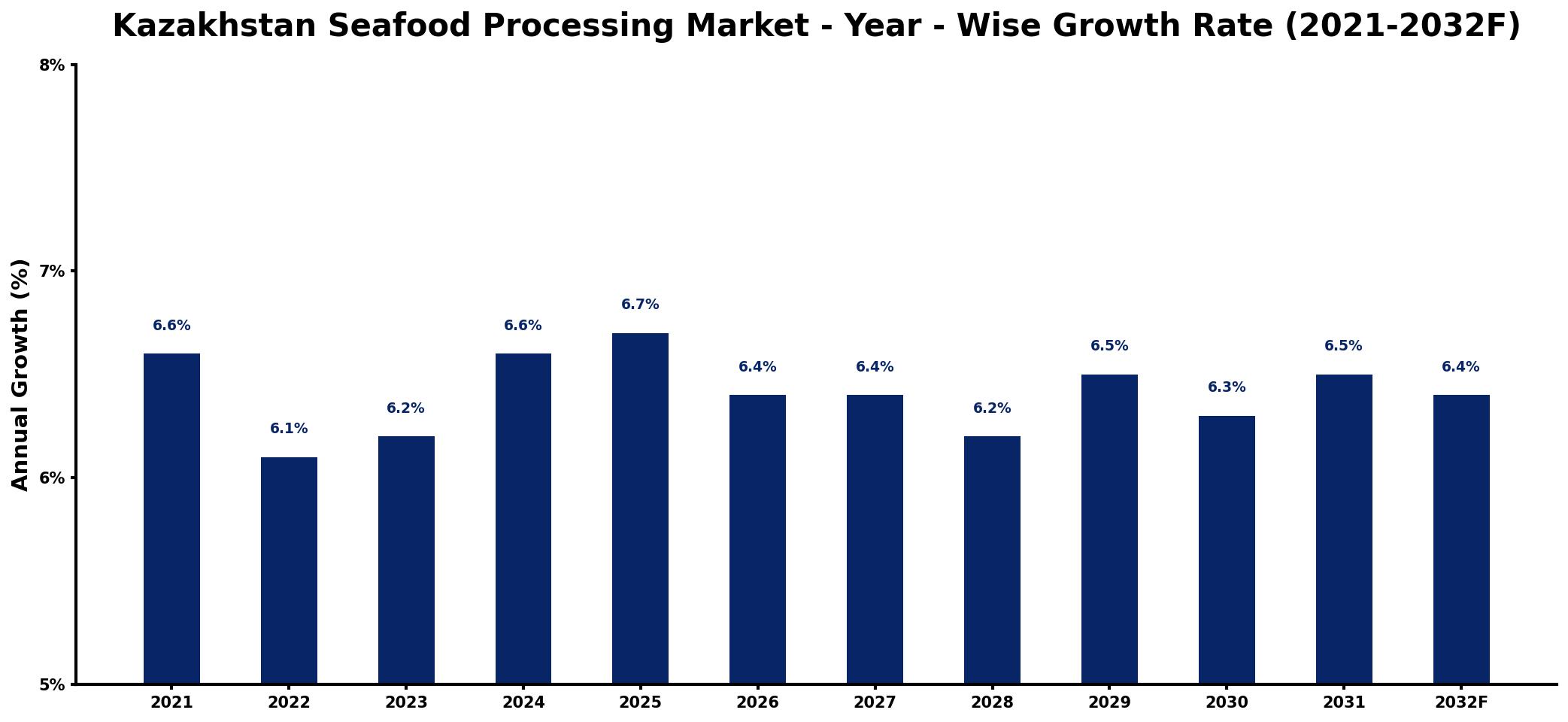
The table below presents the year‑wise growth rates along with the key drivers influencing the market
| Year | Growth Rate | Major Drivers |
| 2021 | 6.6% | Rising consumer health consciousness |
| 2022 | 6.1% | Increased domestic production capacity |
| 2023 | 6.2% | Growing export market opportunities |
| 2024 | 6.6% | Expansion of cold chain logistics |
| 2025 | 6.7% | Investment in sustainable practices |
| 2026 | 6.4% | Technological advancements in supply |
| 2027 | 6.4% | Diversification of product offerings |
| 2028 | 6.2% | Strengthening of regulatory frameworks |
| 2029 | 6.5% | Growth in e-commerce platforms |
| 2030 | 6.3% | Rising popularity of convenience foods |
| 2031 | 6.5% | Enhanced food safety standards |
| 2032 | 6.4% | Collaboration with global partners |
Note: Market size estimations and growth projections presented in this report are based on 6Wresearch's proprietary forecasting methodology, utilizing the latest available industry data, government publications, and primary research inputs.
Kazakhstan Seafood Processing Market Synopsis
Consumer demand for high-quality and sustainably sourced seafood is the strongest force currently shaping the Kazakhstan seafood processing market. As dietary habits evolve, more consumers are opting for seafood products, driven by a growing emphasis on health and wellness.
Kazakhstan's geographical advantages, particularly its extensive access to the Caspian Sea, provide a solid foundation for the seafood processing industry. This abundant resource, combined with government initiatives aimed at bolstering the sector, is propelling growth and innovation in processing methods and product offerings.
Kazakhstan Seafood Processing Market Key Takeaways
- The market is experiencing a significant shift toward sustainable seafood processing practices.
- Technological advancements in processing facilities are improving efficiency and product quality.
- There is a rising demand for value-added seafood products, such as ready-to-eat meals.
- Government policies are enhancing food safety standards and supporting infrastructure development.
- Investment opportunities exist in modernizing facilities and adopting eco-friendly practices.
Evaluation of Restraints in Kazakhstan Seafood Processing Market
Despite the promising growth, the Kazakhstan seafood processing market faces notable challenges. A significant constraint is the limited access to quality raw materials, primarily due to the country's landlocked nature, which necessitates imports that can inflate costs. Furthermore, inadequate infrastructure and outdated technology can hinder operational efficiencies, thereby restricting market competitiveness. Compliance with stringent regulatory standards and the pressure from imported seafood products further complicate the landscape for local processors, necessitating strategic adjustments to maintain market position.
Kazakhstan Seafood Processing Market Trends
A prominent trend in the Kazakhstan seafood processing market is the increasing consumer preference for certified sustainable seafood. This shift is driving processors to adopt eco-friendly practices and focus on the traceability of their products. Additionally, the popularity of convenience-based products, such as smoked seafood and ready-to-eat meals, continues to rise, reflecting changing consumer lifestyles. Advances in processing technology also present opportunities to enhance product quality and operational efficiency, ensuring that the market remains competitive on both a local and international scale.
Kazakhstan Seafood Processing Market Opportunities
Investment opportunities within the Kazakhstan seafood processing market are abundant. Modernizing processing facilities to leverage advanced technologies can significantly enhance efficiency and product quality. The growing domestic and international demand for seafood creates avenues for expanding production capacity. Collaborations with local fisheries to secure a reliable supply of high-quality raw materials are crucial for sustained growth. Moreover, incorporating sustainable practices not only meets consumer expectations but also offers a competitive edge in a market increasingly focused on environmental responsibility.
Government Initiatives in the Kazakhstan Seafood Processing Market
The government of Kazakhstan plays a pivotal role in the development of the seafood processing market through various initiatives aimed at promoting sustainability and food safety. Policies focusing on hygiene standards, quality control, and traceability are being enforced to enhance the processing chain's integrity. Additionally, the government encourages the development of aquaculture and sustainable fishing practices to reduce reliance on imports, alongside providing incentives and subsidies to attract investment in modern processing technologies. These efforts collectively aim to uplift the industry and align with international standards.
Future Insights of the Kazakhstan Seafood Processing Market
The future outlook for the Kazakhstan seafood processing market remains optimistic as it adapts to changing consumer preferences and industry demands. The anticipated increase in disposable incomes and health consciousness will likely propel the demand for high-quality seafood products. Continuous advancements in technology and a focus on sustainability will drive efficiency and foster innovation in product offerings. As the market evolves, it is well-positioned to attract further investments and encourage new players, heralding a phase of dynamic growth and development through 2032.
Kazakhstan Seafood Processing Market Latest Developments (2025 - 2026)
In recent months, the Kazakhstan seafood processing market has witnessed a strong push toward modernization, with several facilities upgrading their technology to enhance product quality and efficiency. There is also an increasing emphasis on sustainable sourcing, with companies exploring partnerships with local fisheries. These developments indicate a growing alignment with global trends toward sustainability and high-quality production, positioning the market favorably for future growth.
Kazakhstan Seafood Processing Market - Key Attractiveness of the Report
- 10 Years of Market Numbers
- Historical Data Starting from 2022 to 2025
- Base Year: 2025
- Forecast Data until 2032
- Key Performance Indicators Impacting the Market
- Major Upcoming Developments and Projects
Key Highlights of the Report:
- Kazakhstan Seafood Processing Market Outlook
- Market Size of Kazakhstan Seafood Processing Market, 2025
- Forecast of Kazakhstan Seafood Processing Market, 2032
- Historical Data and Forecast of Kazakhstan Seafood Processing Revenues & Volume for the Period 2022-2032F
- Kazakhstan Seafood Processing Market Trend Evolution
- Kazakhstan Seafood Processing Market Drivers and Challenges
- Kazakhstan Seafood Processing Price Trends
- Kazakhstan Seafood Processing Porter's Five Forces
- Kazakhstan Seafood Processing Industry Life Cycle
- Historical Data and Forecast of Kazakhstan Seafood Processing Market Revenues & Volume By Equipment Type for the Period 2022-2032F
- Historical Data and Forecast of Kazakhstan Seafood Processing Market Revenues & Volume By Gutting Equipment for the Period 2022-2032F
- Historical Data and Forecast of Kazakhstan Seafood Processing Market Revenues & Volume By Sealing Equipment for the Period 2022-2032F
- Historical Data and Forecast of Kazakhstan Seafood Processing Market Revenues & Volume By Filleting Equipment for the Period 2022-2032F
- Historical Data and Forecast of Kazakhstan Seafood Processing Market Revenues & Volume By Deboning Equipment for the Period 2022-2032F
- Historical Data and Forecast of Kazakhstan Seafood Processing Market Revenues & Volume By other Equipment for the Period 2022-2032F
- Historical Data and Forecast of Kazakhstan Seafood Processing Market Revenues & Volume By Category for the Period 2022-2032F
- Historical Data and Forecast of Kazakhstan Seafood Processing Market Revenues & Volume By Single-Function Equipment for the Period 2022-2032F
- Historical Data and Forecast of Kazakhstan Seafood Processing Market Revenues & Volume By Multi-Function Equipment for the Period 2022-2032F
- Historical Data and Forecast of Kazakhstan Seafood Processing Market Revenues & Volume By Seafood Type for the Period 2022-2032F
- Historical Data and Forecast of Kazakhstan Seafood Processing Market Revenues & Volume By Fish for the Period 2022-2032F
- Historical Data and Forecast of Kazakhstan Seafood Processing Market Revenues & Volume By Crustaceans for the Period 2022-2032F
- Historical Data and Forecast of Kazakhstan Seafood Processing Market Revenues & Volume By Mollusks for the Period 2022-2032F
- Historical Data and Forecast of Kazakhstan Seafood Processing Market Revenues & Volume By others for the Period 2022-2032F
- Kazakhstan Seafood Processing Import Export Trade Statistics
- Market Opportunity Assessment By Equipment Type
- Market Opportunity Assessment By Category
- Market Opportunity Assessment By Seafood Type
- Kazakhstan Seafood Processing Top Companies Market Share
- Kazakhstan Seafood Processing Competitive Benchmarking By Technical and Operational Parameters
- Kazakhstan Seafood Processing Company Profiles
- Kazakhstan Seafood Processing Key Strategic Recommendations






































