Kazakhstan Spinning Machinery Market Size, Share & Growth Rate
The Kazakhstan Spinning Machinery Market was estimated at USD 227 Million in 2025 and is projected to reach USD 299 Million by 2032, growing at a CAGR of 4.0% from 2026 to 2032. This growth is fueled by the ongoing expansion of the domestic textile sector, which is increasingly demanding sophisticated spinning technologies. The convergence of rising disposable incomes and shifting consumer preferences further amplifies the need for high-quality textiles, driving machinery innovations.
Kazakhstan Spinning Machinery Market Year-wise Growth Rate and Key Drivers
This graph highlights how the Kazakhstan Spinning Machinery Market has steadily grown over the years, supported by major growth factors.
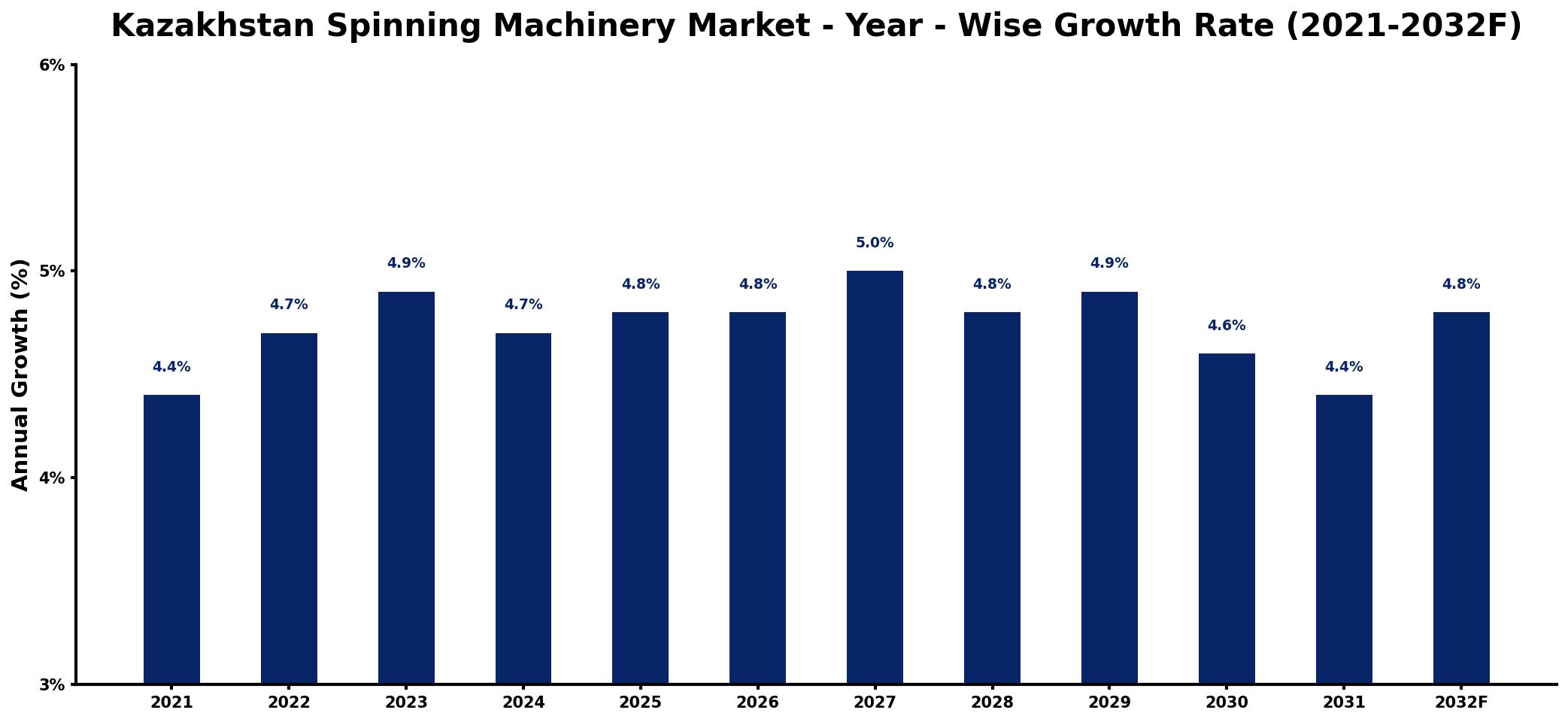
The table below presents the year‑wise growth rates along with the key drivers influencing the market
| Year | Growth Rate | Major Drivers |
| 2021 | 4.4% | Increased textile production capacity |
| 2022 | 4.7% | Higher demand for sustainable fibers |
| 2023 | 4.9% | Expansion of apparel export markets |
| 2024 | 4.7% | Investments in modern textile technology |
| 2025 | 4.8% | Growth in eco-friendly initiatives |
| 2026 | 4.8% | Rising consumer fashion trends |
| 2027 | 5.0% | Development of regional textile hubs |
| 2028 | 4.8% | Surge in online retail platforms |
| 2029 | 4.9% | Increased government textile support |
| 2030 | 4.6% | Emerging markets textile demand |
| 2031 | 4.4% | Strengthened local manufacturing policies |
| 2032 | 4.8% | Enhanced research and innovation funding |
Note: Market size estimations and growth projections presented in this report are based on 6Wresearch's proprietary forecasting methodology, utilizing the latest available industry data, government publications, and primary research inputs.
Kazakhstan Spinning Machinery Market Synopsis
The primary catalyst shaping the Kazakhstan Spinning Machinery Market today is the rapid development of the countrys textile industry. As domestic textile manufacturers strive to enhance production efficiency, the demand for advanced spinning equipment is steadily increasing. This trend is bolstered by a greater focus on quality and sustainability within the sector.
Moreover, government initiatives aimed at bolstering the textile industry play a pivotal role in nurturing market growth. By promoting foreign investments and providing favorable conditions for local manufacturers, these policies are fostering an environment ripe for technological advancement and market expansion.
Kazakhstan Spinning Machinery Market Key Takeaways
- Growing demand for advanced spinning machinery is enhancing production efficiency in the textile sector.
- Sustainable and eco-friendly technologies are becoming increasingly prioritized by industry players.
- Digital technologies such as IoT and AI are being integrated to optimize operations and maintenance.
- Investment opportunities abound in supplying modern machinery and offering maintenance services.
- Government support through incentives and regulations is facilitating industry growth.
Evaluation of Restraints in Kazakhstan Spinning Machinery Market
Despite the optimistic outlook, the Kazakhstan Spinning Machinery Market faces several limitations. Limited access to state-of-the-art technology often hinders manufacturers from fully optimizing production. High import costs associated with modern equipment create additional financial burdens. Furthermore, the industry struggles with a shortage of skilled labor necessary to operate and maintain advanced machinery efficiently. These factors combined present challenges that require strategic navigation to ensure competitiveness in both local and international arenas.
Kazakhstan Spinning Machinery Market Trends
Several trends are currently influencing the Kazakhstan Spinning Machinery Market. A notable shift towards greater automation in spinning equipment is evident, aiming to enhance operational productivity and lower labor costs. Additionally, the emphasis on sustainability is prompting manufacturers to explore eco-friendly machinery options that reduce energy consumption. The adoption of digital tools, including predictive analytics, is becoming common as companies seek to improve maintenance practices and operational efficiencies. Flexibility and customization in machinery are also trending, catering to diverse producer needs.
Kazakhstan Spinning Machinery Market Opportunities
The market for spinning machinery in Kazakhstan holds significant opportunities for growth and investment. As textile manufacturers seek to modernize their operations, the demand for advanced spinning equipment—such as ring spinning and compact spinning machines—is on the rise. Additionally, there is a burgeoning market for maintenance and repair services aimed at extending the lifespan and performance of existing equipment. Collaborating with local textile producers to provide tailored solutions and technology upgrades could further enhance investment prospects in this evolving landscape.
Government Initiatives in the Kazakhstan Spinning Machinery Market
The Kazakhstani government has rolled out a suite of policies aimed at stimulating the growth of the spinning machinery market. These include various investment incentives, tax breaks, and financial support to attract both domestic and foreign players. Research and development initiatives are also a focal point, as the government aims to enhance local manufacturing competitiveness through technological advancements. Additionally, regulations ensuring quality standards and environmental sustainability contribute to fostering a robust industry framework.
Future Insights of the Kazakhstan Spinning Machinery Market
Looking ahead to 2026-2032, the Kazakhstan Spinning Machinery Market is positioned for promising growth. The increasing demand for textiles, coupled with government support and a focus on technological advancements, is likely to sustain market expansion. Advancements in automation and digital technologies will not only enhance productivity but also improve the overall quality of textile outputs. This evolving landscape indicates a ripe opportunity for both local and international market participants to capitalize on the burgeoning demand.
Kazakhstan Spinning Machinery Market Latest Developments (2025 - 2026)
Recent developments within the Kazakhstan Spinning Machinery Market reflect a heightened interest in automation and sustainability among manufacturers. Companies are increasingly investing in modernizing their machinery to align with global standards, while collaborations between technology providers and textile producers are on the rise. Furthermore, there's a noticeable shift in focus towards integrating digital solutions that allow for smarter manufacturing processes and predictive maintenance capabilities.
Kazakhstan Spinning Machinery Market - Key Attractiveness of the Report
- 10 Years of Market Numbers
- Historical Data Starting from 2022 to 2025
- Base Year: 2025
- Forecast Data until 2032
- Key Performance Indicators Impacting the Market
- Major Upcoming Developments and Projects
Key Highlights of the Report:
- Kazakhstan Spinning Machinery Market Outlook
- Market Size of Kazakhstan Spinning Machinery Market, 2025
- Forecast of Kazakhstan Spinning Machinery Market, 2032
- Historical Data and Forecast of Kazakhstan Spinning Machinery Revenues & Volume for the Period 2022-2032F
- Kazakhstan Spinning Machinery Market Trend Evolution
- Kazakhstan Spinning Machinery Market Drivers and Challenges
- Kazakhstan Spinning Machinery Price Trends
- Kazakhstan Spinning Machinery Porter's Five Forces
- Kazakhstan Spinning Machinery Industry Life Cycle
- Historical Data and Forecast of Kazakhstan Spinning Machinery Market Revenues & Volume By Type for the Period 2022-2032F
- Historical Data and Forecast of Kazakhstan Spinning Machinery Market Revenues & Volume By Ring for the Period 2022-2032F
- Historical Data and Forecast of Kazakhstan Spinning Machinery Market Revenues & Volume By Rotor Spinning for the Period 2022-2032F
- Historical Data and Forecast of Kazakhstan Spinning Machinery Market Revenues & Volume By Material for the Period 2022-2032F
- Historical Data and Forecast of Kazakhstan Spinning Machinery Market Revenues & Volume By Natural for the Period 2022-2032F
- Historical Data and Forecast of Kazakhstan Spinning Machinery Market Revenues & Volume By Synthetic for the Period 2022-2032F
- Historical Data and Forecast of Kazakhstan Spinning Machinery Market Revenues & Volume By Others for the Period 2022-2032F
- Historical Data and Forecast of Kazakhstan Spinning Machinery Market Revenues & Volume By End-Use Industry for the Period 2022-2032F
- Historical Data and Forecast of Kazakhstan Spinning Machinery Market Revenues & Volume By Clothing for the Period 2022-2032F
- Historical Data and Forecast of Kazakhstan Spinning Machinery Market Revenues & Volume By Textile for the Period 2022-2032F
- Historical Data and Forecast of Kazakhstan Spinning Machinery Market Revenues & Volume By Other Industry for the Period 2022-2032F
- Kazakhstan Spinning Machinery Import Export Trade Statistics
- Market Opportunity Assessment By Type
- Market Opportunity Assessment By Material
- Market Opportunity Assessment By End-Use Industry
- Kazakhstan Spinning Machinery Top Companies Market Share
- Kazakhstan Spinning Machinery Competitive Benchmarking By Technical and Operational Parameters
- Kazakhstan Spinning Machinery Company Profiles
- Kazakhstan Spinning Machinery Key Strategic Recommendations






































