Kazakhstan Sports Flooring Market Summary
The kazakhstan sports flooring market was estimated at USD 167 Million in 2025 and is projected to reach USD 235 Million by 2032, growing at a CAGR of 5.7% from 2026 to 2032.
Kazakhstan Sports Flooring Market Year-wise Growth Rate and Key Drivers
This graph highlights how the Kazakhstan Sports Flooring Market has steadily grown over the past five years, supported by major growth factors.
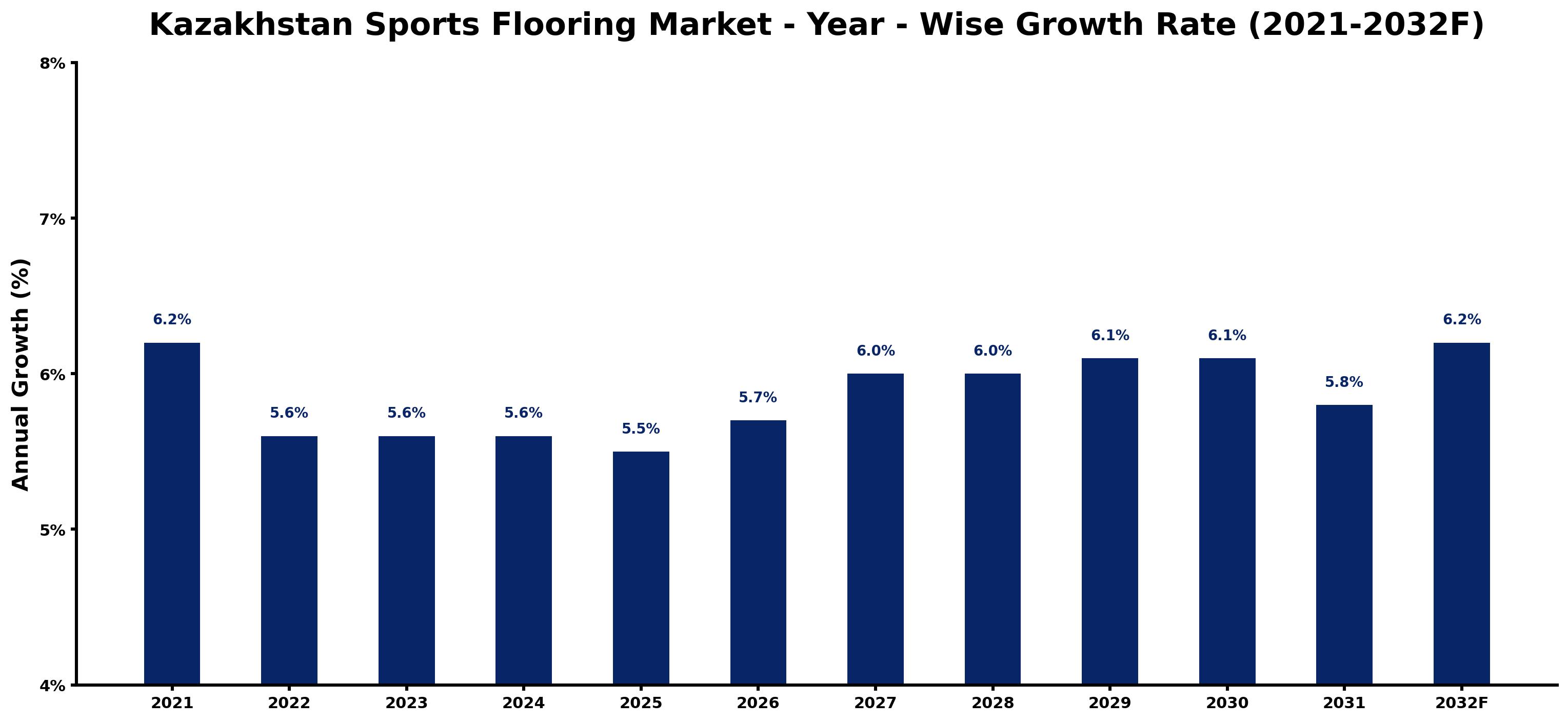
The table below presents the year wise growth rates along with the key drivers influencing the market
| Year | Growth Rate | Major Drivers |
| 2021 | 6.2% | Increased urbanization leads to more sports facilities requiring high-quality flooring options. |
| 2022 | 5.6% | Investment in youth sports programs boosts the demand for durable flooring solutions. |
| 2023 | 5.6% | A surge in fitness awareness drives renovations of existing athletic spaces. |
| 2024 | 5.6% | International sporting events scheduled, prompting upgrades in local sports infrastructure. |
| 2025 | 5.5% | Emergence of eco-friendly flooring materials resonates with sustainability-conscious consumers. |
| 2026 | 5.7% | Local manufacturers expand, reducing dependency on imported sports flooring products. |
| 2027 | 6.0% | Innovative flooring technologies enhance performance, attracting high-level athletic events. |
| 2028 | 6.0% | Government support for sports initiatives stimulates infrastructure development across regions. |
| 2029 | 6.1% | Urban redevelopment projects integrate multi-purpose sports facilities, increasing flooring demand. |
| 2030 | 6.1% | Corporate sponsorships elevate sports programs, leading to increased flooring investments. |
| 2031 | 5.8% | Trends in home fitness encourage the installation of premium flooring solutions. |
| 2032 | 6.2% | Digital platforms promote sports engagement, leading to higher demand for versatile flooring. |
Note - Market size estimations and growth projections presented in this report are based on 6Wresearch's advanced forecasting approach, validated with industry datasets as of June 2026.
Kazakhstan Sports Flooring Market Synopsis
The Kazakhstan Sports Flooring Market is projected to reach 5.7% and witness significant growth during the forecast period (2026-2032). This growth is primarily driven by an increasing emphasis on developing sports infrastructure and enhancing public engagement in fitness and sports activities. As the population becomes more aware of the health benefits associated with physical activity, the demand for various types of sports flooring—including hardwood, synthetic, and rubber—continues to rise. This report delves into the market dynamics, challenges, and the evolving landscape of the Kazakhstan sports flooring sector.
Kazakhstan Sports Flooring Market Growth Drivers
A key factor contributing to the expansion of the Kazakhstan Sports Flooring Market is the strategic investment in sports infrastructure. Government initiatives aimed at promoting physical fitness are resulting in the establishment of more sports facilities. This is fostering an environment where demand for durable and high-quality flooring solutions is escalating. Important growth drivers include:
- Investments in new sports complexes, community centers, and educational institutions that require specialized flooring.
- Growing awareness among the public about the significance of fitness, encouraging more participation in sports activities.
- The trend towards environmentally sustainable flooring materials, appealing to both commercial and residential markets.
- Increased organization of sporting events and competitions which necessitate high-performance sports surfaces.
- Expansion of fitness centers and gyms offering diverse workout options, requiring versatile flooring solutions.
Kazakhstan Sports Flooring Market Trends and Opportunities
The Kazakhstan Sports Flooring Market is witnessing notable trends as stakeholders adapt to evolving consumer preferences. A significant trend is the shift towards sustainable materials that not only enhance performance but also minimize environmental impact. Additionally, the following trends are shaping the market landscape:
- Rising demand for multipurpose sports flooring that accommodates various indoor and outdoor activities.
- Preference for modular flooring systems, allowing for flexibility in design and installation, appealing to a wider range of facilities.
- Enhanced focus on safety features, such as slip resistance and shock absorption, to protect athletes and users.
- Growing inclination towards specialized flooring tailored for specific sports, enhancing performance and safety.
- Opportunities for innovation in flooring technologies, driven by consumer demand for high-quality, long-lasting materials.
Kazakhstan Sports Flooring Market Challenges and Restraints
Despite its growth, the Kazakhstan Sports Flooring Market faces several challenges that could impede its development. Addressing these obstacles is crucial for sustained progress:
- Limited availability of high-quality raw materials, which can restrict the production of premium sports flooring solutions.
- Fluctuating prices of raw materials affecting profit margins and pricing strategies for suppliers.
- A lack of awareness regarding the benefits of specialized sports flooring among potential buyers, which slows market adoption.
- Competition from alternative flooring solutions like ceramics and vinyl, which may offer lower initial costs.
- Infrastructure and logistical challenges in remote regions that may complicate the distribution and installation of flooring products.
Kazakhstan Sports Flooring Market Investment Opportunities
The prospects for investment within the Kazakhstan Sports Flooring Market are compelling, fueled by a burgeoning demand for quality sports environments. As the country invests in fitness and sports activities, the following opportunities present themselves:
- Investing in the supply chain for specialized flooring materials tailored for specific sports activities can meet rising demand.
- Opportunities in the maintenance and renovation of existing sports flooring infrastructure, aligning with modern safety standards.
- Creating partnerships with local fitness centers and sports facilities to provide customized flooring solutions.
- Exploring government initiatives aimed at enhancing sports participation, which can lead to increased demand for flooring solutions.
- Capitalizing on the trend of sustainable materials by investing in technologies that produce eco-friendly flooring options.
Kazakhstan Sports Flooring Market Government Investment and Initiatives
The Kazakhstan government has recognized the importance of a robust sports infrastructure and has implemented various initiatives to bolster the sports flooring market. These initiatives include:
- Policies focused on promoting high-quality and safe flooring materials in sports facilities to enhance athlete safety.
- Regulations aimed at standardizing flooring product quality, ensuring reliability in the market.
- Investment incentives for local manufacturers to stimulate domestic production of sports flooring materials.
- Public spending on sports infrastructure projects, including schools, parks, and community centers that require advanced flooring solutions.
- Support for initiatives that aim to raise public engagement in sports and physical activities, driving demand for suitable flooring options.
Kazakhstan Sports Flooring Market Latest Developments (May 2025 - June 2026)
In recent months leading up to June 2026, the Kazakhstan Sports Flooring Market has experienced various developments that reflect shifts in industry focus. Key movements include:
- Growing investments in innovative flooring technologies that enhance user experience and performance.
- Increased emphasis on sustainability as manufacturers adapt to environmental concerns and consumer preferences.
- Strategic partnerships forming between sports facility operators and flooring suppliers to improve product offerings.
- Heightened awareness campaigns aimed at educating potential buyers on the benefits and options for specialized sports flooring.
- Expansion in the variety of flooring solutions available to cater to the diverse needs of indoor and outdoor sports.
Kazakhstan Sports Flooring Market - Key Attractiveness of the Report
- 10 Years of Market Numbers
- Historical Data Starting from 2022 to 2025
- Base Year: 2025
- Forecast Data until 2032
- Key Performance Indicators Impacting the Market
- Major Upcoming Developments and Projects
Key Highlights of the Report:
- Kazakhstan Sports Flooring Market Outlook
- Market Size of Kazakhstan Sports Flooring Market, 2025
- Forecast of Kazakhstan Sports Flooring Market, 2032F
- Historical Data and Forecast of Kazakhstan Sports Flooring Revenues & Volume for the Period 2022-2032F
- Kazakhstan Sports Flooring Market Trend Evolution
- Kazakhstan Sports Flooring Market Drivers and Challenges
- Kazakhstan Sports Flooring Price Trends
- Kazakhstan Sports Flooring Porter's Five Forces
- Kazakhstan Sports Flooring Industry Life Cycle
- Historical Data and Forecast of Kazakhstan Sports Flooring Market Revenues & Volume By Product Type for the Period 2022-2032F
- Historical Data and Forecast of Kazakhstan Sports Flooring Market Revenues & Volume By Outdoor for the Period 2022-2032F
- Historical Data and Forecast of Kazakhstan Sports Flooring Market Revenues & Volume By Indoor for the Period 2022-2032F
- Historical Data and Forecast of Kazakhstan Sports Flooring Market Revenues & Volume By Material Type for the Period 2022-2032F
- Historical Data and Forecast of Kazakhstan Sports Flooring Market Revenues & Volume By Wood for the Period 2022-2032F
- Historical Data and Forecast of Kazakhstan Sports Flooring Market Revenues & Volume By Rubber for the Period 2022-2032F
- Historical Data and Forecast of Kazakhstan Sports Flooring Market Revenues & Volume By Polymeric for the Period 2022-2032F
- Historical Data and Forecast of Kazakhstan Sports Flooring Market Revenues & Volume By Sales Channel for the Period 2022-2032F
- Historical Data and Forecast of Kazakhstan Sports Flooring Market Revenues & Volume By Direct Sales for the Period 2022-2032F
- Historical Data and Forecast of Kazakhstan Sports Flooring Market Revenues & Volume By Independent Sports Outlet for the Period 2022-2032F
- Historical Data and Forecast of Kazakhstan Sports Flooring Market Revenues & Volume By Mass Merchandiser for the Period 2022-2032F
- Historical Data and Forecast of Kazakhstan Sports Flooring Market Revenues & Volume By Value Added Resellers for the Period 2022-2032F
- Historical Data and Forecast of Kazakhstan Sports Flooring Market Revenues & Volume By End-users for the Period 2022-2032F
- Historical Data and Forecast of Kazakhstan Sports Flooring Market Revenues & Volume By Commercial for the Period 2022-2032F
- Historical Data and Forecast of Kazakhstan Sports Flooring Market Revenues & Volume By Residential for the Period 2022-2032F
- Kazakhstan Sports Flooring Import Export Trade Statistics
- Market Opportunity Assessment By Product Type
- Market Opportunity Assessment By Material Type
- Market Opportunity Assessment By Sales Channel
- Market Opportunity Assessment By End-users
- Kazakhstan Sports Flooring Top Companies Market Share
- Kazakhstan Sports Flooring Competitive Benchmarking By Technical and Operational Parameters
- Kazakhstan Sports Flooring Company Profiles
- Kazakhstan Sports Flooring Key Strategic Recommendations






































