Kazakhstan Sulphur Market Size, Share & Growth Rate
The Kazakhstan Sulphur Market was estimated at USD 243 Million in 2025 and is projected to reach USD 340 Million by 2032, growing at a CAGR of 4.9% from 2026 to 2032. This growth trajectory is largely fueled by the expanding agricultural sector that heavily relies on sulphur for fertilizer production, alongside increased industrial applications in chemicals and mining. The country's strategic geographical position also enhances its export capabilities to rapidly growing markets in Asia.
Kazakhstan Sulphur Market Year-wise Growth Rate and Key Drivers
This graph highlights how the Kazakhstan Sulphur Market has steadily grown over the years, supported by major growth factors.
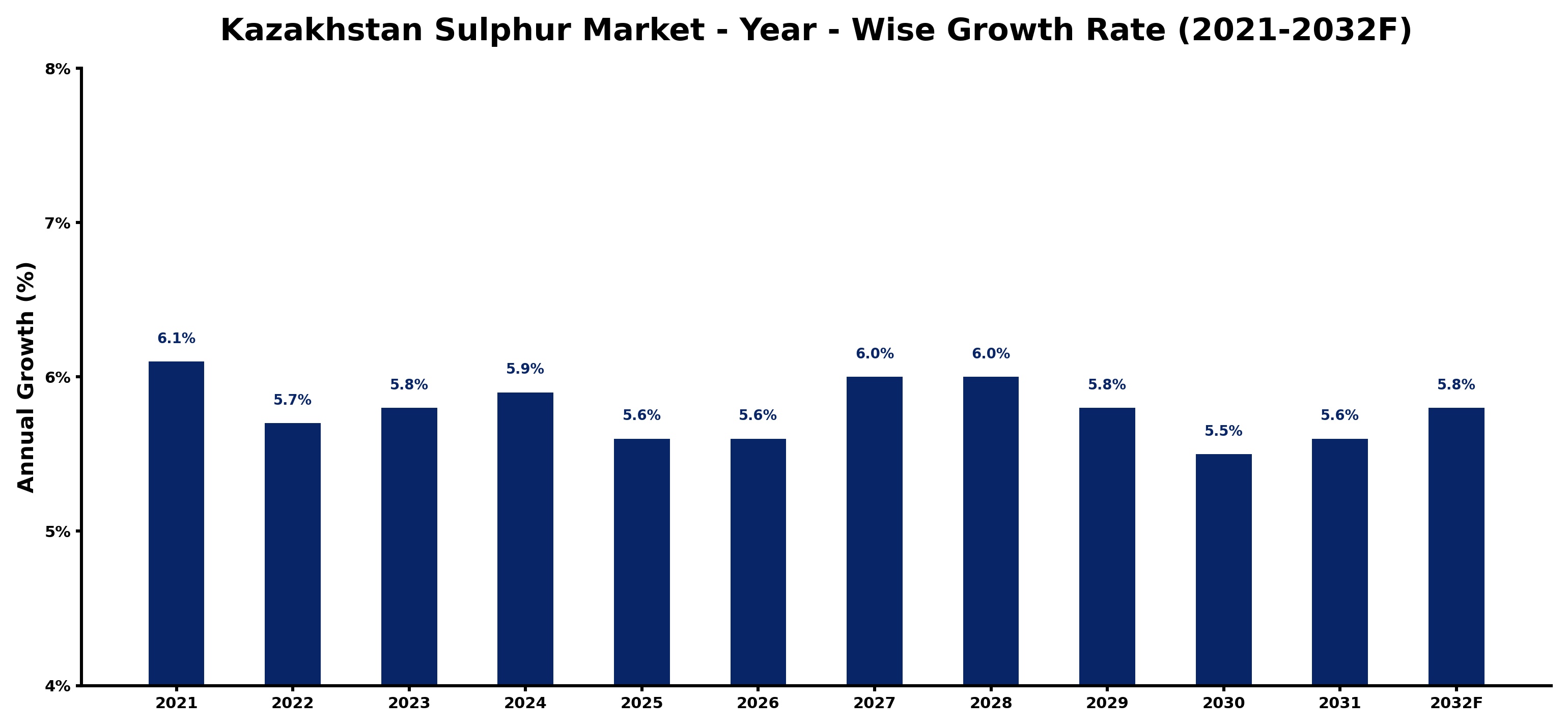
The table below presents the year‑wise growth rates along with the key drivers influencing the market
| Year | Growth Rate | Major Drivers |
| 2021 | 6.1% | Increased agricultural production demand |
| 2022 | 5.7% | Industrial applications expanded significantly |
| 2023 | 5.8% | Energy sector growth enhanced usage |
| 2024 | 5.9% | Construction industry boosted consumption |
| 2025 | 5.6% | Chemical manufacturing increased requirements |
| 2026 | 5.6% | Fertilizer production expanded rapidly |
| 2027 | 6.0% | Environmental regulations drove innovation |
| 2028 | 6.0% | Export opportunities enhanced market reach |
| 2029 | 5.8% | Technological advancements improved efficiency |
| 2030 | 5.5% | Sustainable practices gained traction |
| 2031 | 5.6% | Investment in infrastructure projects increased |
| 2032 | 5.8% | Collaboration with international partners grew |
Note - Market size estimations and growth projections presented in this report are based on 6Wresearch's advanced forecasting approach, validated with industry datasets as of June 2026.
Kazakhstan Sulphur Market Synopsis
In recent years, the Kazakhstan sulphur market has gained considerable momentum, driven by robust demand from both agricultural and industrial sectors. However, as we look ahead, the market is expected to encounter fluctuations in global pricing and evolving regulatory landscapes that may impact its growth trajectory.
Despite these potential hurdles, the outlook remains optimistic. The ongoing focus on enhancing agricultural productivity and the growing adoption of sulphur in emissions control and waste treatment reflect a significant opportunity for sustained market expansion in Kazakhstan.
Kazakhstan Sulphur Market Key Takeaways
- Kazakhstan is one of the world's top sulphur producers, primarily due to its oil and gas sector.
- The market is export-oriented, with significant shipments to China, Russia, and other Asian nations.
- Growing industrial applications, particularly in fertilizers and chemicals, are driving demand.
- Strategic investments in processing technologies and infrastructure are anticipated to foster growth.
- Environmental regulations are increasingly promoting sulphur's role in emissions control.
Evaluation of Restraints in Kazakhstan Sulphur Market
Despite the promising outlook for the Kazakhstan sulphur market, several restraints could hinder growth. One significant challenge is the volatility of global sulphur prices, which can directly influence domestic production and profitability. Additionally, infrastructure constraints in transportation could limit efficient distribution, impacting export capabilities. Regulatory shifts surrounding environmental policies could further complicate operations and necessitate compliance investments from local producers. Together, these factors underscore the importance of strategic planning and adaptation within this evolving market landscape.
Kazakhstan Sulphur Market Trends
Current trends in the Kazakhstan sulphur market highlight a notable increase in the usage of sulphur in agricultural applications, particularly for fertilizers aimed at improving crop yields. Concurrently, emerging industries such as chemical manufacturing are integrating sulphur into their processes, thereby diversifying its application base. Furthermore, heightened awareness regarding environmental sustainability is fostering an uptick in sulphur's role in waste treatment and emissions control technologies. These trends indicate a shifting landscape where sulphur is increasingly recognized not just as a byproduct but as a critical resource for various industrial needs.
Kazakhstan Sulphur Market Opportunities
Investment opportunities within the Kazakhstan sulphur market are promising, particularly due to the country's vast sulphur reserves. Investors can capitalize on the increasing demand across multiple sectors, including agriculture, mining, and chemical manufacturing. Furthermore, the potential for collaboration with local producers, as well as partnerships with international firms seeking to enter the market, presents a strategic avenue for expansion. As the market evolves, innovative approaches to sulphur utilization may also emerge, providing additional avenues for investment and growth.
Government Initiatives in the Kazakhstan Sulphur Market
Kazakhstan's government is actively engaging in policies that prioritize environmental sustainability and efficient resource management within the sulphur market. Regulatory frameworks aimed at minimizing sulphur emissions from industrial processes are central to these initiatives. Moreover, public spending is directed toward advancing sustainable mining practices and promoting research and development in sulphur utilization technologies. These efforts not only aim to reduce environmental impact but also bolster the long-term viability of sulphur production in Kazakhstan.
Future Insights of the Kazakhstan Sulphur Market
Looking forward to the period from 2026 to 2032, the Kazakhstan sulphur market is projected to continue its upward trajectory. Factors such as the country's abundant sulphur reserves, a solid demand from the agricultural and chemical sectors, and strategic infrastructure enhancements will likely drive growth. However, stakeholders should remain cognizant of global pricing fluctuations and competitive pressures from other sulphur-producing nations. Overall, the market's future appears robust, supported by both domestic consumption and favorable export dynamics.
Kazakhstan Sulphur Market Latest Developments (May 2025 - June 2026)
Recent developments within the Kazakhstan sulphur market indicate a heightened focus on sustainability and the adoption of advanced processing technologies. There is increasing collaboration between government entities and private enterprises aimed at enhancing sulphur recovery and utilization efficiency. Furthermore, strategic investments are being made in logistics infrastructure to streamline sulphur exports to key markets, particularly in Asia. These initiatives reflect a proactive approach toward meeting both domestic and international demand while adhering to environmental standards.
Kazakhstan Sulphur Market - Key Attractiveness of the Report
- 10 Years of Market Numbers
- Historical Data Starting from 2022 to 2025
- Base Year: 2025
- Forecast Data until 2032
- Key Performance Indicators Impacting the Market
- Major Upcoming Developments and Projects
Key Highlights of the Report:
- Kazakhstan Sulphur Market Outlook
- Market Size of Kazakhstan Sulphur Market, 2025
- Forecast of Kazakhstan Sulphur Market, 2032
- Historical Data and Forecast of Kazakhstan Sulphur Revenues & Volume for the Period 2022-2032F
- Kazakhstan Sulphur Market Trend Evolution
- Kazakhstan Sulphur Market Drivers and Challenges
- Kazakhstan Sulphur Price Trends
- Kazakhstan Sulphur Porter's Five Forces
- Kazakhstan Sulphur Industry Life Cycle
- Historical Data and Forecast of Kazakhstan Sulphur Market Revenues & Volume By Product Type for the Period 2022-2032F
- Historical Data and Forecast of Kazakhstan Sulphur Market Revenues & Volume By Natural Gas for the Period 2022-2032F
- Historical Data and Forecast of Kazakhstan Sulphur Market Revenues & Volume By Crude Oil for the Period 2022-2032F
- Historical Data and Forecast of Kazakhstan Sulphur Market Revenues & Volume By Others for the Period 2022-2032F
- Historical Data and Forecast of Kazakhstan Sulphur Market Revenues & Volume By End Users for the Period 2022-2032F
- Historical Data and Forecast of Kazakhstan Sulphur Market Revenues & Volume By Sulfuric Acid (Fertilizers) for the Period 2022-2032F
- Historical Data and Forecast of Kazakhstan Sulphur Market Revenues & Volume By Sulfuric Acid (Metal Manufacturing) for the Period 2022-2032F
- Historical Data and Forecast of Kazakhstan Sulphur Market Revenues & Volume By Chemical Processing for the Period 2022-2032F
- Kazakhstan Sulphur Import Export Trade Statistics
- Market Opportunity Assessment By Product Type
- Market Opportunity Assessment By End Users
- Kazakhstan Sulphur Top Companies Market Share
- Kazakhstan Sulphur Competitive Benchmarking By Technical and Operational Parameters
- Kazakhstan Sulphur Company Profiles
- Kazakhstan Sulphur Key Strategic Recommendations






































