Kazakhstan Trolley Market Size, Share & Growth Rate
The Kazakhstan Trolley Market was estimated at USD 488 Million in 2025 and is projected to reach USD 677 Million by 2032, growing at a CAGR of 4.8% from 2026 to 2032. This robust growth trajectory is driven primarily by urbanization and the expansion of the retail sector, where the increasing complexity of logistics demands advanced trolley solutions. Furthermore, the rise of e-commerce has necessitated efficient material handling tools that cater to diverse sectors, further fueling market growth.
Kazakhstan Trolley Market Year-wise Growth Rate and Key Drivers
This graph highlights how the Kazakhstan Trolley Market has steadily grown over the years, supported by major growth factors.
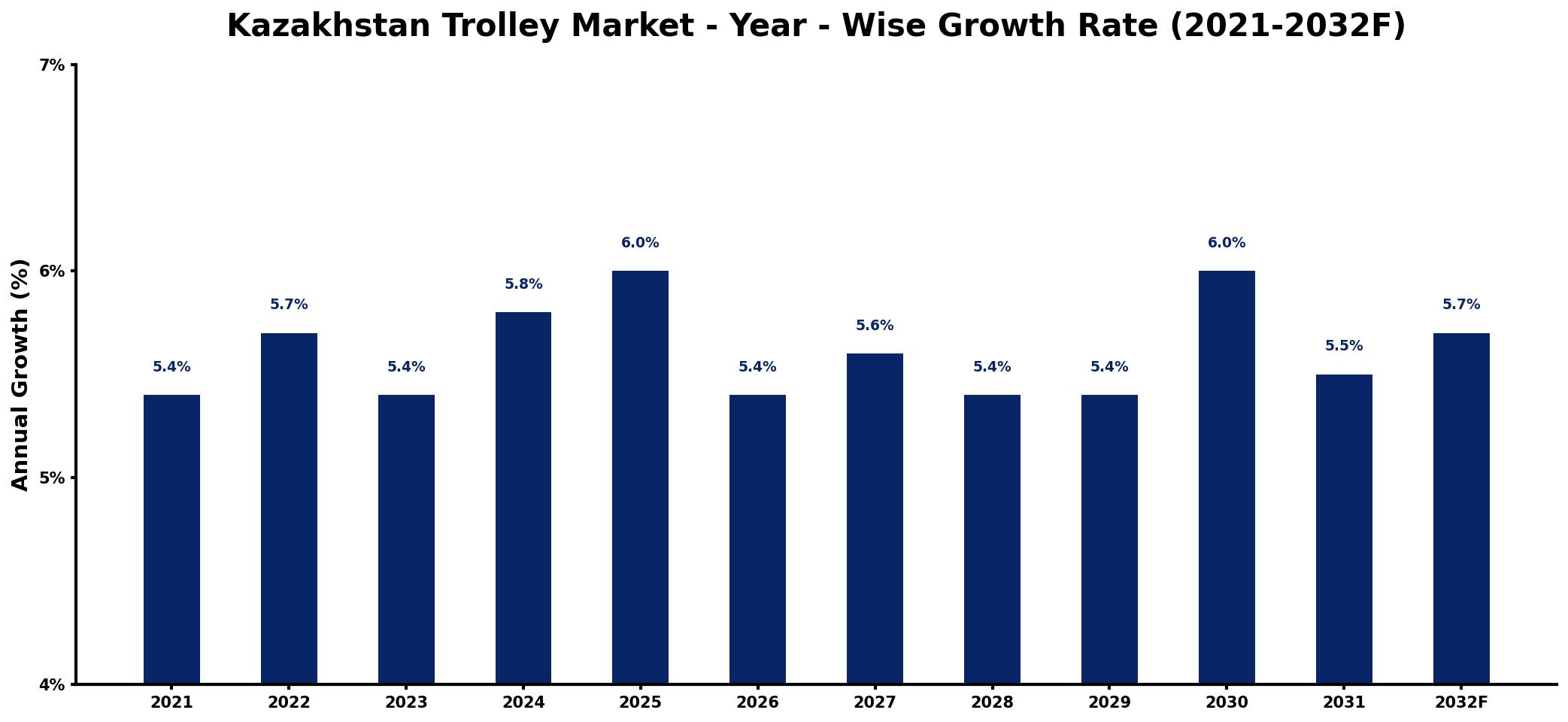
The table below presents the year‑wise growth rates along with the key drivers influencing the market
| Year | Growth Rate | Major Drivers |
| 2021 | 5.4% | Rising urban population density |
| 2022 | 5.7% | Increased public transport investment |
| 2023 | 5.4% | Growing environmental sustainability focus |
| 2024 | 5.8% | Expansion of urban infrastructure projects |
| 2025 | 6.0% | Higher disposable income levels |
| 2026 | 5.4% | Increased tourism and travel demand |
| 2027 | 5.6% | Development of regional trade routes |
| 2028 | 5.4% | Advancements in smart city initiatives |
| 2029 | 5.4% | Strengthened local manufacturing capabilities |
| 2030 | 6.0% | Enhanced logistics and distribution networks |
| 2031 | 5.5% | rising export shipment volumes |
| 2032 | 5.7% | growing emerging market penetration |
Note: Market size estimations and growth projections presented in this report are based on 6Wresearch's proprietary forecasting methodology, utilizing the latest available industry data, government publications, and primary research inputs.
Kazakhstan Trolley Market Synopsis
Urbanization stands as the most influential force currently shaping the Kazakhstan Trolley Market. As cities expand, the demand for effective transportation and storage solutions within retail environments, logistics centers, and healthcare facilities continues to rise, necessitating innovative trolley designs that prioritize functionality and user comfort.
Concurrently, the evolving landscape of retail and e-commerce is pushing businesses to seek out trolleys that enhance operational efficiency. This shift is encouraging manufacturers to invest in ergonomic and customizable trolley solutions that align with contemporary consumer needs, particularly in bustling urban centers.
Kazakhstan Trolley Market Key Takeaways
- Projected growth from USD 488 Million in 2025 to USD 677 Million by 2032 underscores the market's potential.
- Urbanization and the growth of retail sectors are key factors driving demand for advanced trolley solutions.
- The emergence of e-commerce has significantly increased the need for efficient material handling tools.
- Technological advancements like IoT-enabled and electric-powered trolleys are becoming increasingly popular.
- Government initiatives promoting eco-friendly trolleys are helping to shape market dynamics.
Evaluation of Restraints in Kazakhstan Trolley Market
Despite its growth potential, the Kazakhstan Trolley Market faces considerable restraints. Outdated infrastructure significantly hinders efficient transportation, leading to operational inefficiencies in logistics and retail operations. Financial constraints further limit the ability of businesses to invest in modern trolley systems, which are essential for enhanced productivity. The competition posed by other public transport modes, particularly buses and minibuses, also complicates the market landscape by offering alternative solutions for goods transportation.
Kazakhstan Trolley Market Trends
Several notable trends are shaping the Kazakhstan Trolley Market. The increasing preference for ergonomic trolley designs reflects a growing awareness of worker safety and comfort in various sectors. Concurrently, the adoption of smart technology is leading to the integration of IoT capabilities in trolleys, providing real-time tracking and enhanced operational efficiency. Additionally, the demand for eco-friendly trolleys, supported by governmental policies, is becoming a significant trend as businesses and consumers alike become more environmentally conscious.
Kazakhstan Trolley Market Opportunities
The Kazakhstan Trolley Market presents numerous growth and investment opportunities. With the retail and e-commerce sectors expanding rapidly, there is a clear need for innovative trolley solutions tailored to modern logistics challenges. The demand for electric-powered and smart trolleys offers avenues for technological advancements that can enhance efficiency and sustainability. Additionally, leveraging government incentives aimed at eco-friendly transportation solutions could spur further investments in upgrading trolley fleets.
Government Initiatives in the Kazakhstan Trolley Market
The Kazakhstan government is actively investing in public transportation infrastructure, which indirectly benefits the trolley market. Policies promoting the adoption of electric and eco-friendly trolleys are encouraging businesses to modernize their fleets. Financial incentives and subsidies are also available for those looking to procure and maintain advanced trolley solutions, thereby supporting market growth and promoting sustainability within urban environments.
Future Insights of the Kazakhstan Trolley Market
Looking ahead to 2026-2032, the Kazakhstan Trolley Market is expected to continue on its growth trajectory, fueled by ongoing urbanization and an increasingly digital retail landscape. Innovations in trolley technology, particularly in the areas of smart features and sustainability, will likely dominate the market. As businesses adapt to evolving consumer expectations and seek to enhance operational efficiencies, investment in advanced trolley solutions will remain a strategic focus for many stakeholders.
Kazakhstan Trolley Market Latest Developments (2025 - 2026)
Recent developments in the Kazakhstan Trolley Market indicate a shift towards smarter solutions and eco-friendly designs. Manufacturers are increasingly launching products that integrate IoT technology, allowing for real-time inventory management and monitoring. This trend is expected to reshape operational practices across sectors, including retail and logistics. Additionally, there is a noticeable movement towards adopting electric-powered trolleys, driven by both consumer demand for sustainable options and government incentives aimed at reducing urban pollution.
Kazakhstan Trolley Market - Key Attractiveness of the Report
- 10 Years of Market Numbers
- Historical Data Starting from 2022 to 2025
- Base Year: 2025
- Forecast Data until 2032
- Key Performance Indicators Impacting the Market
- Major Upcoming Developments and Projects
Key Highlights of the Report:
- Kazakhstan Trolley Market Outlook
- Market Size of Kazakhstan Trolley Market, 2025
- Forecast of Kazakhstan Trolley Market, 2032
- Historical Data and Forecast of Kazakhstan Trolley Revenues & Volume for the Period 2022-2032F
- Kazakhstan Trolley Market Trend Evolution
- Kazakhstan Trolley Market Drivers and Challenges
- Kazakhstan Trolley Price Trends
- Kazakhstan Trolley Porter's Five Forces
- Kazakhstan Trolley Industry Life Cycle
- Historical Data and Forecast of Kazakhstan Trolley Market Revenues & Volume By Product for the Period 2022-2032F
- Historical Data and Forecast of Kazakhstan Trolley Market Revenues & Volume By Manual for the Period 2022-2032F
- Historical Data and Forecast of Kazakhstan Trolley Market Revenues & Volume By Electric for the Period 2022-2032F
- Historical Data and Forecast of Kazakhstan Trolley Market Revenues & Volume By Application for the Period 2022-2032F
- Historical Data and Forecast of Kazakhstan Trolley Market Revenues & Volume By Commercial for the Period 2022-2032F
- Historical Data and Forecast of Kazakhstan Trolley Market Revenues & Volume By Non-commercial for the Period 2022-2032F
- Historical Data and Forecast of Kazakhstan Trolley Market Revenues & Volume By Distribution for the Period 2022-2032F
- Historical Data and Forecast of Kazakhstan Trolley Market Revenues & Volume By Offline for the Period 2022-2032F
- Historical Data and Forecast of Kazakhstan Trolley Market Revenues & Volume By Online for the Period 2022-2032F
- Kazakhstan Trolley Import Export Trade Statistics
- Market Opportunity Assessment By Product
- Market Opportunity Assessment By Application
- Market Opportunity Assessment By Distribution
- Kazakhstan Trolley Top Companies Market Share
- Kazakhstan Trolley Competitive Benchmarking By Technical and Operational Parameters
- Kazakhstan Trolley Company Profiles
- Kazakhstan Trolley Key Strategic Recommendations






































