Kazakhstan Video Conferencing Market Size & Growth Rate (2026-2032)
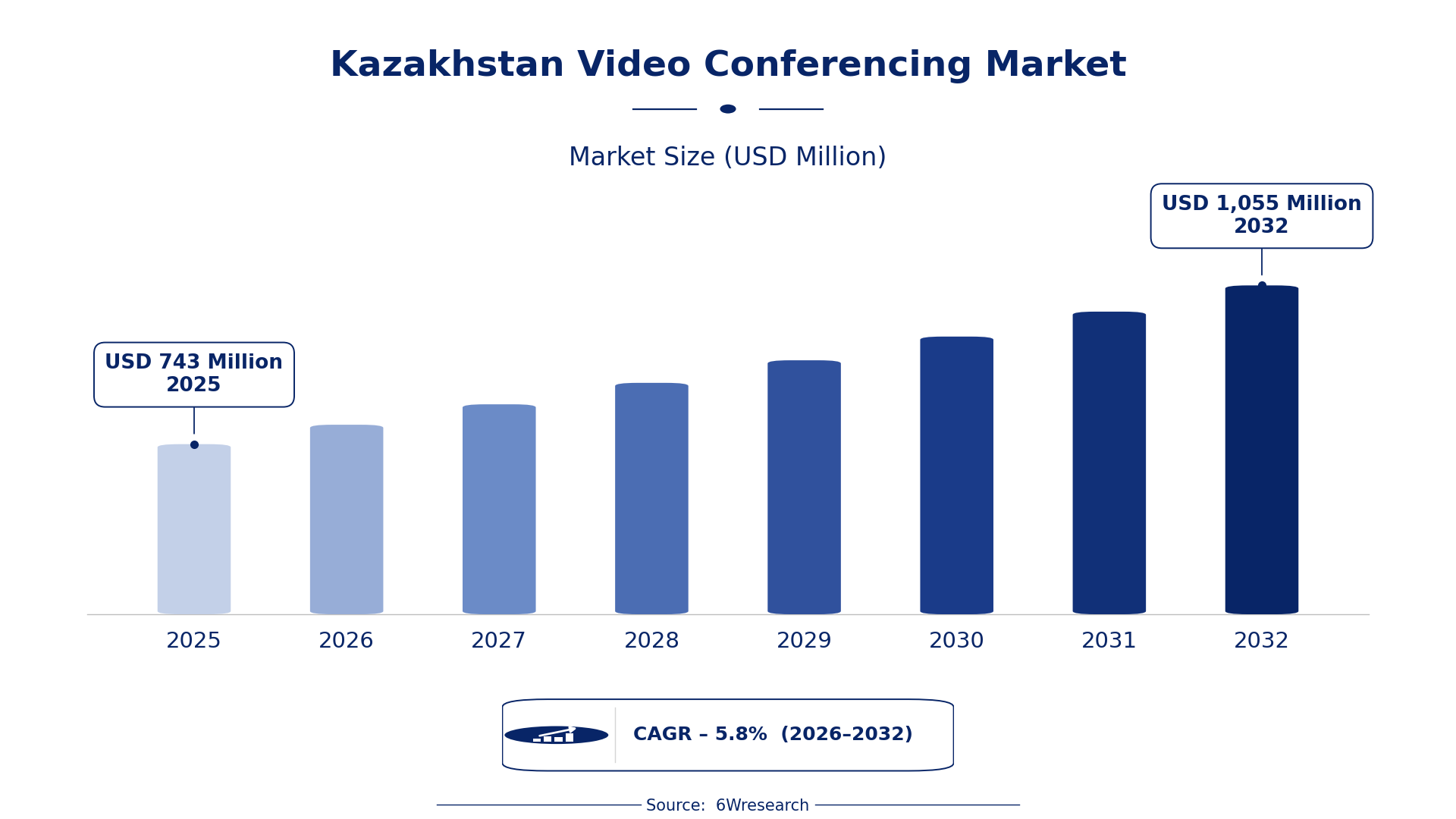
The Kazakhstan Video Conferencing Market was estimated at USD 743 Million in 2025 and is projected to reach USD 1055 Million by 2032, growing at a CAGR of 5.8% from 2026 to 2032.
Kazakhstan Video Conferencing Market Synopsis
The increasing demand for remote collaboration is the primary force driving the Kazakhstan Video Conferencing Market. Retailers, in particular, are leveraging these solutions to facilitate effective communication, as teams become more geographically dispersed and remote work gains traction.
This shift not only enhances productivity but also optimizes operational costs by reducing the need for travel. As organizations adapt to hybrid work models, the urgency for reliable video conferencing tools continues to rise, presenting a ripe opportunity for growth in this market.
Kazakhstan Video Conferencing Market Year-wise Growth Rate and Key Drivers
This graph illustrates the annual growth rates of the Kazakhstan Video Conferencing Market from 2021 to 2032, highlighting a steady upward trajectory and projected expansion over the forecast period.
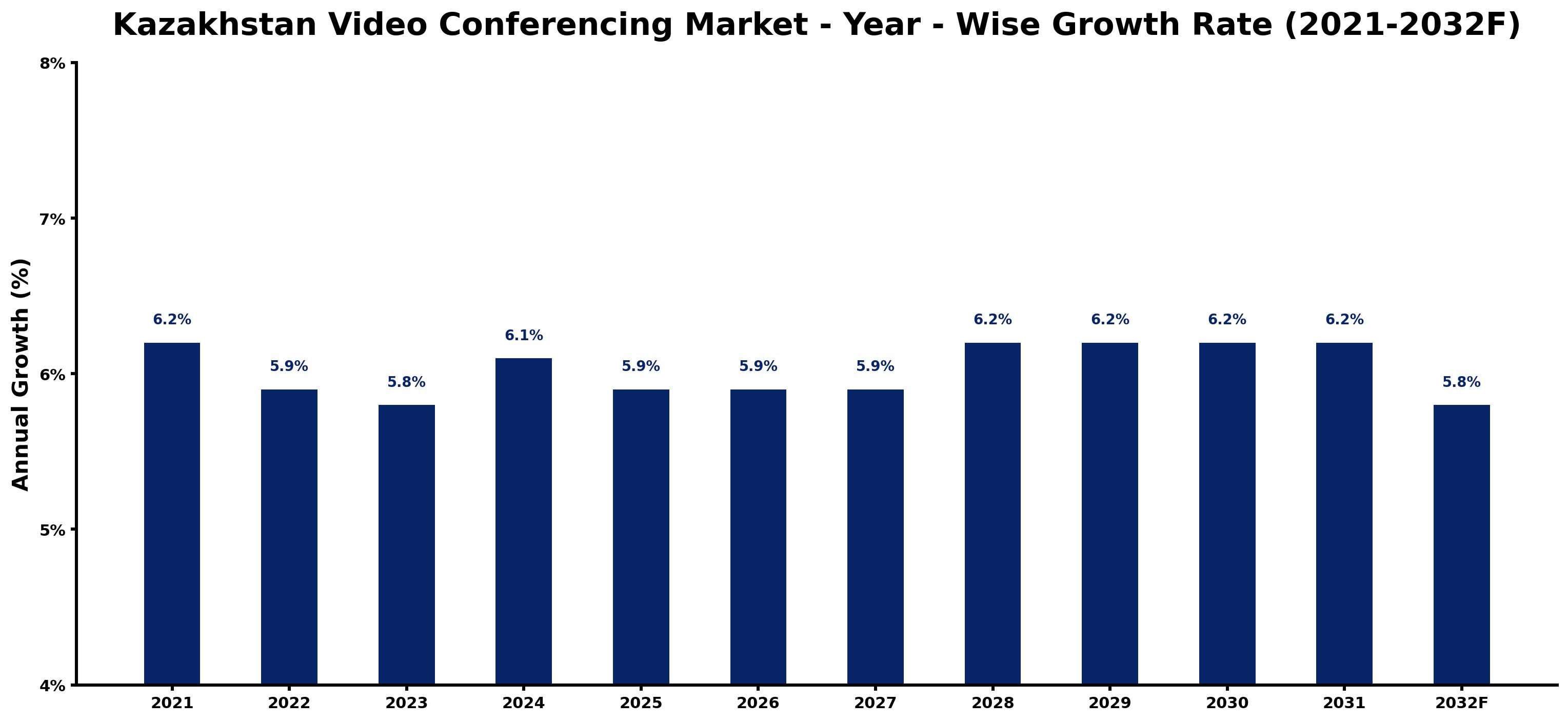
The table below presents the year‑wise growth rates along with the key drivers influencing the market
| Year | Growth Rate | Major Drivers |
| 2021 | 6.2% | Increased remote work adoption post-COVID-19 pandemic. |
| 2022 | 5.9% | Kazakhstan's digital transformation strategy promotes online collaboration tools. |
| 2023 | 5.8% | Investment in education technology boosts video conferencing usage. |
| 2024 | 6.1% | Government initiatives to enhance rural internet connectivity. |
| 2025 | 5.9% | Rise in virtual training programs across various industries. |
| 2026 | 5.9% | Demand for telehealth services increases video conferencing needs. |
| 2027 | 5.9% | Growing startup ecosystem stimulates demand for online meetings. |
| 2028 | 6.2% | Implementation of Smart City projects necessitates video communication. |
| 2029 | 6.2% | Surge in cross-border business interactions promotes video conferencing. |
| 2030 | 6.2% | Local regulatory support for digital communication platforms increases. |
| 2031 | 6.2% | Increased corporate focus on remote team management strategies. |
| 2032 | 5.8% | Expanding youth demographic drives demand for online education tools. |
Note: Market size estimations and growth projections presented in this report are based on 6Wresearch's proprietary forecasting methodology, utilizing the latest available industry data, government publications, and primary research inputs.
Kazakhstan Video Conferencing Market Key Takeaways
Below are some of the specific key takeaways from the market, including:
- The market is driven by globalization and the shift towards remote work.
- Video conferencing solutions are becoming essential for sectors like retail, education, and healthcare.
- Inadequate internet infrastructure in remote areas remains a significant barrier.
- Government initiatives are increasingly promoting digital communication tools.
- There is a growing concern about data security and privacy among users.
Evaluation of Restraints in Kazakhstan Video Conferencing Market
The growth of the Kazakhstan Video Conferencing Market faces notable challenges. Chief among these is the inadequate internet infrastructure, especially in rural regions. This disparity hinders the quality of video calls and can lead to frustrating user experiences. Concerns about data security further complicate adoption rates, as organizations are wary of potential breaches. Economic fluctuations, driven by unstable exchange rates and limited purchasing power, also restrict investment in advanced video conferencing technologies.
Kazakhstan Video Conferencing Market Trends
The rise of hybrid work models is reshaping the demand for video conferencing solutions. Businesses are increasingly seeking integrated platforms that combine video conferencing with other collaborative tools. Additionally, the focus on user experience is pushing vendors to enhance their offerings with features like AI-driven analytics and improved security protocols. As remote learning and telehealth services gain traction, the demand for reliable video conferencing tools will only intensify.
Kazakhstan Video Conferencing Market Opportunities
With the market poised for growth, several opportunities are emerging. Investment in digital infrastructure is likely to enhance connectivity across the country, making video conferencing more accessible. on top of that, there is a growing need for customized solutions tailored to various sectors, such as education and healthcare. Companies that can provide scalable and secure video conferencing solutions stand to benefit from this burgeoning demand.
Government Initiatives in the Kazakhstan Video Conferencing Market
The Kazakhstan government is actively promoting the adoption of digital communication technologies, which is significantly impacting the video conferencing market. Policies aimed at enhancing remote work capabilities are designed to improve productivity and encourage businesses to utilize video conferencing solutions. These initiatives reflect a broader commitment to reducing travel-related emissions while fostering a modernized communication environment.
- A national digital infrastructure upgrade programme launched in early 2023 aims to improve internet access across remote regions.
- Currently ongoing is a public-private initiative focused on enhancing cybersecurity measures for digital communication tools.
- In 2024, a regulatory framework will be introduced to promote billing transparency and consumer protection in the video conferencing sector.
- A planned initiative for 2025 will incentivize businesses to adopt energy-efficient video conferencing technologies.
Future Insights of the Kazakhstan Video Conferencing Market
Looking ahead to 2026-2032, the Kazakhstan Video Conferencing Market is expected to continue its upward trajectory. As more companies embrace hybrid work, the demand for effective communication tools will only grow stronger. The integration of advanced technologies such as artificial intelligence and machine learning into video conferencing solutions will enhance user experience and security. on top of that, government support for digital initiatives will bolster market growth, creating a favorable environment for both established players and new entrants.
Kazakhstan Video Conferencing Market Latest Developments
In the past year, the Kazakhstan Video Conferencing Market has seen a notable uptick in activity, driven largely by the ongoing adaptation to remote work scenarios. Companies are increasingly investing in video conferencing capabilities, not only for internal meetings but also for customer interactions and training sessions. This trend reflects a broader commitment to enhancing digital communication strategies across various sectors.
- A major technology vendor announced the rollout of an enhanced video conferencing platform in Q2 2023, focusing on improved user interface and security features.
- An initiative that began in early 2023 is currently underway, aiming to integrate video conferencing tools with existing enterprise software solutions.
- In late 2022, a consortium of local businesses launched a collaborative project to develop a regional video conferencing solution tailored for SMEs.
- A planned launch in early 2024 will introduce a new educational platform combining video conferencing with interactive learning tools.
Kazakhstan Video Conferencing Market - Key Attractiveness of the Report
- 10 Years of Market Numbers
- Historical Data Starting from 2022 to 2025
- Base Year: 2025
- Forecast Data until 2032
- Key Performance Indicators Impacting the Market
- Major Upcoming Developments and Projects
Key Highlights of the Report:
- Kazakhstan Video Conferencing Market Outlook
- Market Size of Kazakhstan Video Conferencing Market, 2022
- Forecast of Kazakhstan Video Conferencing Market, 2032
- Historical Data and Forecast of Kazakhstan Video Conferencing Revenues & Volume for the Period 2022-2032F
- Kazakhstan Video Conferencing Market Trend Evolution
- Kazakhstan Video Conferencing Market Drivers and Challenges
- Kazakhstan Video Conferencing Price Trends
- Kazakhstan Video Conferencing Porter's Five Forces
- Kazakhstan Video Conferencing Industry Life Cycle
- Historical Data and Forecast of Kazakhstan Video Conferencing Market Revenues & Volume By Component for the Period 2022-2032F
- Historical Data and Forecast of Kazakhstan Video Conferencing Market Revenues & Volume By Hardware for the Period 2022-2032F
- Historical Data and Forecast of Kazakhstan Video Conferencing Market Revenues & Volume By Solutions for the Period 2022-2032F
- Historical Data and Forecast of Kazakhstan Video Conferencing Market Revenues & Volume By Services for the Period 2022-2032F
- Historical Data and Forecast of Kazakhstan Video Conferencing Market Revenues & Volume By Application for the Period 2022-2032F
- Historical Data and Forecast of Kazakhstan Video Conferencing Market Revenues & Volume By Corporate Communications for the Period 2022-2032F
- Historical Data and Forecast of Kazakhstan Video Conferencing Market Revenues & Volume By Training for the Period 2022-2032F
- Historical Data and Forecast of Kazakhstan Video Conferencing Market Revenues & Volume By Development for the Period 2022-2032F
- Historical Data and Forecast of Kazakhstan Video Conferencing Market Revenues & Volume By Marketing & Client Engagement for the Period 2022-2032F
- Historical Data and Forecast of Kazakhstan Video Conferencing Market Revenues & Volume By Deployment Mode for the Period 2022-2032F
- Historical Data and Forecast of Kazakhstan Video Conferencing Market Revenues & Volume By On-premises for the Period 2022-2032F
- Historical Data and Forecast of Kazakhstan Video Conferencing Market Revenues & Volume By Cloud for the Period 2022-2032F
- Historical Data and Forecast of Kazakhstan Video Conferencing Market Revenues & Volume By Vertical for the Period 2022-2032F
- Historical Data and Forecast of Kazakhstan Video Conferencing Market Revenues & Volume By BFSI for the Period 2022-2032F
- Historical Data and Forecast of Kazakhstan Video Conferencing Market Revenues & Volume By IT and Telecom for the Period 2022-2032F
- Historical Data and Forecast of Kazakhstan Video Conferencing Market Revenues & Volume By Healthcare & Lifescience for the Period 2022-2032F
- Historical Data and Forecast of Kazakhstan Video Conferencing Market Revenues & Volume By Education for the Period 2022-2032F
- Historical Data and Forecast of Kazakhstan Video Conferencing Market Revenues & Volume By Media and Entertainment for the Period 2022-2032F
- Historical Data and Forecast of Kazakhstan Video Conferencing Market Revenues & Volume By Other Verticals for the Period 2022-2032F
- Kazakhstan Video Conferencing Import Export Trade Statistics
- Market Opportunity Assessment By Component
- Market Opportunity Assessment By Application
- Market Opportunity Assessment By Deployment Mode
- Market Opportunity Assessment By Vertical
- Kazakhstan Video Conferencing Top Companies Market Share
- Kazakhstan Video Conferencing Competitive Benchmarking By Technical and Operational Parameters
- Kazakhstan Video Conferencing Company Profiles
- Kazakhstan Video Conferencing Key Strategic Recommendations






































