Kazakhstan Wholesale Market Summary
The kazakhstan wholesale market was estimated at USD 477 Million in 2025 and is projected to reach USD 647 Million by 2032, growing at a CAGR of 4.9% from 2026 to 2032.
Kazakhstan Wholesale Market Year-wise Growth Rate and Key Drivers
This graph highlights how the Kazakhstan Wholesale Market has steadily grown over the past five years, supported by major growth factors.
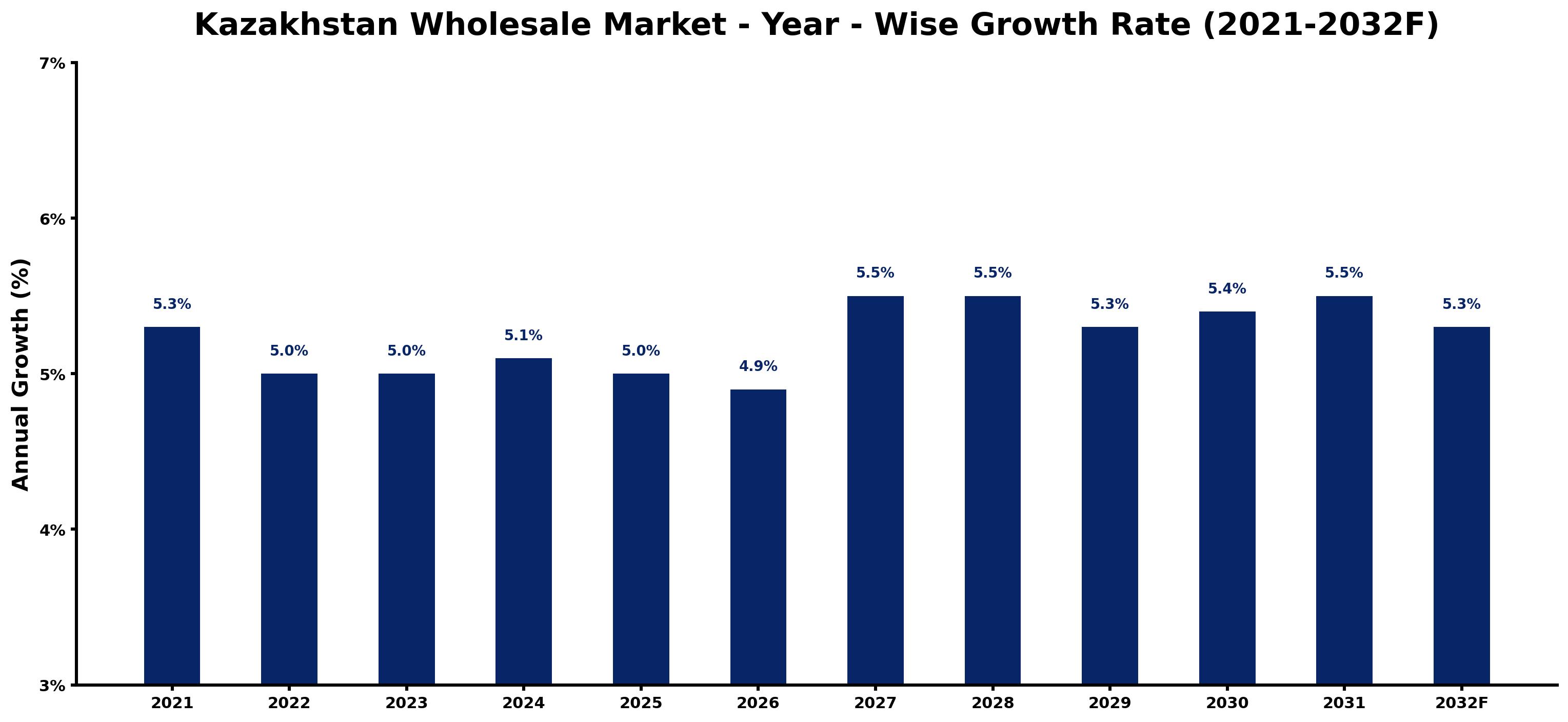
The table below presents the year wise growth rates along with the key drivers influencing the market
| Year | Growth Rate | Major Drivers |
| 2021 | 5.3% | Post-lockdown retail projects revitalized interest in efficient wholesale distribution channels. |
| 2022 | 5.0% | E-commerce expansion led to increased demand for warehouse and logistics capabilities. |
| 2023 | 5.0% | Local sourcing preferences strengthened the position of regional wholesale suppliers significantly. |
| 2024 | 5.1% | Investment in digital platforms improved transparency and operational efficiency across sectors. |
| 2025 | 5.0% | Partnerships between wholesalers and retailers created innovative product delivery solutions. |
| 2026 | 4.9% | Technology adoption in inventory management streamlined operations and reduced costs drastically. |
| 2027 | 5.5% | Urbanization trends prompted new wholesale hubs in emerging metropolitan areas. |
| 2028 | 5.5% | Sustainability initiatives influenced wholesale strategies, favoring eco-friendly product lines. |
| 2029 | 5.3% | Increased foreign investment brought new competition to the wholesale market landscape. |
| 2030 | 5.4% | Regional trade agreements improved access to international markets for local wholesalers. |
| 2031 | 5.5% | Consumer preferences shifted towards quality over quantity, reshaping wholesale offerings significantly. |
| 2032 | 5.3% | Digitalization in B2B transactions transformed traditional wholesale methods into modern frameworks. |
Note - Market size estimations and growth projections presented in this report are based on 6Wresearch's advanced forecasting approach, validated with industry datasets as of June 2026.
Kazakhstan Wholesale Market Synopsis
The Kazakhstan Wholesale Market is projected to reach 4.9% and witness significant growth during the forecast period (2026-2032). This growth trajectory is driven by several key factors, including rising consumer spending, enhanced disposable income levels, and improving overall economic stability within the country. The government's ongoing "Kazakhstan 2030" initiative is particularly noteworthy, as it aims to foster a conducive business environment by offering various incentives for foreign investments, stimulating local enterprises, and enhancing competitiveness among domestic producers.
Kazakhstan Wholesale Market Growth Drivers
Several elements underpin the anticipated growth of the Kazakhstan wholesale market during the forecast period. Key drivers include:
- Increasing consumer spending is a significant factor as households benefit from rising disposable income, leading to higher demand for a broader range of wholesale goods.
- The advancement of the digital economy has facilitated a substantial increase in eCommerce activities, providing wholesalers with new channels to reach consumers and stimulate sales.
- Government policies focused on improving infrastructure are enhancing connectivity within the country and with neighboring markets, making the logistics of wholesale distribution more efficient.
- The establishment of public-private partnerships aims at modernizing transport networks and storage facilities, thereby boosting the operational capabilities of wholesalers.
- Rising competition among domestic producers, encouraged by government policies, is likely to lead to better pricing and quality of goods available in the wholesale market.
Kazakhstan Wholesale Market Government Investment and Initiatives
The Kazakhstan government is actively pursuing investment strategies that support the growth of the wholesale market. As part of the "Kazakhstan 2030" program, initiatives include:
- Significant public spending on infrastructure projects focused on logistics and transportation networks, including the enhancement of arterial roads and rail connections.
- Incentive schemes for foreign investors aimed at attracting capital into the wholesale sector, including tax breaks and streamlined regulatory processes.
- Support for local businesses through grants and subsidies, which aim to bolster competitiveness and innovation among domestic wholesalers.
- Promotion of regional economic integration within Central Asia, improving trade links and creating a more interconnected wholesale market landscape.
- Investment in digital infrastructure to enhance the eCommerce capabilities of wholesalers, thereby expanding their market reach and operational efficiency.
Kazakhstan Wholesale Market Latest Developments (May 2025 - June 2026)
From May 2025 to June 2026, the Kazakhstan wholesale market has undergone notable changes that reflect the evolving landscape of the industry. Recent developments include:
- A marked increase in the establishment of digital marketplaces, allowing wholesalers to leverage technology to streamline operations and enhance customer engagement.
- Government efforts to consolidate trade regulations have simplified the compliance framework for wholesalers, making it easier for businesses to operate and grow.
- Emerging collaborative initiatives between public and private sectors aimed at improving supply chain transparency and efficiency, which is crucial for enhancing market competition.
- Growing interest in sustainable practices among wholesalers, leading to increased investment in eco-friendly technologies and practices to meet consumer demand for responsible sourcing.
- The burgeoning growth of urban centers has prompted wholesalers to reevaluate distribution strategies, focusing on last-mile deliveries to meet growing consumer expectations.
Kazakhstan Wholesale Market - Key Attractiveness of the Report
- 10 Years of Market Numbers
- Historical Data Starting from 2022 to 2025
- Base Year: 2025
- Forecast Data until 2032
- Key Performance Indicators Impacting the Market
- Major Upcoming Developments and Projects
Key Highlights of the Report:
- Kazakhstan Wholesale Market Outlook
- Market Size of Kazakhstan Wholesale Market, 2025
- Forecast of Kazakhstan Wholesale Market, 2032F
- Historical Data and Forecast of Kazakhstan Wholesale Revenues & Volume for the Period 2022-2032F
- Kazakhstan Wholesale Market Trend Evolution
- Kazakhstan Wholesale Market Drivers and Challenges
- Kazakhstan Wholesale Price Trends
- Kazakhstan Wholesale Porter's Five Forces
- Kazakhstan Wholesale Industry Life Cycle
- Historical Data and Forecast of Kazakhstan Wholesale Market Revenues & Volume By Type for the Period 2022-2032F
- Historical Data and Forecast of Kazakhstan Wholesale Market Revenues & Volume By Non-Durable Goods Merchant Wholesalers for the Period 2022-2032F
- Historical Data and Forecast of Kazakhstan Wholesale Market Revenues & Volume By Wholesale Electronic Markets And Agents And Brokers for the Period 2022-2032F
- Historical Data and Forecast of Kazakhstan Wholesale Market Revenues & Volume By Durable Goods Merchant Wholesalers for the Period 2022-2032F
- Historical Data and Forecast of Kazakhstan Wholesale Market Revenues & Volume By Ownership for the Period 2022-2032F
- Historical Data and Forecast of Kazakhstan Wholesale Market Revenues & Volume By Wholesale/Distribution Chain for the Period 2022-2032F
- Historical Data and Forecast of Kazakhstan Wholesale Market Revenues & Volume By Independent Wholesalers for the Period 2022-2032F
- Kazakhstan Wholesale Import Export Trade Statistics
- Market Opportunity Assessment By Type
- Market Opportunity Assessment By Ownership
- Kazakhstan Wholesale Top Companies Market Share
- Kazakhstan Wholesale Competitive Benchmarking By Technical and Operational Parameters
- Kazakhstan Wholesale Company Profiles
- Kazakhstan Wholesale Key Strategic Recommendations






































