Kazakhstan Wire Harness Market Size, Share & Growth Rate
The Kazakhstan Wire Harness Market was estimated at USD 152 Million in 2025 and is projected to reach USD 209 Million by 2032, growing at a CAGR of 4.7% from 2026 to 2032. This growth trajectory is primarily fueled by the robust expansion of the automotive sector, which increasingly integrates advanced technologies into manufacturing processes. Moreover, the rising demand for consumer electronics and industrial machinery is further propelling the need for high-quality and customized wire harness solutions.
Kazakhstan Wire Harness Market Year-wise Growth Rate and Key Drivers
This graph highlights how the Kazakhstan Wire Harness Market has steadily grown over the years, supported by major growth factors.
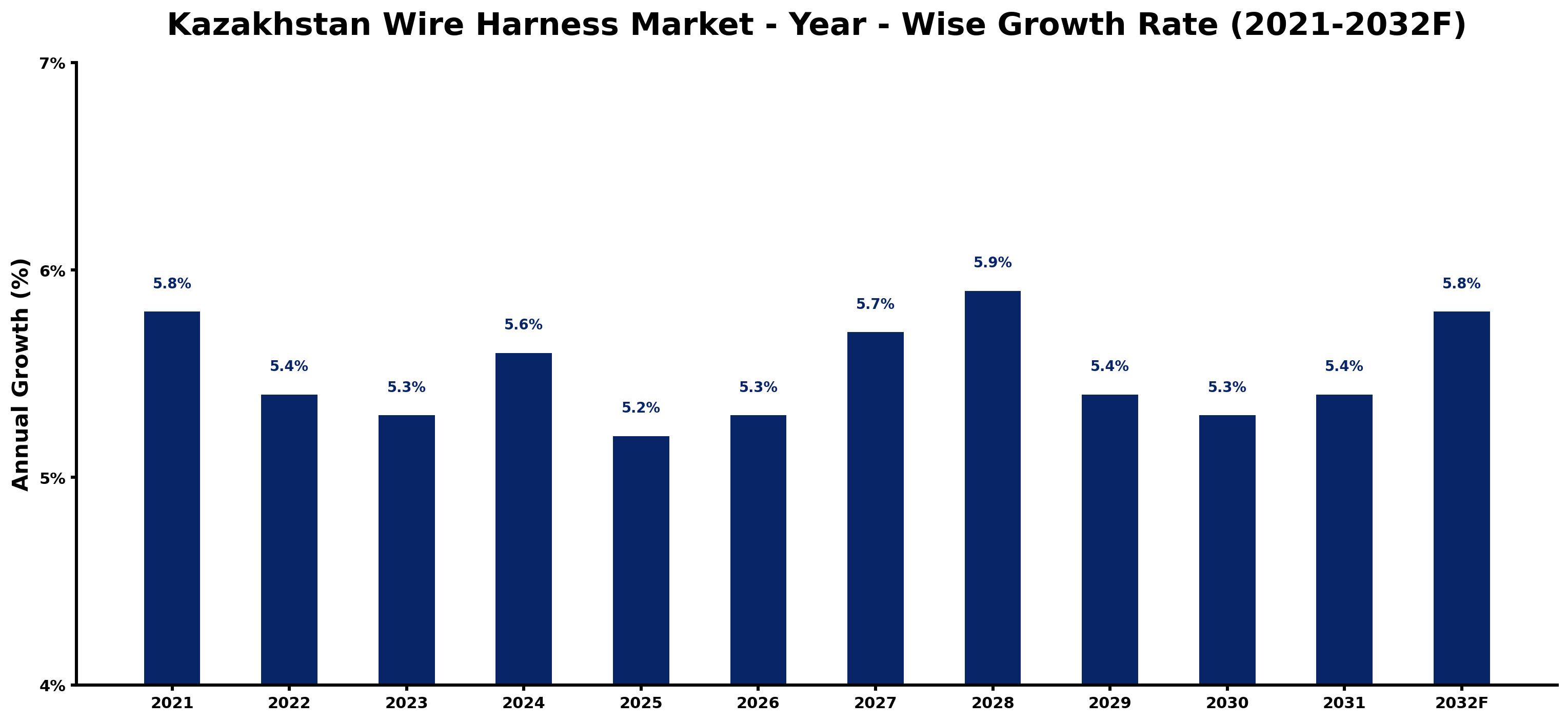
The table below presents the year‑wise growth rates along with the key drivers influencing the market
| Year | Growth Rate | Major Drivers |
| 2021 | 5.8% | Government infrastructure modernization initiatives |
| 2022 | 5.4% | Increasing smart city development projects |
| 2023 | 5.3% | Rising electricity demand across industries |
| 2024 | 5.6% | Increasing adoption of advanced technologies |
| 2025 | 5.2% | Increasing industrial automation investments |
| 2026 | 5.3% | Increasing smart city development projects |
| 2027 | 5.7% | Expansion of commercial construction activities |
| 2028 | 5.9% | Expansion of commercial construction activities |
| 2029 | 5.4% | Rapid growth in telecom and data center sectors |
| 2030 | 5.3% | Growing renewable energy integration projects |
| 2031 | 5.4% | Growing renewable energy integration projects |
| 2032 | 5.8% | Expansion of manufacturing activities |
Note - Market size estimations and growth projections presented in this report are based on 6Wresearch’s advanced forecasting approach, validated with industry datasets as of June 2026.
Kazakhstan Wire Harness Market Synopsis
Currently, the wire harness market in Kazakhstan is witnessing significant momentum as local manufacturers adapt to the evolving needs of various sectors. With automotive production on the rise, the requirement for reliable wire harnesses that adhere to stringent quality and safety standards has never been more critical.
In the realm of electronics and industrial automation, the focus on innovative wiring solutions is changing the landscape. The ability to provide customized designs, coupled with a growing emphasis on sustainability, is shaping the strategies of manufacturers operating within the country.
Kazakhstan Wire Harness Market Key Takeaways
- The market is projected to grow at a CAGR of 4.7% from 2026 to 2032.
- Automotive sector expansion is a primary driver of demand for wire harnesses.
- Customization and adherence to quality standards are crucial for success.
- Volatility in raw material prices remains a persistent concern.
- Technological advancements are essential for enhancing manufacturing efficiency.
Evaluation of Restraints in Kazakhstan Wire Harness Market
Despite its growth potential, the Kazakhstan wire harness market faces several constraints that could hinder its expansion. The complexity of manufacturing processes requires high levels of precision and reliability, which can be challenging to maintain consistently. Furthermore, fluctuations in the prices of essential raw materials such as copper and plastics add a layer of unpredictability to cost structures, impacting profitability. Stringent quality control measures, particularly in sectors like automotive and aerospace, impose additional burdens on manufacturers striving to meet rigorous industry standards.
Kazakhstan Wire Harness Market Trends
Several trends are currently shaping the Kazakhstan wire harness market. A notable shift towards automation in manufacturing processes is enhancing efficiency and reducing operational costs. Additionally, there is an increasing focus on sustainable materials and practices, as consumers and regulators alike demand environmentally friendly solutions. The integration of smart technologies into wire harness designs, allowing for enhanced connectivity and performance, is becoming a significant differentiator in the marketplace.
Kazakhstan Wire Harness Market Opportunities
The landscape for the Kazakhstan wire harness market is ripe with opportunities. As the automotive industry continues to evolve with the rise of electric vehicles, demand for specialized wire harnesses tailored to these innovations is expected to surge. Furthermore, partnerships with global firms can facilitate access to advanced technologies, bolstering local production capabilities. Investment in research and development will not only enhance product offerings but also position companies to capitalize on emerging trends in various sectors, including aerospace and consumer electronics.
Government Initiatives in the Kazakhstan Wire Harness Market
Kazakhstan's government is actively promoting the growth of the wire harness market through various initiatives aimed at bolstering the automotive and electronics sectors. These include tax incentives for manufacturers and investments in modern production facilities. By fostering partnerships with global companies, the government is also enhancing local firms' technological capabilities, thereby creating a more competitive environment for wire harness production.
Future Insights of the Kazakhstan Wire Harness Market
Looking ahead to 2026-2032, the Kazakhstan wire harness market is poised for continued growth. As domestic industries embrace advanced manufacturing technologies, the demand for high-quality wire harness solutions will remain strong. Increased automotive production, coupled with a push for innovation in electronics, will likely drive market expansion. Companies that adapt quickly to technological advancements and shifting consumer preferences will be well-positioned to capture a larger share of this burgeoning market.
Kazakhstan Wire Harness Market Latest Developments (May 2025 - June 2026)
Recent developments in the Kazakhstan wire harness market indicate a growing trend towards the adoption of smart manufacturing technologies. Companies are increasingly investing in automated production lines and advanced quality control systems to enhance efficiency. Moreover, collaborations between local manufacturers and international technology firms are emerging, aimed at improving product offerings and expanding market reach. The focus on sustainability and eco-friendly practices is also gaining traction, as firms seek to align with global environmental standards.
Kazakhstan Wire Harness Market - Key Attractiveness of the Report
- 10 Years of Market Numbers
- Historical Data Starting from 2022 to 2025
- Base Year: 2025
- Forecast Data until 2032
- Key Performance Indicators Impacting the Market
- Major Upcoming Developments and Projects
Key Highlights of the Report:
- Kazakhstan Wire Harness Market Outlook
- Market Size of Kazakhstan Wire Harness Market, 2025
- Forecast of Kazakhstan Wire Harness Market, 2032
- Historical Data and Forecast of Kazakhstan Wire Harness Revenues & Volume for the Period 2022-2032F
- Kazakhstan Wire Harness Market Trend Evolution
- Kazakhstan Wire Harness Market Drivers and Challenges
- Kazakhstan Wire Harness Price Trends
- Kazakhstan Wire Harness Porter's Five Forces
- Kazakhstan Wire Harness Industry Life Cycle
- Historical Data and Forecast of Kazakhstan Wire Harness Market Revenues & Volume By Product Type for the Period 2022-2032F
- Historical Data and Forecast of Kazakhstan Wire Harness Market Revenues & Volume By Wire Harness Connector for the Period 2022-2032F
- Historical Data and Forecast of Kazakhstan Wire Harness Market Revenues & Volume By Wire Harness Terminal for the Period 2022-2032F
- Historical Data and Forecast of Kazakhstan Wire Harness Market Revenues & Volume By Material for the Period 2022-2032F
- Historical Data and Forecast of Kazakhstan Wire Harness Market Revenues & Volume By PVC for the Period 2022-2032F
- Historical Data and Forecast of Kazakhstan Wire Harness Market Revenues & Volume By Vinyl for the Period 2022-2032F
- Historical Data and Forecast of Kazakhstan Wire Harness Market Revenues & Volume By Thermoplast Elastomer for the Period 2022-2032F
- Historical Data and Forecast of Kazakhstan Wire Harness Market Revenues & Volume By Polyurethane for the Period 2022-2032F
- Historical Data and Forecast of Kazakhstan Wire Harness Market Revenues & Volume By Polyethylene for the Period 2022-2032F
- Historical Data and Forecast of Kazakhstan Wire Harness Market Revenues & Volume By Application for the Period 2022-2032F
- Historical Data and Forecast of Kazakhstan Wire Harness Market Revenues & Volume By Automotive for the Period 2022-2032F
- Historical Data and Forecast of Kazakhstan Wire Harness Market Revenues & Volume By Marine and Marine Engine for the Period 2022-2032F
- Historical Data and Forecast of Kazakhstan Wire Harness Market Revenues & Volume By Aerospace & Defense for the Period 2022-2032F
- Historical Data and Forecast of Kazakhstan Wire Harness Market Revenues & Volume By Military Machines for the Period 2022-2032F
- Historical Data and Forecast of Kazakhstan Wire Harness Market Revenues & Volume By Gaming & Amusements for the Period 2022-2032F
- Historical Data and Forecast of Kazakhstan Wire Harness Market Revenues & Volume By Medical Equipment & Devices for the Period 2022-2032F
- Historical Data and Forecast of Kazakhstan Wire Harness Market Revenues & Volume By Commercial Refrigeration & Food Machines for the Period 2022-2032F
- Historical Data and Forecast of Kazakhstan Wire Harness Market Revenues & Volume By Others for the Period 2022-2032F
- Kazakhstan Wire Harness Import Export Trade Statistics
- Market Opportunity Assessment By Product Type
- Market Opportunity Assessment By Material
- Market Opportunity Assessment By Application
- Kazakhstan Wire Harness Top Companies Market Share
- Kazakhstan Wire Harness Competitive Benchmarking By Technical and Operational Parameters
- Kazakhstan Wire Harness Company Profiles
- Kazakhstan Wire Harness Key Strategic Recommendations






































