Kazakhstan Wireless Connectivity Market Size, Share & Growth Rate
The Kazakhstan Wireless Connectivity Market was estimated at USD 430 Million in 2025 and is projected to reach USD 578 Million by 2032, growing at a CAGR of 4.3% from 2026 to 2032. This growth is primarily driven by the increasing adoption of smartphones and the rising demand for high-speed internet services across urban and rural areas. Government initiatives aimed at enhancing digital infrastructure and the rollout of 5G technology further underscore the momentum in this dynamic market.
Kazakhstan Wireless Connectivity Market Growth Rate Analysis (2021-2032)
The Kazakhstan wireless connectivity market has shown a stable growth pattern, with annual increases of 5.2% in 2021 and 5.3% in 2023, followed by a slight dip to 4.9% in 2022. This fluctuation can be attributed to investments in infrastructure and an ongoing transition towards digitalization, which have spurred consumer demand for reliable connectivity. While growth is expected to stabilize at around 5.0% through 2027, with a gradual decline to 4.8% by 2029, the commitment to enhancing technological advancements and government policies supporting broadband expansion remain crucial drivers. As the market enters 2031 and beyond, renewed investments could invigorate growth, leading to another rise of 5.2% in 2031 and 5.3% in 2032.
Kazakhstan Wireless Connectivity Market Year-wise Growth Rate and Key Drivers
This graph highlights how the Kazakhstan Wireless Connectivity Market has steadily grown over the past five years, supported by major growth factors.
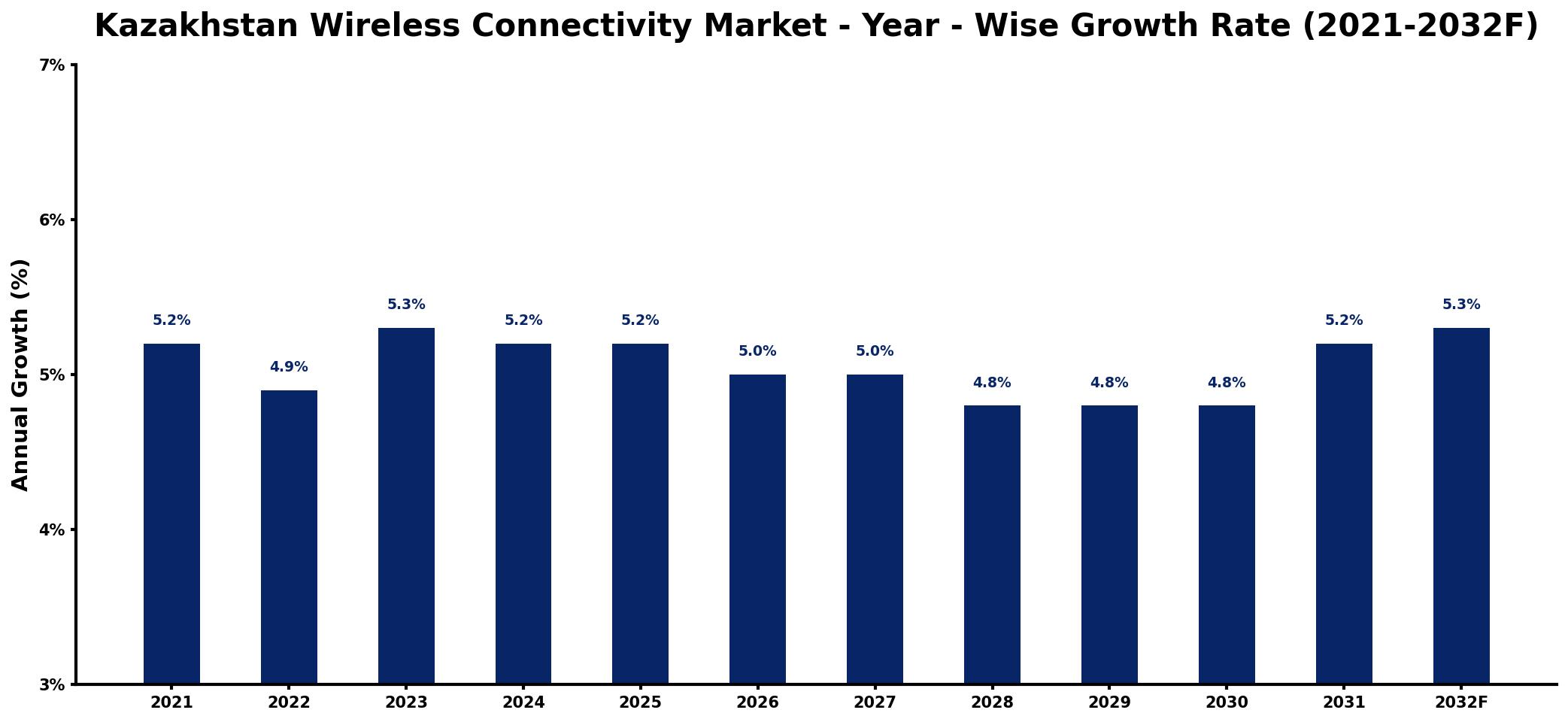
The table below presents the year‑wise growth rates along with the key drivers influencing the market
| Year | Growth Rate | Major Drivers |
| 2021 | 5.2% | Increased smartphone penetration rates |
| 2022 | 4.9% | Expansion of urban infrastructure projects |
| 2023 | 5.3% | Growing demand for IoT applications |
| 2024 | 5.2% | Rising investments in digital services |
| 2025 | 5.2% | Surge in e-commerce activities |
| 2026 | 5.0% | Development of smart city initiatives |
| 2027 | 5.0% | Increase in remote work solutions |
| 2028 | 4.8% | Growing adoption of 5G technology |
| 2029 | 4.8% | expanding healthcare application demand |
| 2030 | 4.8% | Rising interest in telehealth services |
| 2031 | 5.2% | growing commercial sector adoption |
| 2032 | 5.3% | expanding industrial usage applications |
Note: Market size estimations and growth projections presented in this report are based on 6Wresearch's proprietary forecasting methodology, utilizing the latest available industry data, government publications, and primary research inputs.
Kazakhstan Wireless Connectivity Market Synopsis
The wireless connectivity landscape in Kazakhstan is rapidly evolving, with significant advancements in technology and infrastructure. Recent momentum in mobile service usage is reshaping consumer expectations and driving demand for faster and more reliable connectivity. As the market shifts toward more advanced technologies, including 5G and IoT, stakeholders are positioned to leverage these innovations to enhance service offerings and improve customer experiences.
Looking ahead, the Kazakhstan Wireless Connectivity Market is set to expand further as telecom operators ramp up investments in their network capabilities. The governments strategic focus on digital transformation will be critical in addressing challenges related to rural connectivity and regulatory compliance, creating a fertile ground for future growth.
Kazakhstan Wireless Connectivity Market Key Takeaways
- The market is poised for robust growth with the anticipated rollout of 5G technology.
- Smartphone penetration is significantly impacting consumer behavior and data consumption trends.
- Ongoing investments by telecom operators are crucial for expanding network coverage and service quality.
- Regulatory policies encourage competition, enhancing service offerings and pricing for consumers.
- The governments support for digital initiatives is instrumental in shaping the market landscape.
Evaluation of Restraints in Kazakhstan Wireless Connectivity Market
The Kazakhstan Wireless Connectivity Market faces several constraints that could hinder its growth trajectory. One of the primary challenges is the country's vast geography, which complicates the establishment of a comprehensive and efficient network infrastructure, particularly in remote areas. Regulatory hurdles can also impede the rapid deployment of new technologies, creating an environment where compliance becomes a significant concern for market players. The competitive landscape is intense, requiring continual innovation and differentiation to maintain market share amidst pricing pressures.
Kazakhstan Wireless Connectivity Market Trends
Several key trends are currently shaping the Kazakhstan Wireless Connectivity Market. The rollout of 5G technology stands out as a transformative force, promising enhanced speeds and lower latency for consumers and businesses alike. Additionally, the increasing demand for IoT devices and smart home solutions is driving the adoption of advanced wireless technologies. Telecom operators are actively seeking partnerships with technology providers to foster innovation, enhance service capabilities, and tap into the growing market for connected devices and applications.
Kazakhstan Wireless Connectivity Market Opportunities
Investment opportunities abound in the Kazakhstan Wireless Connectivity Market, particularly in network expansion and infrastructure upgrades. As the population becomes more digitally engaged, there is a pressing need for improved wireless connectivity solutions. The imminent deployment of 5G technology will spur demand for enhanced connectivity services, creating prospects for innovative applications and business models. Furthermore, government initiatives aimed at bolstering the ICT sector will attract investment, fostering a supportive environment for growth.
Government Initiatives in the Kazakhstan Wireless Connectivity Market
Kazakhstan's government has introduced various initiatives to foster growth in the wireless connectivity sector. There is a strong emphasis on improving digital infrastructure, specifically through the expansion of 4G and 5G network coverage. Regulatory frameworks have been established to promote healthy competition among service providers, ensuring enhanced service quality and affordability for consumers. Additionally, the government is encouraging partnerships with private entities to stimulate innovation and investment in wireless technologies.
Future Insights of the Kazakhstan Wireless Connectivity Market
The future of the Kazakhstan Wireless Connectivity Market appears bright, with strong growth trajectories expected from 2026 to 2032. The continued increase in mobile data consumption, coupled with expanding smartphone adoption, will drive demand for next-generation connectivity solutions. The advent of 5G technology is anticipated to facilitate the proliferation of IoT applications, further integrating wireless connectivity into everyday life. As remote work and digital services become more prevalent, reliable wireless connectivity will remain paramount, propelling ongoing investments and innovation in this burgeoning market.
Kazakhstan Wireless Connectivity Market Latest Developments (2025 - 2026)
Recent developments in the Kazakhstan Wireless Connectivity Market indicate a trend towards greater collaboration between telecom operators and tech companies. Initiatives focused on enhancing network infrastructure and expanding coverage are increasingly common, with stakeholders investing in next-generation technologies to meet the demands of a rapidly evolving digital landscape. Efforts are being made to improve rural connectivity, while regulatory adjustments are being considered to streamline service deployment and foster competition.
Kazakhstan Wireless Connectivity Market - Key Attractiveness of the Report
- 10 Years of Market Numbers
- Historical Data Starting from 2022 to 2025
- Base Year: 2025
- Forecast Data until 2032
- Key Performance Indicators Impacting the Market
- Major Upcoming Developments and Projects
Key Highlights of the Report:
- Kazakhstan Wireless Connectivity Market Outlook
- Market Size of Kazakhstan Wireless Connectivity Market, 2025
- Forecast of Kazakhstan Wireless Connectivity Market, 2032
- Historical Data and Forecast of Kazakhstan Wireless Connectivity Revenues & Volume for the Period 2022-2032F
- Kazakhstan Wireless Connectivity Market Trend Evolution
- Kazakhstan Wireless Connectivity Market Drivers and Challenges
- Kazakhstan Wireless Connectivity Price Trends
- Kazakhstan Wireless Connectivity Porter's Five Forces
- Kazakhstan Wireless Connectivity Industry Life Cycle
- Historical Data and Forecast of Kazakhstan Wireless Connectivity Market Revenues & Volume By Connectivity Type for the Period 2022-2032F
- Historical Data and Forecast of Kazakhstan Wireless Connectivity Market Revenues & Volume By Wi-Fi for the Period 2022-2032F
- Historical Data and Forecast of Kazakhstan Wireless Connectivity Market Revenues & Volume By Bluetooth Classic for the Period 2022-2032F
- Historical Data and Forecast of Kazakhstan Wireless Connectivity Market Revenues & Volume By Bluetooth 4X for the Period 2022-2032F
- Historical Data and Forecast of Kazakhstan Wireless Connectivity Market Revenues & Volume By Bluetooth 5X for the Period 2022-2032F
- Historical Data and Forecast of Kazakhstan Wireless Connectivity Market Revenues & Volume By ZigBee for the Period 2022-2032F
- Historical Data and Forecast of Kazakhstan Wireless Connectivity Market Revenues & Volume By Z-Wave for the Period 2022-2032F
- Historical Data and Forecast of Kazakhstan Wireless Connectivity Market Revenues & Volume By UWB for the Period 2022-2032F
- Historical Data and Forecast of Kazakhstan Wi-Fi Wireless Connectivity Market Revenues & Volume By NFC for the Period 2022-2032F
- Historical Data and Forecast of Kazakhstan Wireless Connectivity Market Revenues & Volume By End Use for the Period 2022-2032F
- Historical Data and Forecast of Kazakhstan Wireless Connectivity Market Revenues & Volume By Wearable Devices for the Period 2022-2032F
- Historical Data and Forecast of Kazakhstan Wireless Connectivity Market Revenues & Volume By Healthcare for the Period 2022-2032F
- Historical Data and Forecast of Kazakhstan Wireless Connectivity Market Revenues & Volume By Consumer Electronics for the Period 2022-2032F
- Historical Data and Forecast of Kazakhstan Wireless Connectivity Market Revenues & Volume By Building Automation for the Period 2022-2032F
- Historical Data and Forecast of Kazakhstan Wireless Connectivity Market Revenues & Volume By Automotive & Transportation for the Period 2022-2032F
- Historical Data and Forecast of Kazakhstan Wireless Connectivity Market Revenues & Volume By Others for the Period 2022-2032F
- Historical Data and Forecast of Kazakhstan Wireless Connectivity Market Revenues & Volume By Type for the Period 2022-2032F
- Historical Data and Forecast of Kazakhstan Wireless Connectivity Market Revenues & Volume By LPWAN for the Period 2022-2032F
- Historical Data and Forecast of Kazakhstan Wireless Connectivity Market Revenues & Volume By Cellular M2M for the Period 2022-2032F
- Historical Data and Forecast of Kazakhstan Wireless Connectivity Market Revenues & Volume By WPAN for the Period 2022-2032F
- Historical Data and Forecast of Kazakhstan Wireless Connectivity Market Revenues & Volume By Satellite (GNSS) for the Period 2022-2032F
- Historical Data and Forecast of Kazakhstan Wireless Connectivity Market Revenues & Volume By WLAN for the Period 2022-2032F
- Kazakhstan Wireless Connectivity Import Export Trade Statistics
- Market Opportunity Assessment By Connectivity Type
- Market Opportunity Assessment By End Use
- Market Opportunity Assessment By Type
- Kazakhstan Wireless Connectivity Top Companies Market Share
- Kazakhstan Wireless Connectivity Competitive Benchmarking By Technical and Operational Parameters
- Kazakhstan Wireless Connectivity Company Profiles
- Kazakhstan Wireless Connectivity Key Strategic Recommendations






































