Kazakhstan Wooden Furniture Market Size, Share & Growth Rate
The Kazakhstan Wooden Furniture Market was estimated at USD 248 Million in 2025 and is projected to reach USD 325 Million by 2032, growing at a CAGR of 3.9% from 2026 to 2032. This growth trajectory is underpinned by a blend of traditional craftsmanship and modern aesthetics that resonate with consumers evolving tastes. The increasing urbanization in Kazakhstan, along with higher disposable incomes, has sparked a greater demand for quality wooden furniture across various sectors.
Kazakhstan Wooden Furniture Market Growth Rate Analysis (2021-2032)
The Kazakhstan wooden furniture market has shown steady growth over recent years, with annual increases hovering around 4.6% to 4.9%. Specifically, the market expanded by 4.7% in 2024, following a robust 4.9% growth in 2023. This stable growth can largely be attributed to rising consumer demand fueled by a growing middle class and increased investment in residential and commercial construction projects. Additionally, the country's focus on sustainable materials and practices has spurred innovations within the industry, attracting both domestic and foreign players. While the growth rate is projected to moderate slightly, hovering between 4.5% and 4.6% in the latter years, the foundation remains strong due to continuous advancements in technology and infrastructure.
Kazakhstan Wooden Furniture Market Year-wise Growth Rate and Key Drivers
This graph highlights how the Kazakhstan Wooden Furniture Market has steadily grown over the past five years, supported by major growth factors.
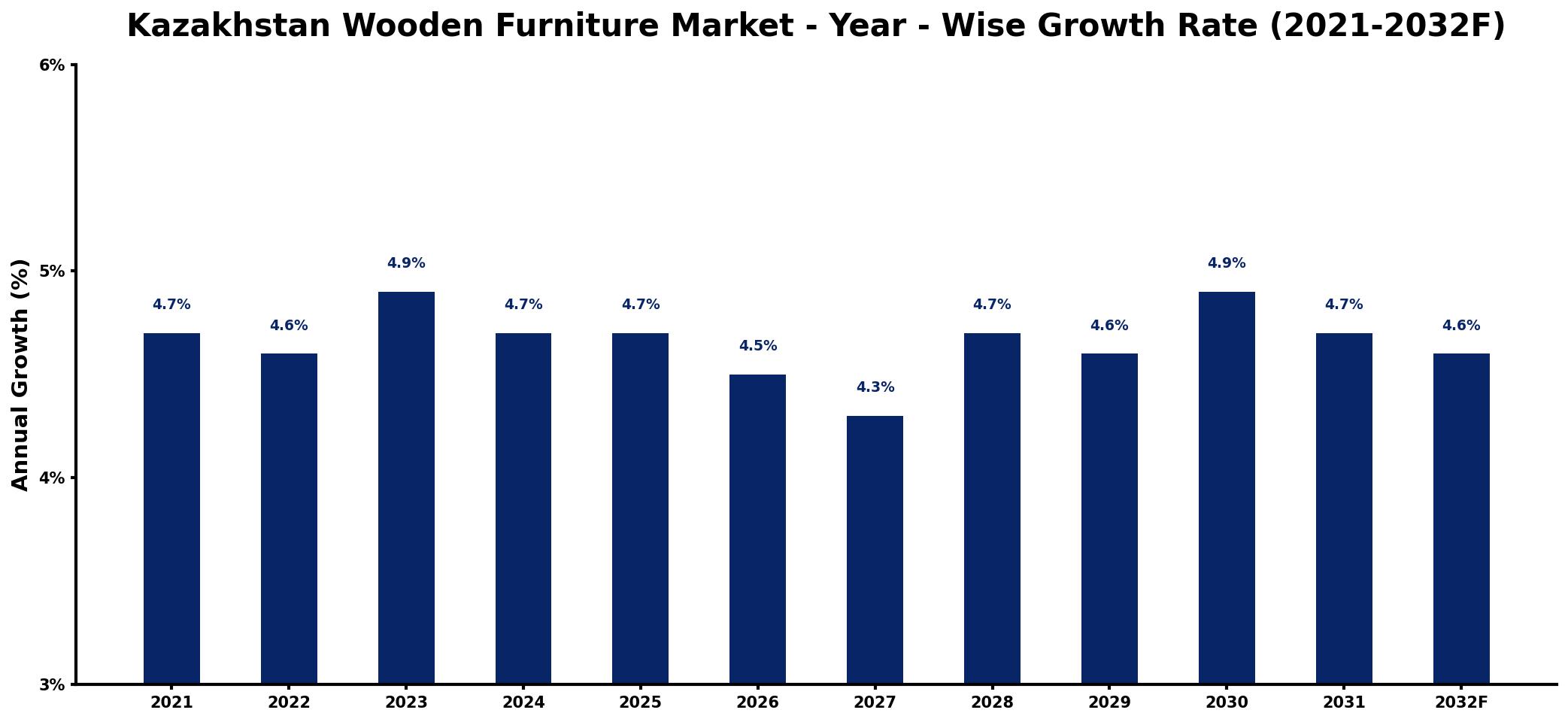
The table below presents the year‑wise growth rates along with the key drivers influencing the market
| Year | Growth Rate | Major Drivers |
| 2021 | 4.7% | Rising consumer spending on home |
| 2022 | 4.6% | Growth in construction sector activities |
| 2023 | 4.9% | Increased demand for local craftsmanship |
| 2024 | 4.7% | Expansion of retail distribution networks |
| 2025 | 4.7% | Surge in eco-friendly material usage |
| 2026 | 4.5% | Investment in modern manufacturing technologies |
| 2027 | 4.3% | Growing popularity of online shopping |
| 2028 | 4.7% | Emergence of sustainable design trends |
| 2029 | 4.6% | Increase in disposable income levels |
| 2030 | 4.9% | Revival of traditional design aesthetics |
| 2031 | 4.7% | Enhanced focus on interior design |
| 2032 | 4.6% | Strengthened export market opportunities |
Note: Market size estimations and growth projections presented in this report are based on 6Wresearch's proprietary forecasting methodology, utilizing the latest available industry data, government publications, and primary research inputs.
Kazakhstan Wooden Furniture Market Synopsis
In Kazakhstan, the wooden furniture segment is distinguished by its unique blend of cultural craftsmanship and contemporary design philosophies. The market is characterized by a growing preference for bespoke furniture pieces that reflect personal style, especially among affluent consumers. Furthermore, the strong influence of interior design trends has led to increased investment in wooden furniture for both residential and commercial spaces.
The hospitality sector, in particular, has seen a surge in demand for high-quality wooden furniture, with hotels seeking distinctive pieces that enhance guest experiences. Additionally, as the real estate market expands, new residential developments are integrating wooden furniture as a staple element, offering a significant boost to the overall market dynamics.
Kazakhstan Wooden Furniture Market Key Takeaways
- The market thrives on the convergence of traditional woodworking and contemporary design trends.
- Urbanization and rising disposable incomes are pivotal drivers of market expansion.
- The hospitality sector plays a crucial role in propelling demand for wooden furniture.
- Local manufacturers face competitive pressure from imports, necessitating strategic innovation.
- Government policies favoring local craftsmanship support market sustainability and growth.
Evaluation of Restraints in Kazakhstan Wooden Furniture Market
The Kazakhstan Wooden Furniture Market grapples with significant challenges that can hinder its growth trajectory. One primary restraint is the intense competition posed by imported furniture, which often comes at lower price points and offers diverse designs. This not only affects local manufacturers but also poses a threat to domestic craftsmanship. Moreover, fluctuations in raw material prices, particularly for hardwood, can lead to unpredictable production costs, impacting profit margins. Compliance with stringent quality standards and sustainability certifications also poses challenges for local producers aiming to remain competitive in both local and international markets.
Kazakhstan Wooden Furniture Market Trends
Current trends in the Kazakhstan Wooden Furniture Market reflect a growing inclination towards sustainability and eco-friendly materials. Consumers are increasingly conscious of the environmental impact of their purchases, driving demand for responsibly sourced wooden products. Additionally, the rise of minimalistic design in interiors has prompted manufacturers to innovate with simpler, more functional furniture pieces. Technology is also shaping the market, with online platforms providing greater access to a wider range of wooden furniture products.
Kazakhstan Wooden Furniture Market Opportunities
The future of the Kazakhstan Wooden Furniture Market is ripe with opportunities, especially in the realm of e-commerce and digital marketing. As more consumers turn to online shopping, there is significant potential for local producers to reach a broader audience. Furthermore, increasing collaboration between designers and manufacturers can lead to the development of unique products tailored to specific consumer needs. Investments in technological advancements for production processes also offer avenues for enhancing efficiency and reducing costs, ultimately benefiting the market.
Government Initiatives in the Kazakhstan Wooden Furniture Market
The government of Kazakhstan actively supports the wooden furniture market through various initiatives aimed at promoting local craftsmanship. Policies include subsidies for furniture manufacturers to encourage production, investment in modern design and technology, and trade agreements designed to facilitate access to new markets. These initiatives not only bolster local businesses but also enhance the competitiveness of Kazakhstan's wooden furniture on a global scale.
Future Insights of the Kazakhstan Wooden Furniture Market
Looking ahead to the period between 2026 and 2032, the Kazakhstan Wooden Furniture Market is expected to continue its upward trajectory, supported by sustained demand for quality furniture across sectors. As urbanization progresses and consumer preferences shift towards sustainable options, local manufacturers are likely to adapt by embracing innovative production techniques. Moreover, the emphasis on design and aesthetics in residential and commercial spaces will fuel further growth in this sector.
Kazakhstan Wooden Furniture Market Latest Developments (2025 - 2026)
In recent months, the Kazakhstan Wooden Furniture Market has witnessed notable shifts towards enhancing product offerings and expanding market reach. Manufacturers have increasingly focused on integrating sustainable materials into their designs, responding to consumer demand for eco-friendly options. Concurrently, a surge in online retail has compelled several companies to enhance their digital presence, making their products more accessible to a broader customer base. Trade exhibitions and events have also been pivotal in showcasing local craftsmanship and fostering collaborations within the industry.
Kazakhstan Wooden Furniture Market - Key Attractiveness of the Report
- 10 Years of Market Numbers
- Historical Data Starting from 2022 to 2025
- Base Year: 2025
- Forecast Data until 2032
- Key Performance Indicators Impacting the Market
- Major Upcoming Developments and Projects
Key Highlights of the Report:
- Kazakhstan Wooden Furniture Market Outlook
- Market Size of Kazakhstan Wooden Furniture Market, 2025
- Forecast of Kazakhstan Wooden Furniture Market, 2032
- Historical Data and Forecast of Kazakhstan Wooden Furniture Revenues & Volume for the Period 2022-2032F
- Kazakhstan Wooden Furniture Market Trend Evolution
- Kazakhstan Wooden Furniture Market Drivers and Challenges
- Kazakhstan Wooden Furniture Price Trends
- Kazakhstan Wooden Furniture Porter's Five Forces
- Kazakhstan Wooden Furniture Industry Life Cycle
- Historical Data and Forecast of Kazakhstan Wooden Furniture Market Revenues & Volume By Type for the Period 2022-2032F
- Historical Data and Forecast of Kazakhstan Wooden Furniture Market Revenues & Volume By Hardwood for the Period 2022-2032F
- Historical Data and Forecast of Kazakhstan Wooden Furniture Market Revenues & Volume By Softwood for the Period 2022-2032F
- Historical Data and Forecast of Kazakhstan Wooden Furniture Market Revenues & Volume By Material for the Period 2022-2032F
- Historical Data and Forecast of Kazakhstan Wooden Furniture Market Revenues & Volume By Plywood for the Period 2022-2032F
- Historical Data and Forecast of Kazakhstan Wooden Furniture Market Revenues & Volume By Laminates for the Period 2022-2032F
- Historical Data and Forecast of Kazakhstan Wooden Furniture Market Revenues & Volume By MDF for the Period 2022-2032F
- Historical Data and Forecast of Kazakhstan Wooden Furniture Market Revenues & Volume By Other Materials for the Period 2022-2032F
- Historical Data and Forecast of Kazakhstan Wooden Furniture Market Revenues & Volume By Product for the Period 2022-2032F
- Historical Data and Forecast of Kazakhstan Wooden Furniture Market Revenues & Volume By Bedroom for the Period 2022-2032F
- Historical Data and Forecast of Kazakhstan Wooden Furniture Market Revenues & Volume By Seating for the Period 2022-2032F
- Historical Data and Forecast of Kazakhstan Wooden Furniture Market Revenues & Volume By Kitchen for the Period 2022-2032F
- Historical Data and Forecast of Kazakhstan Wooden Furniture Market Revenues & Volume By Other Products for the Period 2022-2032F
- Historical Data and Forecast of Kazakhstan Wooden Furniture Market Revenues & Volume By Application for the Period 2022-2032F
- Historical Data and Forecast of Kazakhstan Wooden Furniture Market Revenues & Volume By Residential for the Period 2022-2032F
- Historical Data and Forecast of Kazakhstan Wooden Furniture Market Revenues & Volume By Commercial for the Period 2022-2032F
- Historical Data and Forecast of Kazakhstan Wooden Furniture Market Revenues & Volume By Distribution Channel for the Period 2022-2032F
- Historical Data and Forecast of Kazakhstan Wooden Furniture Market Revenues & Volume By Offline for the Period 2022-2032F
- Historical Data and Forecast of Kazakhstan Wooden Furniture Market Revenues & Volume By Online for the Period 2022-2032F
- Kazakhstan Wooden Furniture Import Export Trade Statistics
- Market Opportunity Assessment By Type
- Market Opportunity Assessment By Material
- Market Opportunity Assessment By Product
- Market Opportunity Assessment By Application
- Market Opportunity Assessment By Distribution Channel
- Kazakhstan Wooden Furniture Top Companies Market Share
- Kazakhstan Wooden Furniture Competitive Benchmarking By Technical and Operational Parameters
- Kazakhstan Wooden Furniture Company Profiles
- Kazakhstan Wooden Furniture Key Strategic Recommendations






































