Kazakhstan Wooden Toys Market Size, Share & Growth Rate
The Kazakhstan Wooden Toys Market was estimated at USD 248 Million in 2025 and is projected to reach USD 329 Million by 2032, growing at a CAGR of 4.1% from 2026 to 2032. This growth trajectory is primarily driven by a shift in parental preferences towards sustainable and educational toys. The increasing awareness regarding the detrimental effects of plastic toys on the environment has further propelled the demand for eco-friendly alternatives, ensuring that wooden toys remain a popular choice among discerning parents.
Kazakhstan Wooden Toys Market Year-wise Growth Rate and Key Drivers
This graph highlights how the Kazakhstan Wooden Toys Market has steadily grown over the years, supported by major growth factors.
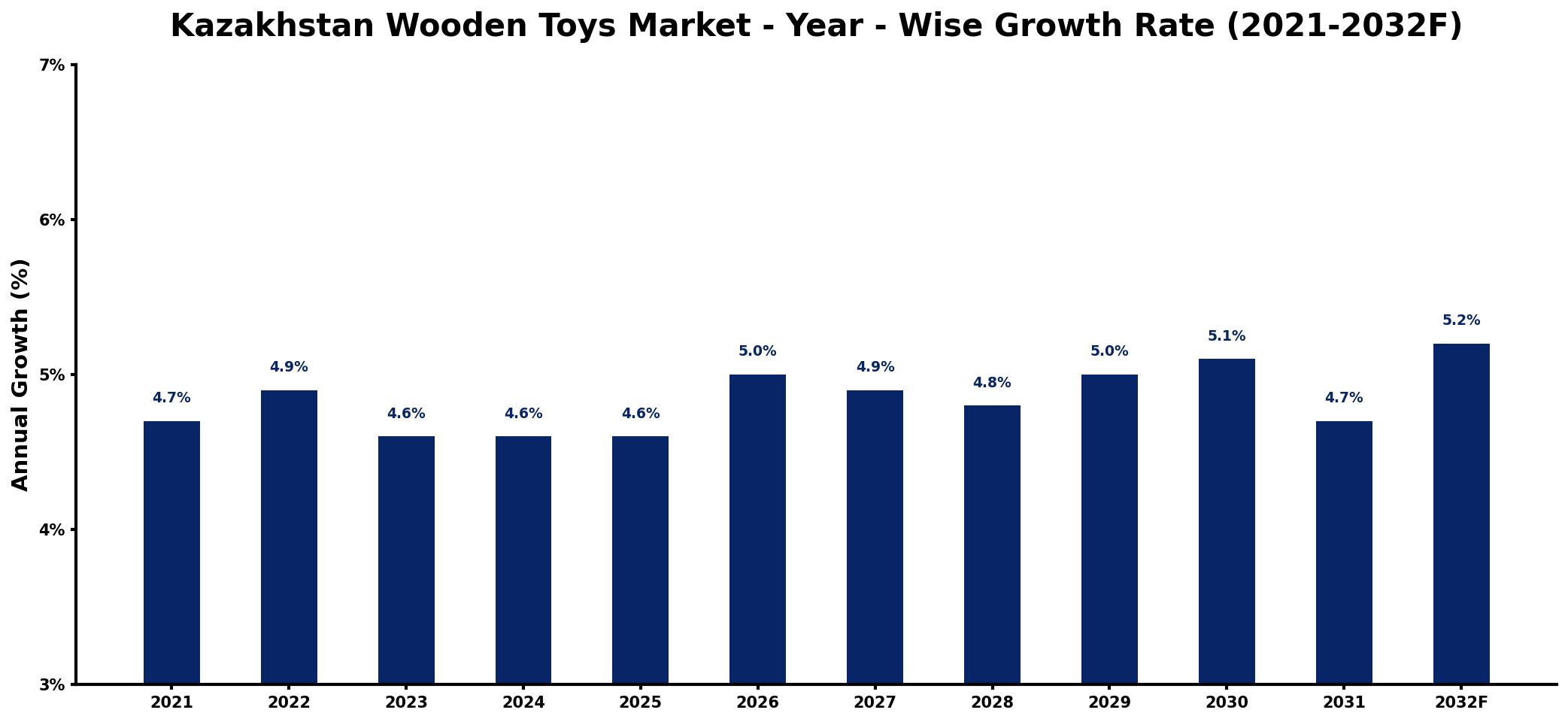
The table below presents the year‑wise growth rates along with the key drivers influencing the market
| Year | Growth Rate | Major Drivers |
| 2021 | 4.7% | Rising consumer interest in sustainability |
| 2022 | 4.9% | Increased online shopping convenience |
| 2023 | 4.6% | Growing market for eco-friendly options |
| 2024 | 4.6% | Expansion of local manufacturing capabilities |
| 2025 | 4.6% | Enhanced distribution channel efficiency |
| 2026 | 5.0% | Surge in educational product demand |
| 2027 | 4.9% | Increased investment in creative design |
| 2028 | 4.8% | Strengthened partnerships with retailers |
| 2029 | 5.0% | Growth in family-oriented spending habits |
| 2030 | 5.1% | Emergence of innovative product lines |
| 2031 | 4.7% | Heightened awareness of quality standards |
| 2032 | 5.2% | Boost in international export opportunities |
Note: Market size estimations and growth projections presented in this report are based on 6Wresearch's proprietary forecasting methodology, utilizing the latest available industry data, government publications, and primary research inputs.
Kazakhstan Wooden Toys Market Synopsis
A pivotal force shaping the Kazakhstan Wooden Toys Market is the rising parental emphasis on safety and educational value. Wooden toys are not only durable but also provide a tactile learning experience, which resonates with today's parents who prioritize development through play.
Furthermore, the commitment to eco-conscious consumption among Kazakhstani consumers is fostering a vibrant market for wooden toys. As parents become more mindful of their purchasing decisions, wooden toys, often crafted from sustainable materials and finished with non-toxic paints, have gained a reputation as safe, reliable, and environmentally friendly products.
Kazakhstan Wooden Toys Market Key Takeaways
- Growing parental preference for non-toxic, sustainable toys is driving market demand.
- Educational value and durability of wooden toys significantly contribute to their appeal.
- Government initiatives support local artisans and sustainable manufacturing practices.
- Rising awareness of the developmental benefits of play is stimulating market growth.
- Challenges from cheaper plastic alternatives necessitate a focus on consumer education.
Evaluation of Restraints in Kazakhstan Wooden Toys Market
Despite its promising growth, the Kazakhstan Wooden Toys Market faces significant restraints. The primary limitation stems from fierce competition with plastic and electronic toys, which often offer interactive features at lower price points. Moreover, ensuring compliance with safety standards for children's products remains a critical concern for manufacturers. Consumer education is essential, as many potential buyers may not fully appreciate the benefits of wooden toys. Increasing awareness regarding the eco-friendly attributes and educational advantages of wooden toys is vital for expanding market reach.
Kazakhstan Wooden Toys Market Trends
A notable trend is the growing intersection of technology and traditional play. Brands are beginning to integrate modern educational methodologies into their wooden toys, enhancing their learning potential without compromising on safety. Additionally, customization options are emerging, allowing consumers to purchase unique, handcrafted items that appeal to the individual tastes of children and parents alike.
Sustainability trends are pushing manufacturers to explore innovative materials and production techniques. A shift towards locally sourced wood and organic finishes reflects a broader movement towards environmentally responsible consumption in Kazakhstan, thereby aligning with the values of conscious consumers.
Kazakhstan Wooden Toys Market Opportunities
The Kazakhstan Wooden Toys Market presents substantial growth and investment opportunities, particularly in expanding the product range. There is a clear demand for interactive educational toys that combine learning and play. Additionally, e-commerce channels represent a significant opportunity for reaching a wider audience, especially among urban families looking for convenient purchasing options. Collaboration with educational institutions to develop curriculum-aligned toys could also open new revenue streams, enhancing both market reach and educational impact.
Government Initiatives in the Kazakhstan Wooden Toys Market
The Kazakh government actively promotes the wooden toys market through various initiatives aimed at supporting local artisans and sustainable production. Grants and financial incentives for small manufacturers facilitate the development of eco-friendly toys. Additionally, policies aimed at maintaining high safety standards ensure that consumers can trust the quality of wooden toys available in the market. Public campaigns to raise awareness about the importance of sustainable play options also contribute to the positive market landscape.
Future Insights of the Kazakhstan Wooden Toys Market
Looking ahead to the period from 2026 to 2032, the Kazakhstan Wooden Toys Market is expected to continue its upward trajectory. The growing inclination towards environmentally friendly products, coupled with an increased understanding of the role of play in child development, positions wooden toys as a staple in the evolving toy industry. By fostering innovation and emphasizing quality craftsmanship, manufacturers will likely solidify their market presence, catering to a demographic increasingly driven by sustainability and education.
Kazakhstan Wooden Toys Market Latest Developments (2025 - 2026)
Recent developments in the Kazakhstan Wooden Toys Market have highlighted a surge in consumer interest towards artisanal products. Many manufacturers are responding by showcasing traditional craftsmanship at local fairs and exhibitions. Initiatives to educate consumers about the benefits of wooden toys have also gained momentum, with workshops and community events focusing on child development through play. The collaboration between manufacturers and educational institutions is becoming more common, aiming to align products with modern educational frameworks.
Kazakhstan Wooden Toys Market - Key Attractiveness of the Report
- 10 Years of Market Numbers
- Historical Data Starting from 2022 to 2025
- Base Year: 2025
- Forecast Data until 2032
- Key Performance Indicators Impacting the Market
- Major Upcoming Developments and Projects
Key Highlights of the Report:
- Kazakhstan Wooden Toys Market Outlook
- Market Size of Kazakhstan Wooden Toys Market, 2025
- Forecast of Kazakhstan Wooden Toys Market, 2032
- Historical Data and Forecast of Kazakhstan Wooden Toys Revenues & Volume for the Period 2022-2032F
- Kazakhstan Wooden Toys Market Trend Evolution
- Kazakhstan Wooden Toys Market Drivers and Challenges
- Kazakhstan Wooden Toys Price Trends
- Kazakhstan Wooden Toys Porter's Five Forces
- Kazakhstan Wooden Toys Industry Life Cycle
- Historical Data and Forecast of Kazakhstan Wooden Toys Market Revenues & Volume By Product Type for the Period 2022-2032F
- Historical Data and Forecast of Kazakhstan Wooden Toys Market Revenues & Volume By Educational Toys for the Period 2022-2032F
- Historical Data and Forecast of Kazakhstan Wooden Toys Market Revenues & Volume By Construction Toys for the Period 2022-2032F
- Historical Data and Forecast of Kazakhstan Wooden Toys Market Revenues & Volume By Musical Toys for the Period 2022-2032F
- Historical Data and Forecast of Kazakhstan Wooden Toys Market Revenues & Volume By Game Toys for the Period 2022-2032F
- Historical Data and Forecast of Kazakhstan Wooden Toys Market Revenues & Volume By Dolls & Miniatures for the Period 2022-2032F
- Historical Data and Forecast of Kazakhstan Wooden Toys Market Revenues & Volume By Automotive Toys for the Period 2022-2032F
- Historical Data and Forecast of Kazakhstan Wooden Toys Market Revenues & Volume By Pretend Play Toys for the Period 2022-2032F
- Historical Data and Forecast of Kazakhstan Wooden Toys Market Revenues & Volume By Wood Type for the Period 2022-2032F
- Historical Data and Forecast of Kazakhstan Wooden Toys Market Revenues & Volume By Softwood for the Period 2022-2032F
- Historical Data and Forecast of Kazakhstan Wooden Toys Market Revenues & Volume By Hardwood for the Period 2022-2032F
- Historical Data and Forecast of Kazakhstan Wooden Toys Market Revenues & Volume By Age Group for the Period 2022-2032F
- Historical Data and Forecast of Kazakhstan Wooden Toys Market Revenues & Volume By Below 1 Year for the Period 2022-2032F
- Historical Data and Forecast of Kazakhstan Wooden Toys Market Revenues & Volume By Age 1-3 for the Period 2022-2032F
- Historical Data and Forecast of Kazakhstan Wooden Toys Market Revenues & Volume By Age 3-5 for the Period 2022-2032F
- Historical Data and Forecast of Kazakhstan Wooden Toys Market Revenues & Volume By Age 5-12 for the Period 2022-2032F
- Historical Data and Forecast of Kazakhstan Wooden Toys Market Revenues & Volume By Age 12+ for the Period 2022-2032F
- Historical Data and Forecast of Kazakhstan Wooden Toys Market Revenues & Volume By Distribution Channel for the Period 2022-2032F
- Historical Data and Forecast of Kazakhstan Wooden Toys Market Revenues & Volume By Online for the Period 2022-2032F
- Historical Data and Forecast of Kazakhstan Wooden Toys Market Revenues & Volume By Offline for the Period 2022-2032F
- Kazakhstan Wooden Toys Import Export Trade Statistics
- Market Opportunity Assessment By Product Type
- Market Opportunity Assessment By Wood Type
- Market Opportunity Assessment By Age Group
- Market Opportunity Assessment By Distribution Channel
- Kazakhstan Wooden Toys Top Companies Market Share
- Kazakhstan Wooden Toys Competitive Benchmarking By Technical and Operational Parameters
- Kazakhstan Wooden Toys Company Profiles
- Kazakhstan Wooden Toys Key Strategic Recommendations






































