Kazakhstan Workforce Management Market Size & Growth Rate (2026-2032)
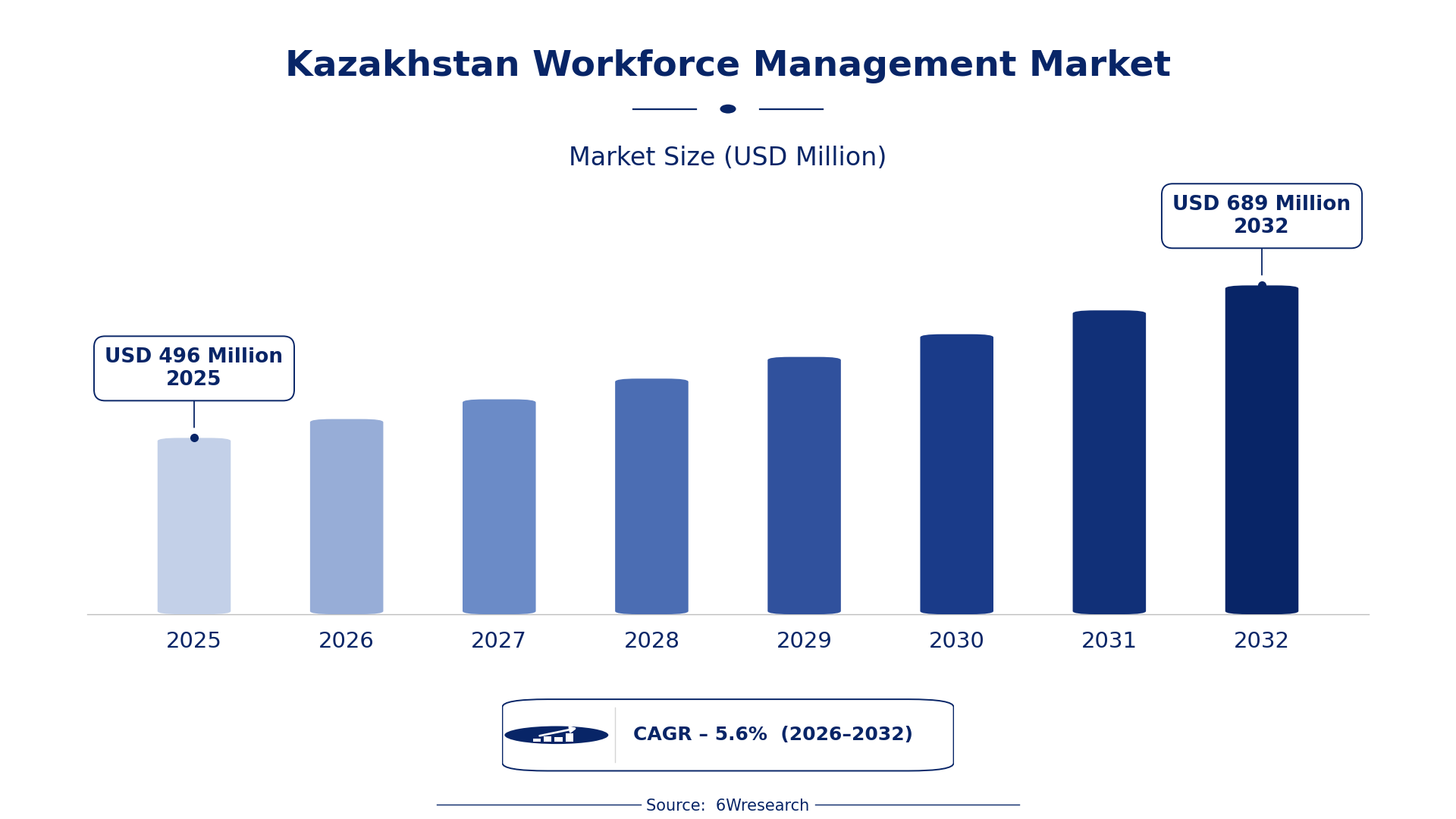
The Kazakhstan Workforce Management Market was estimated at USD 496 Million in 2025 and is projected to reach USD 689 Million by 2032, growing at a CAGR of 5.6% from 2026 to 2032.
Kazakhstan Workforce Management Market Synopsis
The Kazakhstan Workforce Management Market has witnessed a surge in demand as organizations prioritize productivity and regulatory compliance. With the increasing adoption of remote work, companies are exploring innovative solutions to manage their workforce effectively.
Looking ahead, the market is expected to continue its growth trajectory. Organizations are not just adopting these solutions for efficiency but also to enhance employee engagement, which is becoming a core focus in the competitive labor environment.
Kazakhstan Workforce Management Market Year-wise Growth Rate and Key Drivers
This graph illustrates the annual growth rates of the Kazakhstan Workforce Management Market from 2021 to 2032, highlighting a steady upward trajectory and projected expansion over the forecast period.
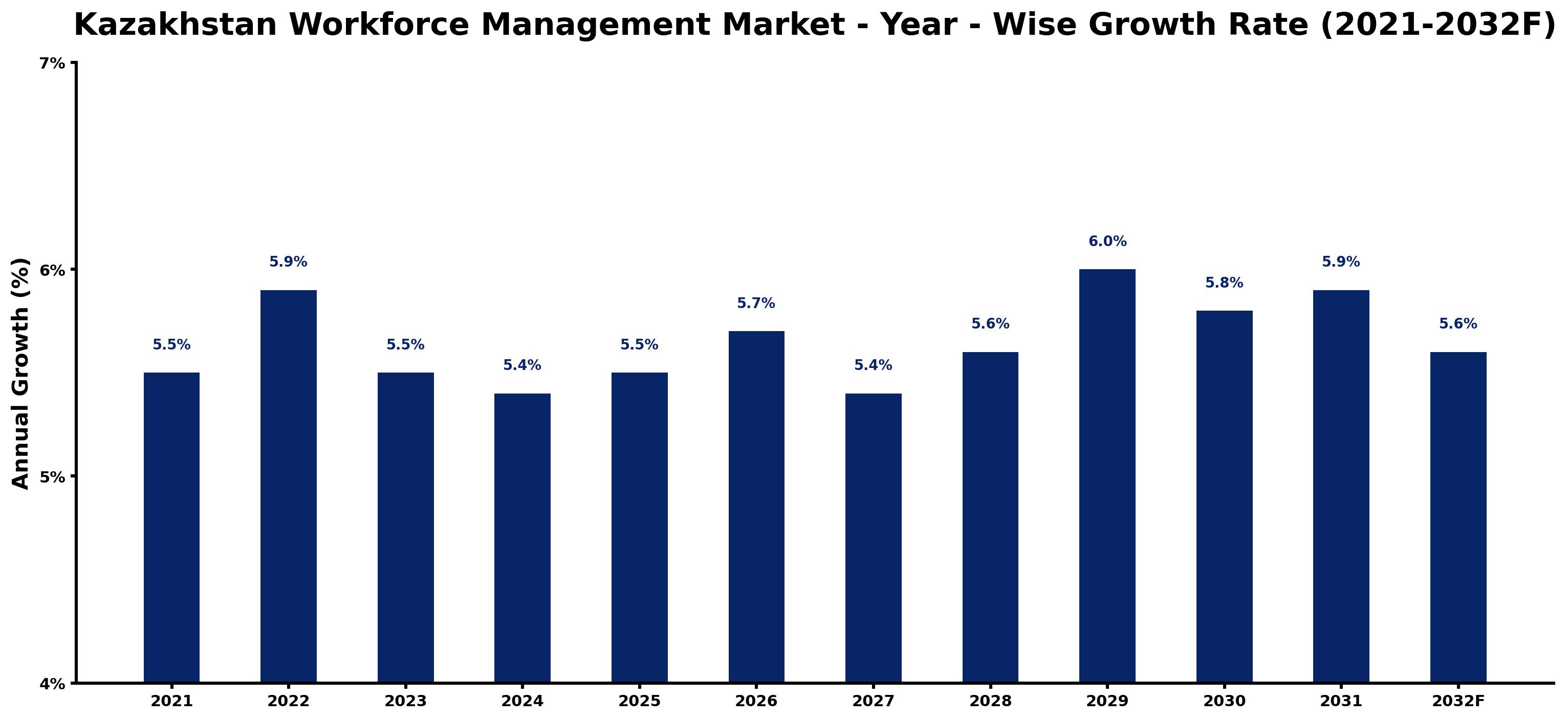
The table below presents the year‑wise growth rates along with the key drivers influencing the market
| Year | Growth Rate | Major Drivers |
| 2021 | 5.5% | Government easing labor regulations for businesses |
| 2022 | 5.9% | Increased focus on talent retention strategies |
| 2023 | 5.5% | Rise in remote work trends post-pandemic |
| 2024 | 5.4% | Implementation of digital HR solutions in companies |
| 2025 | 5.5% | Partnerships with universities for workforce upskilling |
| 2026 | 5.7% | Growing interest in employee wellness programs |
| 2027 | 5.4% | Shift towards performance management technologies |
| 2028 | 5.6% | Emergence of local hr-tech startups enhancing competition |
| 2029 | 6.0% | Increased foreign investment in local enterprises |
| 2030 | 5.8% | Government initiatives promoting digital workplace transformation |
| 2031 | 5.9% | Higher demand for analytics-driven workforce solutions |
| 2032 | 5.6% | Focus on diversity and inclusion in hiring practices |
Note: Market size estimations and growth projections presented in this report are based on 6Wresearch's proprietary forecasting methodology, utilizing the latest available industry data, government publications, and primary research inputs.
Kazakhstan Workforce Management Market Key Takeaways
Below are some of the specific key takeaways from the market, including:
- Labor optimization and compliance are primary drivers of the market.
- Remote work arrangements are significantly influencing workforce management practices.
- Advanced technologies such as AI are gradually being integrated into workforce management solutions.
- Data accuracy and privacy concerns present challenges for market adoption.
- Government initiatives are fostering a more efficient labor market through various support programs.
Evaluation of Restraints in Kazakhstan Workforce Management Market
Several restraints are hampering the growth of the Kazakhstan Workforce Management Market. One major issue is the slow integration of advanced technologies, particularly AI and machine learning, into existing systems. Many organizations struggle with data accuracy and ensuring compliance with evolving labor regulations. Additionally, there are growing employee concerns regarding privacy and job security due to increasing automation, which complicates the adoption of new management practices.
Kazakhstan Workforce Management Market Trends
The market is currently shaped by several key trends. Firstly, there's a notable shift towards cloud-based solutions, allowing organizations to access management tools remotely. Secondly, businesses are increasingly focusing on employee well-being and engagement metrics, prompting the development of more user-friendly interfaces and features. Lastly, the demand for data analytics capabilities in workforce management solutions is rising, enabling organizations to make informed decisions based on workforce performance and trends.
Kazakhstan Workforce Management Market Opportunities
Opportunities abound in the Kazakhstan Workforce Management Market, particularly for providers who can offer tailored solutions addressing specific industry needs. Companies that can harness AI for labor forecasting and performance optimization will find a receptive audience. There’s also a growing market for training programs aimed at upskilling employees in new workforce management technologies, creating a dual benefit of enhancing productivity and employee satisfaction.
Government Initiatives in the Kazakhstan Workforce Management Market
The government of Kazakhstan is actively shaping the Workforce Management Market through a variety of initiatives aimed at enhancing labor efficiency. Current policies are designed to support businesses adopting workforce management systems, ensuring that they meet compliance standards while improving productivity. The regulatory framework is evolving to facilitate better practices in human resource management, which is critical for the market's growth.
- A recently launched initiative provides financial incentives for companies that implement advanced workforce management systems.
- Ongoing training programs are being conducted to equip employees with the necessary skills to utilize new HR technologies effectively.
- A planned regulatory framework expected to be introduced in 2026 will mandate compliance standards for labor management practices.
- Current government grants are available for the development of HR tech solutions focusing on labor efficiency.
- A national digital infrastructure upgrade programme is underway to enhance connectivity and access to workforce management tools.
Future Insights of the Kazakhstan Workforce Management Market
As we look towards 2026-2032, the Kazakhstan Workforce Management Market is set for significant evolution. The integration of advanced technologies will become more pronounced, with AI and analytics driving decision-making processes in HR departments. on top of that, as remote work solidifies its place in organizational structures, workforce management solutions will need to adapt accordingly. Companies prioritizing employee engagement and productivity will emerge as leaders in this competitive market.
Kazakhstan Workforce Management Market Latest Developments
In the past year, the Kazakhstan Workforce Management Market has seen a flurry of activity, particularly in response to the shifting demands of the labor market. Organizations are increasingly investing in technologies that streamline workforce operations and enhance employee experiences. This trend is largely driven by the need for compliance and efficiency amid changing labor regulations.
- A major technology vendor launched an AI-driven performance management tool in early 2025, enhancing tracking and evaluation capabilities.
- An initiative that began in mid-2025 focuses on integrating advanced analytics into existing workforce management systems, streamlining operations.
- By late 2025, several regional companies completed the rollout of cloud-based workforce management solutions, demonstrating a shift toward digital platforms.
- A planned partnership between local governments and tech firms is expected to kick off in early 2026, aimed at expanding workforce management training programs.
Kazakhstan Workforce Management Market - Key Attractiveness of the Report
- 10 Years of Market Numbers
- Historical Data Starting from 2022 to 2025
- Base Year: 2025
- Forecast Data until 2032
- Key Performance Indicators Impacting the Market
- Major Upcoming Developments and Projects
Key Highlights of the Report:
- Kazakhstan Workforce Management Market Outlook
- Market Size of Kazakhstan Workforce Management Market, 2025
- Forecast of Kazakhstan Workforce Management Market, 2032
- Historical Data and Forecast of Kazakhstan Workforce Management Revenues & Volume for the Period 2022-2032F
- Kazakhstan Workforce Management Market Trend Evolution
- Kazakhstan Workforce Management Market Drivers and Challenges
- Kazakhstan Workforce Management Price Trends
- Kazakhstan Workforce Management Porter's Five Forces
- Kazakhstan Workforce Management Industry Life Cycle
- Historical Data and Forecast of Kazakhstan Workforce Management Market Revenues & Volume By Solution for the Period 2022-2032F
- Historical Data and Forecast of Kazakhstan Workforce Management Market Revenues & Volume By Time and Attendance Management for the Period 2022-2032F
- Historical Data and Forecast of Kazakhstan Workforce Management Market Revenues & Volume By Leave and Absence Management for the Period 2022-2032F
- Historical Data and Forecast of Kazakhstan Workforce Management Market Revenues & Volume By Workforce Scheduling for the Period 2022-2032F
- Historical Data and Forecast of Kazakhstan Workforce Management Market Revenues & Volume By Workforce Analytics for the Period 2022-2032F
- Historical Data and Forecast of Kazakhstan Workforce Management Market Revenues & Volume By Others for the Period 2022-2032F
- Historical Data and Forecast of Kazakhstan Workforce Management Market Revenues & Volume By Component for the Period 2022-2032F
- Historical Data and Forecast of Kazakhstan Workforce Management Market Revenues & Volume By Solutions for the Period 2022-2032F
- Historical Data and Forecast of Kazakhstan Workforce Management Market Revenues & Volume By Services for the Period 2022-2032F
- Historical Data and Forecast of Kazakhstan Workforce Management Market Revenues & Volume By Service for the Period 2022-2032F
- Historical Data and Forecast of Kazakhstan Workforce Management Market Revenues & Volume By Consulting for the Period 2022-2032F
- Historical Data and Forecast of Kazakhstan Workforce Management Market Revenues & Volume By Implementation for the Period 2022-2032F
- Historical Data and Forecast of Kazakhstan Workforce Management Market Revenues & Volume By Training, Support and Maintenance for the Period 2022-2032F
- Historical Data and Forecast of Kazakhstan Workforce Management Market Revenues & Volume By Deployment Type for the Period 2022-2032F
- Historical Data and Forecast of Kazakhstan Workforce Management Market Revenues & Volume By On-Premises for the Period 2022-2032F
- Historical Data and Forecast of Kazakhstan Workforce Management Market Revenues & Volume By Cloud for the Period 2022-2032F
- Historical Data and Forecast of Kazakhstan Workforce Management Market Revenues & Volume By Organization Size for the Period 2022-2032F
- Historical Data and Forecast of Kazakhstan Workforce Management Market Revenues & Volume By Large Enterprises for the Period 2022-2032F
- Historical Data and Forecast of Kazakhstan Workforce Management Market Revenues & Volume By Small and Medium-sized Enterprises (SMEs) for the Period 2022-2032F
- Historical Data and Forecast of Kazakhstan Workforce Management Market Revenues & Volume By Vertical for the Period 2022-2032F
- Historical Data and Forecast of Kazakhstan Workforce Management Market Revenues & Volume By Banking, Financial Services and Insurance (BFSI) for the Period 2022-2032F
- Historical Data and Forecast of Kazakhstan Workforce Management Market Revenues & Volume By Telecom for the Period 2022-2032F
- Historical Data and Forecast of Kazakhstan Workforce Management Market Revenues & Volume By Government for the Period 2022-2032F
- Historical Data and Forecast of Kazakhstan Workforce Management Market Revenues & Volume By Consumer Goods and Retail for the Period 2022-2032F
- Historical Data and Forecast of Kazakhstan Workforce Management Market Revenues & Volume By Manufacturing for the Period 2022-2032F
- Historical Data and Forecast of Kazakhstan Workforce Management Market Revenues & Volume By Energy and Utilities for the Period 2022-2032F
- Historical Data and Forecast of Kazakhstan Workforce Management Market Revenues & Volume By Transportation and Logistics for the Period 2022-2032F
- Historical Data and Forecast of Kazakhstan Workforce Management Market Revenues & Volume By Healthcare and Life Sciences for the Period 2022-2032F
- Kazakhstan Workforce Management Import Export Trade Statistics
- Market Opportunity Assessment By Solution
- Market Opportunity Assessment By Component
- Market Opportunity Assessment By Service
- Market Opportunity Assessment By Deployment Type
- Market Opportunity Assessment By Organization Size
- Market Opportunity Assessment By Vertical
- Kazakhstan Workforce Management Top Companies Market Share
- Kazakhstan Workforce Management Competitive Benchmarking By Technical and Operational Parameters
- Kazakhstan Workforce Management Company Profiles
- Kazakhstan Workforce Management Key Strategic Recommendations






































