Kenya Building And Construction Plastic Market Size, Share & Growth Rate
The Kenya Building And Construction Plastic Market was estimated at USD 496 Million in 2025 and is projected to reach USD 722 Million by 2032, growing at a CAGR of 5.5% from 2026 to 2032. This robust growth is propelled by rapid urbanization and an increasing focus on affordable housing solutions. Moreover, innovative advancements in sustainable plastic materials and government initiatives promoting eco-friendly construction practices are set to further amplify demand in this sector.
Kenya Building And Construction Plastic Market Year-wise Growth Rate and Key Drivers
This graph highlights how the Kenya Building And Construction Plastic Market has steadily grown over the years, supported by major growth factors.
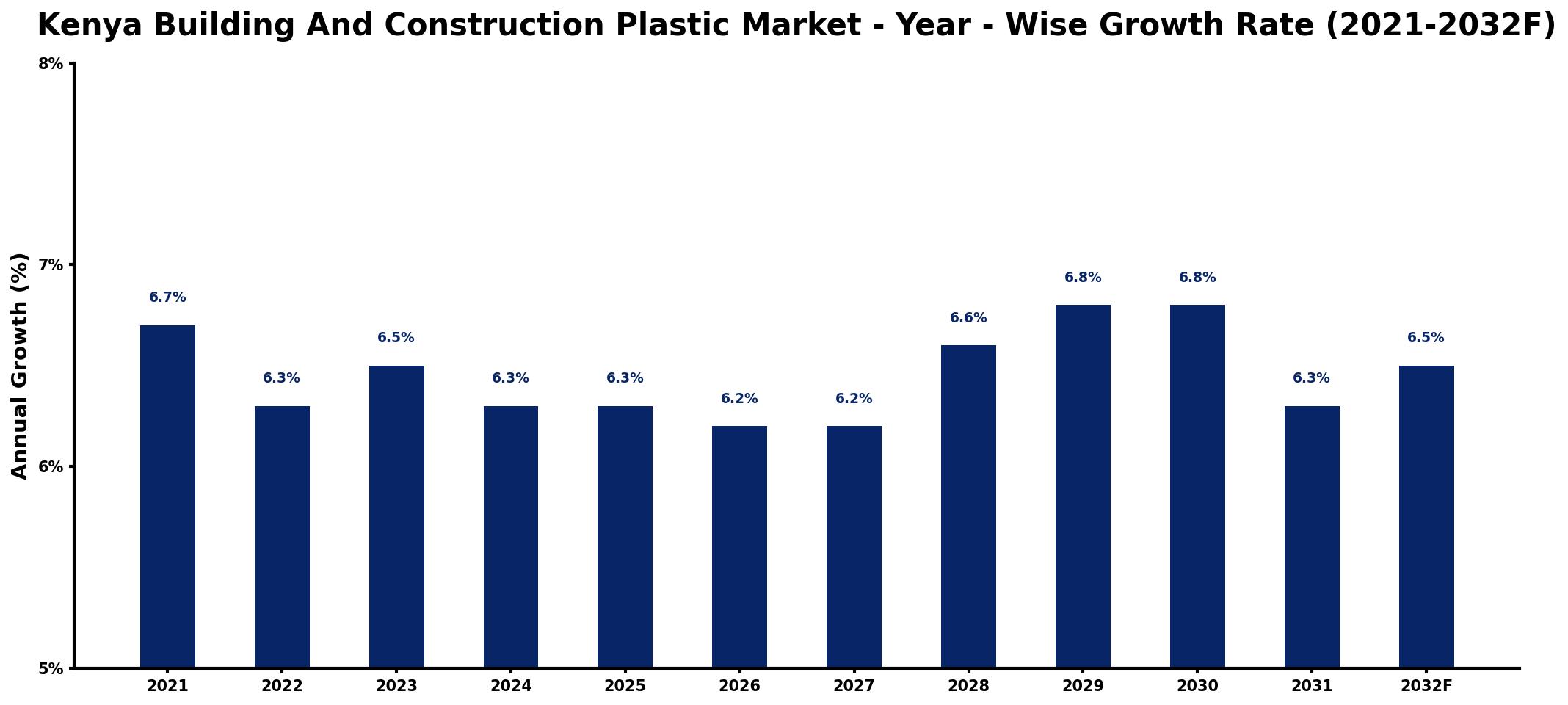
The table below presents the year‑wise growth rates along with the key drivers influencing the market
| Year | Growth Rate | Major Drivers |
| 2021 | 6.7% | Rising urbanization and infrastructure projects |
| 2022 | 6.3% | Increased investment in housing developments |
| 2023 | 6.5% | Growing demand for affordable housing |
| 2024 | 6.3% | Expansion of renewable energy initiatives |
| 2025 | 6.3% | expanding manufacturing base activity |
| 2026 | 6.2% | Technological advancements in manufacturing |
| 2027 | 6.2% | strengthening international trade flows |
| 2028 | 6.6% | Increased focus on sustainability efforts |
| 2029 | 6.8% | Growing population and urban migration |
| 2030 | 6.8% | Enhanced government funding for projects |
| 2031 | 6.3% | Rising interest in eco-friendly alternatives |
| 2032 | 6.5% | Continued growth in infrastructure investments |
Note: Market size estimations and growth projections presented in this report are based on 6Wresearch's proprietary forecasting methodology, utilizing the latest available industry data, government publications, and primary research inputs.
Kenya Building And Construction Plastic Market Synopsis
The Kenya Building And Construction Plastic Market has shown remarkable momentum, driven primarily by the expanding construction industry and heightened demand for versatile plastic materials. This trend contrasts with earlier phases where traditional building materials dominated, indicating a transformative shift towards innovative solutions.
Looking ahead, the market is poised for substantial growth as the emphasis on sustainable practices and eco-friendly materials gains traction. Local manufacturers are not only responding to these trends but also pioneering new products that address the evolving needs of construction projects across the nation.
Kenya Building And Construction Plastic Market Key Takeaways
- Significant growth trajectory forecasted due to increased urbanization and infrastructure development.
- Shifts towards sustainable materials are reshaping product offerings in the construction plastic sector.
- Local manufacturers are focusing on innovation to meet changing demands in the construction market.
- Government policies are encouraging the use of recycled plastics, aligning with environmental sustainability goals.
- Investment opportunities are emerging in manufacturing and recycling of plastic building materials.
Evaluation of Restraints in Kenya Building And Construction Plastic Market
Despite the promising outlook, the Kenya Building And Construction Plastic Market faces several restraints. Fluctuating raw material prices pose a significant challenge, impacting production costs and pricing strategies. Concerns over plastic waste management and environmental impacts continue to push demand for sustainable alternatives, complicating compliance for manufacturers. Furthermore, ensuring high-quality standards while fostering innovation remains a vital issue that could inhibit growth if not addressed effectively.
Kenya Building And Construction Plastic Market Trends
In recent years, the trend towards lightweight and durable materials has gained traction, with thermoplastics such as PVC being preferred for pipes and roofing applications. Additionally, there is a marked increase in the adoption of recycled plastics within construction projects, reflecting a broader commitment to sustainability. Innovative products such as modular components and 3D-printed materials are also emerging, enhancing efficiency in construction processes and appealing to a tech-savvy market.
Kenya Building And Construction Plastic Market Opportunities
The market offers substantial investment opportunities, particularly in the manufacturing of plastic building materials like pipes, insulation, and roofing sheets. Additionally, ventures focused on recycling and producing eco-friendly materials present a sustainable business model. Collaborating with construction companies to provide innovative and cost-effective plastic solutions will also be essential for capitalizing on the markets growth potential. The development of new technologies in plastic manufacturing will further enhance opportunities for investors in this burgeoning sector.
Government Initiatives in the Kenya Building And Construction Plastic Market
The Kenyan government has instituted several policies aimed at regulating the building and construction plastic market while promoting environmental sustainability. Notably, a ban on single-use plastic bags aims to curtail waste, and regulations governing plastic materials in construction ensure safety and quality standards. Additionally, various initiatives are encouraging the integration of recycled plastics into construction projects, illustrating the government's commitment to fostering a sustainable building environment.
Future Insights of the Kenya Building And Construction Plastic Market
As we look towards 2026-2032, the Kenya Building And Construction Plastic Market is set for consistent growth fueled by urbanization and population increase. The urgency for affordable, durable construction materials will drive demand, complemented by a societal shift towards sustainable building practices. Technological advancements in plastic manufacturing promise a broader array of high-quality products, positioning the industry favorably to address the diverse needs of the construction market.
Kenya Building And Construction Plastic Market Latest Developments (2025 - 2026)
Recent developments in the Kenya Building And Construction Plastic Market have reflected a strong push towards sustainable practices. Increased collaboration between manufacturers and construction companies has been noted, focusing on developing innovative plastic solutions. Moreover, a growing public awareness regarding environmental issues has prompted industry players to prioritize eco-friendly practices in their production processes. This strategic alignment showcases a commitment to both market demand and environmental stewardship.
Kenya Building And Construction Plastic Market - Key Attractiveness of the Report
- 10 Years of Market Numbers
- Historical Data Starting from 2022 to 2025
- Base Year: 2025
- Forecast Data until 2032
- Key Performance Indicators Impacting the Market
- Major Upcoming Developments and Projects
Key Highlights of the Report:
- Kenya Building And Construction Plastic Market Outlook
- Market Size of Kenya Building And Construction Plastic Market, 2025
- Forecast of Kenya Building And Construction Plastic Market, 2032
- Historical Data and Forecast of Kenya Building And Construction Plastic Revenues & Volume for the Period 2022-2032F
- Kenya Building And Construction Plastic Market Trend Evolution
- Kenya Building And Construction Plastic Market Drivers and Challenges
- Kenya Building And Construction Plastic Price Trends
- Kenya Building And Construction Plastic Porter's Five Forces
- Kenya Building And Construction Plastic Industry Life Cycle
- Historical Data and Forecast of Kenya Building And Construction Plastic Market Revenues & Volume By Type for the Period 2022-2032F
- Historical Data and Forecast of Kenya Building And Construction Plastic Market Revenues & Volume By Thermoplastic for the Period 2022-2032F
- Historical Data and Forecast of Kenya Building And Construction Plastic Market Revenues & Volume By Thermosetting Plastic for the Period 2022-2032F
- Historical Data and Forecast of Kenya Building And Construction Plastic Market Revenues & Volume By Application for the Period 2022-2032F
- Historical Data and Forecast of Kenya Building And Construction Plastic Market Revenues & Volume By Flooring for the Period 2022-2032F
- Historical Data and Forecast of Kenya Building And Construction Plastic Market Revenues & Volume By Window and Door Panel for the Period 2022-2032F
- Historical Data and Forecast of Kenya Building And Construction Plastic Market Revenues & Volume By Siding for the Period 2022-2032F
- Historical Data and Forecast of Kenya Building And Construction Plastic Market Revenues & Volume By Piping for the Period 2022-2032F
- Historical Data and Forecast of Kenya Building And Construction Plastic Market Revenues & Volume By Roofing for the Period 2022-2032F
- Historical Data and Forecast of Kenya Building And Construction Plastic Market Revenues & Volume By Insulation for the Period 2022-2032F
- Historical Data and Forecast of Kenya Building And Construction Plastic Market Revenues & Volume By Others for the Period 2022-2032F
- Kenya Building And Construction Plastic Import Export Trade Statistics
- Market Opportunity Assessment By Type
- Market Opportunity Assessment By Application
- Kenya Building And Construction Plastic Top Companies Market Share
- Kenya Building And Construction Plastic Competitive Benchmarking By Technical and Operational Parameters
- Kenya Building And Construction Plastic Company Profiles
- Kenya Building And Construction Plastic Key Strategic Recommendations






































