Kenya Bulletproof Glass Market Size, Share & Growth Rate
The Kenya Bulletproof Glass Market was estimated at USD 426 Million in 2025 and is projected to reach USD 596 Million by 2032, growing at a CAGR of 4.9% from 2026 to 2032. This growth trajectory is primarily driven by escalating security concerns, particularly in urban areas, prompting both private and governmental investments in protective solutions. Additionally, infrastructure developments and increased adoption of safety protocols within the defense sector play crucial roles in accelerating market expansion.
Kenya Bulletproof Glass Market Year-wise Growth Rate and Key Drivers
This graph highlights how the Kenya Bulletproof Glass Market has steadily grown over the years, supported by major growth factors.
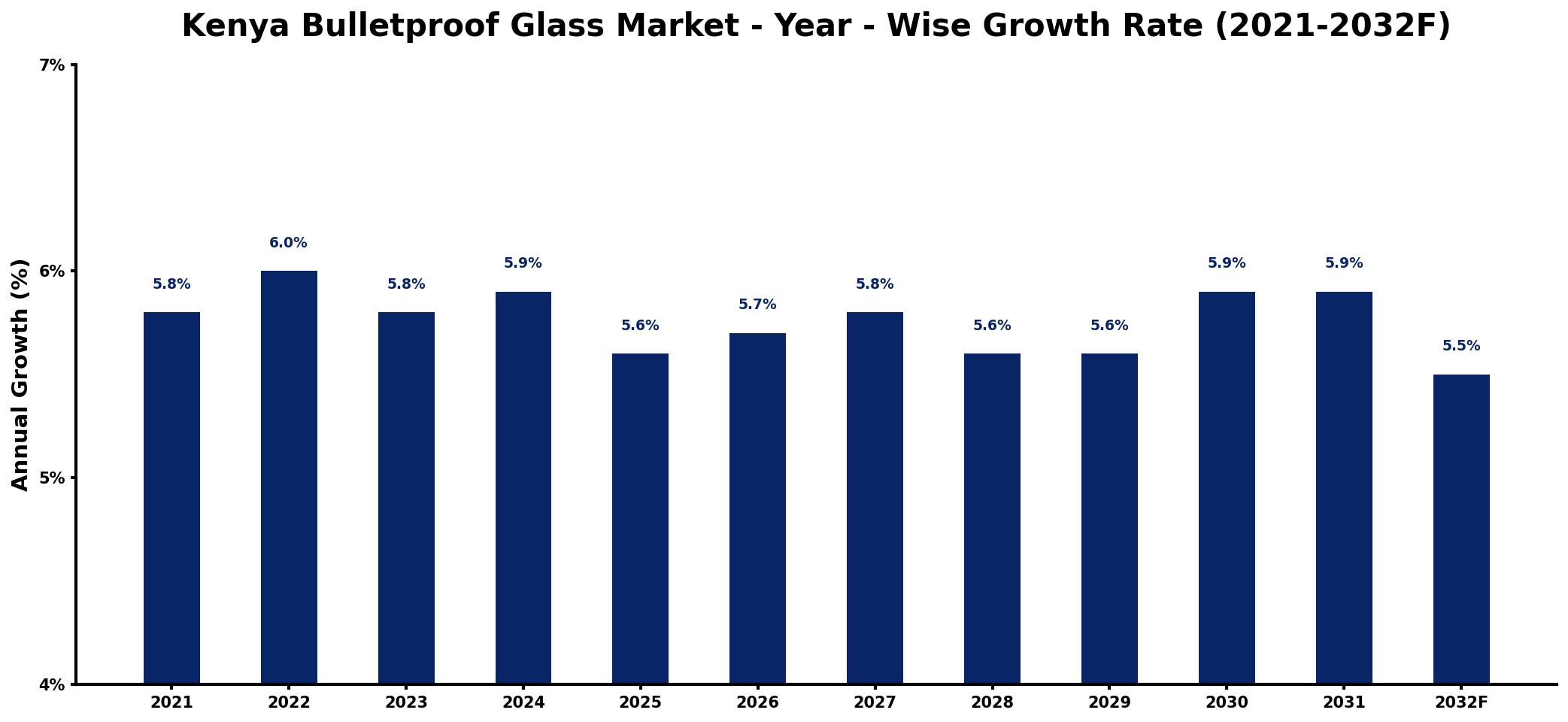
The table below presents the year‑wise growth rates along with the key drivers influencing the market
| Year | Growth Rate | Major Drivers |
| 2021 | 5.8% | Rising security concerns among businesses |
| 2022 | 6.0% | Increased government infrastructure investments |
| 2023 | 5.8% | Growing demand for safety solutions |
| 2024 | 5.9% | Expansion of real estate projects |
| 2025 | 5.6% | Surge in luxury vehicle sales |
| 2026 | 5.7% | Heightened awareness of personal safety |
| 2027 | 5.8% | Growth in commercial property developments |
| 2028 | 5.6% | Emerging markets seeking protective measures |
| 2029 | 5.6% | Increased adoption in residential sectors |
| 2030 | 5.9% | Strengthened regulations on safety standards |
| 2031 | 5.9% | Investments in high-risk environments |
| 2032 | 5.5% | Focus on risk mitigation strategies |
Note: Market size estimations and growth projections presented in this report are based on 6Wresearch's proprietary forecasting methodology, utilizing the latest available industry data, government publications, and primary research inputs.
Kenya Bulletproof Glass Market Synopsis
The demand for bulletproof glass in Kenya is heavily influenced by rising crime rates and the need to fortify vehicles and buildings against potential threats. Critical infrastructure is increasingly being equipped with advanced protective solutions, underscoring a market shift towards enhanced security measures.
As investments in both commercial and residential properties increase, the need for bulletproof glass has become imperative. This demand is fueled not only by individual consumers but also by governmental mandates for better security standards in public buildings, reflecting a growing societal awareness regarding safety.
Kenya Bulletproof Glass Market Key Takeaways
- The market is poised for significant growth, attributed to rising crime rates and heightened security measures.
- Government policies are shaping a regulatory environment that encourages the adoption of bulletproof glass solutions.
- Infrastructure investment remains a vital factor in driving demand for protective glass solutions.
- Challenges such as high production costs could impact innovation and market dynamics.
- The defense sector's expansion is further solidifying the market's growth potential.
Evaluation of Restraints in Kenya Bulletproof Glass Market
Despite the positive growth outlook, the Kenya bulletproof glass market faces significant challenges. High production costs stem from the specialized materials and complex manufacturing processes involved in creating bulletproof solutions. These expenses are compounded by stringent safety and performance standards that require adherence to rigorous compliance measures, potentially stifling innovation. As a result, companies in the sector may find it increasingly difficult to balance cost-effectiveness with the demand for higher-quality, reliable products.
Kenya Bulletproof Glass Market Trends
Current trends reveal an increasing reliance on advanced materials and technologies to improve the performance of bulletproof glass. Innovations in lightweight, transparent polymers are gaining traction, as manufacturers seek to reduce the weight of protective materials without compromising on security. Additionally, there is a growing interest in aesthetic customization, as consumers look for solutions that blend seamlessly with architectural designs.
Kenya Bulletproof Glass Market Opportunities
There are substantial opportunities for growth in the Kenya bulletproof glass market, particularly within the commercial and residential sectors. As urbanization continues, the demand for secure environments will likely prompt more investments in bulletproof glass installations. Furthermore, collaborations between manufacturers and technology providers could lead to innovative solutions that not only enhance safety but also appeal to design-conscious consumers.
Government Initiatives in the Kenya Bulletproof Glass Market
In response to rising security challenges, the Kenyan government has established policies aimed at bolstering public safety. These initiatives include the implementation of certification requirements for bulletproof glass products to ensure quality and reliability. Licensing regulations for security service providers and incentives for investing in security upgrades further emphasize the government's commitment to enhancing protective measures across various sectors.
Future Insights of the Kenya Bulletproof Glass Market
Looking ahead to 2026-2032, the Kenya bulletproof glass market is expected to experience robust growth driven by ongoing security initiatives and infrastructure investments. As the demand for enhanced safety solutions continues to rise, manufacturers are likely to focus on innovation and efficiency. The evolving landscape of security threats will further necessitate a shift towards high-quality, reliable bulletproof solutions, positioning the market for sustained expansion.
Kenya Bulletproof Glass Market Latest Developments (2025 - 2026)
Recent developments in the Kenya bulletproof glass market indicate a growing collaboration between local manufacturers and international technology firms. Innovations in production techniques and material science are emerging, aimed at improving the quality and accessibility of bulletproof glass solutions. Additionally, heightened government focus on public safety is spurring initiatives that encourage the adoption of protective measures in both public and private sectors.
Kenya Bulletproof Glass Market - Key Attractiveness of the Report
- 10 Years of Market Numbers
- Historical Data Starting from 2022 to 2025
- Base Year: 2025
- Forecast Data until 2032
- Key Performance Indicators Impacting the Market
- Major Upcoming Developments and Projects
Key Highlights of the Report:
- Kenya Bulletproof Glass Market Outlook
- Market Size of Kenya Bulletproof Glass Market, 2025
- Forecast of Kenya Bulletproof Glass Market, 2032
- Historical Data and Forecast of Kenya Bulletproof Glass Revenues & Volume for the Period 2022-2032F
- Kenya Bulletproof Glass Market Trend Evolution
- Kenya Bulletproof Glass Market Drivers and Challenges
- Kenya Bulletproof Glass Price Trends
- Kenya Bulletproof Glass Porter's Five Forces
- Kenya Bulletproof Glass Industry Life Cycle
- Historical Data and Forecast of Kenya Bulletproof Glass Market Revenues & Volume By Type for the Period 2022-2032F
- Historical Data and Forecast of Kenya Bulletproof Glass Market Revenues & Volume By Solid Acrylic for the Period 2022-2032F
- Historical Data and Forecast of Kenya Bulletproof Glass Market Revenues & Volume By Traditional Laminated for the Period 2022-2032F
- Historical Data and Forecast of Kenya Bulletproof Glass Market Revenues & Volume By Polycarbonate for the Period 2022-2032F
- Historical Data and Forecast of Kenya Bulletproof Glass Market Revenues & Volume By Glass-clad Polycarbonate for the Period 2022-2032F
- Historical Data and Forecast of Kenya Bulletproof Glass Market Revenues & Volume By Other Types for the Period 2022-2032F
- Historical Data and Forecast of Kenya Bulletproof Glass Market Revenues & Volume By End-user Industry for the Period 2022-2032F
- Historical Data and Forecast of Kenya Bulletproof Glass Market Revenues & Volume By Automotive for the Period 2022-2032F
- Historical Data and Forecast of Kenya Bulletproof Glass Market Revenues & Volume By Buildings and Construction for the Period 2022-2032F
- Historical Data and Forecast of Kenya Bulletproof Glass Market Revenues & Volume By Defense for the Period 2022-2032F
- Historical Data and Forecast of Kenya Bulletproof Glass Market Revenues & Volume By Other End-user Industries for the Period 2022-2032F
- Kenya Bulletproof Glass Import Export Trade Statistics
- Market Opportunity Assessment By Type
- Market Opportunity Assessment By End-user Industry
- Kenya Bulletproof Glass Top Companies Market Share
- Kenya Bulletproof Glass Competitive Benchmarking By Technical and Operational Parameters
- Kenya Bulletproof Glass Company Profiles
- Kenya Bulletproof Glass Key Strategic Recommendations






































