Kenya Business Intelligence Market Size & Growth Rate (2026-2032)
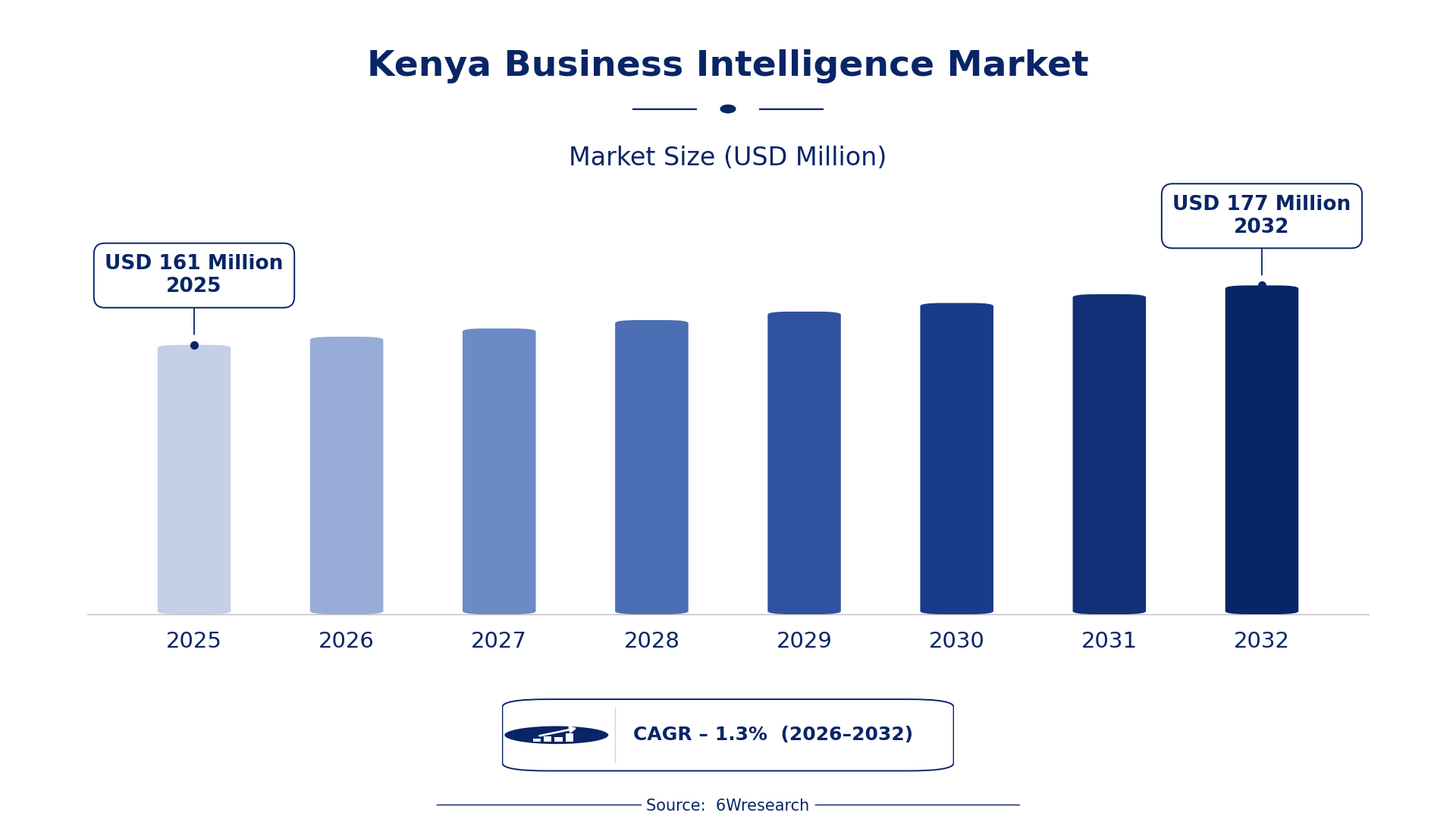
The Kenya Business Intelligence Market was estimated at USD 161 Million in 2025 and is projected to reach USD 177 Million by 2032, growing at a CAGR of 1.3% from 2026 to 2032.
Kenya Business Intelligence Market Synopsis
The demand for business intelligence tools in Kenya is being propelled by the urgent need for real-time insights across various sectors such as finance and healthcare. Organizations are increasingly recognizing that data-driven decision-making is no longer optional; it’s a prerequisite for survival and competitive advantage.
As local and global vendors enter the market, the variety of BI solutions has expanded significantly. From advanced analytics to user-friendly data visualization tools, businesses are investing heavily to enhance operational efficiency and improve customer experiences, all while adapting to a rapidly digitizing environment.
Kenya Business Intelligence Market Year-wise Growth Rate and Key Drivers
This graph illustrates the annual growth rates of the Kenya Business Intelligence Market from 2021 to 2032, highlighting a steady upward trajectory and projected expansion over the forecast period.
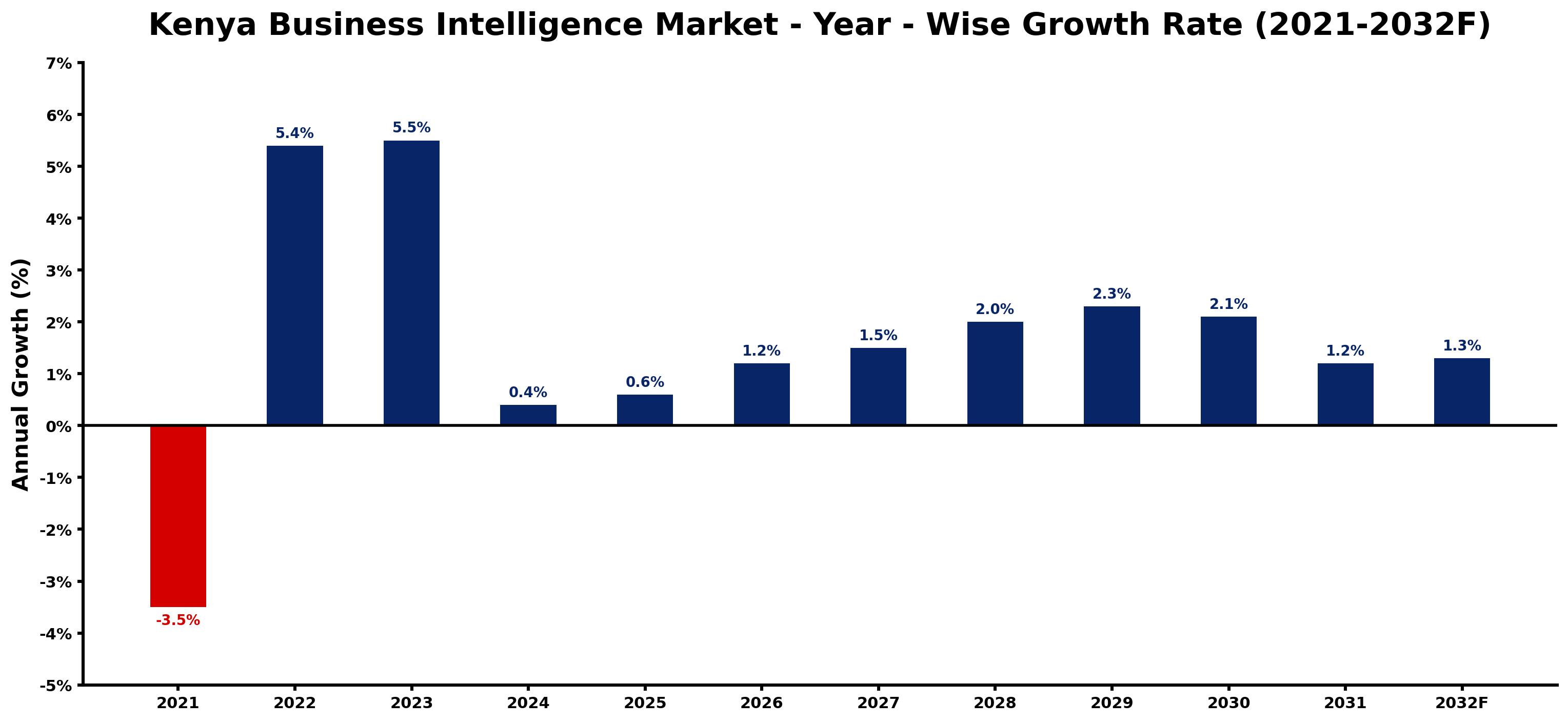
The table below presents the year‑wise growth rates along with the key drivers influencing the market
| Year | Growth Rate | Major Drivers |
| 2021 | -3.5% | High data privacy regulations from Kenyan authorities hampered growth. |
| 2022 | 5.4% | Government's Big Four Agenda emphasizes data-driven decision-making. |
| 2023 | 5.5% | Increasing mobile penetration enhances access to business intelligence. |
| 2024 | 0.4% | Growing e-commerce sector drives demand for data analytics. |
| 2025 | 0.6% | Adoption of AI technologies for improved market forecasting. |
| 2026 | 1.2% | Local startups leveraging data to improve operational efficiency. |
| 2027 | 1.5% | Increased competition requires better insights for businesses. |
| 2028 | 2.0% | Rise in SMEs focusing on data for strategic growth. |
| 2029 | 2.3% | Government incentives for tech initiatives foster analytics use. |
| 2030 | 2.1% | Demand for agricultural insights boosts data solutions adoption. |
| 2031 | 1.2% | Emerging fintech companies depend on analytics for risk assessment. |
| 2032 | 1.3% | Collaborations between universities and tech firms enhance expertise. |
Note: Market size estimations and growth projections presented in this report are based on 6Wresearch's proprietary forecasting methodology, utilizing the latest available industry data, government publications, and primary research inputs.
Kenya Business Intelligence Market Key Takeaways
Below are some of the specific key takeaways from the market, including:
- Rising demand for cloud-based BI solutions is reshaping how organizations approach data analytics.
- Self-service BI platforms are increasingly favored, enabling non-technical users to generate insights independently.
- Integration of artificial intelligence and machine learning into BI tools is enhancing predictive capabilities.
- Government initiatives are fostering a supportive regulatory environment for data-driven governance.
- Investment opportunities are emerging in tailored BI solutions and analytics consultancy services.
Evaluation of Restraints in Kenya Business Intelligence Market
Several factors are hindering the growth of the Kenya Business Intelligence market. Limited access to reliable data sources creates challenges for organizations attempting to extract actionable insights. Inadequate infrastructure for data storage and processing further complicates matters, leaving many businesses ill-equipped to harness the power of their data.
The skills gap in data analytics remains a critical issue, with a shortage of trained professionals slowing down adoption rates. Additionally, many businesses lack awareness of the transformative potential of BI tools, which further delays their implementation. Concerns over data privacy and security, especially in light of evolving regulatory frameworks, also add layers of complexity that companies must navigate.
Kenya Business Intelligence Market Trends
A notable trend in the Kenya Business Intelligence Market is the shift towards cloud-based solutions, reflecting a broader global movement. Organizations are increasingly seeking advanced analytics and data visualization tools that can deliver real-time insights. This trend has led to a surge in the demand for self-service BI platforms, allowing users to independently generate reports and analytics.
Additionally, the integration of AI and machine learning into BI solutions is gaining traction. These technologies enhance predictive analytics and automate decision-making processes, providing organizations with deeper insights. Mobile BI applications are also becoming essential, enabling users to access critical business data on the go, thus facilitating timely and informed decision-making.
Kenya Business Intelligence Market Opportunities
The Kenya Business Intelligence Market is ripe with opportunities for growth and investment. As companies increasingly adopt technology to drive data-driven decision-making, there is a clear demand for innovative BI solutions. Investors can find lucrative prospects in developing customized BI tools tailored to the unique needs of Kenyan businesses.
There is also a strong need for training and consultancy services to help organizations maximize their data utilization. Investing in emerging BI startups that offer cutting-edge technologies presents another exciting avenue. The convergence of these factors positions the market favorably for those looking to capitalize on the growing demand for data analytics solutions.
Government Initiatives in the Kenya Business Intelligence Market
Government policy is significantly influencing the Kenya Business Intelligence Market, as authorities focus on promoting economic growth and transparency. Initiatives aimed at enhancing data collection and analysis capabilities are crucial for organizations seeking to implement effective BI strategies. Regulatory frameworks, particularly around data protection, are shaping how businesses engage with data.
- A national digital infrastructure upgrade programme launched in early 2025 aims to improve access to quality data sources.
- The Kenya Open Data Portal, established recently, promotes the use of BI tools for informed decision-making.
- Current initiatives focus on enhancing training programs for data analytics professionals to address the skills gap.
- Upcoming regulations under the Data Protection Act 2019 will mandate compliance for businesses engaging in data analytics.
- A planned public-private partnership expected to launch by 2026 aims to expand data access across the telecom sector.
Future Insights of the Kenya Business Intelligence Market
Looking ahead to 2026-2032, the Kenya Business Intelligence Market is anticipated to experience substantial growth. The increasing volume of data generated by organizations, coupled with advancements in technology, will drive demand for BI tools and services. Businesses will continue to seek real-time insights to maintain a competitive edge, further fueling market expansion.
As awareness of the benefits of BI tools grows, more organizations will adopt these solutions. The trend towards cloud-based offerings will also support market growth, providing businesses with scalable and agile options. Overall, the future holds exciting prospects for the Kenya Business Intelligence Market as it evolves to meet the needs of a data-driven economy.
Kenya Business Intelligence Market Latest Developments
In the past year, the Kenya Business Intelligence Market has witnessed notable developments that reflect its dynamic nature. Companies are increasingly focusing on enhancing their BI capabilities through innovative solutions and strategic partnerships. The push towards cloud-based platforms continues to gain momentum, with various organizations prioritizing investments in advanced analytics tools.
- A major technology vendor announced the rollout of a new cloud-based BI platform in Q3 2025, aimed at improving user accessibility and data integration.
- An initiative that began in early 2025 is currently underway to provide training programs for data analytics professionals, addressing the skills shortage.
- A partnership between two leading regional operators was established in late 2024 to enhance data-sharing capabilities for improved business insights.
- Upcoming in mid-2026, a launch of a mobile BI application is expected to provide on-the-go access to analytics for business users.
- A recently completed pilot project in late 2025 focused on integrating AI into existing BI systems has shown promising results in predictive analytics.
Kenya Business Intelligence Market - Key Attractiveness of the Report
- 10 Years of Market Numbers
- Historical Data Starting from 2022 to 2025
- Base Year: 2025
- Forecast Data until 2032
- Key Performance Indicators Impacting the Market
- Major Upcoming Developments and Projects
Key Highlights of the Report:
- Kenya Business Intelligence Market Outlook
- Market Size of Kenya Business Intelligence Market, 2025
- Forecast of Kenya Business Intelligence Market, 2032
- Historical Data and Forecast of Kenya Business Intelligence Revenues & Volume for the Period 2022-2032F
- Kenya Business Intelligence Market Trend Evolution
- Kenya Business Intelligence Market Drivers and Challenges
- Kenya Business Intelligence Price Trends
- Kenya Business Intelligence Porter's Five Forces
- Kenya Business Intelligence Industry Life Cycle
- Historical Data and Forecast of Kenya Business Intelligence Market Revenues & Volume By Component for the Period 2022-2032F
- Historical Data and Forecast of Kenya Business Intelligence Market Revenues & Volume By Solutions for the Period 2022-2032F
- Historical Data and Forecast of Kenya Business Intelligence Market Revenues & Volume By Services for the Period 2022-2032F
- Historical Data and Forecast of Kenya Business Intelligence Market Revenues & Volume By Business Function for the Period 2022-2032F
- Historical Data and Forecast of Kenya Business Intelligence Market Revenues & Volume By Human Resource for the Period 2022-2032F
- Historical Data and Forecast of Kenya Business Intelligence Market Revenues & Volume By Finance for the Period 2022-2032F
- Historical Data and Forecast of Kenya Business Intelligence Market Revenues & Volume By Operations for the Period 2022-2032F
- Historical Data and Forecast of Kenya Business Intelligence Market Revenues & Volume By Sales and Marketing for the Period 2022-2032F
- Historical Data and Forecast of Kenya Business Intelligence Market Revenues & Volume By Deployment Mode for the Period 2022-2032F
- Historical Data and Forecast of Kenya Business Intelligence Market Revenues & Volume By On-premises for the Period 2022-2032F
- Historical Data and Forecast of Kenya Business Intelligence Market Revenues & Volume By Cloud for the Period 2022-2032F
- Historical Data and Forecast of Kenya Business Intelligence Market Revenues & Volume By Organization Size for the Period 2022-2032F
- Historical Data and Forecast of Kenya Business Intelligence Market Revenues & Volume By SMEs for the Period 2022-2032F
- Historical Data and Forecast of Kenya Business Intelligence Market Revenues & Volume By Large Enterprises for the Period 2022-2032F
- Historical Data and Forecast of Kenya Business Intelligence Market Revenues & Volume By Vertical for the Period 2022-2032F
- Historical Data and Forecast of Kenya Business Intelligence Market Revenues & Volume By Retail for the Period 2022-2032F
- Historical Data and Forecast of Kenya Business Intelligence Market Revenues & Volume By Manufacturing for the Period 2022-2032F
- Historical Data and Forecast of Kenya Business Intelligence Market Revenues & Volume By Government and Public Services for the Period 2022-2032F
- Historical Data and Forecast of Kenya Business Intelligence Market Revenues & Volume By Media and Entertainment for the Period 2022-2032F
- Historical Data and Forecast of Kenya Business Intelligence Market Revenues & Volume By Transportation and Logistics for the Period 2022-2032F
- Historical Data and Forecast of Kenya Business Intelligence Market Revenues & Volume By BFSI for the Period 2022-2032F
- Historical Data and Forecast of Kenya Business Intelligence Market Revenues & Volume By Telecom and IT for the Period 2022-2032F
- Historical Data and Forecast of Kenya Business Intelligence Market Revenues & Volume By Healthcare and Life Sciences for the Period 2022-2032F
- Kenya Business Intelligence Import Export Trade Statistics
- Market Opportunity Assessment By Component
- Market Opportunity Assessment By Business Function
- Market Opportunity Assessment By Deployment Mode
- Market Opportunity Assessment By Organization Size
- Market Opportunity Assessment By Vertical
- Kenya Business Intelligence Top Companies Market Share
- Kenya Business Intelligence Competitive Benchmarking By Technical and Operational Parameters
- Kenya Business Intelligence Company Profiles
- Kenya Business Intelligence Key Strategic Recommendations






































