Kenya Canned Fruits Market Summary
The kenya canned fruits market was estimated at USD 468 Million in 2025 and is projected to reach USD 648 Million by 2032, growing at a CAGR of 5.5% from 2026 to 2032.
Kenya Canned Fruits Market Year-wise Growth Rate and Key Drivers
This graph highlights how the Kenya Canned Fruits Market has steadily grown over the past five years, supported by major growth factors.
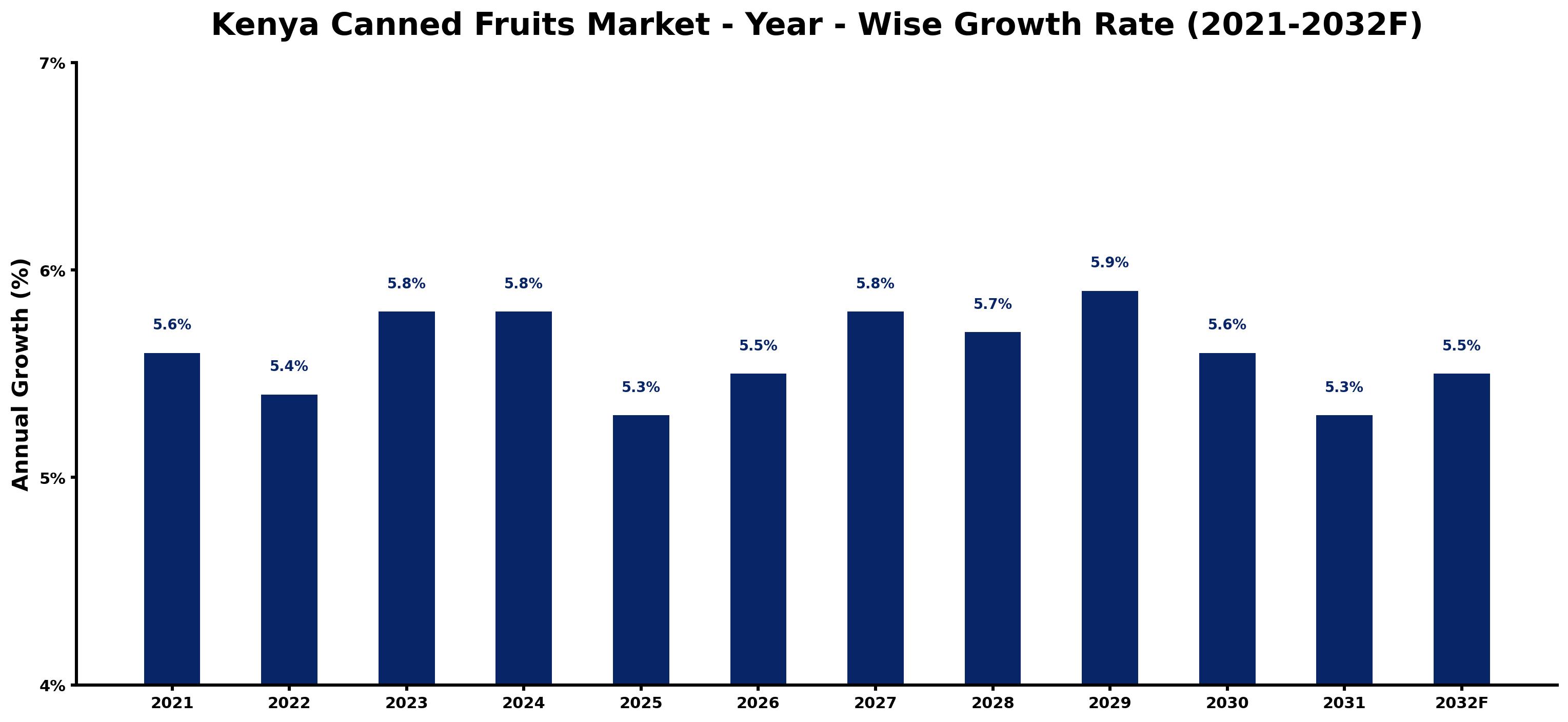
The table below presents the year wise growth rates along with the key drivers influencing the market
| Year | Growth Rate | Major Drivers |
| 2021 | 5.6% | Shifts in consumer behavior reflect a growing preference for convenient food options. |
| 2022 | 5.4% | Urbanization trends continue to reshape food consumption patterns among Kenyan households. |
| 2023 | 5.8% | Product innovations focus on healthier options, appealing to health-conscious consumers. |
| 2024 | 5.8% | Retail channels diversify, with supermarkets expanding canned fruit offerings significantly. |
| 2025 | 5.3% | E-commerce platforms gain traction, enhancing accessibility of canned fruits to consumers. |
| 2026 | 5.5% | Local sourcing initiatives support sustainability, attracting environmentally-conscious buyers. |
| 2027 | 5.8% | Increased disposable incomes stimulate broader consumption of premium canned fruit brands. |
| 2028 | 5.7% | Marketing campaigns highlight convenience, appealing to busy urban professionals. |
| 2029 | 5.9% | Export opportunities arise as regional markets begin to recognize Kenyan canned fruits. |
| 2030 | 5.6% | Collaborations with local farmers ensure consistent supply and quality assurance. |
| 2031 | 5.3% | Consumer education on health benefits drives more informed purchasing decisions. |
| 2032 | 5.5% | Global supply chain improvements enhance distribution efficiency for market players. |
Note - Market size estimations and growth projections presented in this report are based on 6Wresearch's advanced forecasting approach, validated with industry datasets as of June 2026.
Kenya Canned Fruits Market Synopsis
The Kenya Canned Fruits Market is projected to reach 5.5% and witness significant growth during the forecast period (2026-2032). This growth trajectory is primarily fueled by urbanization, evolving consumer preferences emphasizing convenience foods, and increasing disposable incomes. Canned fruits such as pineapples, mangoes, and passion fruits have gained popularity, with pineapple leading in consumption. Additionally, the trend toward healthier eating habits is fostering an increased demand for natural and organic canned alternatives, enabling the market to expand its reach and cater to diverse consumer needs.
Kenya Canned Fruits Market Trends and Opportunities
The Kenya Canned Fruits Market is experiencing notable trends driven by a growing consumer appetite for ready-to-eat and convenient food options. More health-conscious individuals are actively incorporating canned fruits into their diets for their ease of use. This is particularly relevant as the COVID-19 pandemic has intensified consumer focus on shelf-stable products that serve as pantry staples. The market is also witnessing a shift towards natural and organic offerings, as consumers increasingly prioritize clean labels and sustainable sourcing practices.
- The shift in consumer behavior is prompting manufacturers to innovate, introducing new flavors and packaging formats that cater to contemporary taste preferences.
- Health benefits associated with canned fruits are gaining more attention, further driving demand among consumers seeking nutritious, convenient options.
- Online retail platforms are becoming an integral channel for distribution, making it easier for consumers to access a variety of canned fruits.
- Moreover, demographic changes, including the rise of urban populations, are contributing significantly to market growth as urban consumers seek quick meal solutions.
- These evolving trends present lucrative opportunities for market expansion and innovation in terms of product offerings and distribution strategies.
Kenya Canned Fruits Market Challenges and Restraints
Despite the growth opportunities, the Kenya Canned Fruits Market faces several challenges that may impact its potential. One primary challenge is the limited availability of locally sourced fruits for canning, which can result in elevated costs related to the importation of fruits. Consumer perceptions regarding canned fruits compared to fresh options create another hurdle, as there are ongoing concerns about additives, preservatives, and overall nutritional value.
- There is also a noticeable lack of awareness concerning the benefits of canned fruits, which can hinder consumer adoption rates.
- Logistical issues present additional barriers, as maintaining quality and freshness during transportation remains a significant concern.
- Competition from other snacking options can detract from the appeal of canned fruits, which some consumers perceive as less convenient than fresh fruits.
- Furthermore, market fragmentation complicates the distribution process, making it challenging for brands to maintain consistent availability of products.
- Addressing these challenges will require focused marketing campaigns, alliances with local suppliers, and innovation in product packaging.
Kenya Canned Fruits Market Investment Opportunities
The Kenya Canned Fruits Market presents substantial investment opportunities, particularly in light of the increasing demand for convenient and long-lasting food products. As urbanization continues to rise, there is growing interest in canned fruits as practical snacking choices and ingredients for various culinary applications. Opportunities for investment can be identified in the following key areas:
- Expanding production capabilities to meet increasing consumer demands and preferences can enhance market competitiveness.
- Improving distribution networks will ensure better product availability and quality, addressing logistical challenges currently faced in the market.
- Innovative packaging solutions, including eco-friendly materials and user-friendly designs, can draw attention from environmentally conscious consumers.
- Investors should look to leverage Kenya's agricultural resources by sourcing high-quality, locally grown fruits, thus enhancing product quality and reducing import reliance.
- Aligning product offerings with health trends, such as organic and non-GMO options, can attract health-focused consumers looking for nutritious alternatives.
Kenya Canned Fruits Market Government Investment and Initiatives
The Kenyan government has implemented various policies and initiatives to bolster the canned fruits market. These initiatives are aimed at promoting sustainable agricultural practices, providing subsidies for farmers, and enhancing infrastructure for transportation and storage. The government is also focusing on establishing stringent quality standards and regulations to ensure food safety while facilitating market access for local products.
- Public investment in agricultural development is designed to boost productivity and quality in fruit production, laying a solid foundation for the canned fruits sector.
- The government has initiated programs that aim to improve logistics, ensuring that canned fruits can be transported efficiently to meet market demand.
- Participation in international trade agreements aims to open new export markets for Kenyan canned fruits, thus increasing competitiveness on a global scale.
- By fostering partnerships between public and private sectors, the government is working to enhance the overall ecosystem supporting the canned fruits market.
- These initiatives underscore the government's commitment to enhancing the competitive landscape and sustainability of the canned fruits market in Kenya.
Kenya Canned Fruits Market Latest Developments (May 2025 - June 2026)
Recent developments in the Kenya Canned Fruits Market from May 2025 to June 2026 indicate a proactive shift towards innovation and sustainability. Manufacturers are increasingly focusing on diversifying product lines to include organic and natural variants, in response to rising consumer awareness regarding health and wellness. Additionally, there has been a noticeable uptick in partnerships aimed at enhancing supply chain efficiencies to reduce costs and improve product availability.
- Technological advancements in processing and packaging are being adopted to extend shelf life and improve convenience for consumers.
- There is a growing emphasis on clean label products, prompting companies to reformulate existing offerings to eliminate unnecessary additives.
- Furthermore, increased participation in global trade events has showcased Kenyan canned fruits, enhancing their visibility in international markets.
- Collaboration with local farmers is becoming more common to ensure a steady supply of high-quality fruits, which supports local economies and reduces dependency on imports.
- Overall, these developments highlight a positive shift towards meeting evolving consumer needs while addressing sustainability concerns within the industry.
Kenya Canned Fruits Market - Key Attractiveness of the Report
- 10 Years of Market Numbers
- Historical Data Starting from 2022 to 2025
- Base Year: 2025
- Forecast Data until 2032
- Key Performance Indicators Impacting the Market
- Major Upcoming Developments and Projects
Key Highlights of the Report:
- Kenya Canned Fruits Market Outlook
- Market Size of Kenya Canned Fruits Market, 2025
- Forecast of Kenya Canned Fruits Market, 2032F
- Historical Data and Forecast of Kenya Canned Fruits Revenues & Volume for the Period 2022-2032F
- Kenya Canned Fruits Market Trend Evolution
- Kenya Canned Fruits Market Drivers and Challenges
- Kenya Canned Fruits Price Trends
- Kenya Canned Fruits Porter's Five Forces
- Kenya Canned Fruits Industry Life Cycle
- Historical Data and Forecast of Kenya Canned Fruits Market Revenues & Volume By Fruit Type for the Period 2022-2032F
- Historical Data and Forecast of Kenya Canned Fruits Market Revenues & Volume By Peaches for the Period 2022-2032F
- Historical Data and Forecast of Kenya Canned Fruits Market Revenues & Volume By Pineapple for the Period 2022-2032F
- Historical Data and Forecast of Kenya Canned Fruits Market Revenues & Volume By Mandarin oranges for the Period 2022-2032F
- Historical Data and Forecast of Kenya Canned Fruits Market Revenues & Volume By Pears for the Period 2022-2032F
- Historical Data and Forecast of Kenya Canned Fruits Market Revenues & Volume By Others for the Period 2022-2032F
- Historical Data and Forecast of Kenya Canned Fruits Market Revenues & Volume By Form for the Period 2022-2032F
- Historical Data and Forecast of Kenya Canned Fruits Market Revenues & Volume By Whole fruits for the Period 2022-2032F
- Historical Data and Forecast of Kenya Canned Fruits Market Revenues & Volume By Cut fruits for the Period 2022-2032F
- Historical Data and Forecast of Kenya Canned Fruits Market Revenues & Volume By Distribution Channel for the Period 2022-2032F
- Historical Data and Forecast of Kenya Canned Fruits Market Revenues & Volume By Supermarkets/Hypermarkets for the Period 2022-2032F
- Historical Data and Forecast of Kenya Canned Fruits Market Revenues & Volume By Convenience Stores for the Period 2022-2032F
- Historical Data and Forecast of Kenya Canned Fruits Market Revenues & Volume By Online Retail for the Period 2022-2032F
- Historical Data and Forecast of Kenya Canned Fruits Market Revenues & Volume By Other for the Period 2022-2032F
- Kenya Canned Fruits Import Export Trade Statistics
- Market Opportunity Assessment By Fruit Type
- Market Opportunity Assessment By Form
- Market Opportunity Assessment By Distribution Channel
- Kenya Canned Fruits Top Companies Market Share
- Kenya Canned Fruits Competitive Benchmarking By Technical and Operational Parameters
- Kenya Canned Fruits Company Profiles
- Kenya Canned Fruits Key Strategic Recommendations






































