Kenya Cement and Concrete Market Growth Rate Analysis (2025 - 2031)
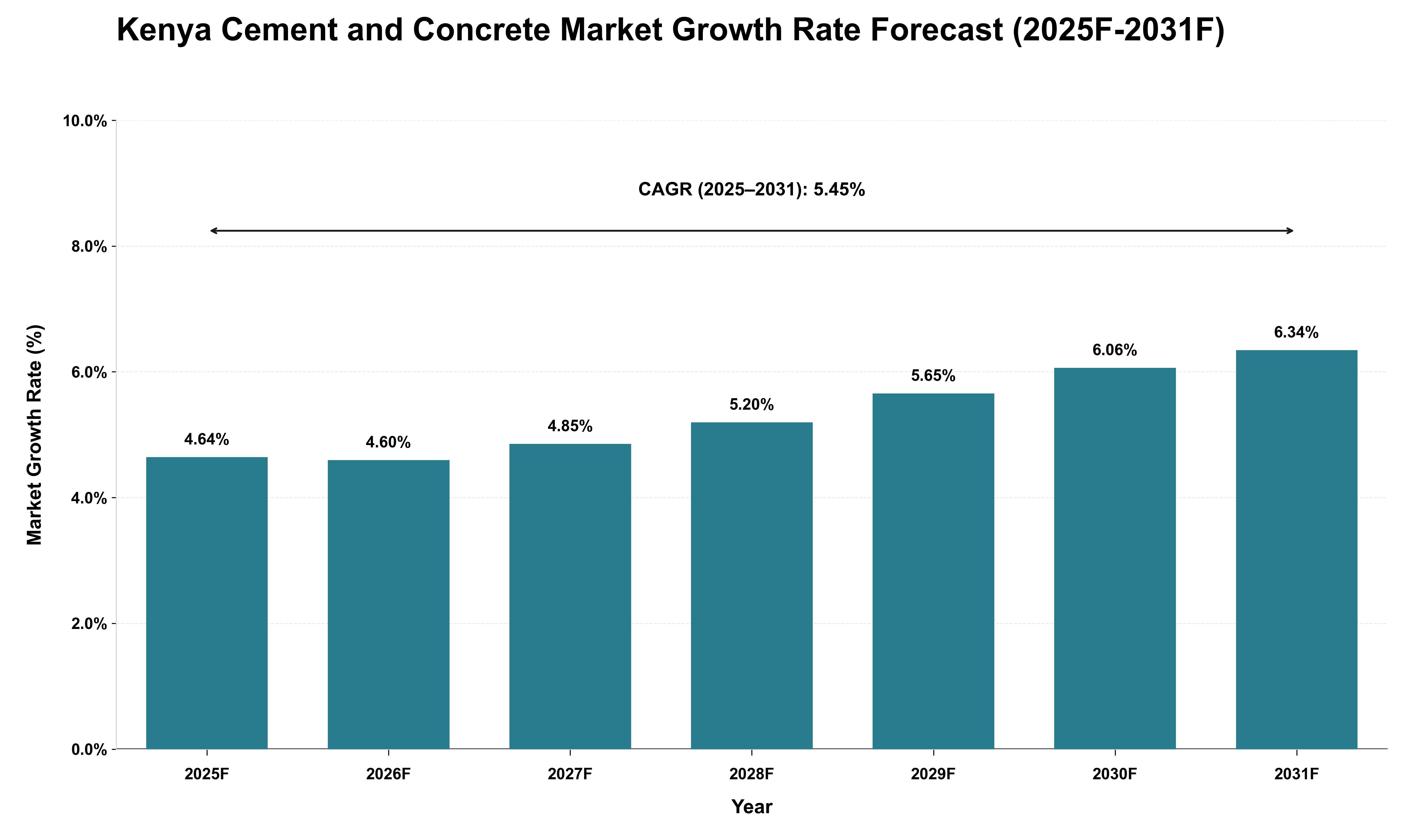
The Kenya cement and concrete market will experience a notable transformation driven by technological advancements and product substitution over the forecast period. As construction methodologies evolve, the adoption of alternative materials and innovative production techniques will likely enhance efficiency and reduce costs, contributing to an anticipated compound annual growth rate (CAGR) of 5.45%. The growth trajectory will reflect incremental increases in annual rates, peaking at 6.34% in 2031, as stakeholders increasingly prioritize sustainable practices and high-performance materials. Additionally, import dependencies may shift as local production capabilities expand through investments in modernized facilities, thereby reducing reliance on foreign sources. This dynamic will be further influenced by cyclical trends in infrastructure development and urbanization efforts, which are expected to drive demand for cement and concrete products throughout the forecast horizon.
Key Highlights of the Report:
- Kenya Cement and Concrete Market Outlook
- Market Size of Kenya Cement and Concrete Market, 2024
- Forecast of Kenya Cement and Concrete Market, 2026
- Historical Data and Forecast of Kenya Cement and Concrete Revenues & Volume for the Period 2021 - 2031
- Kenya Cement and Concrete Market Trend Evolution
- Kenya Cement and Concrete Market Drivers and Challenges
- Kenya Cement and Concrete Price Trends
- Kenya Cement and Concrete Porter's Five Forces
- Kenya Cement and Concrete Industry Life Cycle
- Historical Data and Forecast of Kenya Cement and Concrete Market Revenues & Volume By Type for the Period 2021 - 2031
- Historical Data and Forecast of Kenya Cement and Concrete Market Revenues & Volume By Cement for the Period 2021 - 2031
- Historical Data and Forecast of Kenya Cement and Concrete Market Revenues & Volume By Ready-Mix Concrete for the Period 2021 - 2031
- Historical Data and Forecast of Kenya Cement and Concrete Market Revenues & Volume By Concrete PipeBrickand Block for the Period 2021 - 2031
- Historical Data and Forecast of Kenya Cement and Concrete Market Revenues & Volume By Others for the Period 2021 - 2031
- Historical Data and Forecast of Kenya Cement and Concrete Market Revenues & Volume By Applications for the Period 2021 - 2031
- Historical Data and Forecast of Kenya Cement and Concrete Market Revenues & Volume By Residential for the Period 2021 - 2031
- Historical Data and Forecast of Kenya Cement and Concrete Market Revenues & Volume By Nonresidential for the Period 2021 - 2031
- Kenya Cement and Concrete Import Export Trade Statistics
- Market Opportunity Assessment By Type
- Market Opportunity Assessment By Applications
- Kenya Cement and Concrete Top Companies Market Share
- Kenya Cement and Concrete Competitive Benchmarking By Technical and Operational Parameters
- Kenya Cement and Concrete Company Profiles
- Kenya Cement and Concrete Key Strategic Recommendations






































