Kenya Cigarette Market Size, Share & Growth Rate
The Kenya Cigarette Market was estimated at USD 416 Million in 2025 and is projected to reach USD 524 Million by 2032, growing at a CAGR of 3.4% from 2026 to 2032. This growth trajectory is primarily driven by the nation's youthful demographic, which continues to show a cultural affinity for smoking, alongside rapid urbanization. Despite heightened regulations and a growing public health discourse, the market demonstrates resilience as manufacturers adapt to changing consumer preferences, notably towards flavored and low-tar products.
Kenya Cigarette Market Year-wise Growth Rate and Key Drivers
This graph highlights how the Kenya Cigarette Market has steadily grown over the years, supported by major growth factors.
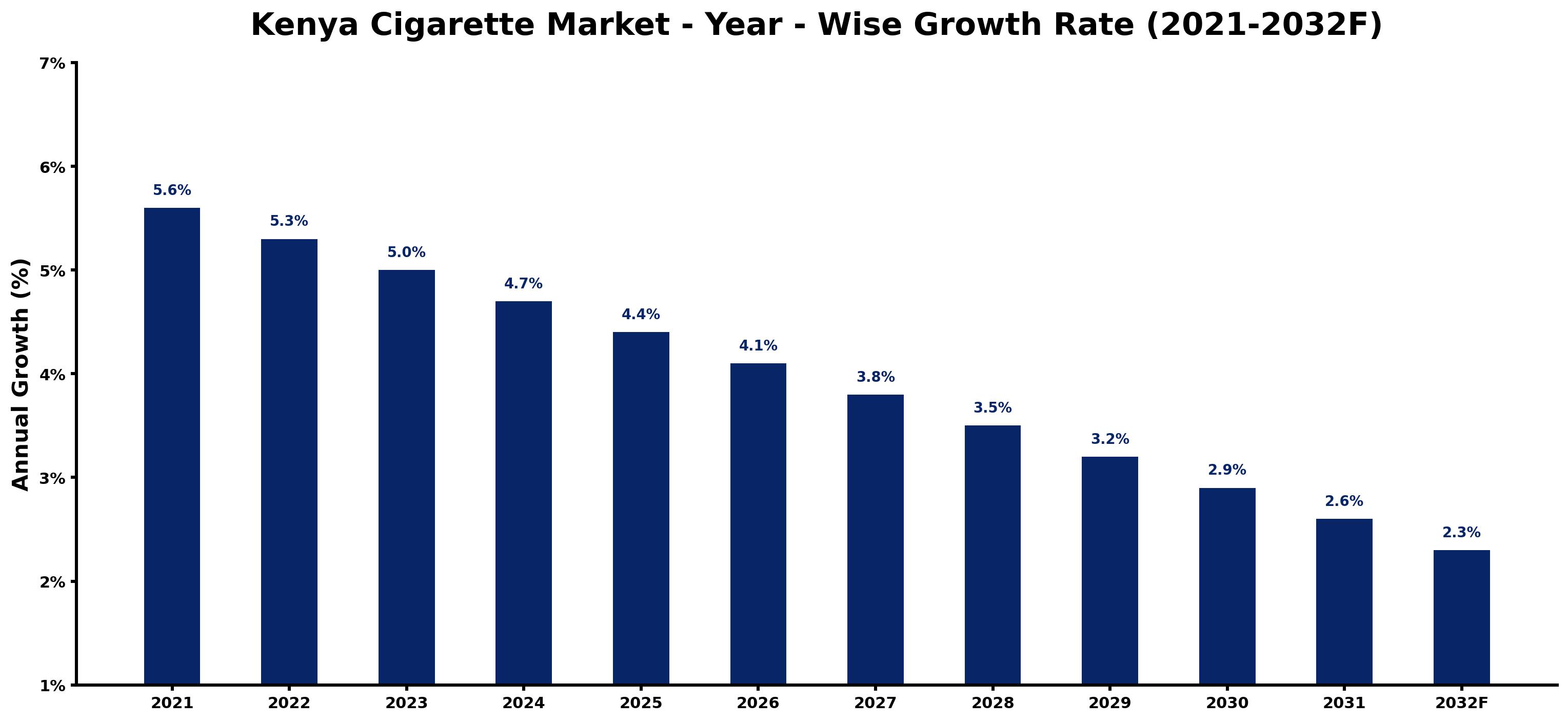
The table below presents the year‑wise growth rates along with the key drivers influencing the market
| Year | Growth Rate | Major Drivers |
| 2021 | 5.6% | Increasing industrial infrastructure investments |
| 2022 | 5.3% | Increasing smart city development projects |
| 2023 | 5.0% | Increasing industrial infrastructure investments |
| 2024 | 4.7% | Increasing industrial automation investments |
| 2025 | 4.4% | Rising electricity demand across industries |
| 2026 | 4.1% | Environmental regulations reducing traditional demand |
| 2027 | 3.8% | Environmental regulations reducing traditional demand |
| 2028 | 3.5% | Technology transition toward sustainable alternatives |
| 2029 | 3.2% | Technology transition toward sustainable alternatives |
| 2030 | 2.9% | Environmental regulations reducing traditional demand |
| 2031 | 2.6% | Environmental regulations reducing traditional demand |
| 2032 | 2.3% | Environmental regulations reducing traditional demand |
Note - Market size estimations and growth projections presented in this report are based on 6Wresearch's advanced forecasting approach, validated with industry datasets as of June 2026.
Kenya Cigarette Market Synopsis
The Kenya cigarette market is currently experiencing a complex evolution shaped by both regulatory pressures and shifting consumer preferences. The presence of a large young population, combined with urbanization trends, continues to sustain demand for cigarette products, even as health concerns gain traction.
As consumers increasingly gravitate towards lower-risk alternatives, there is a noticeable rise in the demand for flavored and menthol cigarettes. This shift reflects broader lifestyle changes, with younger demographics seeking products that align more closely with their preferences, even amid a backdrop of stringent tobacco regulations.
Kenya Cigarette Market Key Takeaways
- The market is poised for growth, driven by a youthful population and urbanization trends.
- Health awareness is influencing consumer choices, leading to a preference for lower-tar and flavored cigarettes.
- Regulatory frameworks are tightening, impacting advertising and packaging strategies.
- There is a significant presence of counterfeit products, posing risks to legitimate brands.
- Emerging investment opportunities exist in innovative product offerings and strategic partnerships.
Evaluation of Restraints in Kenya Cigarette Market
The Kenya cigarette market grapples with several constraints that limit its potential. Strict government regulations, including elevated taxes and comprehensive advertising restrictions, are impacting both sales and market visibility. Additionally, an increasing segment of the population is becoming health-conscious, leading to reduced consumption rates. The prevalence of counterfeit and smuggled cigarettes complicates the landscape further, undermining established brands and impacting revenues across the legitimate sector.
Kenya Cigarette Market Trends
A notable trend within the Kenya cigarette market is the growing preference for low-cost and value brands. Economic factors are pushing consumers towards more affordable options as disposable income constraints tighten. Additionally, the rising demand for flavored cigarettes, particularly among younger demographics, highlights a shift in consumer behavior, as these products become more widely accepted. The market is also witnessing increased investment from international players seeking to innovate and capture a share of the evolving market.
Kenya Cigarette Market Opportunities
Investment opportunities in the Kenya cigarette market lie in the rapid urbanization and the potential for introducing innovative products such as electronic cigarettes or low-nicotine options. Companies that adapt their strategies to align with health trends and consumer preferences stand to gain significantly. Furthermore, forming strategic partnerships with local retailers could enhance market penetration and drive growth amidst a changing regulatory landscape.
Government Initiatives in the Kenya Cigarette Market
The Kenyan government has enacted various policies to regulate the tobacco sector, aiming to mitigate health risks associated with smoking. The Tobacco Control Act embodies measures that restrict advertising, curb smoking in public spaces, and enforce packaging regulations with graphic health warnings. Additionally, excise taxes on tobacco products serve both to discourage consumption and to generate fiscal revenue. Compliance with these evolving regulations is crucial for maintaining market presence and mitigating potential penalties for companies operating within this space.
Future Insights of the Kenya Cigarette Market
Looking ahead, the Kenya cigarette market is set to navigate a path fraught with challenges stemming from increasing regulatory measures aimed at curbing tobacco use. However, steady population growth and urbanization may still present avenues for growth, particularly through innovative product offerings. The future is likely to feature a gradual shift towards alternatives such as e-cigarettes and heated tobacco products, reflecting broader global trends towards reduced harm. As consumer preferences continue to evolve, players in the market must remain agile to capitalize on emerging opportunities while adhering to stringent health regulations.
Kenya Cigarette Market Latest Developments (May 2025 - June 2026)
In the recent months, the Kenya cigarette market has witnessed a surge in interest towards novel product formats that comply with existing regulations while appealing to health-conscious consumers. Companies are experimenting with innovative marketing strategies to align with public health initiatives. Additionally, there is an ongoing effort to combat the impact of illicit trade, as stakeholders collaborate with governmental bodies to enhance market integrity and consumer safety.
Kenya Cigarette Market - Key Attractiveness of the Report
- 10 Years of Market Numbers
- Historical Data Starting from 2022 to 2025
- Base Year: 2025
- Forecast Data until 2032
- Key Performance Indicators Impacting the Market
- Major Upcoming Developments and Projects
Key Highlights of the Report:
- Kenya Cigarette? Market Outlook
- Market Size of Kenya Cigarette? Market, 2025
- Forecast of Kenya Cigarette? Market, 2032
- Historical Data and Forecast of Kenya Cigarette? Revenues & Volume for the Period 2022-2032F
- Kenya Cigarette? Market Trend Evolution
- Kenya Cigarette? Market Drivers and Challenges
- Kenya Cigarette? Price Trends
- Kenya Cigarette? Porter's Five Forces
- Kenya Cigarette? Industry Life Cycle
- Historical Data and Forecast of Kenya Cigarette? Market Revenues & Volume By Type for the Period 2022-2032F
- Historical Data and Forecast of Kenya Cigarette? Market Revenues & Volume By Light for the Period 2022-2032F
- Historical Data and Forecast of Kenya Cigarette? Market Revenues & Volume By Medium for the Period 2022-2032F
- Historical Data and Forecast of Kenya Cigarette? Market Revenues & Volume By Others for the Period 2022-2032F
- Historical Data and Forecast of Kenya Cigarette? Market Revenues & Volume By Distribution Channel for the Period 2022-2032F
- Historical Data and Forecast of Kenya Cigarette? Market Revenues & Volume By Tobacco Shops for the Period 2022-2032F
- Historical Data and Forecast of Kenya Cigarette? Market Revenues & Volume By Supermarket and Hypermarkets for the Period 2022-2032F
- Historical Data and Forecast of Kenya Cigarette? Market Revenues & Volume By Convenience Stores for the Period 2022-2032F
- Historical Data and Forecast of Kenya Cigarette? Market Revenues & Volume By Online Stores for the Period 2022-2032F
- Historical Data and Forecast of Kenya Cigarette? Market Revenues & Volume By Others for the Period 2022-2032F
- Kenya Cigarette? Import Export Trade Statistics
- Market Opportunity Assessment By Type
- Market Opportunity Assessment By Distribution Channel
- Kenya Cigarette? Top Companies Market Share
- Kenya Cigarette? Competitive Benchmarking By Technical and Operational Parameters
- Kenya Cigarette? Company Profiles
- Kenya Cigarette? Key Strategic Recommendations






































