Kenya Circuit Protection Market Size, Share & Growth Rate
The Kenya Circuit Protection Market was estimated at USD 294 Million in 2025 and is projected to reach USD 406 Million by 2032, growing at a CAGR of 4.7% from 2026 to 2032. This growth trajectory is driven largely by the increasing adoption of electronic devices and the expansion of renewable energy systems across the country. Additionally, the push for industrial automation is further propelling the demand for circuit protection devices such as fuses, circuit breakers, and surge protectors, which are critical for ensuring the safety and reliability of electrical systems.
Kenya Circuit Protection Market Year-wise Growth Rate and Key Drivers
This graph highlights how the Kenya Circuit Protection Market has steadily grown over the years, supported by major growth factors.
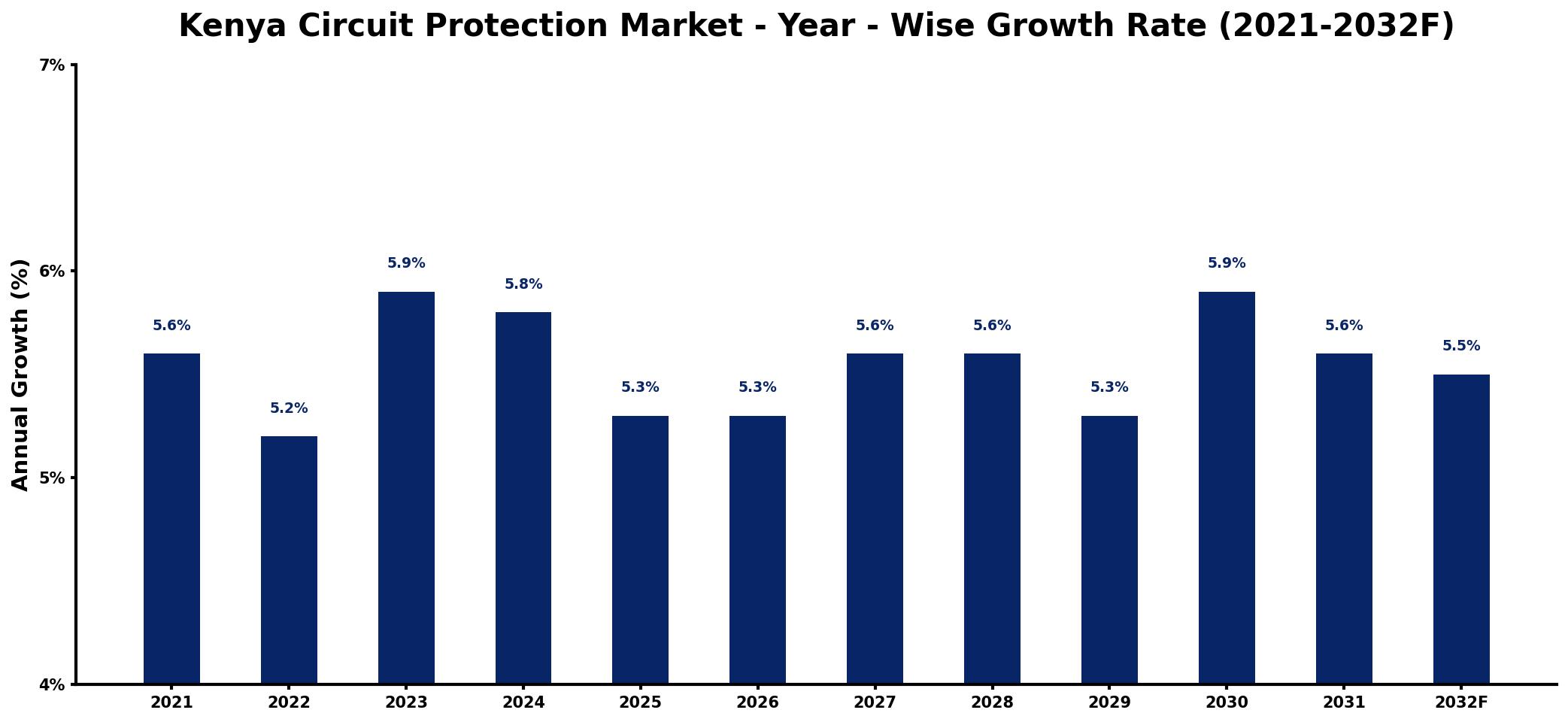
The table below presents the year‑wise growth rates along with the key drivers influencing the market
| Year | Growth Rate | Major Drivers |
| 2021 | 5.6% | Rising demand for renewable energy |
| 2022 | 5.2% | Increase in residential construction projects |
| 2023 | 5.9% | Growth of electric vehicle market |
| 2024 | 5.8% | Expansion of manufacturing facilities |
| 2025 | 5.3% | Investments in smart grid technologies |
| 2026 | 5.3% | Advancements in automation systems |
| 2027 | 5.6% | Surge in industrial automation needs |
| 2028 | 5.6% | Growing focus on energy efficiency |
| 2029 | 5.3% | Development of urban infrastructure projects |
| 2030 | 5.9% | Increased adoption of IoT devices |
| 2031 | 5.6% | increased pharmaceutical industry usage |
| 2032 | 5.5% | Rising investments in sustainable technologies |
Note: Market size estimations and growth projections presented in this report are based on 6Wresearch's proprietary forecasting methodology, utilizing the latest available industry data, government publications, and primary research inputs.
Kenya Circuit Protection Market Synopsis
As Kenya continues to develop its infrastructure and boost its electronics sector, the need for reliable circuit protection becomes paramount. The country's unique energy challenges, including frequent power fluctuations, have made circuit protection devices indispensable for both residential and commercial applications.
Furthermore, the government's focus on improving safety standards in the electrical sector has heightened awareness of the importance of circuit protection. This regulatory framework not only fosters growth but also encourages the adoption of advanced technologies in the manufacturing of protective devices.
Kenya Circuit Protection Market Key Takeaways
- The market is projected to grow significantly due to increased investment in the electronics industry.
- Enhanced regulatory measures are pushing for improved safety standards in electrical systems.
- The growing adoption of renewable energy systems is driving demand for circuit protection solutions.
- Power supply inconsistencies in Kenya create a unique demand for effective circuit protection devices.
- Awareness of safety standards is increasingly influencing consumer choices in circuit protection products.
Evaluation of Restraints in Kenya Circuit Protection Market
Despite the promising growth outlook, the Kenya Circuit Protection Market faces notable restraints. Chief among these is the inconsistent power supply prevalent in various regions, which complicates the implementation of robust electrical infrastructures. Additionally, affordability remains a significant barrier, as many consumers and businesses find high-quality circuit protection devices financially out of reach. This dual challenge limits widespread adoption and necessitates innovative solutions that balance cost with efficacy.
Kenya Circuit Protection Market Trends
Current trends indicate a surge in the integration of smart technologies within circuit protection devices. These advancements are set to enhance user experience by providing real-time monitoring and data analytics capabilities. Additionally, the market is witnessing a shift towards environmentally friendly products, spurred by rising global awareness of sustainability. Manufacturers are increasingly looking to develop eco-efficient circuit protection devices that not only meet regulatory standards but also appeal to environmentally conscious consumers.
Kenya Circuit Protection Market Opportunities
Significant opportunities exist for stakeholders within the Kenya Circuit Protection Market, particularly in the renewable energy sector. As investments in solar and wind energy expand, the demand for specialized circuit protection devices tailored to these systems is set to rise. Moreover, there is potential for growth in the commercial sector as businesses prioritize safety and efficiency, leading to increased adoption of advanced circuit protection solutions.
Government Initiatives in the Kenya Circuit Protection Market
Government initiatives play a pivotal role in shaping the landscape of the Kenya Circuit Protection Market. Policies aimed at enhancing safety standards and compliance with international regulations are actively being enforced. These regulations not only aim to minimize electrical hazards but also promote innovation and quality within the market. The government has been investing in public infrastructure projects, which further drives the demand for reliable circuit protection solutions.
Future Insights of the Kenya Circuit Protection Market
Looking ahead to the period from 2026 to 2032, the Kenya Circuit Protection Market is poised for substantial growth. The drive towards technological advancement in circuit protection devices will likely be coupled with increased governmental support for electrical safety. As more households and businesses adopt new technologies, the demand for reliable circuit protection will evolve, ensuring a robust market landscape that is adaptable to future challenges and opportunities.
Kenya Circuit Protection Market Latest Developments (2025 - 2026)
Recent developments in the Kenya Circuit Protection Market have highlighted a shift towards more advanced protective technologies. Companies are increasingly collaborating with research institutions to innovate in product design, focusing on smart circuit protection devices that offer enhanced functionalities. Additionally, the regulatory landscape continues to evolve, with new safety standards being introduced, which aim to address contemporary electrical challenges faced by the industry.
Kenya Circuit Protection Market - Key Attractiveness of the Report
- 10 Years of Market Numbers
- Historical Data Starting from 2022 to 2025
- Base Year: 2025
- Forecast Data until 2032
- Key Performance Indicators Impacting the Market
- Major Upcoming Developments and Projects
Key Highlights of the Report:
- Kenya Circuit Protection Market Outlook
- Market Size of Kenya Circuit Protection Market, 2025
- Forecast of Kenya Circuit Protection Market, 2032
- Historical Data and Forecast of Kenya Circuit Protection Revenues & Volume for the Period 2022-2032F
- Kenya Circuit Protection Market Trend Evolution
- Kenya Circuit Protection Market Drivers and Challenges
- Kenya Circuit Protection Price Trends
- Kenya Circuit Protection Porter's Five Forces
- Kenya Circuit Protection Industry Life Cycle
- Historical Data and Forecast of Kenya Circuit Protection Market Revenues & Volume By Type for the Period 2022-2032F
- Historical Data and Forecast of Kenya Circuit Protection Market Revenues & Volume By Overcurrent Protection for the Period 2022-2032F
- Historical Data and Forecast of Kenya Circuit Protection Market Revenues & Volume By ESD Protection for the Period 2022-2032F
- Historical Data and Forecast of Kenya Circuit Protection Market Revenues & Volume By Overvoltage Protection for the Period 2022-2032F
- Historical Data and Forecast of Kenya Circuit Protection Market Revenues & Volume By Device for the Period 2022-2032F
- Historical Data and Forecast of Kenya Circuit Protection Market Revenues & Volume By Circuit Breakers for the Period 2022-2032F
- Historical Data and Forecast of Kenya Circuit Protection Market Revenues & Volume By Fuses for the Period 2022-2032F
- Historical Data and Forecast of Kenya Circuit Protection Market Revenues & Volume By ESD Protection Devices for the Period 2022-2032F
- Historical Data and Forecast of Kenya Circuit Protection Market Revenues & Volume By Surge Protection Devices for the Period 2022-2032F
- Historical Data and Forecast of Kenya Circuit Protection Market Revenues & Volume By Industry for the Period 2022-2032F
- Historical Data and Forecast of Kenya Circuit Protection Market Revenues & Volume By Construction for the Period 2022-2032F
- Historical Data and Forecast of Kenya Circuit Protection Market Revenues & Volume By Automotive and Transportation for the Period 2022-2032F
- Historical Data and Forecast of Kenya Circuit Protection Market Revenues & Volume By Electronics and Electrical Equipment for the Period 2022-2032F
- Historical Data and Forecast of Kenya Circuit Protection Market Revenues & Volume By Industrial for the Period 2022-2032F
- Historical Data and Forecast of Kenya Circuit Protection Market Revenues & Volume By Energy for the Period 2022-2032F
- Historical Data and Forecast of Kenya Circuit Protection Market Revenues & Volume By Others for the Period 2022-2032F
- Kenya Circuit Protection Import Export Trade Statistics
- Market Opportunity Assessment By Type
- Market Opportunity Assessment By Device
- Market Opportunity Assessment By Industry
- Kenya Circuit Protection Top Companies Market Share
- Kenya Circuit Protection Competitive Benchmarking By Technical and Operational Parameters
- Kenya Circuit Protection Company Profiles
- Kenya Circuit Protection Key Strategic Recommendations






































