Kenya Coated Steel Market Growth Rate Analysis (2025 - 2031)
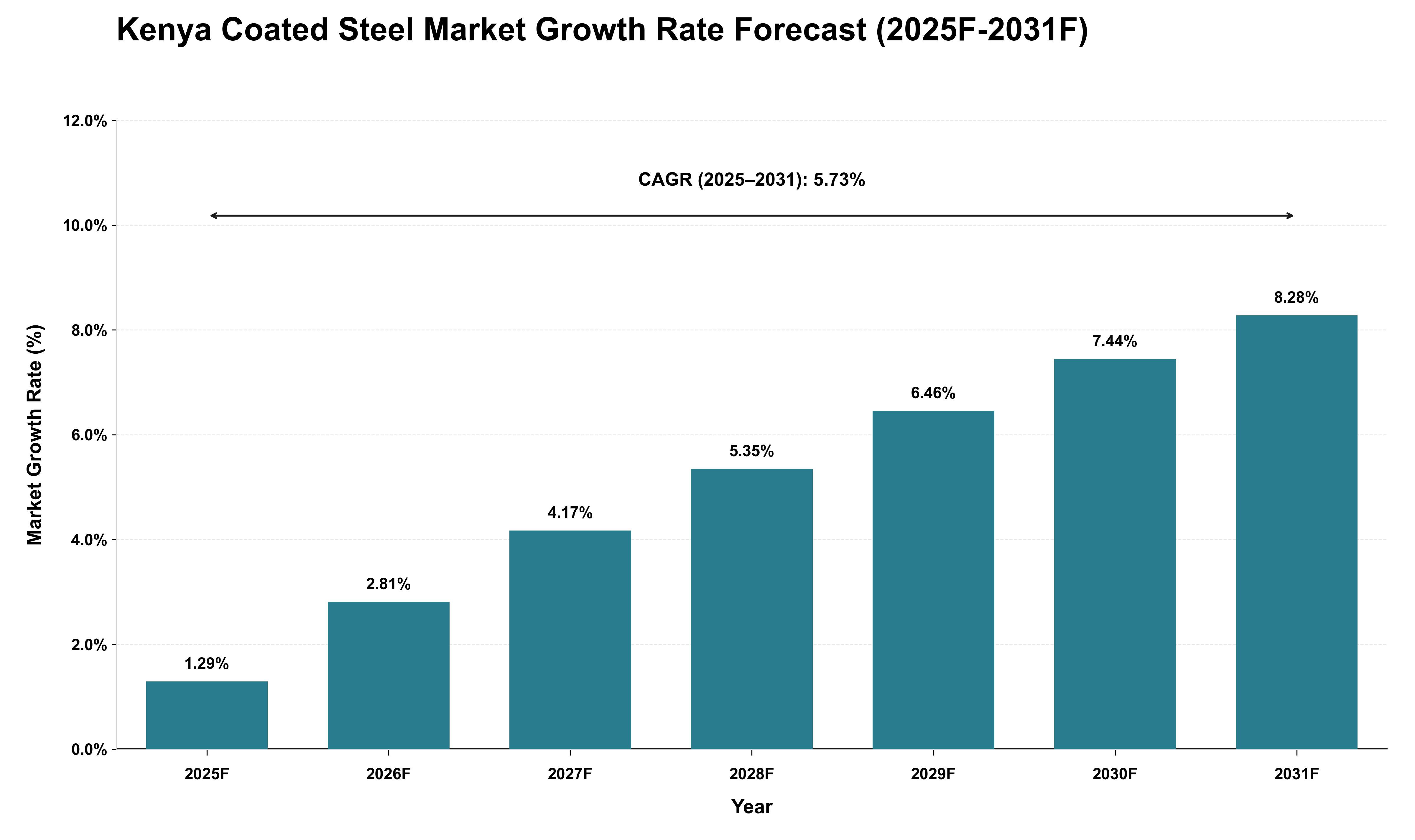
The Kenya coated steel market is projected to experience a compound annual growth rate of 5.73% from 2025 to 2031, reflecting an upward trajectory in demand driven by infrastructural development and construction activities. The initial growth rate of 1.29% in 2025 will likely be influenced by rising input costs and supply chain constraints, which may initially temper expansion. However, as the market adjusts, growth rates are expected to accelerate significantly, peaking at 8.28% in 2031. This acceleration can be attributed to improved efficiencies in production and logistics, alongside a potential easing of import dependencies as local manufacturing capabilities strengthen. Additionally, cyclical trends in global steel prices will play a crucial role; fluctuations may impact input costs but could also stimulate domestic production initiatives aimed at reducing reliance on imports, thereby fostering a more resilient market environment over the forecast period.
Key Highlights of the Report:
- Kenya Coated Steel Market Outlook
- Market Size of Kenya Coated Steel Market, 2024
- Forecast of Kenya Coated Steel Market, 2031
- Historical Data and Forecast of Kenya Coated Steel Revenues & Volume for the Period 2021- 2031
- Kenya Coated Steel Market Trend Evolution
- Kenya Coated Steel Market Drivers and Challenges
- Kenya Coated Steel Price Trends
- Kenya Coated Steel Porter's Five Forces
- Kenya Coated Steel Industry Life Cycle
- Historical Data and Forecast of Kenya Coated Steel Market Revenues & Volume By Type for the Period 2021- 2031
- Historical Data and Forecast of Kenya Coated Steel Market Revenues & Volume By Metallic Coated Steel for the Period 2021- 2031
- Historical Data and Forecast of Kenya Coated Steel Market Revenues & Volume By Organic Coated Steel for the Period 2021- 2031
- Historical Data and Forecast of Kenya Coated Steel Market Revenues & Volume By Tinplate for the Period 2021- 2031
- Historical Data and Forecast of Kenya Coated Steel Market Revenues & Volume By Application for the Period 2021- 2031
- Historical Data and Forecast of Kenya Coated Steel Market Revenues & Volume By Vehicle Body and Parts for the Period 2021- 2031
- Historical Data and Forecast of Kenya Coated Steel Market Revenues & Volume By Solar Energy Equipment for the Period 2021- 2031
- Historical Data and Forecast of Kenya Coated Steel Market Revenues & Volume By Industrial Machinery for the Period 2021- 2031
- Historical Data and Forecast of Kenya Coated Steel Market Revenues & Volume By Structural Building Components for the Period 2021- 2031
- Historical Data and Forecast of Kenya Coated Steel Market Revenues & Volume By Electric Appliances for the Period 2021- 2031
- Historical Data and Forecast of Kenya Coated Steel Market Revenues & Volume By Others for the Period 2021- 2031
- Kenya Coated Steel Import Export Trade Statistics
- Market Opportunity Assessment By Type
- Market Opportunity Assessment By Application
- Kenya Coated Steel Top Companies Market Share
- Kenya Coated Steel Competitive Benchmarking By Technical and Operational Parameters
- Kenya Coated Steel Company Profiles
- Kenya Coated Steel Key Strategic Recommendations






































