Kenya Coffee Beans Market Summary
The kenya coffee beans market was estimated at USD 417 Million in 2025 and is projected to reach USD 580 Million by 2032, growing at a CAGR of 5.9% from 2026 to 2032.
Kenya Coffee Beans Market Year-wise Growth Rate and Key Drivers
This graph highlights how the Kenya Coffee Beans Market has steadily grown over the past five years, supported by major growth factors.
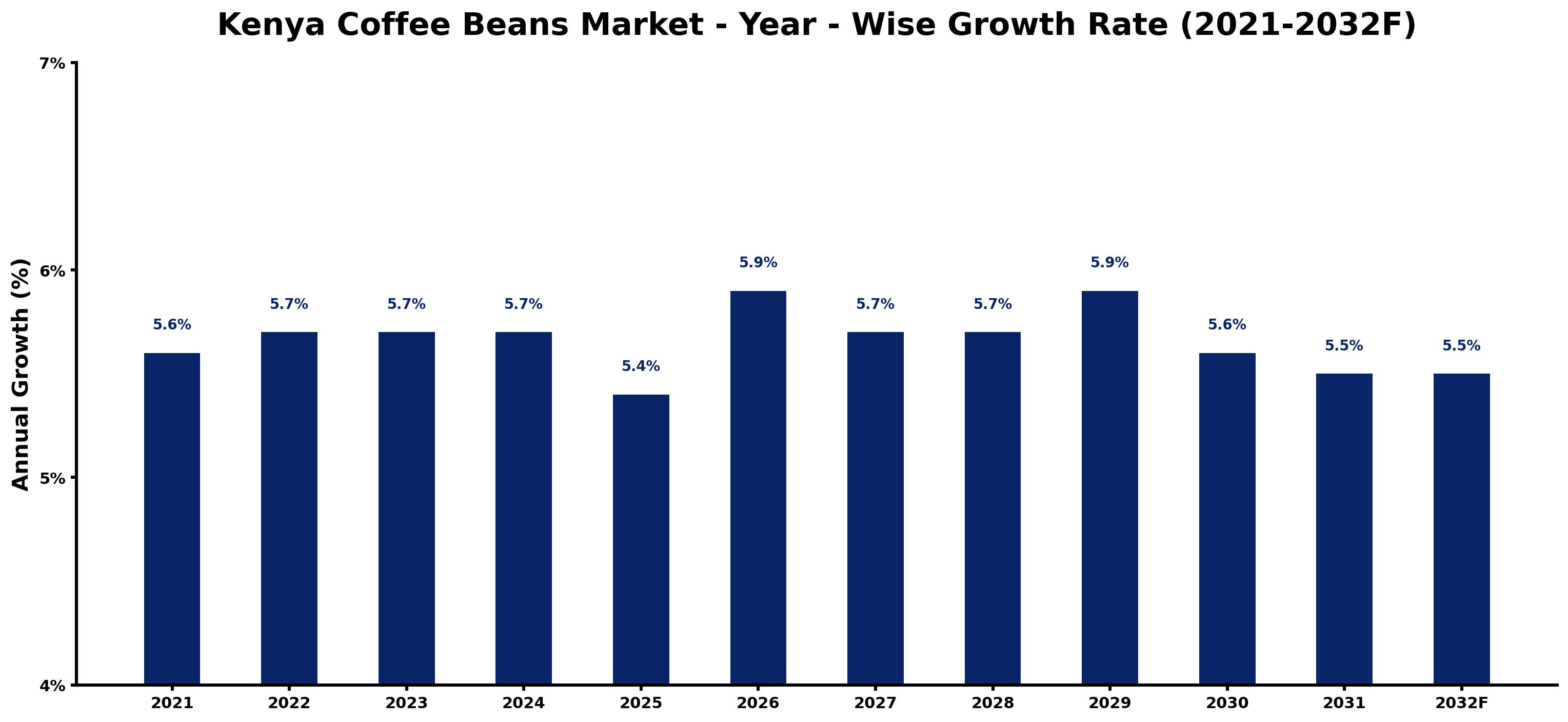
The table below presents the year wise growth rates along with the key drivers influencing the market
| Year | Growth Rate | Major Drivers |
| 2021 | 5.6% | Local farmers increasingly embraced sustainable practices for coffee cultivation. |
| 2022 | 5.7% | Private sector investments bolstered infrastructure for processing coffee beans effectively. |
| 2023 | 5.7% | Kenyan coffee brands gained popularity in international markets, boosting exports significantly. |
| 2024 | 5.7% | Emerging tech platforms connected farmers directly to consumers, enhancing profit margins. |
| 2025 | 5.4% | Increased awareness of specialty coffees attracted a new demographic of drinkers. |
| 2026 | 5.9% | Collaborations between cooperatives improved quality control in coffee production processes. |
| 2027 | 5.7% | E-commerce growth facilitated wider access to Kenyan coffee for global consumers. |
| 2028 | 5.7% | Expansion of local roasteries diversified product offerings and enhanced brand visibility. |
| 2029 | 5.9% | Increased climate resilience programs reduced risks associated with climate change effects. |
| 2030 | 5.6% | Local universities initiated research programs focused on coffee varieties and pest management. |
| 2031 | 5.5% | Cultural events highlighting coffee heritage attracted tourism, boosting local economies. |
| 2032 | 5.5% | Global trends toward ethical sourcing solidified Kenya's position as a premium coffee supplier. |
Note - Market size estimations and growth projections presented in this report are based on 6Wresearch's advanced forecasting approach, validated with industry datasets as of June 2026.
Kenya Coffee Beans Market Synopsis
The Kenya Coffee Beans Market is projected to reach 5.9% and witness significant growth during the forecast period (2026-2032). This growth is driven by various factors, notably the increasing global demand for specialty coffee. The unique flavor profile and quality of Kenyan coffee beans have garnered attention from emerging markets, particularly China and India, where coffee culture is rapidly evolving. Furthermore, growing disposable incomes in developing economies are enabling consumers to purchase premium-priced coffees, propelling the market forward.
Kenya Coffee Beans Market Growth Drivers
Several key factors are contributing to the dynamic growth of the Kenya Coffee Beans Market. The first major driver is the escalating global appetite for specialty coffee, which is distinguished by its unique and rich flavor. As consumers seek more distinctive coffee experiences, the popularity of Kenyan coffee beans continues to rise.
- The increasing popularity of coffee culture in emerging markets like China and India plays a significant role in driving demand for Kenyan coffee beans.
- As middle-class populations expand in developing countries, there is a corresponding increase in disposable income, allowing for greater consumption of premium coffee products.
- Technological advancements in processing and packaging are enhancing the quality and shelf life of Kenyan coffee, making it more attractive to consumers worldwide.
- Global trends towards sustainability and ethical sourcing are fostering a favorable environment for Kenyan coffee, which often aligns with these values.
- Export incentives provided by the Kenyan government support local farmers in accessing international markets, leading to improved revenues and market expansion.
Kenya Coffee Beans Market Trends and Opportunities
The Kenya Coffee Beans Market is positioned to see numerous trends and opportunities that can shape its future. The specialty coffee segment stands out as a key growth area, presenting exciting possibilities for stakeholders in the industry. Additionally, the rising trend of coffee consumption in non-traditional markets opens doors for new consumers.
- Collaboration between farmers and international coffee roasters is enhancing quality control, leading to a more consistent product in the global market.
- The growth of e-commerce platforms is facilitating direct-to-consumer sales, allowing Kenyan coffee farmers to reach broader audiences.
- Consumer preferences are shifting towards sustainably sourced coffee, creating avenues for brands emphasizing ethical practices in production.
- Innovative brewing methods and coffee experiences, such as cold brew and specialty blends, are attracting younger consumers seeking unique offerings.
- Market players are exploring value-added products, such as instant coffee and coffee-based beverages, tapping into convenience-focused consumer segments.
Kenya Coffee Beans Market Challenges and Restraints
Despite the promising growth trajectory, the Kenya Coffee Beans Market faces several challenges that could impact its development. Understanding these potential restraints is crucial for stakeholders aiming to navigate the market successfully.
- Climate change poses a significant threat to coffee farming, with unpredictable weather patterns affecting bean quality and yields.
- Fluctuations in global coffee prices can impact farmers' income, leading to uncertainty in investment and production decisions.
- The ongoing struggle with pests and diseases in coffee crops can disrupt supply and diminish quality, posing risks to market stability.
- Competition from other coffee-producing nations may pressure Kenya's market share, especially if those countries enhance their branding and marketing efforts.
- Operational challenges, including inadequate infrastructure and limited access to financing for farmers, can hinder the industry's growth potential.
Kenya Coffee Beans Market Government Investment and Initiatives
The Kenyan government remains committed to bolstering the agricultural sector, with particular emphasis on coffee production. Various initiatives aim to support farmers and promote exports, ensuring sustainable growth in the Kenya Coffee Beans Market.
- Government policies encouraging agricultural modernization and the adoption of new technologies are enhancing productivity and efficiency in coffee farming.
- Investment in research and development is facilitating the discovery of disease-resistant coffee varieties, helping to safeguard against crop failures.
- Collaboration with international organizations and NGOs fosters knowledge sharing, enabling farmers to adopt better practices and improve yield quality.
- Incentives aimed at promoting coffee exports have led to increased visibility for Kenyan coffee on the global stage, enhancing demand.
- Programs focused on training and supporting local coffee cooperatives empower farmers, ensuring they benefit from fair pricing and are integrated into international value chains.
Kenya Coffee Beans Market Latest Developments (May 2025 - June 2026)
During the period from May 2025 to June 2026, the Kenya Coffee Beans Market experienced notable developments that reflect the evolving landscape of the industry. These developments span various aspects, including technological advancements, market strategies, and consumer trends.
- Innovative processing technologies were introduced to enhance the quality of coffee beans, thus improving the market competitiveness of Kenyan coffee.
- Efforts to cultivate new coffee varieties that withstand climate-related challenges gained momentum, marking significant strides in agricultural resilience.
- Increased partnerships between local farmers and international brands contributed to improved market access and knowledge transfer.
- Promotional campaigns highlighting the unique characteristics of Kenyan coffee helped boost its profile in international markets.
- The rise of specialty coffee shops and cafés in urban areas further stimulated local consumption of Kenyan coffee, solidifying its status as a premium choice.
Kenya Coffee Beans Market - Key Attractiveness of the Report
- 10 Years of Market Numbers
- Historical Data Starting from 2022 to 2025
- Base Year: 2025
- Forecast Data until 2032
- Key Performance Indicators Impacting the Market
- Major Upcoming Developments and Projects
Key Highlights of the Report:
- Kenya Coffee Beans Market Outlook
- Market Size of Kenya Coffee Beans Market, 2025
- Forecast of Kenya Coffee Beans Market, 2032F
- Historical Data and Forecast of Kenya Coffee Beans Revenues & Volume for the Period 2022-2032F
- Kenya Coffee Beans Market Trend Evolution
- Kenya Coffee Beans Market Drivers and Challenges
- Kenya Coffee Beans Price Trends
- Kenya Coffee Beans Porter's Five Forces
- Kenya Coffee Beans Industry Life Cycle
- Historical Data and Forecast of Kenya Coffee Beans Market Revenues & Volume By Product Type for the Period 2022-2032F
- Historical Data and Forecast of Kenya Coffee Beans Market Revenues & Volume By Arabica for the Period 2022-2032F
- Historical Data and Forecast of Kenya Coffee Beans Market Revenues & Volume By Robusta for the Period 2022-2032F
- Historical Data and Forecast of Kenya Coffee Beans Market Revenues & Volume By Others for the Period 2022-2032F
- Historical Data and Forecast of Kenya Coffee Beans Market Revenues & Volume By Applications for the Period 2022-2032F
- Historical Data and Forecast of Kenya Coffee Beans Market Revenues & Volume By Personal Care for the Period 2022-2032F
- Historical Data and Forecast of Kenya Coffee Beans Market Revenues & Volume By Food for the Period 2022-2032F
- Historical Data and Forecast of Kenya Coffee Beans Market Revenues & Volume By Pharmaceutical for the Period 2022-2032F
- Kenya Coffee Beans Import Export Trade Statistics
- Market Opportunity Assessment By Product Type
- Market Opportunity Assessment By Applications
- Kenya Coffee Beans Top Companies Market Share
- Kenya Coffee Beans Competitive Benchmarking By Technical and Operational Parameters
- Kenya Coffee Beans Company Profiles
- Kenya Coffee Beans Key Strategic Recommendations






































