Kenya Cognitive Computing Market Size & Growth Rate (2026-2032)
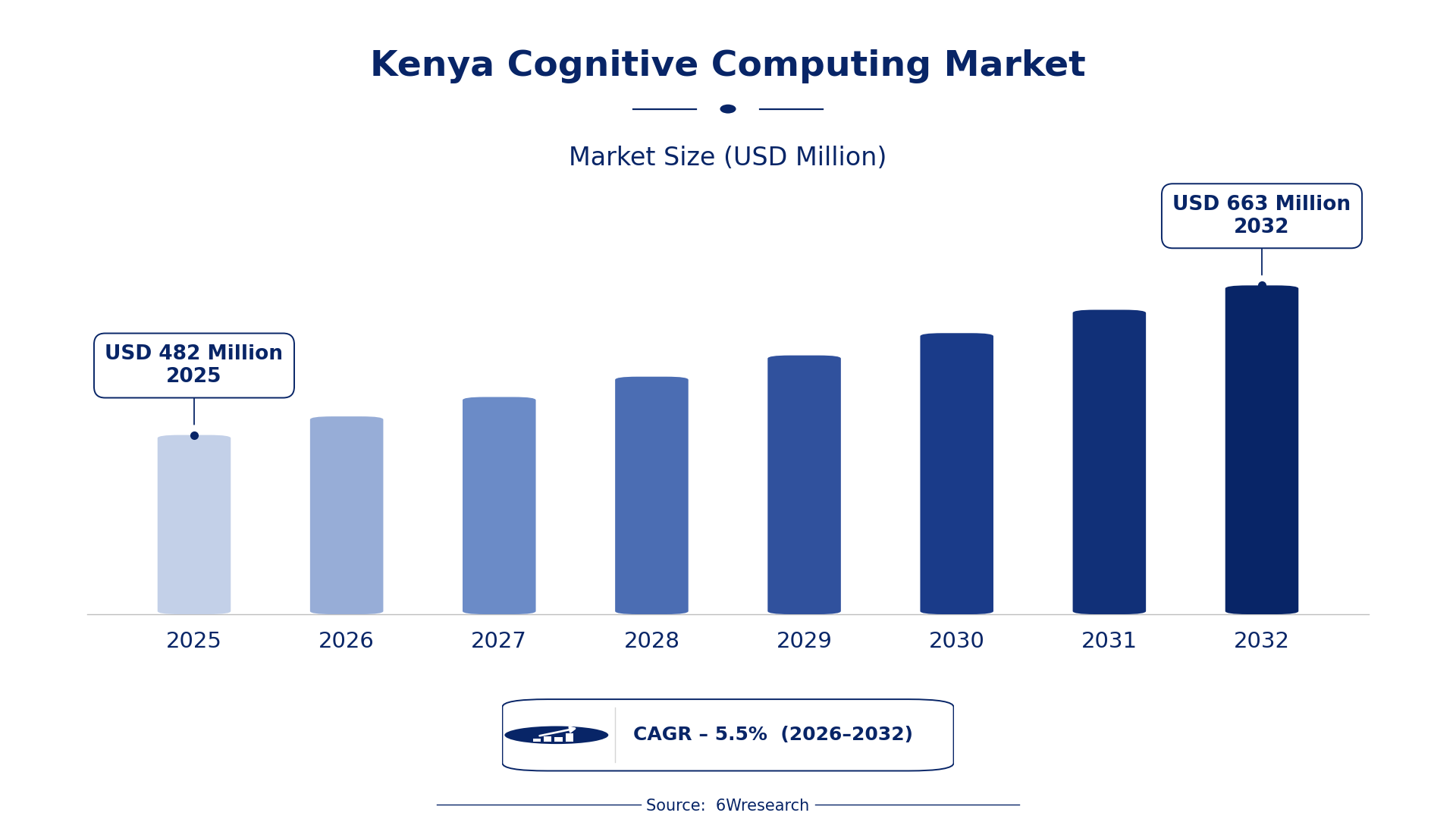
The Kenya Cognitive Computing Market was estimated at USD 482 Million in 2025 and is projected to reach USD 663 Million by 2032, growing at a CAGR of 5.5% from 2026 to 2032.
Kenya Cognitive Computing Market Synopsis
The demand for cognitive computing solutions in Kenya is escalating as businesses seek to enhance their operational efficiency through intelligent automation. This demand spans various sectors, including healthcare and finance, where the need for data-driven decision-making is critical.
Organizations in Kenya are increasingly adopting technologies such as natural language processing and machine learning to improve their customer service and predictive analytics capabilities. The ability of these cognitive systems to analyze vast amounts of data allows companies to offer personalized experiences, thereby driving further adoption.
Kenya Cognitive Computing Market Year-wise Growth Rate and Key Drivers
This graph illustrates the annual growth rates of the Kenya Cognitive Computing Market from 2021 to 2032, highlighting a steady upward trajectory and projected expansion over the forecast period.

The table below presents the year‑wise growth rates along with the key drivers influencing the market
| Year | Growth Rate | Major Drivers |
| 2021 | 5.8% | Increased government funding for AI innovation projects |
| 2022 | 5.2% | Rise in mobile internet penetration enhancing cognitive applications |
| 2023 | 5.6% | Adoption of AI in financial services supporting growth |
| 2024 | 5.2% | Local startups driving innovation in AI-driven healthcare solutions |
| 2025 | 5.5% | Emergence of AI-based platforms for talent management |
| 2026 | 5.5% | Growth in AI applications for wildlife conservation efforts |
| 2027 | 5.5% | Government's Vision 2030 promoting smart technology integration |
| 2028 | 5.8% | Surge in demand for personalized learning through AI |
| 2029 | 5.4% | Adoption of AI chatbots enhancing customer service experiences |
| 2030 | 5.2% | Integration of AI in government services increasing efficiency |
| 2031 | 5.6% | Collaboration with international firms boosting cognitive development |
| 2032 | 5.5% | Implementation of AI in transportation logistics optimizing operations |
Note: Market size estimations and growth projections presented in this report are based on 6Wresearch's proprietary forecasting methodology, utilizing the latest available industry data, government publications, and primary research inputs.
Kenya Cognitive Computing Market Key Takeaways
Below are some of the specific key takeaways from the market, including:
- The cognitive computing market is driven by the increasing need for intelligent automation across industries.
- Healthcare applications are among the largest adopters, focusing on diagnosis and predictive analytics.
- Natural language processing is a key technology enabling better customer interaction and service delivery.
- Challenges include infrastructure limitations and a shortage of skilled professionals in AI and machine learning.
- Government initiatives are shaping the market by promoting research and ethical use of technology.
Evaluation of Restraints in Kenya Cognitive Computing Market
Despite the potential for growth, the Kenya cognitive computing market faces several hurdles. Infrastructure limitations are significant, as many businesses lack access to the necessary high-performance computing facilities. This shortfall restricts their ability to implement advanced cognitive solutions effectively. on top of that, the dearth of skilled professionals proficient in algorithm development continues to hinder the market's progress, leaving organizations ill-equipped to maximize the benefits of cognitive computing.
Kenya Cognitive Computing Market Trends
Several trends are emerging in the Kenya cognitive computing market. A growing emphasis on explainable AI is becoming apparent, as organizations seek to ensure transparency in decision-making processes. Additionally, the integration of cognitive technologies with existing IT infrastructures is gaining traction, allowing for a smoother transition into intelligent systems. The rise of data privacy concerns is also prompting businesses to adopt ethical frameworks to govern their use of cognitive solutions.
Kenya Cognitive Computing Market Opportunities
Significant opportunities exist for investment in cognitive computing technologies in Kenya. The healthcare sector is ripe for innovation, with potential applications in diagnostics and patient care management. Financial services also present avenues for growth, particularly in fraud detection and risk assessment. on top of that, as businesses increasingly seek to personalize customer interactions, companies providing natural language processing solutions are well-positioned for success.
Government Initiatives in the Kenya Cognitive Computing Market
Government policy is crucial in shaping the Kenya cognitive computing market, as it creates an enabling environment for research and technological adoption. By implementing supportive regulations, the government can facilitate ethical practices and foster innovation. These initiatives aim to address the market's infrastructure and talent gaps, ensuring that Kenya remains competitive in the cognitive computing domain.
- A recently completed national digital infrastructure upgrade program aims to improve internet access, enhancing the foundation for cognitive computing applications.
- A current initiative focuses on promoting research and development in AI technologies through grants and funding for universities and tech startups.
- A planned public-private partnership seeks to establish training centers for developing skilled professionals in AI and machine learning by 2027.
- Ongoing regulatory efforts are addressing data privacy concerns, with a framework expected to be finalized by late 2026.
- A newly introduced technology adoption policy encourages organizations to invest in cognitive computing solutions, facilitating access to necessary resources.
Future Insights of the Kenya Cognitive Computing Market
Looking ahead to 2026-2032, the Kenya cognitive computing market is set for substantial expansion. As industries increasingly recognize the value of data-driven insights, the demand for cognitive systems will only intensify. With government initiatives focusing on infrastructure and skill development, the market is likely to attract more investments. Companies that adapt and innovate will find themselves at the forefront of this growing sector.
Kenya Cognitive Computing Market Latest Developments
Recent activity in the Kenya cognitive computing market has showcased a trend toward innovation and collaboration. Over the past year, various initiatives have emerged, reflecting the sector's growth potential and the commitment of organizations to harness cognitive technologies.
- A leading technology vendor launched a new cognitive analytics platform in Q1 2025, aimed at improving predictive capabilities for businesses in finance.
- An initiative that began in mid-2025 and remains underway focuses on integrating AI-driven customer service tools in retail, enhancing customer engagement.
- A major regional operator announced plans in late 2025 for a comprehensive rollout of machine learning solutions tailored for the healthcare sector.
- By early 2026, a consortium of universities and tech companies will kick off a collaborative research project to develop ethical AI frameworks.
- A technology summit scheduled for Q3 2026 will showcase innovations in cognitive computing and foster networking among stakeholders in the industry.
Kenya Cognitive Computing Market - Key Attractiveness of the Report
- 10 Years of Market Numbers
- Historical Data Starting from 2022 to 2025
- Base Year: 2025
- Forecast Data until 2032
- Key Performance Indicators Impacting the Market
- Major Upcoming Developments and Projects
Key Highlights of the Report:
- Kenya Cognitive Computing Market Outlook
- Market Size of Kenya Cognitive Computing Market, 2025
- Forecast of Kenya Cognitive Computing Market, 2032
- Historical Data and Forecast of Kenya Cognitive Computing Revenues & Volume for the Period 2022-2032F
- Kenya Cognitive Computing Market Trend Evolution
- Kenya Cognitive Computing Market Drivers and Challenges
- Kenya Cognitive Computing Price Trends
- Kenya Cognitive Computing Porter's Five Forces
- Kenya Cognitive Computing Industry Life Cycle
- Historical Data and Forecast of Kenya Cognitive Computing Market Revenues & Volume By Application for the Period 2022-2032F
- Historical Data and Forecast of Kenya Cognitive Computing Market Revenues & Volume By IVA for the Period 2022-2032F
- Historical Data and Forecast of Kenya Cognitive Computing Market Revenues & Volume By Chatbot for the Period 2022-2032F
- Historical Data and Forecast of Kenya Cognitive Computing Market Revenues & Volume By Behavioral Analysis for the Period 2022-2032F
- Historical Data and Forecast of Kenya Cognitive Computing Market Revenues & Volume By Component for the Period 2022-2032F
- Historical Data and Forecast of Kenya Cognitive Computing Market Revenues & Volume By Platform for the Period 2022-2032F
- Historical Data and Forecast of Kenya Cognitive Computing Market Revenues & Volume By Service for the Period 2022-2032F
- Historical Data and Forecast of Kenya Cognitive Computing Market Revenues & Volume By Technology for the Period 2022-2032F
- Historical Data and Forecast of Kenya Cognitive Computing Market Revenues & Volume By Machine Learning (ML) for the Period 2022-2032F
- Historical Data and Forecast of Kenya Cognitive Computing Market Revenues & Volume By Human Computer Interaction for the Period 2022-2032F
- Historical Data and Forecast of Kenya Cognitive Computing Market Revenues & Volume By Natural Language Processing (NLP) for the Period 2022-2032F
- Historical Data and Forecast of Kenya Cognitive Computing Market Revenues & Volume By Deep Learning for the Period 2022-2032F
- Historical Data and Forecast of Kenya Cognitive Computing Market Revenues & Volume By Application for the Period 2022-2032F
- Historical Data and Forecast of Kenya Cognitive Computing Market Revenues & Volume By Automation for the Period 2022-2032F
- Historical Data and Forecast of Kenya Cognitive Computing Market Revenues & Volume By Intelligent Virtual Assistants for the Period 2022-2032F
- Historical Data and Forecast of Kenya Cognitive Computing Market Revenues & Volume By Behavioral Analysis for the Period 2022-2032F
- Historical Data and Forecast of Kenya Cognitive Computing Market Revenues & Volume By Biometrics for the Period 2022-2032F
- Historical Data and Forecast of Kenya Cognitive Computing Market Revenues & Volume By Others for the Period 2022-2032F
- Historical Data and Forecast of Kenya Cognitive Computing Market Revenues & Volume By Deployment Mode for the Period 2022-2032F
- Historical Data and Forecast of Kenya Cognitive Computing Market Revenues & Volume By On-premise for the Period 2022-2032F
- Historical Data and Forecast of Kenya Cognitive Computing Market Revenues & Volume By Cloud for the Period 2022-2032F
- Historical Data and Forecast of Kenya Cognitive Computing Market Revenues & Volume By Hybrid for the Period 2022-2032F
- Historical Data and Forecast of Kenya Cognitive Computing Market Revenues & Volume By Organization Size for the Period 2022-2032F
- Historical Data and Forecast of Kenya Cognitive Computing Market Revenues & Volume By Large Enterprises for the Period 2022-2032F
- Historical Data and Forecast of Kenya Cognitive Computing Market Revenues & Volume By Small and Medium-Sized Enterprises (SMEs) for the Period 2022-2032F
- Historical Data and Forecast of Kenya Cognitive Computing Market Revenues & Volume By Business Functions for the Period 2022-2032F
- Historical Data and Forecast of Kenya Cognitive Computing Market Revenues & Volume By Human Resources (HR) for the Period 2022-2032F
- Historical Data and Forecast of Kenya Cognitive Computing Market Revenues & Volume By Legal for the Period 2022-2032F
- Historical Data and Forecast of Kenya Cognitive Computing Market Revenues & Volume By Finance for the Period 2022-2032F
- Historical Data and Forecast of Kenya Cognitive Computing Market Revenues & Volume By Marketing and Advertising for the Period 2022-2032F
- Historical Data and Forecast of Kenya Cognitive Computing Market Revenues & Volume By Industry Vertical for the Period 2022-2032F
- Historical Data and Forecast of Kenya Cognitive Computing Market Revenues & Volume By BFSI for the Period 2022-2032F
- Historical Data and Forecast of Kenya Cognitive Computing Market Revenues & Volume By Retail and eCommerce for the Period 2022-2032F
- Historical Data and Forecast of Kenya Cognitive Computing Market Revenues & Volume By Telecommunication and IT for the Period 2022-2032F
- Historical Data and Forecast of Kenya Cognitive Computing Market Revenues & Volume By Healthcare and Life Sciences for the Period 2022-2032F
- Historical Data and Forecast of Kenya Cognitive Computing Market Revenues & Volume By Manufacturing for the Period 2022-2032F
- Historical Data and Forecast of Kenya Cognitive Computing Market Revenues & Volume By Government and Defense for the Period 2022-2032F
- Historical Data and Forecast of Kenya Cognitive Computing Market Revenues & Volume By Media and Entertainment for the Period 2022-2032F
- Historical Data and Forecast of Kenya Cognitive Computing Market Revenues & Volume By Travel and Hospitality for the Period 2022-2032F
- Kenya Cognitive Computing Import Export Trade Statistics
- Market Opportunity Assessment By Application
- Market Opportunity Assessment By Component
- Market Opportunity Assessment By Technology
- Market Opportunity Assessment By Application
- Market Opportunity Assessment By Deployment Mode
- Market Opportunity Assessment By Organization Size
- Market Opportunity Assessment By Business Functions
- Market Opportunity Assessment By Industry Vertical
- Kenya Cognitive Computing Top Companies Market Share
- Kenya Cognitive Computing Competitive Benchmarking By Technical and Operational Parameters
- Kenya Cognitive Computing Company Profiles
- Kenya Cognitive Computing Key Strategic Recommendations






































