Kenya Cold Chain Market Size, Share & Growth Rate
The Kenya Cold Chain Market was estimated at USD 1495 Million in 2025 and is projected to reach USD 2591 Million by 2032, growing at a CAGR of 8.2% from 2026 to 2032. This substantial growth trajectory is primarily fueled by the rising demand for temperature-sensitive products, particularly in the food and pharmaceutical sectors. As consumer awareness around food safety and quality continues to rise, businesses are increasingly prioritizing investments in cold storage and refrigerated transport solutions to meet market expectations.
Kenya Cold Chain Market Year-wise Growth Rate and Key Drivers
This graph highlights how the Kenya Cold Chain Market has steadily grown over the years, supported by major growth factors.
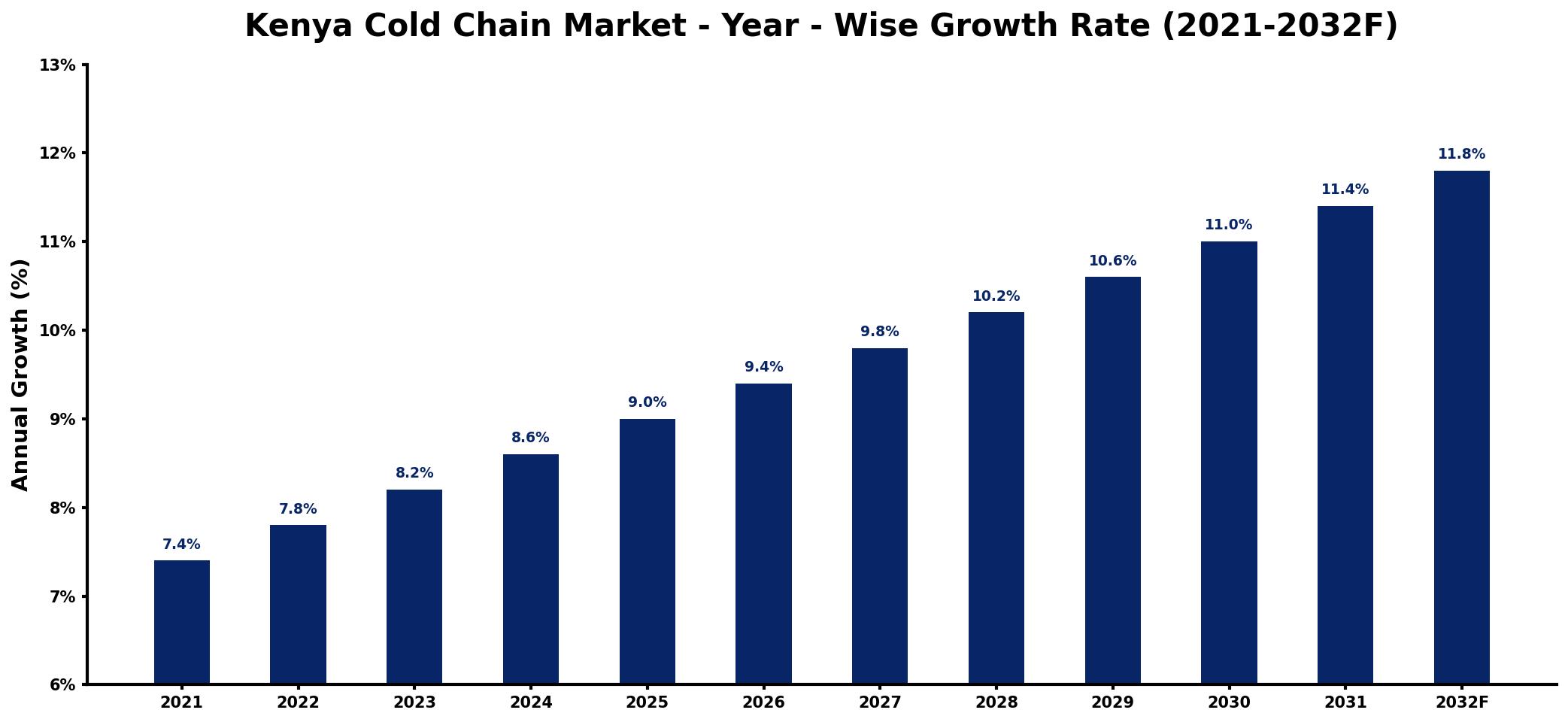
The table below presents the year‑wise growth rates along with the key drivers influencing the market
| Year | Growth Rate | Major Drivers |
| 2021 | 7.4% | Increased demand for perishable goods |
| 2022 | 7.8% | Rising investment in logistics infrastructure |
| 2023 | 8.2% | Growth in food export markets |
| 2024 | 8.6% | Expansion of retail distribution networks |
| 2025 | 9.0% | Technological advancements in preservation |
| 2026 | 9.4% | Higher consumer awareness on quality |
| 2027 | 9.8% | Rise in e-commerce food sales |
| 2028 | 10.2% | Government incentives for food safety |
| 2029 | 10.6% | Partnerships with international suppliers |
| 2030 | 11.0% | Increased urbanization and population growth |
| 2031 | 11.4% | Focus on sustainable food practices |
| 2032 | 11.8% | Emergence of new market players |
Note: Market size estimations and growth projections presented in this report are based on 6Wresearch's proprietary forecasting methodology, utilizing the latest available industry data, government publications, and primary research inputs.
Kenya Cold Chain Market Synopsis
The Kenya Cold Chain Market is currently witnessing a robust transformation, driven by advancements in logistics and a surge in demand for fresh and perishable products. With a significant portion of the agricultural output reliant on efficient cold chain systems, the need for reliable refrigeration methods is becoming more critical.
In recent years, investments in cold chain infrastructure have gained momentum, reflecting a commitment to improving the integrity of products throughout the supply chain. As the market expands, businesses are increasingly focusing on integrating technology, such as IoT systems, to enhance temperature monitoring and ensure compliance with safety standards.
Kenya Cold Chain Market Key Takeaways
- The cold chain sector is vital for preserving the quality of perishable goods, with rising demand across agriculture and healthcare.
- Government initiatives are fostering the development of cold chain facilities, helping to mitigate post-harvest losses.
- Technological advancements, particularly in IoT and monitoring systems, are reshaping operations in the cold chain landscape.
- Investment opportunities abound in logistics, refrigeration, and transportation services tailored to temperature-sensitive products.
- Challenges such as infrastructure inadequacies and high operational costs need addressing to unlock the market's full potential.
Evaluation of Restraints in Kenya Cold Chain Market
Despite the promising growth outlook for the Kenya Cold Chain Market, significant constraints hinder its potential. Key issues include a lack of adequate infrastructure, which results in inefficiencies across the supply chain. Inconsistent electricity supply poses a major risk, as temperature fluctuations can jeopardize product safety. Moreover, high energy costs and limited access to financing for cold chain investments further exacerbate the situation. The industry also grapples with a shortage of skilled workforce, which complicates the adoption of advanced technologies necessary for effective operation. These challenges collectively lead to food wastage and diminished product quality, underscoring the critical need for strategic intervention.
Kenya Cold Chain Market Trends
Several key trends are shaping the Kenya Cold Chain Market. The increasing adoption of IoT-enabled monitoring systems facilitates real-time tracking of temperature-sensitive products, enhancing safety and compliance. Additionally, there is a noticeable shift towards automated cold storage solutions, which not only improve efficiency but also reduce operational risks. Furthermore, the ongoing emphasis on sustainability is driving investments in energy-efficient refrigeration technologies. The COVID-19 pandemic has also accelerated the need for robust cold chain logistics to support the distribution of vaccines, amplifying the market's significance.
Kenya Cold Chain Market Opportunities
The Kenya Cold Chain Market offers substantial investment opportunities. With the agricultural sector continuing to thrive, there is a growing necessity for enhanced cold storage and transportation solutions. Investors can capitalize on the trend toward modernizing cold chain infrastructure, particularly in rural areas, which often lack adequate facilities. Additionally, technology providers focusing on cold chain logistics stand to benefit from increasing demand for advanced monitoring systems and data analytics services. Collaborations with local producers could also yield comprehensive end-to-end cold chain solutions, fostering better resource management and product distribution.
Government Initiatives in the Kenya Cold Chain Market
The Kenyan government has implemented several initiatives aimed at bolstering the cold chain sector. Policies such as the National Cold Chain Policy are designed to enhance the efficiency of cold chain systems, particularly for food products. Regulatory frameworks governing the storage and transport of perishables are in place to ensure quality standards are met. Furthermore, the establishment of cold storage facilities and targeted training programs for industry stakeholders are helping to create a more skilled workforce, essential for the development of a robust cold chain infrastructure.
Future Insights of the Kenya Cold Chain Market
Looking ahead to 2026-2032, the Kenya Cold Chain Market is set to experience notable expansion. Factors driving this growth include the increasing consumer demand for high-quality and safe food products, coupled with advancements in cold chain technologies. As the food and beverage industry continues to evolve, businesses will prioritize maintaining product integrity throughout the supply chain. Government initiatives aimed at improving logistics infrastructure will further support market development, paving the way for innovations that enhance efficiency and reduce wastage in the sector.
Kenya Cold Chain Market Latest Developments (2025 - 2026)
In the recent months leading to mid-2026, the Kenya Cold Chain Market has seen increased activity in infrastructure development, with several projects aimed at expanding cold storage facilities underway. The integration of advanced technology into logistics operations is becoming more prevalent, with businesses investing in automated systems for better efficiency. The focus on sustainability has also been heightened, with new initiatives promoting energy-efficient cold chain practices. Moreover, public-private partnerships are emerging as crucial collaborations to address the challenges faced within the sector.
Kenya Cold Chain Market - Key Attractiveness of the Report
- 10 Years of Market Numbers
- Historical Data Starting from 2022 to 2025
- Base Year: 2025
- Forecast Data until 2032
- Key Performance Indicators Impacting the Market
- Major Upcoming Developments and Projects
Key Highlights of the Report:
- Kenya Cold Chain Market Outlook
- Market Size of Kenya Cold Chain Market, 2025
- Forecast of Kenya Cold Chain Market, 2032
- Historical Data and Forecast of Kenya Cold Chain Revenues & Volume for the Period 2022-2032F
- Kenya Cold Chain Market Trend Evolution
- Kenya Cold Chain Market Drivers and Challenges
- Kenya Cold Chain Price Trends
- Kenya Cold Chain Porter's Five Forces
- Kenya Cold Chain Industry Life Cycle
- Historical Data and Forecast of Kenya Cold Chain Market Revenues & Volume By Temperature Type for the Period 2022-2032F
- Historical Data and Forecast of Kenya Cold Chain Market Revenues & Volume By Frozen for the Period 2022-2032F
- Historical Data and Forecast of Kenya Cold Chain Market Revenues & Volume By Chilled for the Period 2022-2032F
- Historical Data and Forecast of Kenya Cold Chain Market Revenues & Volume By Type for the Period 2022-2032F
- Historical Data and Forecast of Kenya Cold Chain Market Revenues & Volume By Refrigerated warehousing for the Period 2022-2032F
- Historical Data and Forecast of Kenya Cold Chain Market Revenues & Volume By Refrigerated transport for the Period 2022-2032F
- Historical Data and Forecast of Kenya Cold Chain Market Revenues & Volume By Application for the Period 2022-2032F
- Historical Data and Forecast of Kenya Cold Chain Market Revenues & Volume By Dairy & frozen desserts for the Period 2022-2032F
- Historical Data and Forecast of Kenya Cold Chain Market Revenues & Volume By Fish, meat, and seafood products for the Period 2022-2032F
- Historical Data and Forecast of Kenya Cold Chain Market Revenues & Volume By Bakery & confectionery products for the Period 2022-2032F
- Historical Data and Forecast of Kenya Cold Chain Market Revenues & Volume By Fruits & vegetables for the Period 2022-2032F
- Historical Data and Forecast of Kenya Cold Chain Market Revenues & Volume By Others for the Period 2022-2032F
- Kenya Cold Chain Import Export Trade Statistics
- Market Opportunity Assessment By Temperature Type
- Market Opportunity Assessment By Type
- Market Opportunity Assessment By Application
- Kenya Cold Chain Top Companies Market Share
- Kenya Cold Chain Competitive Benchmarking By Technical and Operational Parameters
- Kenya Cold Chain Company Profiles
- Kenya Cold Chain Key Strategic Recommendations






































