Kenya Container Security Market Size & Growth Rate (2026-2032)
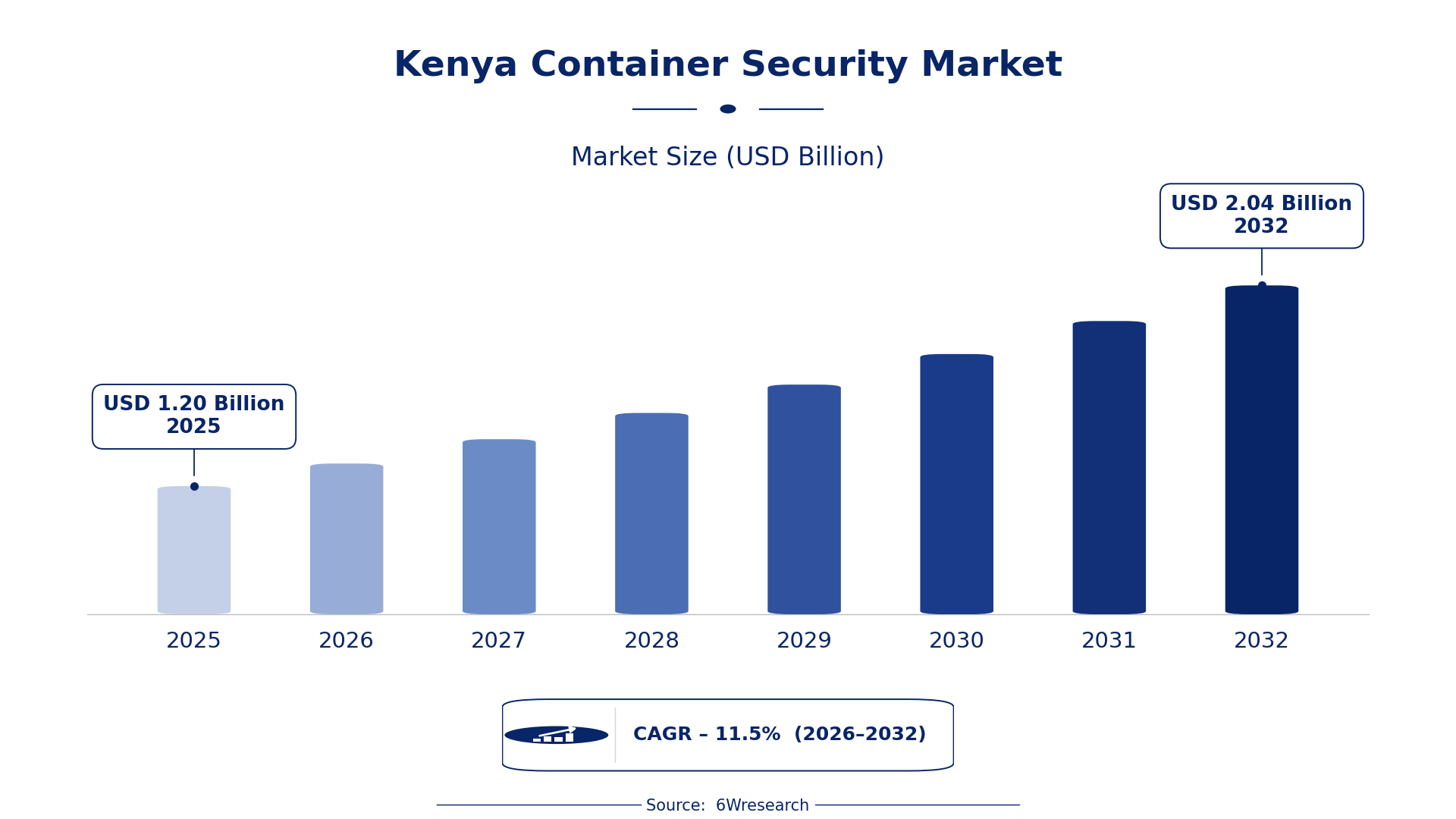
The Kenya Container Security Market was estimated at USD 1196 Million in 2025 and is projected to reach USD 2039 Million by 2032, growing at a CAGR of 11.5% from 2026 to 2032.
Kenya Container Security Market Synopsis
The rapid adoption of containerized applications among businesses in Kenya has intensified the focus on container security. Companies are increasingly realizing that safeguarding these environments against cyber threats is not just an option but a necessity to protect sensitive data and maintain regulatory compliance.
As organizations embrace DevSecOps practices, the demand for container security solutions has surged. Tools that provide vulnerability scanning, runtime protection, and access control are becoming essential in safeguarding containerized workloads against evolving cyber threats. This trend is expected to catalyze significant growth in the market over the coming years.
Kenya Container Security Market Year-wise Growth Rate and Key Drivers
This graph illustrates the annual growth rates of the Kenya Container Security Market from 2021 to 2032, highlighting a steady upward trajectory and projected expansion over the forecast period.
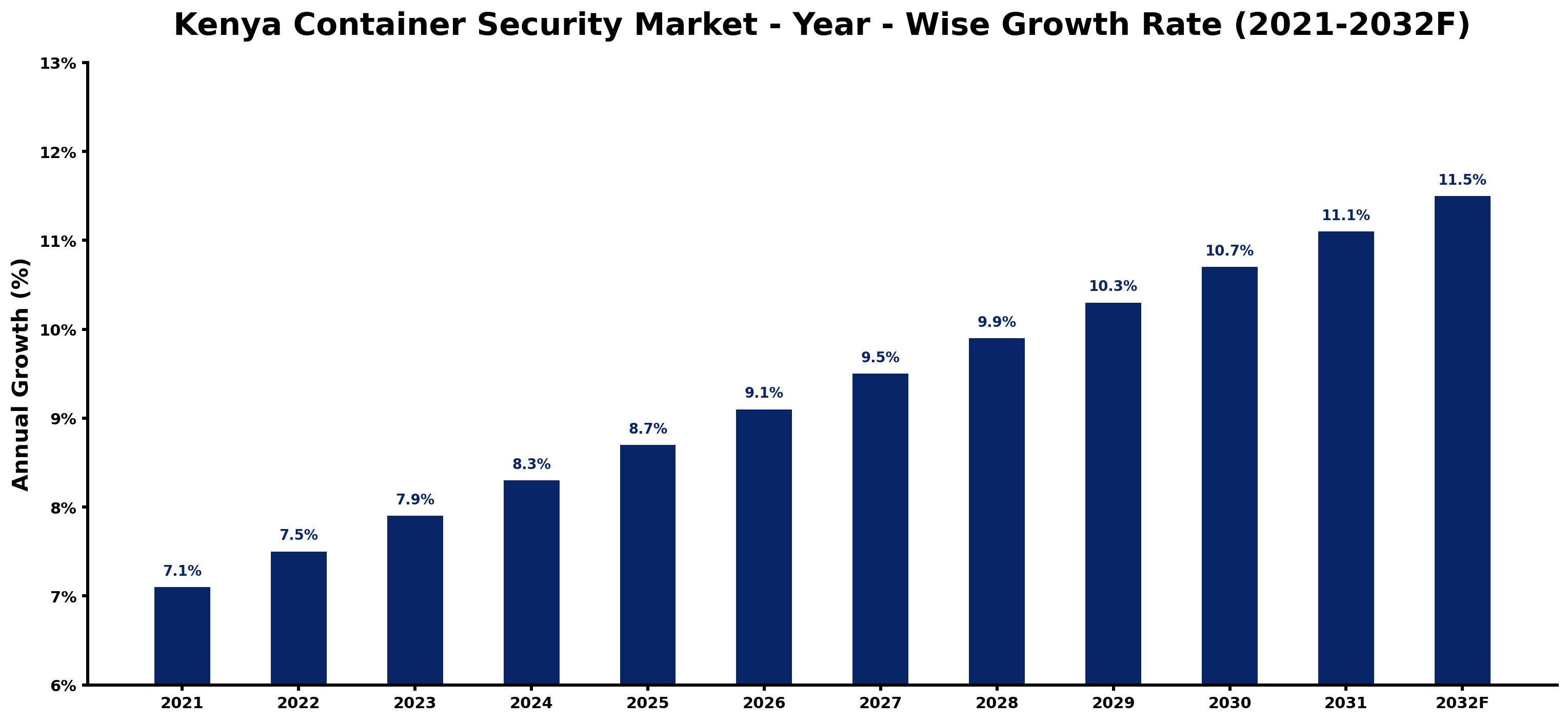
The table below presents the year‑wise growth rates along with the key drivers influencing the market
| Year | Growth Rate | Major Drivers |
| 2021 | 7.1% | Implementation of Kenya's National Logistics Strategy improvements. |
| 2022 | 7.5% | Increased cargo theft incidents prompting stronger security measures. |
| 2023 | 7.9% | Adoption of biometric access controls at shipping facilities. |
| 2024 | 8.3% | Enhanced partnerships between KPA and international security firms. |
| 2025 | 8.7% | Increased trade with neighboring countries boosting security needs. |
| 2026 | 9.1% | Growing e-commerce demands for secure container handling solutions. |
| 2027 | 9.5% | Government regulations mandating real-time container tracking systems. |
| 2028 | 9.9% | Technological advancements in RFID sensors for container security. |
| 2029 | 10.3% | Rising awareness of supply chain vulnerabilities in Kenya. |
| 2030 | 10.7% | Public-private collaborations enhancing overall logistics security frameworks. |
| 2031 | 11.1% | Increased foreign investment in Kenya's logistics security infrastructure. |
| 2032 | 11.5% | Emergence of regional security standards influencing container protocols. |
Note: Market size estimations and growth projections presented in this report are based on 6Wresearch's proprietary forecasting methodology, utilizing the latest available industry data, government publications, and primary research inputs.
Kenya Container Security Market Key Takeaways
Below are some of the specific key takeaways from the market, including:
- Increasing awareness among enterprises about the importance of container security solutions.
- Adoption of DevSecOps practices is driving market growth.
- Infrastructure constraints present challenges in deploying security solutions effectively.
- Small businesses face affordability issues when investing in security technologies.
- Government policies are evolving to enhance the security of containerized trade.
Evaluation of Restraints in Kenya Container Security Market
Despite the positive growth trajectory, several restraints hinder the Kenya Container Security Market. A primary issue is the limited awareness regarding container vulnerabilities, which hampers adoption rates. Many organizations, especially small to medium enterprises, struggle with the high costs associated with security solutions. Infrastructure limitations further complicate the deployment of these tools, making it difficult for businesses to implement effective security measures.
Kenya Container Security Market Trends
Key trends influencing the Kenya Container Security Market include the rising integration of AI-driven analytics for threat detection and response. Companies are also focusing on automated security solutions that streamline vulnerability management. As cloud-native architectures gain traction, demand for tailored security frameworks will become crucial. on top of that, partnerships between tech firms and government agencies are expected to facilitate better security protocols.
Kenya Container Security Market Opportunities
There are noteworthy opportunities for growth in this market. Increased investment in digital infrastructure will likely enhance the capabilities of security solutions. Additionally, businesses that can offer cost-effective security technologies tailored for smaller enterprises may find a lucrative niche. International collaboration to enhance standards and best practices presents another avenue for potential growth, fostering a safer environment for containerized applications.
Government Initiatives in the Kenya Container Security Market
Government initiatives are increasingly shaping the Kenya Container Security Market, emphasizing the regulation of cargo security and compliance measures. As the government recognizes the importance of protecting trade integrity, policies are being crafted to enhance security protocols across logistics hubs. This regulatory focus is vital for attracting investments in security technologies and practices.
- A recent initiative launched in late 2025 aimed to standardize cargo screening processes at major ports.
- A current program is underway to upgrade security infrastructure in key logistics hubs, enhancing threat detection capabilities.
- Planned regulations for 2027 aim to mandate comprehensive security audits for all container operations.
- The government is collaborating with international partners to implement joint security exercises aimed at combating smuggling.
- Ongoing workshops focus on raising awareness among businesses about container security vulnerabilities and solutions.
Future Insights of the Kenya Container Security Market
Looking ahead to 2026-2032, the Kenya Container Security Market is set for remarkable evolution. As the digital transformation accelerates, organizations will increasingly prioritize robust security protocols for their container environments. Emerging technologies such as machine learning and AI will play pivotal roles in shaping the future of threat detection and management, ensuring that businesses can maintain compliance while safeguarding their assets against growing cyber threats.
Kenya Container Security Market Latest Developments
In the past 12-14 months, the Kenya Container Security Market has witnessed a surge in activity, highlighting a growing recognition of the need for enhanced security measures. Organizations are actively seeking advanced solutions to counteract increasing cyber threats, while the government is intensifying efforts to improve regulatory frameworks. This momentum is expected to spur further investments in security technologies.
- A leading regional operator announced a rollout of advanced container security software in Q3 2025, enhancing their existing security measures.
- In early 2025, a major technology vendor completed a partnership with local companies to provide affordable security solutions tailored for small enterprises.
- An initiative began in mid-2025 to introduce cybersecurity training programs for logistics personnel, enhancing awareness of container vulnerabilities.
- A rollout expected to begin in late 2026 aims to integrate biometric access controls at ports to bolster security measures.
- In early 2025, a new cloud-based security monitoring system was launched, allowing real-time threat detection for containerized applications.
Kenya Container Security Market - Key Attractiveness of the Report
- 10 Years of Market Numbers
- Historical Data Starting from 2022 to 2025
- Base Year: 2025
- Forecast Data until 2032
- Key Performance Indicators Impacting the Market
- Major Upcoming Developments and Projects
Key Highlights of the Report:
- Kenya Container Security Market Outlook
- Market Size of Kenya Container Security Market, 2025
- Forecast of Kenya Container Security Market, 2032
- Historical Data and Forecast of Kenya Container Security Revenues & Volume for the Period 2022-2032F
- Kenya Container Security Market Trend Evolution
- Kenya Container Security Market Drivers and Challenges
- Kenya Container Security Price Trends
- Kenya Container Security Porter's Five Forces
- Kenya Container Security Industry Life Cycle
- Historical Data and Forecast of Kenya Container Security Market Revenues & Volume By Component for the Period 2022-2032F
- Historical Data and Forecast of Kenya Container Security Market Revenues & Volume By Container Security Products for the Period 2022-2032F
- Historical Data and Forecast of Kenya Container Security Market Revenues & Volume By Services (Professional, Managed) for the Period 2022-2032F
- Historical Data and Forecast of Kenya Container Security Market Revenues & Volume By Deployment Type for the Period 2022-2032F
- Historical Data and Forecast of Kenya Container Security Market Revenues & Volume By Cloud for the Period 2022-2032F
- Historical Data and Forecast of Kenya Container Security Market Revenues & Volume By On-premises for the Period 2022-2032F
- Historical Data and Forecast of Kenya Container Security Market Revenues & Volume By Vertical for the Period 2022-2032F
- Historical Data and Forecast of Kenya Container Security Market Revenues & Volume By BFSI for the Period 2022-2032F
- Historical Data and Forecast of Kenya Container Security Market Revenues & Volume By Retail for the Period 2022-2032F
- Historical Data and Forecast of Kenya Container Security Market Revenues & Volume By Government for the Period 2022-2032F
- Historical Data and Forecast of Kenya Container Security Market Revenues & Volume By Healthcare for the Period 2022-2032F
- Kenya Container Security Import Export Trade Statistics
- Market Opportunity Assessment By Component
- Market Opportunity Assessment By Deployment Type
- Market Opportunity Assessment By Vertical
- Kenya Container Security Top Companies Market Share
- Kenya Container Security Competitive Benchmarking By Technical and Operational Parameters
- Kenya Container Security Company Profiles
- Kenya Container Security Key Strategic Recommendations






































