Kenya Dimension Stone Market Size, Share & Growth Rate
The Kenya Dimension Stone Market was estimated at USD 1030 Million in 2025 and is projected to reach USD 1465 Million by 2032, growing at a CAGR of 5.2% from 2026 to 2032. This robust growth is largely driven by the burgeoning construction sector and the rising demand for high-quality, aesthetically appealing materials among homeowners and developers. Furthermore, as urbanization accelerates and the middle class expands, the preference for durable and sustainable building materials like granite and marble continues to rise.
Kenya Dimension Stone Market Year-wise Growth Rate and Key Drivers
This graph highlights how the Kenya Dimension Stone Market has steadily grown over the years, supported by major growth factors.
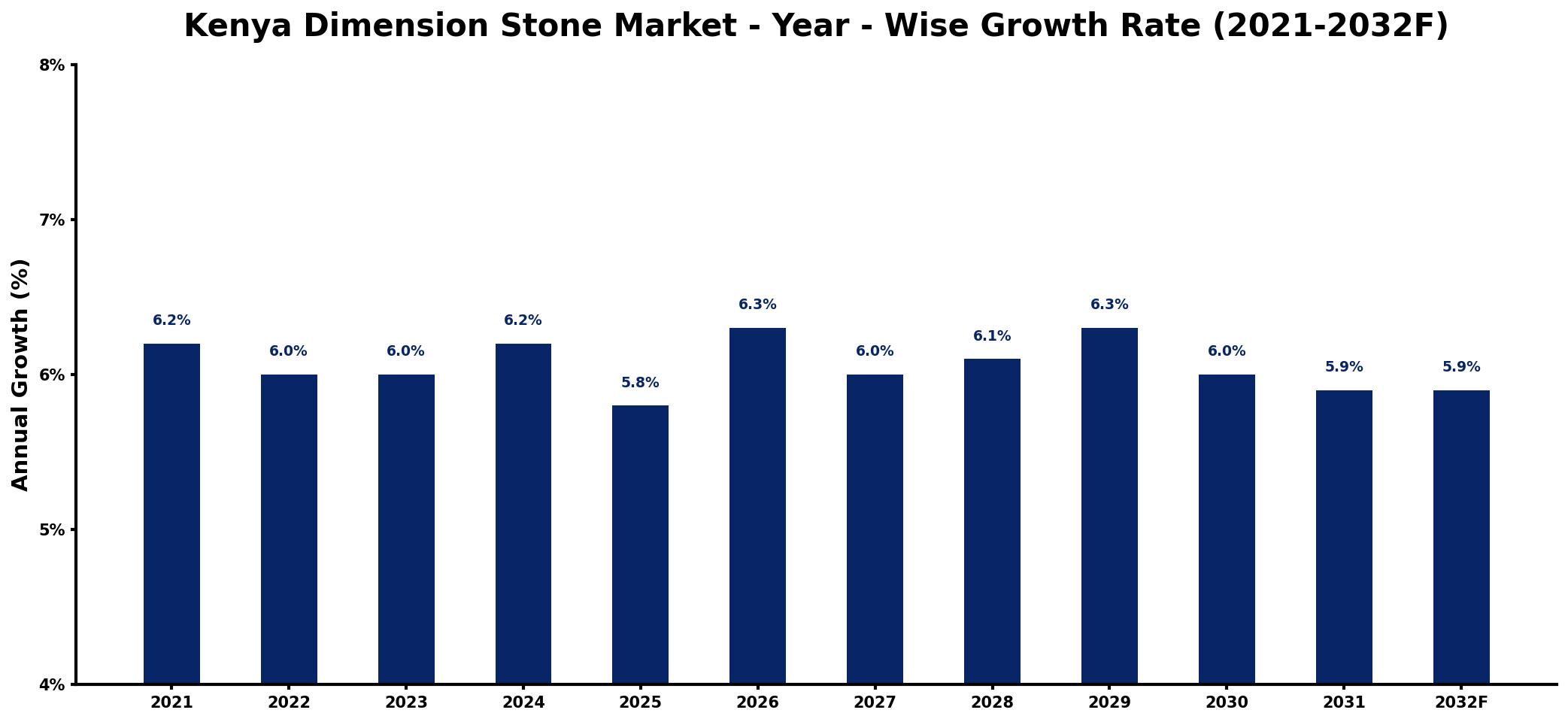
The table below presents the year‑wise growth rates along with the key drivers influencing the market
| Year | Growth Rate | Major Drivers |
| 2021 | 6.2% | Increased infrastructure development projects |
| 2022 | 6.0% | Growing residential construction demand |
| 2023 | 6.0% | Rising investment in commercial properties |
| 2024 | 6.2% | enhanced product quality standards |
| 2025 | 5.8% | Strengthened urbanization initiatives nationwide |
| 2026 | 6.3% | Surge in public sector projects |
| 2027 | 6.0% | Increased exports to regional markets |
| 2028 | 6.1% | Boost in renewable energy installations |
| 2029 | 6.3% | Growing interest in sustainable architecture |
| 2030 | 6.0% | Rising urban redevelopment initiatives |
| 2031 | 5.9% | Increased foreign investment opportunities |
| 2032 | 5.9% | Strengthened local manufacturing capabilities |
Note: Market size estimations and growth projections presented in this report are based on 6Wresearch's proprietary forecasting methodology, utilizing the latest available industry data, government publications, and primary research inputs.
Kenya Dimension Stone Market Synopsis
The most significant force shaping the Kenya Dimension Stone Market today is the rapid urbanization, which is fostering a strong demand for premium construction materials. With infrastructural projects on the rise, the spotlight is on locally sourced stones such as Kenyan Black Marble and Kenya Green Granite, which are not only durable but also contribute to an aesthetic identity in building projects.
Local quarries are increasingly catering to both the domestic and export markets, underlining the competitiveness of the sector. However, challenges related to extraction costs and the need for advanced processing facilities remain, necessitating innovation and investment to maximize the market's potential.
Kenya Dimension Stone Market Key Takeaways
- The market is characterized by a notable increase in demand for sustainable and locally sourced dimension stones.
- Infrastructural development and urbanization continue to drive the need for high-quality materials in construction projects.
- Investment opportunities are expanding, particularly in the mining and processing sectors to meet the growing demand.
- Environmental sustainability is becoming a focal point, leading to the adoption of eco-friendly mining practices.
- Government regulations are increasingly supportive of local processing to boost economic growth and job creation.
Evaluation of Restraints in Kenya Dimension Stone Market
Despite its promising growth, the Kenya Dimension Stone Market faces several restraints that could impede its progress. The limited access to modern mining technologies hampers efficient extraction processes, leading to increased operational costs. Furthermore, the inadequate infrastructure, particularly in transport and power supply, poses logistical challenges in getting the dimension stones from quarries to processing sites. Moreover, competition from imported stones, which often benefit from advanced extraction and processing technologies abroad, adds pressure on local producers. Additionally, evolving and sometimes inconsistent government regulations can create uncertainties for investors, impacting long-term planning and operational stability within the sector.
Kenya Dimension Stone Market Trends
The market is currently witnessing a shift towards the use of indigenous stones, as consumers increasingly seek unique and high-quality products that resonate with local aesthetics. This trend aligns with the broader movement towards environmentally friendly practices, where eco-conscious consumers prioritize sustainably sourced materials. Furthermore, customization is on the rise, with stakeholders responding to the demand for bespoke stone products that meet specific design requirements. As technology evolves, innovative extraction and processing methods are being adopted, enhancing product quality and operational efficiency.
Kenya Dimension Stone Market Opportunities
The Kenya Dimension Stone Market is ripe with investment opportunities that can drive growth in the coming years. As the construction sector continues to expand, investors can capitalize on the rising demand for premium dimension stones by enhancing quarrying and processing operations. Additionally, the export potential for Kenyan dimension stones to international markets provides a lucrative avenue for companies looking to leverage global demand. By focusing on developing efficient extraction techniques and establishing robust distribution channels, investors can position themselves favorably in this evolving market landscape.
Government Initiatives in the Kenya Dimension Stone Market
The Kenyan government has implemented various initiatives aimed at supporting the dimension stone industry, focusing on sustainable practices and economic growth. The Mining Act of 2016 sets the framework for regulating mining activities, including dimension stone extraction, ensuring compliance with environmental standards. The government also promotes value addition and local processing to foster job creation and economic development. Through collaboration with relevant agencies, these policies aim to enhance the market's appeal while balancing environmental considerations.
Future Insights of the Kenya Dimension Stone Market
Looking ahead to 2026-2032, the Kenya Dimension Stone Market appears well-positioned for steady growth, driven by ongoing construction activities and infrastructure projects. The increasing demand for high-quality and sustainable building materials will continue to play a pivotal role in shaping the market's trajectory. As technology advances, improved mining and processing methods are expected to enhance productivity, allowing local players to compete more effectively against imports. Overall, the market is anticipated to flourish, creating significant opportunities for stakeholders engaged in the dimension stone industry.
Kenya Dimension Stone Market Latest Developments (2025 - 2026)
Recent developments in the Kenya Dimension Stone Market reflect a strong commitment to sustainability and innovation. Industry stakeholders have begun adopting more environmentally friendly practices, leading to a gradual shift towards eco-sensitive extraction and processing methods. The trend toward customization is also gaining momentum, with manufacturers increasingly offering personalized stone solutions to meet diverse customer preferences. Meanwhile, infrastructure improvements are underway, aimed at enhancing the transportation and logistics framework essential for market growth.
Kenya Dimension Stone Market - Key Attractiveness of the Report
- 10 Years of Market Numbers
- Historical Data Starting from 2022 to 2025
- Base Year: 2025
- Forecast Data until 2032
- Key Performance Indicators Impacting the Market
- Major Upcoming Developments and Projects
Key Highlights of the Report:
- Kenya Dimension Stone Market Outlook
- Market Size of Kenya Dimension Stone Market, 2025
- Forecast of Kenya Dimension Stone Market, 2032
- Historical Data and Forecast of Kenya Dimension Stone Revenues & Volume for the Period 2022-2032F
- Kenya Dimension Stone Market Trend Evolution
- Kenya Dimension Stone Market Drivers and Challenges
- Kenya Dimension Stone Price Trends
- Kenya Dimension Stone Porter's Five Forces
- Kenya Dimension Stone Industry Life Cycle
- Historical Data and Forecast of Kenya Dimension Stone Market Revenues & Volume By Type for the Period 2022-2032F
- Historical Data and Forecast of Kenya Dimension Stone Market Revenues & Volume By Granite for the Period 2022-2032F
- Historical Data and Forecast of Kenya Dimension Stone Market Revenues & Volume By Limestone for the Period 2022-2032F
- Historical Data and Forecast of Kenya Dimension Stone Market Revenues & Volume By Marble for the Period 2022-2032F
- Historical Data and Forecast of Kenya Dimension Stone Market Revenues & Volume By Travertine for the Period 2022-2032F
- Historical Data and Forecast of Kenya Dimension Stone Market Revenues & Volume By Other varieties for the Period 2022-2032F
- Historical Data and Forecast of Kenya Dimension Stone Market Revenues & Volume By Application for the Period 2022-2032F
- Historical Data and Forecast of Kenya Dimension Stone Market Revenues & Volume By Structural use for the Period 2022-2032F
- Historical Data and Forecast of Kenya Dimension Stone Market Revenues & Volume By Decorative uses for the Period 2022-2032F
- Kenya Dimension Stone Import Export Trade Statistics
- Market Opportunity Assessment By Type
- Market Opportunity Assessment By Application
- Kenya Dimension Stone Top Companies Market Share
- Kenya Dimension Stone Competitive Benchmarking By Technical and Operational Parameters
- Kenya Dimension Stone Company Profiles
- Kenya Dimension Stone Key Strategic Recommendations






































