Kenya Fiber Optic Components Market Size, Share & Growth Rate
The Kenya Fiber Optic Components Market was estimated at USD 278 Million in 2025 and is projected to reach USD 390 Million by 2032, growing at a CAGR of 5.0% from 2026 to 2032. This growth trajectory is largely driven by the accelerating demand for high-speed internet services, spurred by ongoing digital transformation initiatives across multiple sectors. The expansion of telecommunication networks and government support for improving broadband access in underserved regions further underpin this positive outlook.
Kenya Fiber Optic Components Market Year-wise Growth Rate and Key Drivers
This graph highlights how the Kenya Fiber Optic Components Market has steadily grown over the years, supported by major growth factors.
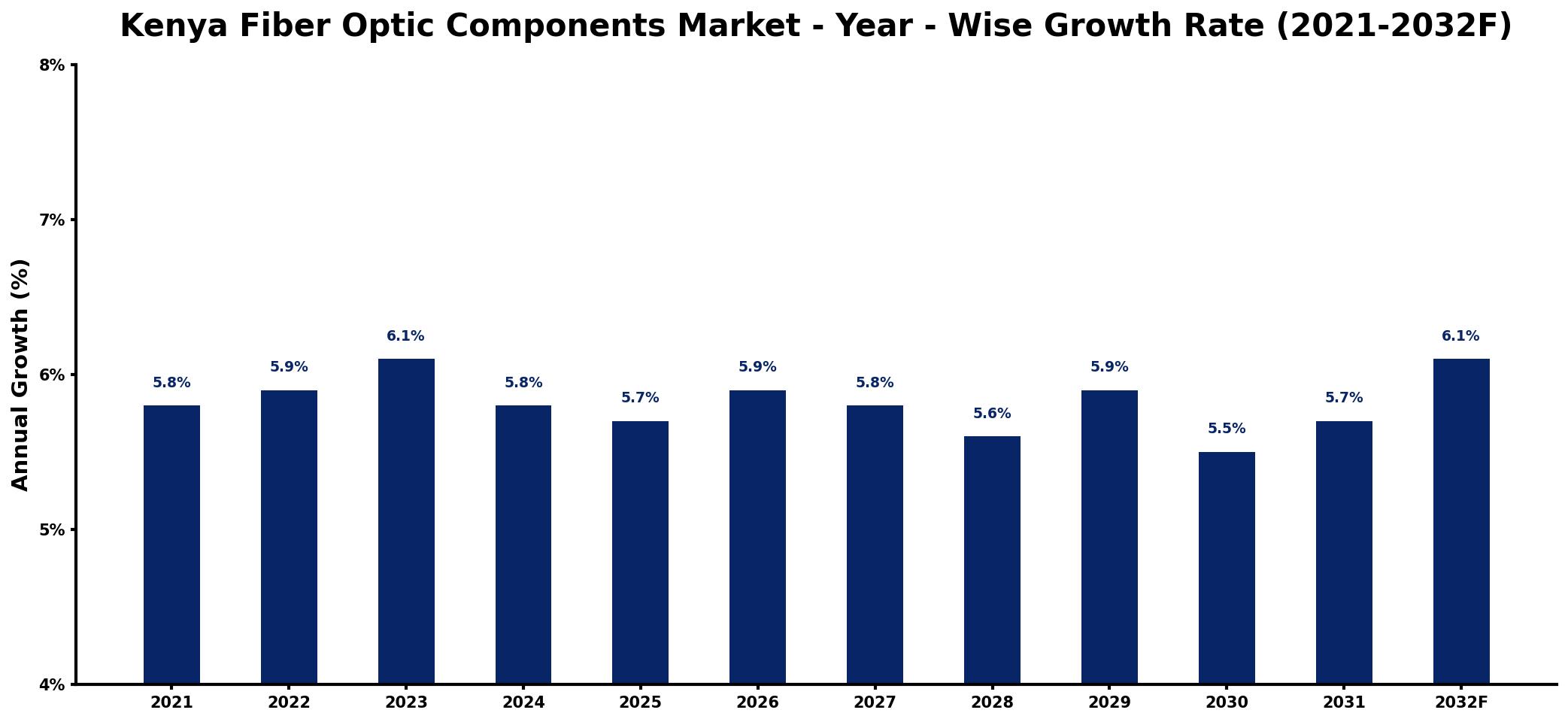
The table below presents the year‑wise growth rates along with the key drivers influencing the market
| Year | Growth Rate | Major Drivers |
| 2021 | 5.8% | Rising internet penetration rates |
| 2022 | 5.9% | Increased investment in infrastructure |
| 2023 | 6.1% | Growing demand for connectivity solutions |
| 2024 | 5.8% | Expansion of mobile network coverage |
| 2025 | 5.7% | Emerging technologies driving adoption |
| 2026 | 5.9% | Government initiatives supporting digitalization |
| 2027 | 5.8% | Surge in data consumption trends |
| 2028 | 5.6% | Enhanced focus on smart cities |
| 2029 | 5.9% | Growing e-commerce market dynamics |
| 2030 | 5.5% | Increased demand for cloud services |
| 2031 | 5.7% | Rising adoption of IoT applications |
| 2032 | 6.1% | Boost in regional telecom partnerships |
Note: Market size estimations and growth projections presented in this report are based on 6Wresearch's proprietary forecasting methodology, utilizing the latest available industry data, government publications, and primary research inputs.
Kenya Fiber Optic Components Market Synopsis
In recent years, the Kenya Fiber Optic Components Market has witnessed a notable shift toward modern telecommunications infrastructure. Driven by the push for greater digital connectivity, the market is evolving to support the increasing demand for reliable data transmission solutions across various industries.
The rise of fiber-to-the-home (FTTH) networks and investments in 5G technology signal a robust commitment to enhancing Kenya's digital landscape. This commitment reflects a broader trend toward improved service delivery, better connectivity, and a more inclusive digital economy.
Kenya Fiber Optic Components Market Key Takeaways
- The market is poised for significant growth, driven by strong demand for high-speed internet services.
- Government initiatives are facilitating the expansion of broadband infrastructure, particularly in underserved areas.
- Technological advancements are paving the way for innovative fiber optic components tailored to modern connectivity needs.
- Key trends include the rollout of 5G networks and the adoption of cloud computing solutions.
- Investment opportunities abound as organizations look to enhance their fiber optic networks to meet evolving demands.
Evaluation of Restraints in Kenya Fiber Optic Components Market
While the Kenya Fiber Optic Components Market shows promise, several key limitations hinder its growth potential. High initial capital investments required for infrastructure establishment present significant barriers for many organizations. Moreover, a shortage of skilled labor for installation and maintenance adds complexity to project execution. Limited consumer awareness, especially in rural areas, further impedes market penetration. Addressing these challenges will require strategic investments and educational campaigns to highlight the long-term benefits of fiber optics over traditional systems.
Kenya Fiber Optic Components Market Trends
Emerging trends significantly influence the Kenya Fiber Optic Components Market. The increasing reliance on technologies such as the Internet of Things (IoT) and cloud computing emphasizes the need for robust fiber optic infrastructure. Additionally, the deployment of fiber-to-the-home (FTTH) networks is becoming more prevalent, enhancing home connectivity and supporting remote work scenarios. As the landscape shifts, the market is likely to witness ongoing innovation in component design and capability, catering to the evolving requirements of both businesses and consumers.
Kenya Fiber Optic Components Market Opportunities
The opportunities for investment within the Kenya Fiber Optic Components Market are abundant. As demand for high-speed internet services continues to grow, there is a pressing need for more fiber optic cables, connectors, and transceivers. Collaborations with local telecom operators and government bodies can unlock strategic avenues for market entry, particularly in rural regions where broadband access is still limited. The burgeoning adoption of digital services in sectors such as healthcare, education, and finance further underscores the market's growth potential.
Government Initiatives in the Kenya Fiber Optic Components Market
The Kenyan government has rolled out a series of initiatives designed to bolster the Fiber Optic Components Market. The National Broadband Strategy aims to enhance broadband access and connectivity throughout the country, which directly supports fiber optic infrastructure development. Additionally, investments in projects such as the National Optic Fiber Backbone Infrastructure (NOFBI) serve to expand the fiber optic network effectively. Regulatory bodies like the Communications Authority of Kenya (CAK) play a critical role in fostering competition, ensuring consumer protection, and facilitating a conducive market environment.
Future Insights of the Kenya Fiber Optic Components Market
Looking ahead to 2026-2032, the Kenya Fiber Optic Components Market is set to experience sustained growth. The increasing emphasis on digitalization and advancements in telecommunications infrastructure are expected to drive demand for fiber optic solutions. As more industries adopt digital technologies and the government continues to prioritize broadband access, the market is likely to flourish. This landscape presents considerable opportunities for businesses willing to invest in high-quality fiber optic components that meet the demands of a dynamic digital economy.
Kenya Fiber Optic Components Market Latest Developments (2025 - 2026)
Recent developments within the Kenya Fiber Optic Components Market indicate a strong push toward modernization and infrastructure enhancement. Initiatives focused on expanding network coverage, particularly in rural regions, are gaining traction. Additionally, new partnerships are emerging between telecom providers and technology firms aimed at innovating fiber optic solutions. The ongoing rollout of 5G networks is also creating a ripple effect, stimulating demand for advanced fiber optic components.
Kenya Fiber Optic Components Market - Key Attractiveness of the Report
- 10 Years of Market Numbers
- Historical Data Starting from 2022 to 2025
- Base Year: 2025
- Forecast Data until 2032
- Key Performance Indicators Impacting the Market
- Major Upcoming Developments and Projects
Key Highlights of the Report:
- Kenya Fiber Optic Components Market Outlook
- Market Size of Kenya Fiber Optic Components Market, 2025
- Forecast of Kenya Fiber Optic Components Market, 2032
- Historical Data and Forecast of Kenya Fiber Optic Components Revenues & Volume for the Period 2022-2032F
- Kenya Fiber Optic Components Market Trend Evolution
- Kenya Fiber Optic Components Market Drivers and Challenges
- Kenya Fiber Optic Components Price Trends
- Kenya Fiber Optic Components Porter's Five Forces
- Kenya Fiber Optic Components Industry Life Cycle
- Historical Data and Forecast of Kenya Fiber Optic Components Market Revenues & Volume By Type for the Period 2022-2032F
- Historical Data and Forecast of Kenya Fiber Optic Components Market Revenues & Volume By Cables for the Period 2022-2032F
- Historical Data and Forecast of Kenya Fiber Optic Components Market Revenues & Volume By Active Optical Cables for the Period 2022-2032F
- Historical Data and Forecast of Kenya Fiber Optic Components Market Revenues & Volume By Amplifiers for the Period 2022-2032F
- Historical Data and Forecast of Kenya Fiber Optic Components Market Revenues & Volume By Splitters for the Period 2022-2032F
- Historical Data and Forecast of Kenya Fiber Optic Components Market Revenues & Volume By Connectors for the Period 2022-2032F
- Historical Data and Forecast of Kenya Fiber Optic Components Market Revenues & Volume By Circulators for the Period 2022-2032F
- Historical Data and Forecast of Kenya Fiber Optic Components Market Revenues & Volume By Transceivers for the Period 2022-2032F
- Historical Data and Forecast of Kenya Cables Fiber Optic Components Market Revenues & Volume By Others for the Period 2022-2032F
- Historical Data and Forecast of Kenya Fiber Optic Components Market Revenues & Volume By Data Rate for the Period 2022-2032F
- Historical Data and Forecast of Kenya Fiber Optic Components Market Revenues & Volume By Less than 10Gbps for the Period 2022-2032F
- Historical Data and Forecast of Kenya Fiber Optic Components Market Revenues & Volume By 10 Gbps to 40Gbps for the Period 2022-2032F
- Historical Data and Forecast of Kenya Fiber Optic Components Market Revenues & Volume By 41 Gbps to 100Gbps for the Period 2022-2032F
- Historical Data and Forecast of Kenya Fiber Optic Components Market Revenues & Volume By More than 100 Gbps for the Period 2022-2032F
- Historical Data and Forecast of Kenya Fiber Optic Components Market Revenues & Volume By Application for the Period 2022-2032F
- Historical Data and Forecast of Kenya Fiber Optic Components Market Revenues & Volume By Distributed Sensing for the Period 2022-2032F
- Historical Data and Forecast of Kenya Fiber Optic Components Market Revenues & Volume By Analytical and Medical Equipment for the Period 2022-2032F
- Historical Data and Forecast of Kenya Fiber Optic Components Market Revenues & Volume By Lighting for the Period 2022-2032F
- Historical Data and Forecast of Kenya Fiber Optic Components Market Revenues & Volume By Communications for the Period 2022-2032F
- Kenya Fiber Optic Components Import Export Trade Statistics
- Market Opportunity Assessment By Type
- Market Opportunity Assessment By Data Rate
- Market Opportunity Assessment By Application
- Kenya Fiber Optic Components Top Companies Market Share
- Kenya Fiber Optic Components Competitive Benchmarking By Technical and Operational Parameters
- Kenya Fiber Optic Components Company Profiles
- Kenya Fiber Optic Components Key Strategic Recommendations






































