Kenya Fishing Equipment Market Size Growth Rate
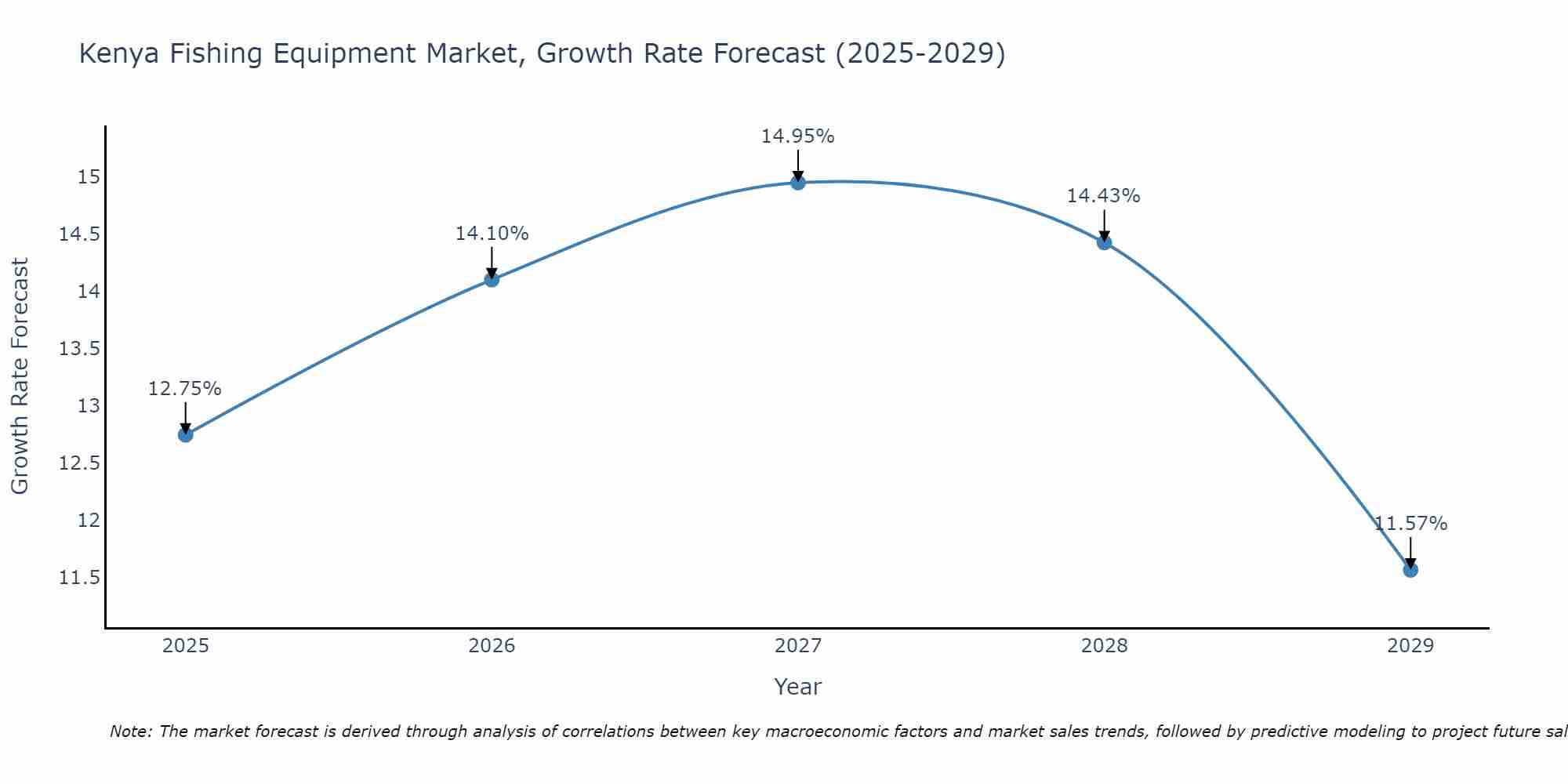
The Kenya Fishing Equipment Market is projected to witness mixed growth rate patterns during 2025 to 2029. Starting at 12.75% in 2025, the market peaks at 14.95% in 2027, and settles at 11.57% by 2029.
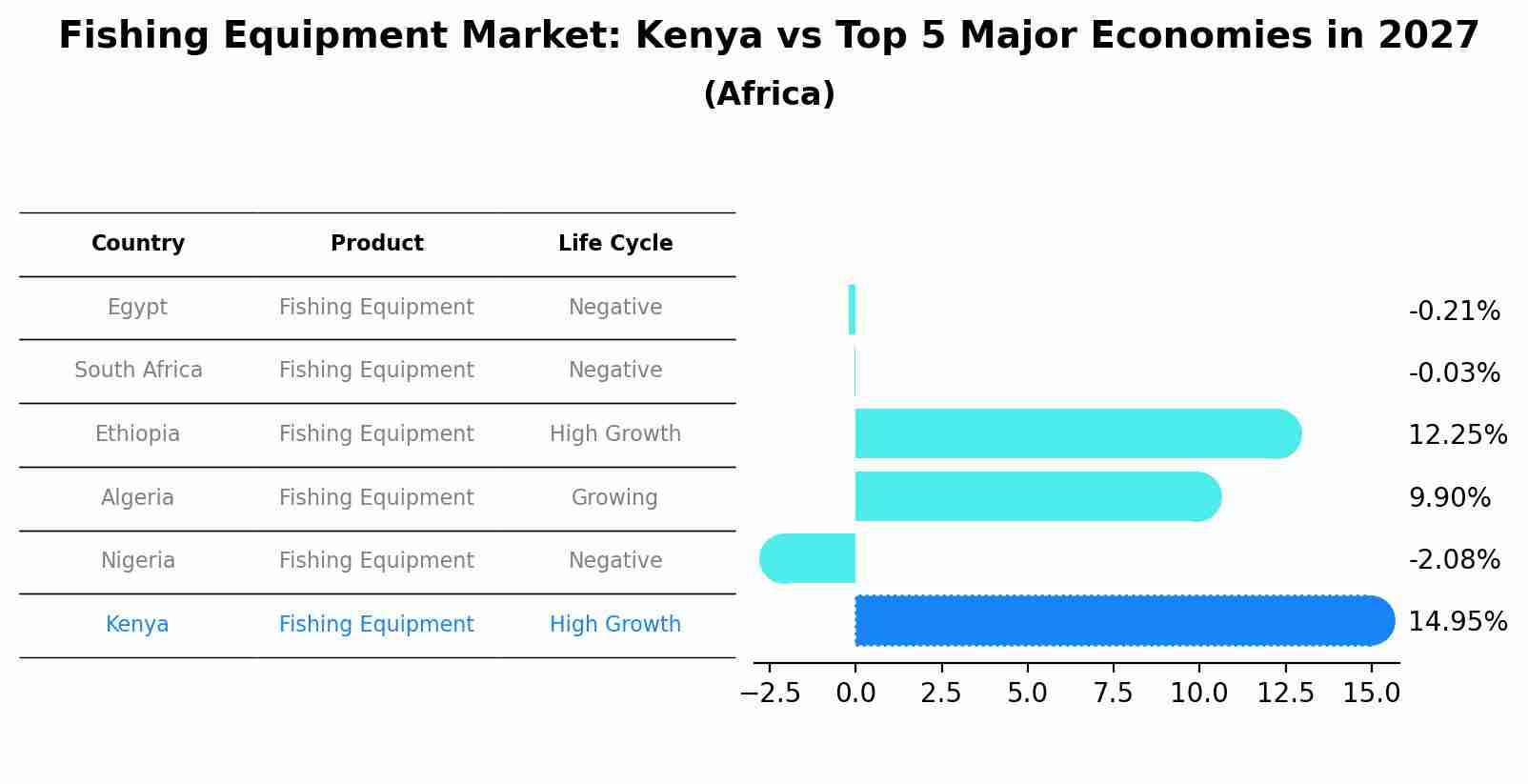
Fishing Equipment Market: Kenya vs Top 5 Major Economies in 2027 (Africa)
In the Africa region, the Fishing Equipment market in Kenya is projected to expand at a high growth rate of 14.95% by 2027. The largest economy is Egypt, followed by South Africa, Ethiopia, Algeria and Nigeria.
Kenya Fishing Equipment Market Overview
The Kenya Fishing Equipment Market is experiencing steady growth driven by the country`s extensive coastline, numerous lakes, and rivers that offer abundant fishing opportunities. The market is characterized by a wide range of fishing equipment including rods, reels, lines, lures, and accessories catering to both recreational and commercial fishermen. Key players in the market offer products tailored to local preferences and fishing conditions, with a focus on durability and affordability. The market is also witnessing a shift towards more sustainable fishing practices, leading to an increased demand for eco-friendly and ethically sourced fishing gear. With a growing interest in recreational fishing and the development of aquaculture in the region, the Kenya Fishing Equipment Market is expected to continue expanding in the coming years.
Kenya Fishing Equipment Market Trends
In the Kenya fishing equipment market, some notable trends include a growing demand for eco-friendly and sustainable fishing gear such as biodegradable fishing lines and non-toxic bait. Additionally, there is an increasing interest in advanced technology in fishing equipment, with anglers seeking out products like GPS fish finders and smart fishing rods. The rise of online shopping platforms has made it easier for consumers to access a wider variety of fishing gear and compare prices effectively. Furthermore, there is a shift towards customization and personalization in fishing equipment, with more anglers looking for tailor-made solutions to suit their specific fishing needs. Overall, the market is witnessing a blend of environmental consciousness, technological innovation, and consumer-centric approaches shaping the fishing equipment industry in Kenya.
Kenya Fishing Equipment Market Challenges
The Kenya Fishing Equipment Market faces several challenges, including inconsistent government regulations and enforcement, limited access to financing for small-scale fishermen to purchase modern equipment, and the presence of counterfeit products in the market which undermine the quality and reliability of genuine fishing gear. Additionally, inadequate infrastructure, such as storage facilities and cold chain logistics, hinders the efficient distribution of fishing equipment across the country. The high cost of imported fishing gear due to tariffs and taxes also poses a challenge for both manufacturers and consumers. Overall, these challenges contribute to a fragmented and less competitive market environment, making it difficult for local fishermen and businesses to thrive and meet the growing demand for high-quality fishing equipment in Kenya.
Kenya Fishing Equipment Market Investment Opportunities
The Kenya Fishing Equipment Market presents promising investment opportunities due to the growing demand for fishing gear driven by the country`s extensive coastline and numerous inland water bodies. Key areas for investment include modernizing and expanding the production of fishing equipment such as rods, reels, nets, and hooks to meet the needs of both commercial fishermen and recreational anglers. Additionally, there is potential for investments in innovative technologies and sustainable practices in fishing equipment manufacturing to cater to environmentally conscious consumers. Developing distribution channels and retail outlets for fishing equipment in strategic locations could also offer profitable investment prospects. Overall, tapping into the Kenya Fishing Equipment Market presents opportunities for investors to capitalize on the country`s rich fishing resources and increasing interest in fishing as a leisure activity.
Kenya Fishing Equipment Market Government Policy
The government of Kenya has implemented various policies to regulate the fishing equipment market. This includes the Fisheries Management and Development Act, which outlines guidelines for sustainable fishing practices and conservation of marine resources. Additionally, the government has imposed import duties on certain types of fishing equipment to promote local manufacturing and support the domestic fishing industry. Furthermore, there are regulations in place to ensure the safety and quality of fishing equipment sold in the market, including standards for materials used and product certification requirements. These policies aim to promote the growth of the fishing equipment market in Kenya while also safeguarding the environment and supporting local businesses in the industry.
Kenya Fishing Equipment Market Future Outlook
The future outlook for the Kenya Fishing Equipment Market appears promising due to several key factors. With the increasing popularity of recreational fishing and the growing demand for fresh seafood in Kenya, there is a rising need for high-quality fishing equipment. Additionally, the government`s focus on promoting the fishing industry and sustainable fishing practices is expected to drive further growth in the market. Technological advancements in fishing gear, such as sonar systems and GPS tracking devices, are also likely to attract more consumers looking for efficient and innovative equipment. As a result, the Kenya Fishing Equipment Market is projected to experience steady growth in the coming years, presenting opportunities for both local and international manufacturers and suppliers to expand their presence in the market.
Key Highlights of the Report:
- Kenya Fishing Equipment Market Outlook
- Market Size of Kenya Fishing Equipment Market, 2021
- Forecast of Kenya Fishing Equipment Market, 2031
- Historical Data and Forecast of Kenya Fishing Equipment Revenues & Volume for the Period 2018 - 2031
- Kenya Fishing Equipment Market Trend Evolution
- Kenya Fishing Equipment Market Drivers and Challenges
- Kenya Fishing Equipment Price Trends
- Kenya Fishing Equipment Porter's Five Forces
- Kenya Fishing Equipment Industry Life Cycle
- Historical Data and Forecast of Kenya Fishing Equipment Market Revenues & Volume By Type for the Period 2018 - 2031
- Historical Data and Forecast of Kenya Fishing Equipment Market Revenues & Volume By Hooks for the Period 2018 - 2031
- Historical Data and Forecast of Kenya Fishing Equipment Market Revenues & Volume By Lines for the Period 2018 - 2031
- Historical Data and Forecast of Kenya Fishing Equipment Market Revenues & Volume By Sinkers & Floats for the Period 2018 - 2031
- Historical Data and Forecast of Kenya Fishing Equipment Market Revenues & Volume By Rods for the Period 2018 - 2031
- Historical Data and Forecast of Kenya Fishing Equipment Market Revenues & Volume By Reels for the Period 2018 - 2031
- Historical Data and Forecast of Kenya Fishing Equipment Market Revenues & Volume By Nets & Traps for the Period 2018 - 2031
- Historical Data and Forecast of Kenya Fishing Equipment Market Revenues & Volume By Spear & Gaffs for the Period 2018 - 2031
- Historical Data and Forecast of Kenya Hooks Fishing Equipment Market Revenues & Volume By Others for the Period 2018 - 2031
- Historical Data and Forecast of Kenya Fishing Equipment Market Revenues & Volume By Nature for the Period 2018 - 2031
- Historical Data and Forecast of Kenya Fishing Equipment Market Revenues & Volume By Fresh Water for the Period 2018 - 2031
- Historical Data and Forecast of Kenya Fishing Equipment Market Revenues & Volume By Salt Water for the Period 2018 - 2031
- Historical Data and Forecast of Kenya Fishing Equipment Market Revenues & Volume By Fly Fishing for the Period 2018 - 2031
- Historical Data and Forecast of Kenya Fishing Equipment Market Revenues & Volume By Distribution Channel for the Period 2018 - 2031
- Historical Data and Forecast of Kenya Fishing Equipment Market Revenues & Volume By Online for the Period 2018 - 2031
- Historical Data and Forecast of Kenya Fishing Equipment Market Revenues & Volume By Offline for the Period 2018 - 2031
- Kenya Fishing Equipment Import Export Trade Statistics
- Market Opportunity Assessment By Type
- Market Opportunity Assessment By Nature
- Market Opportunity Assessment By Distribution Channel
- Kenya Fishing Equipment Top Companies Market Share
- Kenya Fishing Equipment Competitive Benchmarking By Technical and Operational Parameters
- Kenya Fishing Equipment Company Profiles
- Kenya Fishing Equipment Key Strategic Recommendations






































