Kenya Food & Beverage Market Growth Rate Analysis (2021-2031)
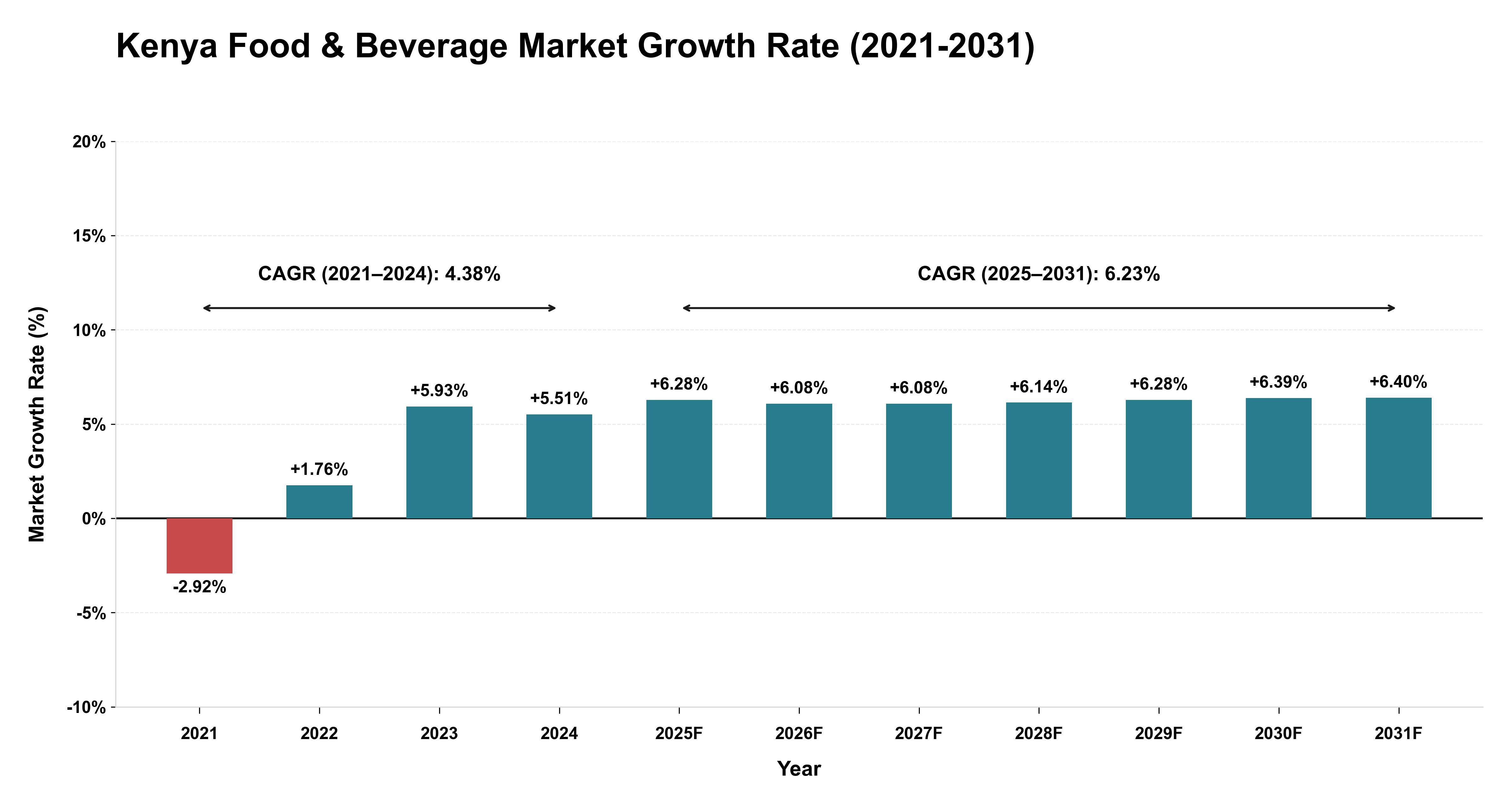
The Kenya Food & Beverage Market witnessed a challenging start in 2021 with a contraction of -2.92%, reflecting temporary headwinds. However, the market swiftly rebounded, showcasing resilience in 2022 with a modest growth of 1.76%. From 2023 onwards, the sector gained strong momentum, with growth rates steadily climbing to 5.93% in 2023 and 5.51% in 2024, indicating robust recovery and expanding consumer demand. Looking ahead to the forecast period from 2025 to 2031, the market is poised for accelerated growth, with a projected CAGR of 6.23%. This trajectory suggests a phase of stabilizing expansion and sustained market development driven by factors like rising disposable incomes and evolving consumer preferences in the region's food and beverage landscape.
Key Highlights of the Report:
- Kenya Food & Beverage Market Outlook
- Market Size of Kenya Food & Beverage Market,2024
- Forecast of Kenya Food & Beverage Market, 2031
- Historical Data and Forecast of Kenya Food & Beverage Revenues & Volume for the Period 2021-2031
- Kenya Food & Beverage Market Trend Evolution
- Kenya Food & Beverage Market Drivers and Challenges
- Kenya Food & Beverage Price Trends
- Kenya Food & Beverage Porter's Five Forces
- Kenya Food & Beverage Industry Life Cycle
- Historical Data and Forecast of Kenya Food & Beverage Market Revenues & Volume By Type for the Period 2021-2031
- Historical Data and Forecast of Kenya Food & Beverage Market Revenues & Volume By Fresh for the Period 2021-2031
- Historical Data and Forecast of Kenya Food & Beverage Market Revenues & Volume By Processed for the Period 2021-2031
- Historical Data and Forecast of Kenya Food & Beverage Market Revenues & Volume By Packaged for the Period 2021-2031
- Historical Data and Forecast of Kenya Food & Beverage Market Revenues & Volume By Beverages for the Period 2021-2031
- Historical Data and Forecast of Kenya Food & Beverage Market Revenues & Volume By Processing Level for the Period 2021-2031
- Historical Data and Forecast of Kenya Food & Beverage Market Revenues & Volume By Raw for the Period 2021-2031
- Historical Data and Forecast of Kenya Food & Beverage Market Revenues & Volume By Semi-Processed for the Period 2021-2031
- Historical Data and Forecast of Kenya Food & Beverage Market Revenues & Volume By Ready-to-Eat for the Period 2021-2031
- Historical Data and Forecast of Kenya Food & Beverage Market Revenues & Volume By Frozen for the Period 2021-2031
- Historical Data and Forecast of Kenya Food & Beverage Market Revenues & Volume By Packaging Type for the Period 2021-2031
- Historical Data and Forecast of Kenya Food & Beverage Market Revenues & Volume By Plastic for the Period 2021-2031
- Historical Data and Forecast of Kenya Food & Beverage Market Revenues & Volume By Glass for the Period 2021-2031
- Historical Data and Forecast of Kenya Food & Beverage Market Revenues & Volume By Metal for the Period 2021-2031
- Historical Data and Forecast of Kenya Food & Beverage Market Revenues & Volume By Paperboard for the Period 2021-2031
- Historical Data and Forecast of Kenya Food & Beverage Market Revenues & Volume By Distribution Channel for the Period 2021-2031
- Historical Data and Forecast of Kenya Food & Beverage Market Revenues & Volume By Online Retail for the Period 2021-2031
- Historical Data and Forecast of Kenya Food & Beverage Market Revenues & Volume By Supermarkets for the Period 2021-2031
- Historical Data and Forecast of Kenya Food & Beverage Market Revenues & Volume By Convenience Stores for the Period 2021-2031
- Historical Data and Forecast of Kenya Food & Beverage Market Revenues & Volume By Specialty Stores for the Period 2021-2031
- Historical Data and Forecast of Kenya Food & Beverage Market Revenues & Volume By Consumer Preference for the Period 2021-2031
- Historical Data and Forecast of Kenya Food & Beverage Market Revenues & Volume By Organic for the Period 2021-2031
- Historical Data and Forecast of Kenya Food & Beverage Market Revenues & Volume By Conventional for the Period 2021-2031
- Historical Data and Forecast of Kenya Food & Beverage Market Revenues & Volume By Gluten-Free for the Period 2021-2031
- Historical Data and Forecast of Kenya Food & Beverage Market Revenues & Volume By Vegan for the Period 2021 - 2029
- Kenya Food & Beverage Import Export Trade Statistics
- Market Opportunity Assessment By Type
- Market Opportunity Assessment By Processing Level
- Market Opportunity Assessment By Packaging Type
- Market Opportunity Assessment By Distribution Channel
- Market Opportunity Assessment By Consumer Preference
- Kenya Food & Beverage Top Companies Market Share
- Kenya Food & Beverage Competitive Benchmarking By Technical and Operational Parameters
- Kenya Food & Beverage Company Profiles
- Kenya Food & Beverage Key Strategic Recommendations






































