Kenya Functional Apparel Market Size, Share & Growth Rate
The Kenya Functional Apparel Market was estimated at USD 226 Million in 2025 and is projected to reach USD 299 Million by 2032, growing at a CAGR of 4.1% from 2026 to 2032. This growth trajectory is fueled by an increasing focus on health and wellness among consumers, who are looking for clothing that not only meets their performance needs but also aligns with their eco-conscious values. As outdoor activities gain popularity, coupled with advancements in fabric technology, the demand for functional apparel in sports, outdoor recreation, and daily wear is set to rise significantly.
Kenya Functional Apparel Market Year-wise Growth Rate and Key Drivers
This graph highlights how the Kenya Functional Apparel Market has steadily grown over the years, supported by major growth factors.
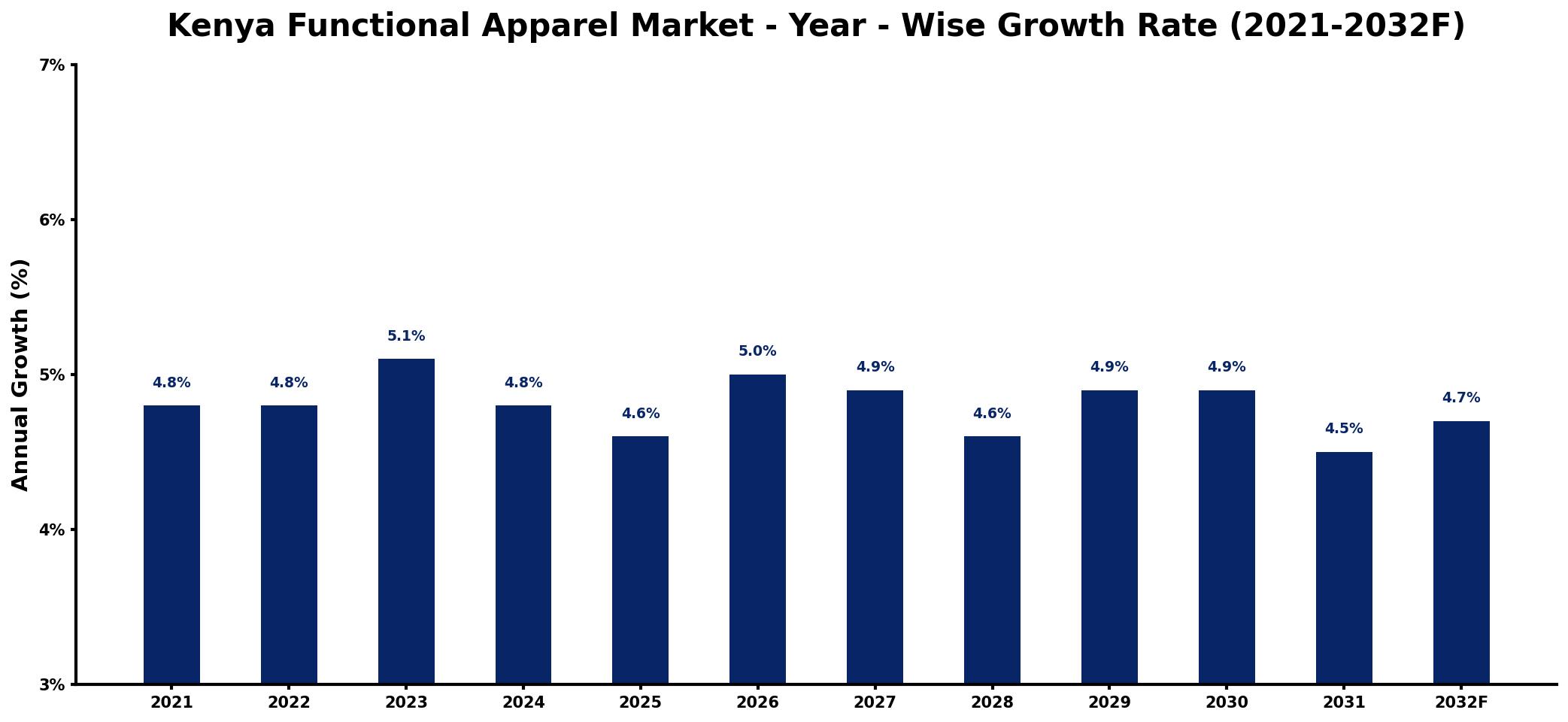
The table below presents the year‑wise growth rates along with the key drivers influencing the market
| Year | Growth Rate | Major Drivers |
| 2021 | 4.8% | Rising health consciousness among consumers |
| 2022 | 4.8% | Increased participation in fitness activities |
| 2023 | 5.1% | Growth in e-commerce platforms |
| 2024 | 4.8% | Expansion of local manufacturing capabilities |
| 2025 | 4.6% | Emergence of sustainable production practices |
| 2026 | 5.0% | Investment in innovative materials technology |
| 2027 | 4.9% | Growing popularity of athleisure trends |
| 2028 | 4.6% | Enhanced marketing strategies by brands |
| 2029 | 4.9% | Collaborations with fitness influencers |
| 2030 | 4.9% | Focus on customization and personalization |
| 2031 | 4.5% | Strengthening distribution network channels |
| 2032 | 4.7% | rising export shipment volumes |
Note: Market size estimations and growth projections presented in this report are based on 6Wresearch's proprietary forecasting methodology, utilizing the latest available industry data, government publications, and primary research inputs.
Kenya Functional Apparel Market Synopsis
In recent years, the Kenya functional apparel market has witnessed a surge, driven by consumer awareness and the push for sustainable practices. However, as the market matures, there is a growing need for innovation and differentiation to cater to diverse consumer preferences.
Looking ahead, the landscape is poised for transformation, as brands and manufacturers strive to meet evolving performance standards and aesthetic demands. The integration of smart textiles and sustainable materials is becoming increasingly important, thus changing the dynamics of product offerings in this sector.
Kenya Functional Apparel Market Key Takeaways
- Rising consumer interest in health and fitness is propelling the demand for functional apparel.
- Innovations in textile technologies are enhancing product performance, including moisture management and UV protection.
- Sustainability considerations are driving brand loyalty, influencing consumers to choose eco-friendly options.
- The outdoor recreation sector is a significant driver of growth in functional apparel adoption.
- Understanding regional preferences is crucial for brands aiming to succeed in the Kenyan market.
Evaluation of Restraints in Kenya Functional Apparel Market
While the Kenya functional apparel market shows potential, several restraints impact its growth. Challenges include the need for stringent performance standards across various fabric types and the ability of manufacturers to keep pace with shifting consumer preferences for both style and functionality. Additionally, the sector must address obstacles related to material innovation, which are critical for maintaining competitiveness in a rapidly evolving market.
Kenya Functional Apparel Market Trends
Current trends in the Kenya functional apparel market emphasize a growing inclination towards multifunctional and performance-oriented clothing. Consumers are increasingly favoring apparel that seamlessly transitions from workout sessions to daily wear. Furthermore, the advent of eco-friendly materials and practices is reshaping the supply chain, with brands adopting sustainability as a key differentiator in their product offerings. Wearable technology is also beginning to make inroads, as smart textiles incorporate features that cater to both fitness enthusiasts and everyday users.
Kenya Functional Apparel Market Opportunities
The functional apparel segment in Kenya presents lucrative opportunities for growth, particularly in niche markets. The rise of urban outdoor activities and increased participation in sports, both organized and recreational, creates a strong demand for tailored solutions. Additionally, brands that invest in research and development for innovative fabrics are likely to gain a competitive edge. Collaborations with local influencers and athletes could also enhance brand visibility and consumer trust, paving the way for expansive growth.
Government Initiatives in the Kenya Functional Apparel Market
The Kenyan government is taking steps to foster the growth of the functional apparel market through the establishment of regulations concerning product safety, labeling, and textile standards. These measures are designed to protect consumers while encouraging innovation in the sector. Additionally, initiatives that support local manufacturing and the use of sustainable materials are increasingly prevalent, aimed at promoting both economic development and environmental responsibility.
Future Insights of the Kenya Functional Apparel Market
As we look towards the period from 2026 to 2032, the Kenya functional apparel market is expected to expand significantly. Driven by increased health consciousness and a preference for sustainable products, consumers will likely continue to seek out performance-driven apparel. The integration of cutting-edge technology in fabric development is anticipated to create new categories of functional apparel that cater to a broader range of consumer needs. With the right investment and focus, the market is well-positioned for sustained growth.
Kenya Functional Apparel Market Latest Developments (2025 - 2026)
Recent developments in the Kenya functional apparel market highlight a trend towards innovative collaborations aimed at enhancing product offerings. Companies are increasingly looking to partner with technology firms to incorporate smart functionalities into their apparel. Furthermore, local brands are gaining traction by focusing on community engagement and sustainability practices, resonating well with the eco-conscious demographic. The emphasis on quality and performance is leading to a more competitive landscape, encouraging brands to continually refine their product lines.
Kenya Functional Apparel Market - Key Attractiveness of the Report
- 10 Years of Market Numbers
- Historical Data Starting from 2022 to 2025
- Base Year: 2025
- Forecast Data until 2032
- Key Performance Indicators Impacting the Market
- Major Upcoming Developments and Projects
Key Highlights of the Report:
- Kenya Functional Apparel Market Outlook
- Market Size of Kenya Functional Apparel Market, 2025
- Forecast of Kenya Functional Apparel Market, 2032
- Historical Data and Forecast of Kenya Functional Apparel Revenues & Volume for the Period 2022-2032F
- Kenya Functional Apparel Market Trend Evolution
- Kenya Functional Apparel Market Drivers and Challenges
- Kenya Functional Apparel Price Trends
- Kenya Functional Apparel Porter's Five Forces
- Kenya Functional Apparel Industry Life Cycle
- Historical Data and Forecast of Kenya Functional Apparel Market Revenues & Volume By Product Type for the Period 2022-2032F
- Historical Data and Forecast of Kenya Functional Apparel Market Revenues & Volume By Sportswear for the Period 2022-2032F
- Historical Data and Forecast of Kenya Functional Apparel Market Revenues & Volume By Activewear for the Period 2022-2032F
- Historical Data and Forecast of Kenya Functional Apparel Market Revenues & Volume By Protective Clothing for the Period 2022-2032F
- Historical Data and Forecast of Kenya Functional Apparel Market Revenues & Volume By Others for the Period 2022-2032F
- Historical Data and Forecast of Kenya Functional Apparel Market Revenues & Volume By Application for the Period 2022-2032F
- Historical Data and Forecast of Kenya Functional Apparel Market Revenues & Volume By Sports Industry for the Period 2022-2032F
- Historical Data and Forecast of Kenya Functional Apparel Market Revenues & Volume By Outdoor Clothing for the Period 2022-2032F
- Historical Data and Forecast of Kenya Functional Apparel Market Revenues & Volume By Healthcare sector for the Period 2022-2032F
- Historical Data and Forecast of Kenya Functional Apparel Market Revenues & Volume By Distribution Channel for the Period 2022-2032F
- Historical Data and Forecast of Kenya Functional Apparel Market Revenues & Volume By Offline Store for the Period 2022-2032F
- Historical Data and Forecast of Kenya Functional Apparel Market Revenues & Volume By Online Store for the Period 2022-2032F
- Kenya Functional Apparel Import Export Trade Statistics
- Market Opportunity Assessment By Product Type
- Market Opportunity Assessment By Application
- Market Opportunity Assessment By Distribution Channel
- Kenya Functional Apparel Top Companies Market Share
- Kenya Functional Apparel Competitive Benchmarking By Technical and Operational Parameters
- Kenya Functional Apparel Company Profiles
- Kenya Functional Apparel Key Strategic Recommendations






































