Global Functional Apparel Market Highlights
| Market Size (2025) | USD 428.3 Billion |
| Forecast Size (2032) | USD 698.1 Billion |
| CAGR | 5.89% |
| Base Year | 2025 |
| Forecast Period | 2026-2032 |
| Largest Region | North America |
| Fastest Growing Region | Asia |
| Largest Segment | Sportswear |
| Fastest Growing Segment | Protective Clothing |
| Leading Companies | Nike, Adidas, Under Armour, Puma, Columbia Sportswear |
Global Functional Apparel Market Size & Growth Rate (2026-2032)
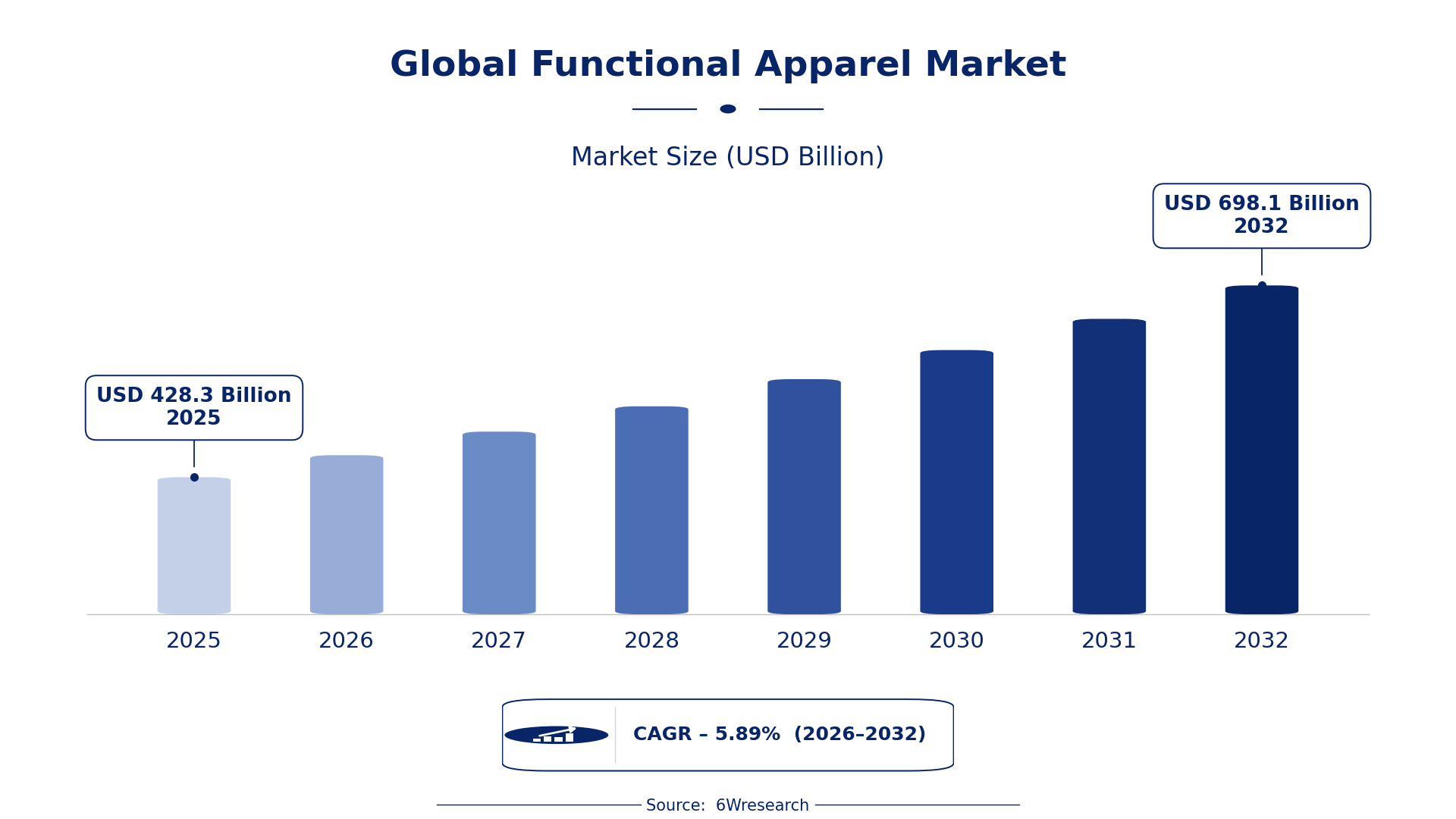
The Global Functional Apparel Market was estimated at USD 428.3 Billion in 2025 and is projected to reach USD 698.1 Billion by 2032, growing at a CAGR of 5.89% from 2026 to 2032.
Global Functional Apparel Market Synopsis
A structural transformation is underway within the Global Functional Apparel Market, characterized by an increased fusion of fashion and functionality. This shift is largely influenced by evolving consumer expectations, leading brands to adopt advanced materials and sustainability practices to meet these demands.
The market is pivotal for multiple sectors, including sports, healthcare, and outdoor activities. Various industries are redefining their clothing requirements, favoring apparel that not only meets aesthetic values but also offers high-performance features like moisture-wicking and UV protection.
Global Functional Apparel Market Year-wise Growth Rate and Key Drivers
This graph illustrates the annual growth rates of the Global Functional Apparel Market from 2022 to 2032, highlighting a steady upward trajectory and projected expansion over the forecast period.
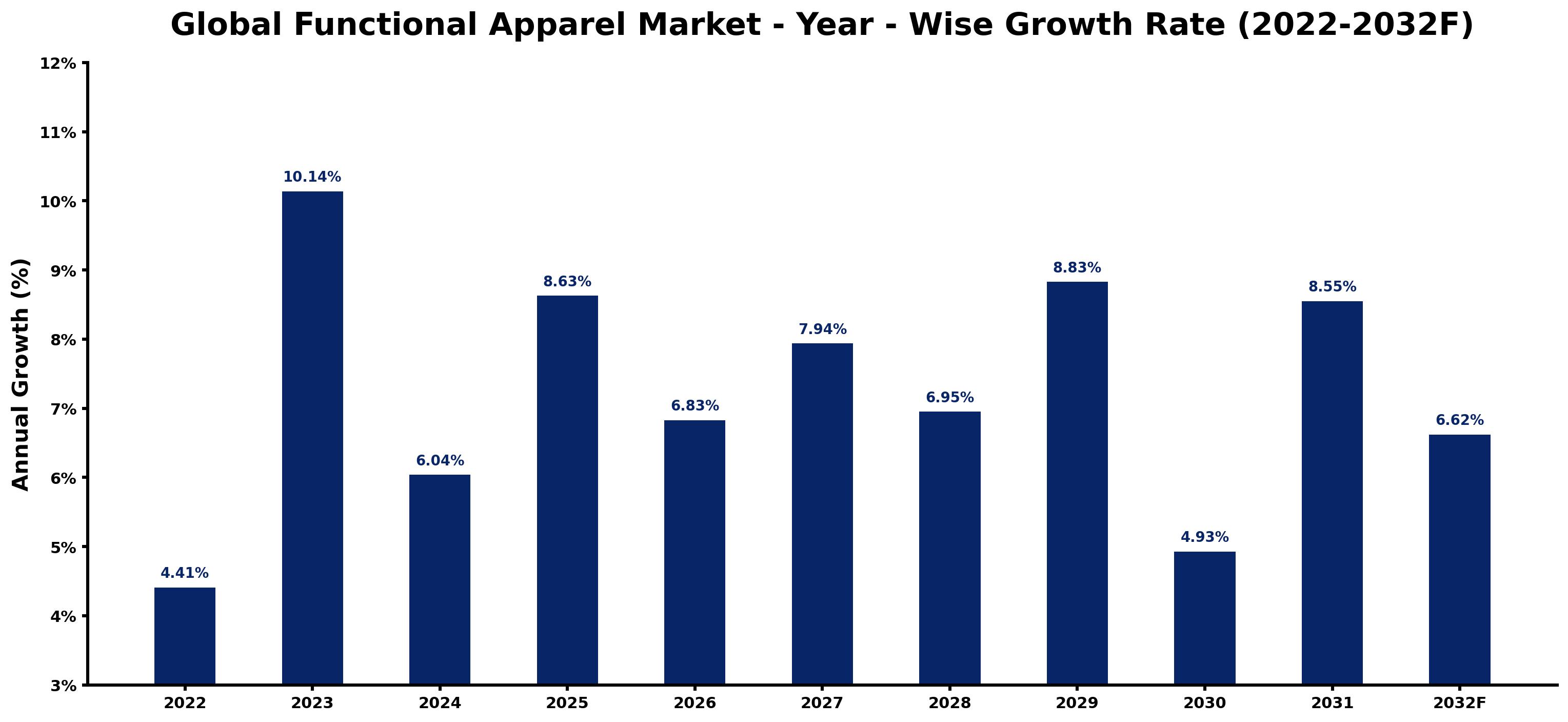
The table below presents the year‑wise growth rates along with the key drivers influencing the market
| Year | Growth Rate (%) | Major Drivers |
| 2022 | 4.41 | Retail channels enhance consumer access to functional apparel, reflecting rising end-user interest. |
| 2023 | 10.14 | An increasing emphasis on sustainability pushes brands towards eco-friendly functional apparel production. |
| 2024 | 6.04 | Rising raw material costs lead to a cautious approach in functional apparel pricing strategies. |
| 2025 | 8.63 | Expanding e-commerce platforms facilitate greater reach for innovative functional apparel offerings. |
| 2026 | 6.83 | Smart textiles positions functional apparel as an attractive investment opportunity for major brands. |
| 2027 | 7.94 | As skilled labor in textile manufacturing increases, functional apparel production becomes more efficient. |
| 2028 | 6.95 | Consumers in the athletic segment seek functional apparel that aligns with personal active lifestyles. |
| 2029 | 8.83 | In urban areas, a notable shift towards functional apparel reflects evolving lifestyle preferences. |
| 2030 | 4.93 | Manufacturers are exploring international markets to expand the distribution of functional apparel. |
| 2031 | 8.55 | A shift towards personalized functional apparel enhances brand loyalty among millennial consumers. |
| 2032 | 6.62 | The introduction of strict sustainability regulations influences raw material selection in functional apparel. |
Note - Market size estimations and growth projections presented in this report are based on 6Wresearch's proprietary research methodology, combining internal industry data, secondary research, and primary validation, updated periodically to reflect current market conditions. As markets evolve rapidly, figures for certain industries may vary slightly and are intended as informed estimates rather than absolute figures. For the most current market sizing, we recommend validating figures with a 6Wresearch analyst.
Global Functional Apparel Market Key Takeaways
Below are some of the specific key takeaways from the market, including:
- Sportswear is expected to account for approximately 40% of the market share in 2025, driven by the rising popularity of athletic activities.
- Protective clothing is projected to exhibit a CAGR of 7.5% from 2026 to 2032, reflecting heightened concerns for safety in various industries.
- The athleisure segment is gaining traction, led by companies such as Adidas, which reported a 20% year-over-year increase in sales for athleisure products in 2025.
- North America remains the largest market, anticipated to hold a share of around 48% in 2025, backed by a robust manufacturing ecosystem and consumer spending.
- Digitalization in retail is transforming the customer experience; for instance, Nike's direct-to-consumer strategy resulted in a 30% revenue spike in the direct channel in 2025.
Evaluation of Restraints in Global Functional Apparel Market
Despite its growth potential, the Global Functional Apparel Market faces several barriers. Notably, the high costs associated with advanced materials and manufacturing processes can hinder affordability. For instance, the average production cost of certain high-tech protective fabrics can be up to 25% more than traditional options. Additionally, brands must navigate an increasingly complex regulatory landscape, which can impose further operational costs. For example, compliance with environmental regulations in Europe can require substantial investment in sustainable sourcing practices.
Global Functional Apparel Market Trends
Three transformative trends are shaping the Global Functional Apparel Market. First, the integration of smart textiles is gaining momentum, with companies like Under Armour introducing connected fitness apparel, that allows users to monitor performance metrics. This trend is projected to increase market engagement significantly. Second, sustainability is becoming non-negotiable; brands are adopting eco-friendly materials, evidenced by Lululemon’s commitment to using 100% sustainable cotton by 2025. Third, the rise of e-commerce is revolutionizing distribution channels, as seen with Puma's significant investment in optimizing its online presence, resulting in a 50% increase in online sales during 2025.
Global Functional Apparel Market Opportunities
Future revenue opportunities in the Global Functional Apparel Market are embedded in various innovative applications. One notable area involves developing advanced protective clothing for the healthcare sector, where companies like 3M are actively exploring antimicrobial and fluid-repellent technologies, anticipating a market entry worth USD 3 Billion by 2026. Another promising opportunity lies in the deployment of customizable, on-demand apparel, which aligns with consumers' growing preference for personalized options. Brands like Nike are expected to invest USD 5 Billion into creating state-of-the-art customization technologies, aiming for a significant market capture by 2030. Collaborations between sportswear and tech sectors hold potential as well, as seen in Adidas's partnership with various tech firms to create interactive apparel.
Global Functional Apparel Market by Product Type
In the Global Functional Apparel Market, Sportswear is the largest segment, holding an estimated share of around 40% in 2025. The Protective Clothing segment, on the other hand, is the fastest-growing, expected to achieve a CAGR of 7.5% from 2026 to 2032. This growth is driven by heightened awareness of safety and performance in work environments, particularly within the construction and healthcare industries, where the demand for certified protective gear is increasing rapidly due to regulatory and safety standards.
Global Functional Apparel Market by Application
The Sports Industry currently leads the applications segment of the Global Functional Apparel Market, commanding an estimated 45% share as of 2025. Conversely, the Healthcare sector is the fastest-growing application, anticipated to expand at a CAGR of 8% from 2026 to 2032. This surge in demand for healthcare apparel is attributed to a rising need for specialized clothing that offers performance enhancement, such as moisture-wicking fabrics and antimicrobial properties, driven by increased global health challenges.
Global Functional Apparel Market by Distribution Channel
In terms of distribution channels, Offline Stores dominate the Global Functional Apparel Market, expected to hold approximately 65% of the market share in 2025. However, Online Stores are rapidly emerging as the fastest-growing channel, projected to increase at a CAGR of 9% from 2026 to 2032. This shift is fueled by a growing preference for online shopping, supported by enhanced digital experiences and convenience for consumers.
Global Functional Apparel Market by Region
North America is the largest region in the Global Functional Apparel Market, with a significant share of around 48% in 2025. Conversely, the Asia region is set to be the fastest-growing, boasting a CAGR of 7% from 2026 to 2032. This growth can be attributed to the expanding middle-class population, coupled with rising disposable income and a growing emphasis on fitness and active lifestyles across diverse Asian markets.
Government Initiatives in the Global Functional Apparel Market
The regulatory and policy environment for the Global Functional Apparel Market is becoming increasingly favorable, reflecting a commitment to sustainability and innovation. Governments around the world are introducing various initiatives aimed at bolstering the industry while ensuring environmental standards are met.
- U.S. Department of Energy, "Wearable Sustainability Program," 2022 - Aimed at promoting energy-efficient manufacturing practices in apparel production, enhancing the sustainability of fabrics used.
- European Commission, "EU Green Deal," 2020 - This initiative aims to make textiles sustainable throughout their entire lifecycle, significantly affecting the regulations around functional apparel within Europe.
- Government of Canada, "Textile Innovation Program," 2023 - This upcoming initiative will support R&D for advanced materials in the apparel sector, boosting innovative fabric use.
- Ministry of Textiles, India, "Skill Development Inititative," 2021 - Focused on enhancing technical skills in garment manufacturing, enabling better production of functional apparel.
Future Insights of the Global Functional Apparel Market
The trajectory of the Global Functional Apparel Market is marked by the integration of smart textile technologies, which are anticipated to redefine user experiences. Companies like Under Armour are already implementing connected apparel that captures performance metrics, steering consumers toward more data-driven fitness regimens. Additionally, advancements in eco-friendly materials are expected to capitalize on the increasing importance of sustainability, highlighted by Aliaxis’s focus on biobased fabrics. By 2032, this fusion of technology and eco-consciousness could shift the competitive dynamics, compelling brands to strengthen their sustainability credentials.
Global Functional Apparel Market Latest Developments
Several significant developments are shaping the Global Functional Apparel Market, highlighting companies’ strategies to enhance their market position.
- Nike is launching a range of eco-friendly running shoes in April 2023, reinforcing their commitment to sustainable practices while enhancing their product offerings.
- Adidas initiated a partnership with a tech firm in February 2023 to develop apparel integrated with performance-tracking sensors, aiming to enhance consumer engagement and market differentiation.
- Under Armour is set to unveil a new line of moisture-wicking workout wear aimed at the East Asian market by the end of 2023, strategically positioning itself in a rapidly expanding fitness culture.
- Columbia Sportswear announced plans in January 2023 to expand their distribution network in Europe, which could significantly increase their market share and brand visibility in that region.
Global Functional Apparel Market Key Players and Industry Positioning
The Global Functional Apparel Market exhibits a mixed competitive landscape, characterized by both established brands and emerging players. Leading companies leverage specialized technology and sustainability initiatives to strengthen their positions.
| Leading Company | Core Strength | Strategic Focus |
|---|---|---|
| Nike | Strong brand recognition and innovation in performance apparel. | Investment in sustainable product lines to attract eco-conscious consumers. |
| Adidas | Diverse product range, particularly in the athleisure segment. | Strategic partnerships with tech firms to enhance product features. |
| Under Armour | Leadership in moisture-wicking technology. | Targeting niche markets with performance-driven products. |
| Puma | Strong emphasis on fashion-forward functional wear. | Expansion into e-commerce and digital engagement strategies. |
| Columbia Sportswear | Expertise in outdoor and adventure apparel. | Focus on enhancing distribution channels in key global markets. |
The competitive dynamics in this sector will likely continue to evolve, with a focus on sustainability and technological integration to maintain market leadership.
Key Attractiveness of the Report
- 10 Years of Market Numbers
- Historical Data Starting from 2022 to 2025
- Base Year: 2025
- Forecast Data until 2032
- Key Performance Indicators Impacting the Market
- Major Upcoming Developments and Projects
Key Highlights of the Report:
- Global Functional Apparel Market Outlook
- Market Size of Global Functional Apparel Market, 2025
- Forecast of Global Functional Apparel Market, 2032
- Historical Data and Forecast of Global Functional Apparel Revenues & Volume for the Period 2022-2032
- Global Functional Apparel Market Trend Evolution
- Global Functional Apparel Market Drivers and Challenges
- Global Functional Apparel Price Trends
- Global Functional Apparel Porter's Five Forces
- Global Functional Apparel Industry Life Cycle
- Historical Data and Forecast of Global Functional Apparel Market Revenues & Volume
- Historical Data and Forecast of Global Functional Apparel Market Revenues & Volume By Product Type for the Period 2022-2032
- Historical Data and Forecast of Global Functional Apparel Market Revenues & Volume By Sportswear for the Period 2022-2032
- Historical Data and Forecast of Global Functional Apparel Market Revenues & Volume By Activewear for the Period 2022-2032
- Historical Data and Forecast of Global Functional Apparel Market Revenues & Volume By Protective Clothing for the Period 2022-2032
- Historical Data and Forecast of Global Functional Apparel Market Revenues & Volume By Others for the Period 2022-2032
- Historical Data and Forecast of Global Functional Apparel Market Revenues & Volume By Application for the Period 2022-2032
- Historical Data and Forecast of Global Functional Apparel Market Revenues & Volume By Sports Industry for the Period 2022-2032
- Historical Data and Forecast of Global Functional Apparel Market Revenues & Volume By Outdoor Clothing for the Period 2022-2032
- Historical Data and Forecast of Global Functional Apparel Market Revenues & Volume By Healthcare sector for the Period 2022-2032
- Historical Data and Forecast of Global Functional Apparel Market Revenues & Volume By Distribution Channel for the Period 2022-2032
- Historical Data and Forecast of Global Functional Apparel Market Revenues & Volume By Offline Store for the Period 2022-2032
- Historical Data and Forecast of Global Functional Apparel Market Revenues & Volume By Online Store for the Period 2022-2032
- Historical Data and Forecast of North America Functional Apparel Market Revenues & Volume By Product Type for the Period 2022-2032
- Historical Data and Forecast of North America Functional Apparel Market Revenues & Volume By Sportswear for the Period 2022-2032
- Historical Data and Forecast of North America Functional Apparel Market Revenues & Volume By Activewear for the Period 2022-2032
- Historical Data and Forecast of North America Functional Apparel Market Revenues & Volume By Protective Clothing for the Period 2022-2032
- Historical Data and Forecast of North America Functional Apparel Market Revenues & Volume By Others for the Period 2022-2032
- Historical Data and Forecast of North America Functional Apparel Market Revenues & Volume By Application for the Period 2022-2032
- Historical Data and Forecast of North America Functional Apparel Market Revenues & Volume By Sports Industry for the Period 2022-2032
- Historical Data and Forecast of North America Functional Apparel Market Revenues & Volume By Outdoor Clothing for the Period 2022-2032
- Historical Data and Forecast of North America Functional Apparel Market Revenues & Volume By Healthcare sector for the Period 2022-2032
- Historical Data and Forecast of North America Functional Apparel Market Revenues & Volume By Distribution Channel for the Period 2022-2032
- Historical Data and Forecast of North America Functional Apparel Market Revenues & Volume By Offline Store for the Period 2022-2032
- Historical Data and Forecast of North America Functional Apparel Market Revenues & Volume By Online Store for the Period 2022-2032
- Historical Data and Forecast of United States of America Functional Apparel Market Revenues & Volume for the Period 2022-2032
- Historical Data and Forecast of Canada Functional Apparel Market Revenues & Volume for the Period 2022-2032
- Historical Data and Forecast of Rest of North America Functional Apparel Market Revenues & Volume for the Period 2022-2032
- Historical Data and Forecast of Latin America (LATAM) Functional Apparel Market Revenues & Volume By Product Type for the Period 2022-2032
- Historical Data and Forecast of Latin America (LATAM) Functional Apparel Market Revenues & Volume By Sportswear for the Period 2022-2032
- Historical Data and Forecast of Latin America (LATAM) Functional Apparel Market Revenues & Volume By Activewear for the Period 2022-2032
- Historical Data and Forecast of Latin America (LATAM) Functional Apparel Market Revenues & Volume By Protective Clothing for the Period 2022-2032
- Historical Data and Forecast of Latin America (LATAM) Functional Apparel Market Revenues & Volume By Others for the Period 2022-2032
- Historical Data and Forecast of Latin America (LATAM) Functional Apparel Market Revenues & Volume By Application for the Period 2022-2032
- Historical Data and Forecast of Latin America (LATAM) Functional Apparel Market Revenues & Volume By Sports Industry for the Period 2022-2032
- Historical Data and Forecast of Latin America (LATAM) Functional Apparel Market Revenues & Volume By Outdoor Clothing for the Period 2022-2032
- Historical Data and Forecast of Latin America (LATAM) Functional Apparel Market Revenues & Volume By Healthcare sector for the Period 2022-2032
- Historical Data and Forecast of Latin America (LATAM) Functional Apparel Market Revenues & Volume By Distribution Channel for the Period 2022-2032
- Historical Data and Forecast of Latin America (LATAM) Functional Apparel Market Revenues & Volume By Offline Store for the Period 2022-2032
- Historical Data and Forecast of Latin America (LATAM) Functional Apparel Market Revenues & Volume By Online Store for the Period 2022-2032
- Historical Data and Forecast of Brazil Functional Apparel Market Revenues & Volume for the Period 2022-2032
- Historical Data and Forecast of Mexico Functional Apparel Market Revenues & Volume for the Period 2022-2032
- Historical Data and Forecast of Argentina Functional Apparel Market Revenues & Volume for the Period 2022-2032
- Historical Data and Forecast of Rest of LATAM Functional Apparel Market Revenues & Volume for the Period 2022-2032
- Historical Data and Forecast of Asia Functional Apparel Market Revenues & Volume By Product Type for the Period 2022-2032
- Historical Data and Forecast of Asia Functional Apparel Market Revenues & Volume By Sportswear for the Period 2022-2032
- Historical Data and Forecast of Asia Functional Apparel Market Revenues & Volume By Activewear for the Period 2022-2032
- Historical Data and Forecast of Asia Functional Apparel Market Revenues & Volume By Protective Clothing for the Period 2022-2032
- Historical Data and Forecast of Asia Functional Apparel Market Revenues & Volume By Others for the Period 2022-2032
- Historical Data and Forecast of Asia Functional Apparel Market Revenues & Volume By Application for the Period 2022-2032
- Historical Data and Forecast of Asia Functional Apparel Market Revenues & Volume By Sports Industry for the Period 2022-2032
- Historical Data and Forecast of Asia Functional Apparel Market Revenues & Volume By Outdoor Clothing for the Period 2022-2032
- Historical Data and Forecast of Asia Functional Apparel Market Revenues & Volume By Healthcare sector for the Period 2022-2032
- Historical Data and Forecast of Asia Functional Apparel Market Revenues & Volume By Distribution Channel for the Period 2022-2032
- Historical Data and Forecast of Asia Functional Apparel Market Revenues & Volume By Offline Store for the Period 2022-2032
- Historical Data and Forecast of Asia Functional Apparel Market Revenues & Volume By Online Store for the Period 2022-2032
- Historical Data and Forecast of China Functional Apparel Market Revenues & Volume for the Period 2022-2032
- Historical Data and Forecast of India Functional Apparel Market Revenues & Volume for the Period 2022-2032
- Historical Data and Forecast of Japan Functional Apparel Market Revenues & Volume for the Period 2022-2032
- Historical Data and Forecast of Rest of Asia Functional Apparel Market Revenues & Volume for the Period 2022-2032
- Historical Data and Forecast of Africa Functional Apparel Market Revenues & Volume By Product Type for the Period 2022-2032
- Historical Data and Forecast of Africa Functional Apparel Market Revenues & Volume By Sportswear for the Period 2022-2032
- Historical Data and Forecast of Africa Functional Apparel Market Revenues & Volume By Activewear for the Period 2022-2032
- Historical Data and Forecast of Africa Functional Apparel Market Revenues & Volume By Protective Clothing for the Period 2022-2032
- Historical Data and Forecast of Africa Functional Apparel Market Revenues & Volume By Others for the Period 2022-2032
- Historical Data and Forecast of Africa Functional Apparel Market Revenues & Volume By Application for the Period 2022-2032
- Historical Data and Forecast of Africa Functional Apparel Market Revenues & Volume By Sports Industry for the Period 2022-2032
- Historical Data and Forecast of Africa Functional Apparel Market Revenues & Volume By Outdoor Clothing for the Period 2022-2032
- Historical Data and Forecast of Africa Functional Apparel Market Revenues & Volume By Healthcare sector for the Period 2022-2032
- Historical Data and Forecast of Africa Functional Apparel Market Revenues & Volume By Distribution Channel for the Period 2022-2032
- Historical Data and Forecast of Africa Functional Apparel Market Revenues & Volume By Offline Store for the Period 2022-2032
- Historical Data and Forecast of Africa Functional Apparel Market Revenues & Volume By Online Store for the Period 2022-2032
- Historical Data and Forecast of South Africa Functional Apparel Market Revenues & Volume for the Period 2022-2032
- Historical Data and Forecast of Nigeria Functional Apparel Market Revenues & Volume for the Period 2022-2032
- Historical Data and Forecast of Egypt Functional Apparel Market Revenues & Volume for the Period 2022-2032
- Historical Data and Forecast of Rest of Africa Functional Apparel Market Revenues & Volume for the Period 2022-2032
- Historical Data and Forecast of Europe Functional Apparel Market Revenues & Volume By Product Type for the Period 2022-2032
- Historical Data and Forecast of Europe Functional Apparel Market Revenues & Volume By Sportswear for the Period 2022-2032
- Historical Data and Forecast of Europe Functional Apparel Market Revenues & Volume By Activewear for the Period 2022-2032
- Historical Data and Forecast of Europe Functional Apparel Market Revenues & Volume By Protective Clothing for the Period 2022-2032
- Historical Data and Forecast of Europe Functional Apparel Market Revenues & Volume By Others for the Period 2022-2032
- Historical Data and Forecast of Europe Functional Apparel Market Revenues & Volume By Application for the Period 2022-2032
- Historical Data and Forecast of Europe Functional Apparel Market Revenues & Volume By Sports Industry for the Period 2022-2032
- Historical Data and Forecast of Europe Functional Apparel Market Revenues & Volume By Outdoor Clothing for the Period 2022-2032
- Historical Data and Forecast of Europe Functional Apparel Market Revenues & Volume By Healthcare sector for the Period 2022-2032
- Historical Data and Forecast of Europe Functional Apparel Market Revenues & Volume By Distribution Channel for the Period 2022-2032
- Historical Data and Forecast of Europe Functional Apparel Market Revenues & Volume By Offline Store for the Period 2022-2032
- Historical Data and Forecast of Europe Functional Apparel Market Revenues & Volume By Online Store for the Period 2022-2032
- Historical Data and Forecast of United Kingdom Functional Apparel Market Revenues & Volume for the Period 2022-2032
- Historical Data and Forecast of France Functional Apparel Market Revenues & Volume for the Period 2022-2032
- Historical Data and Forecast of Germany Functional Apparel Market Revenues & Volume for the Period 2022-2032
- Historical Data and Forecast of Rest of Europe Functional Apparel Market Revenues & Volume for the Period 2022-2032
- Historical Data and Forecast of Middle East Functional Apparel Market Revenues & Volume By Product Type for the Period 2022-2032
- Historical Data and Forecast of Middle East Functional Apparel Market Revenues & Volume By Sportswear for the Period 2022-2032
- Historical Data and Forecast of Middle East Functional Apparel Market Revenues & Volume By Activewear for the Period 2022-2032
- Historical Data and Forecast of Middle East Functional Apparel Market Revenues & Volume By Protective Clothing for the Period 2022-2032
- Historical Data and Forecast of Middle East Functional Apparel Market Revenues & Volume By Others for the Period 2022-2032
- Historical Data and Forecast of Middle East Functional Apparel Market Revenues & Volume By Application for the Period 2022-2032
- Historical Data and Forecast of Middle East Functional Apparel Market Revenues & Volume By Sports Industry for the Period 2022-2032
- Historical Data and Forecast of Middle East Functional Apparel Market Revenues & Volume By Outdoor Clothing for the Period 2022-2032
- Historical Data and Forecast of Middle East Functional Apparel Market Revenues & Volume By Healthcare sector for the Period 2022-2032
- Historical Data and Forecast of Middle East Functional Apparel Market Revenues & Volume By Distribution Channel for the Period 2022-2032
- Historical Data and Forecast of Middle East Functional Apparel Market Revenues & Volume By Offline Store for the Period 2022-2032
- Historical Data and Forecast of Middle East Functional Apparel Market Revenues & Volume By Online Store for the Period 2022-2032
- Historical Data and Forecast of Saudi Arabia Functional Apparel Market Revenues & Volume for the Period 2022-2032
- Historical Data and Forecast of UAE Functional Apparel Market Revenues & Volume for the Period 2022-2032
- Historical Data and Forecast of Turkey Functional Apparel Market Revenues & Volume for the Period 2022-2032
- Historical Data and Forecast of Rest of Middle East Functional Apparel Market Revenues & Volume for the Period 2022-2032
- Global Functional Apparel Market - Key Performance Indicators
- Global Functional Apparel Market - Import Export Trade Statistics
- Global Functional Apparel Market - Opportunity Assessment By Countries
- Global Functional Apparel Market - Opportunity Assessment By Product Type
- Global Functional Apparel Market - Opportunity Assessment By Application
- Global Functional Apparel Market - Opportunity Assessment By Distribution Channel
- Global Functional Apparel Market - Top Companies Market Share
- Global Functional Apparel Market - Top Companies Profiles
- Global Functional Apparel Market - Comparison of Players in Technical and Operating Parameters
- Global Functional Apparel Market - Strategic Recommendations
Markets Covered
The Global Functional Apparel Market report provides a detailed analysis of the following market segments:
By Regions and Countries:
- North America
- Europe
- LATAM
- Middle East
- Asia
- Africa
By Product Type:
- Sportswear
- Activewear
- Protective Clothing
- Others
By Application:
- Sports Industry
- Outdoor Clothing
- Healthcare sector
By Distribution Channel:
- Offline Store
- Online Store






































