Turkey Functional Apparel Market Size, Share & Growth Rate
The Turkey Functional Apparel Market was estimated at USD 230 Million in 2025 and is projected to reach USD 300 Million by 2032, growing at a CAGR of 3.9% from 2026 to 2032. This growth trajectory is driven by an increasing consumer demand for performance-enhancing fabrics, spurred on by a rising interest in sports and fitness. Additionally, technological innovations in fabric manufacturing are enhancing the comfort and functionality of apparel, attracting more consumers to this segment.
Turkey Functional Apparel Market Year-wise Growth Rate and Key Drivers
This graph highlights how the Turkey Functional Apparel Market has steadily grown over the years, supported by major growth factors.
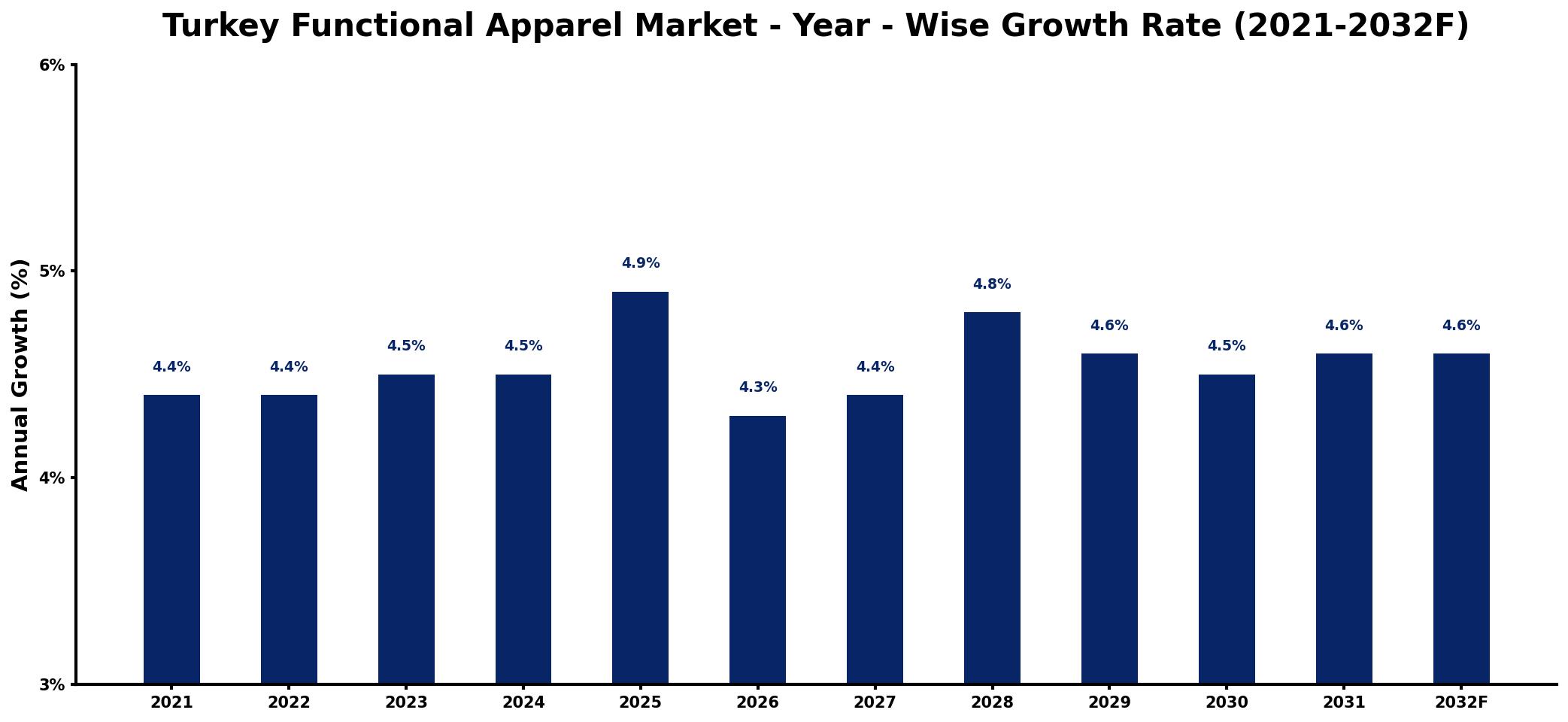
The table below presents the year‑wise growth rates along with the key drivers influencing the market
| Year | Growth Rate | Major Drivers |
| 2021 | 4.4% | Rising fitness consciousness among consumers |
| 2022 | 4.4% | Growing popularity of outdoor activities |
| 2023 | 4.5% | Increased investments in sustainable materials |
| 2024 | 4.5% | Expansion of e-commerce platforms |
| 2025 | 4.9% | increased domestic production output |
| 2026 | 4.3% | Emergence of innovative textile technologies |
| 2027 | 4.4% | Growth in athleisure fashion trends |
| 2028 | 4.8% | Increased consumer focus on performance |
| 2029 | 4.6% | strengthening underlying market demand |
| 2030 | 4.5% | enhanced product quality standards |
| 2031 | 4.6% | improved processing technologies adoption |
| 2032 | 4.6% | Increased awareness of climate impact |
Note: Market size estimations and growth projections presented in this report are based on 6Wresearch's proprietary forecasting methodology, utilizing the latest available industry data, government publications, and primary research inputs.
Turkey Functional Apparel Market Synopsis
Recently, the Turkey Functional Apparel Market has witnessed significant momentum, propelled by the growing awareness of health and fitness among the Turkish population. However, as this trend matures, the market is expected to shift towards more sophisticated apparel offerings that balance performance with style.
Looking ahead, the market is poised for steady growth as consumer preferences evolve towards multifunctional clothing suitable for both athletic and everyday settings. The infusion of innovative fabric technologies will further redefine consumer expectations, paving the way for new opportunities.
Turkey Functional Apparel Market Key Takeaways
- The market is growing steadily, with a projected increase in value from USD 230 Million to USD 300 Million by 2032.
- Consumer interest in health and fitness is a significant driver of demand for functional apparel.
- Innovations in fabric technology are enhancing the performance features of functional apparel.
- The expanding fashion industry is blending style with functionality, appealing to a broader audience.
- Government initiatives are fostering innovation and quality in textile manufacturing.
Evaluation of Restraints in Turkey Functional Apparel Market
Despite its growth potential, the Turkey Functional Apparel Market faces several restraints. High production costs associated with advanced fabric technologies are a significant barrier, limiting profitability for manufacturers. Furthermore, consumer education on the benefits of functional apparel remains inadequate, hindering market penetration. The increasing emphasis on sustainable practices presents an additional challenge, as manufacturers must adapt to meet consumer expectations for environmentally friendly products while maintaining quality and performance.
Turkey Functional Apparel Market Trends
Current trends in the Turkey Functional Apparel Market are focusing on advanced performance features such as moisture-wicking, UV protection, and thermal regulation. Additionally, the intersection of fashion and functionality is becoming increasingly prominent, with brands exploring stylish designs that cater to both athletic and casual consumers. The rise of e-commerce and social media is also shaping consumer engagement, enabling brands to connect directly with health-conscious customers.
Turkey Functional Apparel Market Opportunities
There are substantial growth opportunities in the Turkey Functional Apparel Market, particularly in targeting the youth demographic, which is increasingly drawn to fitness and outdoor activities. Additionally, there is room for brands to innovate in sustainable materials and production methods, catering to environmentally conscious consumers. Collaboration between technology and fashion could lead to groundbreaking products, enhancing the overall consumer experience.
Government Initiatives in the Turkey Functional Apparel Market
The Turkish government plays a vital role in supporting the functional apparel market by implementing policies that encourage innovation in textile manufacturing. Initiatives include funding for research and development in advanced fabric technologies and providing export incentives for functional apparel. The enforcement of quality standards ensures that products not only meet domestic expectations but also align with international performance and safety benchmarks.
Future Insights of the Turkey Functional Apparel Market
Looking toward 2026-2032, the Turkey Functional Apparel Market is expected to flourish as consumer preferences continue to evolve. The fusion of advanced technology with fashion will likely become a central theme, with brands investing in smart textiles that enhance performance. As health consciousness rises and lifestyles become increasingly active, the demand for functional apparel will undoubtedly gain momentum, shaping the future landscape of this dynamic market.
Turkey Functional Apparel Market Latest Developments (2025 - 2026)
Recent developments in the Turkey Functional Apparel Market indicate a growing focus on sustainability, with many brands beginning to adopt eco-friendly materials and practices. Additionally, collaborations between tech companies and apparel manufacturers are emerging, resulting in innovative products that emphasize performance. The shift towards online sales channels is also noticeable, as more consumers turn to e-commerce platforms for their functional apparel needs.
Turkey Functional Apparel Market - Key Attractiveness of the Report
- 10 Years of Market Numbers
- Historical Data Starting from 2022 to 2025
- Base Year: 2025
- Forecast Data until 2032
- Key Performance Indicators Impacting the Market
- Major Upcoming Developments and Projects
Key Highlights of the Report:
- Turkey Functional Apparel Market Outlook
- Market Size of Turkey Functional Apparel Market, 2025
- Forecast of Turkey Functional Apparel Market, 2032
- Historical Data and Forecast of Turkey Functional Apparel Revenues & Volume for the Period 2022-2032F
- Turkey Functional Apparel Market Trend Evolution
- Turkey Functional Apparel Market Drivers and Challenges
- Turkey Functional Apparel Price Trends
- Turkey Functional Apparel Porter's Five Forces
- Turkey Functional Apparel Industry Life Cycle
- Historical Data and Forecast of Turkey Functional Apparel Market Revenues & Volume By Product Type for the Period 2022-2032F
- Historical Data and Forecast of Turkey Functional Apparel Market Revenues & Volume By Sportswear for the Period 2022-2032F
- Historical Data and Forecast of Turkey Functional Apparel Market Revenues & Volume By Activewear for the Period 2022-2032F
- Historical Data and Forecast of Turkey Functional Apparel Market Revenues & Volume By Protective Clothing for the Period 2022-2032F
- Historical Data and Forecast of Turkey Functional Apparel Market Revenues & Volume By Others for the Period 2022-2032F
- Historical Data and Forecast of Turkey Functional Apparel Market Revenues & Volume By Application for the Period 2022-2032F
- Historical Data and Forecast of Turkey Functional Apparel Market Revenues & Volume By Sports Industry for the Period 2022-2032F
- Historical Data and Forecast of Turkey Functional Apparel Market Revenues & Volume By Outdoor Clothing for the Period 2022-2032F
- Historical Data and Forecast of Turkey Functional Apparel Market Revenues & Volume By Healthcare sector for the Period 2022-2032F
- Historical Data and Forecast of Turkey Functional Apparel Market Revenues & Volume By Distribution Channel for the Period 2022-2032F
- Historical Data and Forecast of Turkey Functional Apparel Market Revenues & Volume By Offline Store for the Period 2022-2032F
- Historical Data and Forecast of Turkey Functional Apparel Market Revenues & Volume By Online Store for the Period 2022-2032F
- Turkey Functional Apparel Import Export Trade Statistics
- Market Opportunity Assessment By Product Type
- Market Opportunity Assessment By Application
- Market Opportunity Assessment By Distribution Channel
- Turkey Functional Apparel Top Companies Market Share
- Turkey Functional Apparel Competitive Benchmarking By Technical and Operational Parameters
- Turkey Functional Apparel Company Profiles
- Turkey Functional Apparel Key Strategic Recommendations






































