Romania Functional Apparel Market Size, Share & Growth Rate
The Romania Functional Apparel Market was estimated at USD 297 Million in 2025 and is projected to reach USD 404 Million by 2032, growing at a CAGR of 4.5% from 2026 to 2032. This growth trajectory is driven by the rising health and fitness trends among consumers, coupled with advancements in fabric technologies that enhance performance and comfort. As demand for multifunctional clothing increases, particularly in sportswear and protective gear, the market is poised for substantial expansion.
Romania Functional Apparel Market Year-wise Growth Rate and Key Drivers
This graph highlights how the Romania Functional Apparel Market has steadily grown over the years, supported by major growth factors.
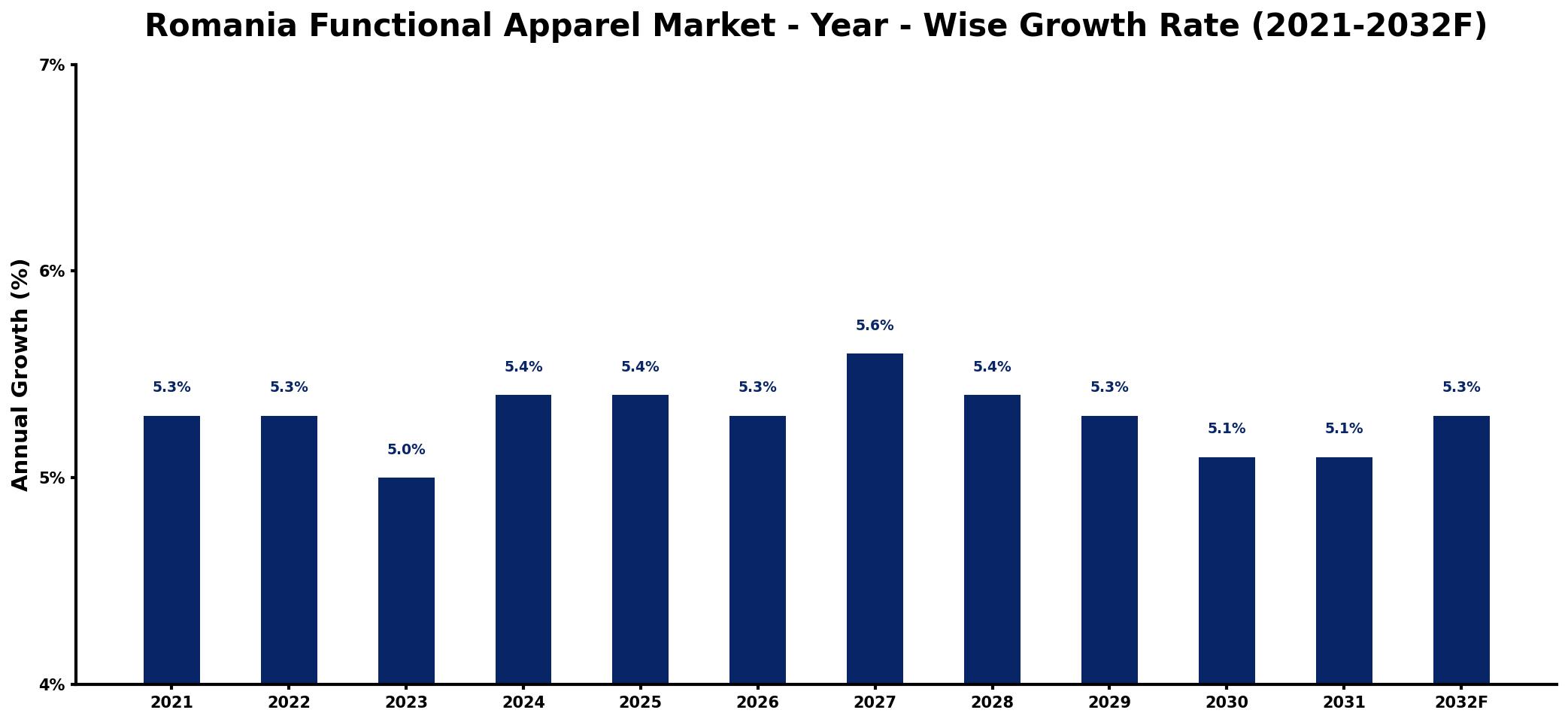
The table below presents the year‑wise growth rates along with the key drivers influencing the market
| Year | Growth Rate | Major Drivers |
| 2021 | 5.3% | increased consumer health awareness |
| 2022 | 5.3% | growing interest in sustainability |
| 2023 | 5.0% | rising fitness participation rates |
| 2024 | 5.4% | expansion of e-commerce platforms |
| 2025 | 5.4% | innovations in fabric technology |
| 2026 | 5.3% | increased disposable income levels |
| 2027 | 5.6% | enhanced marketing strategies implemented |
| 2028 | 5.4% | growth in outdoor activities popularity |
| 2029 | 5.3% | increased corporate wellness programs |
| 2030 | 5.1% | emerging trends in athleisure wear |
| 2031 | 5.1% | development of smart textiles market |
| 2032 | 5.3% | rising demand for customization options |
Note: Market size estimations and growth projections presented in this report are based on 6Wresearch's proprietary forecasting methodology, utilizing the latest available industry data, government publications, and primary research inputs.
Romania Functional Apparel Market Synopsis
In recent years, the Romania functional apparel market has experienced notable momentum, propelled by a growing awareness of health and wellness among the populace. As lifestyles shift toward more active engagements, the appeal of garments that offer specialized functions has intensified.
Looking ahead, the market is expected to evolve significantly. Innovations in smart textiles and sustainable materials will shape consumer preferences, while the integration of technology into apparel promises to enhance performance and usability in everyday life.
Romania Functional Apparel Market Key Takeaways
- Robust growth anticipated with increasing health consciousness among consumers.
- Technological advancements are enhancing fabric performance, encouraging adoption.
- Smart textiles and eco-friendly materials will dominate future innovations.
- Consumer education on functional garment benefits remains a crucial focus.
- Regulatory compliance and safety standards are becoming increasingly stringent.
Evaluation of Restraints in Romania Functional Apparel Market
Despite promising growth, the Romania functional apparel market encounters certain restraints that could hinder its progression. One primary limitation is the ongoing need for technological innovation in fabric development, which can be costly and time-consuming. Furthermore, the adoption of performance fabrics depends on consumer education regarding the benefits of these garments. Issues such as moisture management and thermal regulation remain significant for manufacturers who must ensure their products meet high performance standards. Lastly, navigating regulatory frameworks related to textile safety and environmental impact introduces additional challenges for apparel brands, potentially slowing down the pace of market expansion.
Romania Functional Apparel Market Trends
Current trends in the Romania functional apparel market reveal a strong consumer preference for multifunctional clothing that blends style and performance. As health and fitness culture continues to gain traction, sportswear equipped with moisture-wicking and UV protection features are increasingly in demand. Additionally, the integration of technology in apparel, such as wearable devices that track performance metrics, is emerging as a significant trend. Sustainable practices are also gaining importance, with consumers gravitating towards eco-friendly materials that minimize environmental impact.
Romania Functional Apparel Market Opportunities
The future holds considerable growth and investment opportunities in the Romania functional apparel market. Innovations in smart textiles and the development of multifunctional clothing promise to meet evolving consumer needs. There is a growing demand for apparel that offers specific functional benefits, such as thermal regulation and moisture management, especially among outdoor enthusiasts and athletes. Manufacturers who focus on sustainable sourcing and production practices will likely capture a significant market share, aligning with the increasing consumer demand for environmentally responsible products.
Government Initiatives in the Romania Functional Apparel Market
Government policies in Romania are becoming increasingly supportive of the functional apparel market, emphasizing regulation, innovation, and consumer safety. Initiatives focused on enhancing product quality and performance are being prioritized. Regulatory frameworks are evolving to address manufacturing standards, chemical safety, and labeling requirements, which aim to protect consumer health while fostering competitiveness in both domestic and international markets.
Future Insights of the Romania Functional Apparel Market
Looking toward 2026-2032, the Romania functional apparel market is expected to see sustained growth driven by technological advancements and shifting consumer preferences. The increasing incorporation of wearable technology into garments will redefine functionality, enhancing user experience and engagement. As sustainability continues to be a focal point, companies that invest in eco-friendly materials and processes are likely to gain a competitive edge. In addition, proactive consumer education initiatives will be essential to raise awareness about the advantages of functional apparel, further driving market adoption.
Romania Functional Apparel Market Latest Developments (2025 - 2026)
In the period from & to June 2026, the Romania functional apparel market has experienced significant developments, particularly in the realm of sustainability and technological innovation. Companies are increasingly focusing on creating products that utilize eco-friendly materials and processes. Concurrently, there is a rising trend toward incorporating smart technology into functional apparel, aiming to enhance the user experience and performance monitoring capabilities of garments. Collaboration among industry stakeholders is also on the rise to address consumer education regarding the benefits of functional apparel.
Romania Functional Apparel Market - Key Attractiveness of the Report
- 10 Years of Market Numbers
- Historical Data Starting from 2022 to 2025
- Base Year: 2025
- Forecast Data until 2032
- Key Performance Indicators Impacting the Market
- Major Upcoming Developments and Projects
Key Highlights of the Report:
- Romania Functional Apparel Market Outlook
- Market Size of Romania Functional Apparel Market, 2025
- Forecast of Romania Functional Apparel Market, 2032
- Historical Data and Forecast of Romania Functional Apparel Revenues & Volume for the Period 2022-2032F
- Romania Functional Apparel Market Trend Evolution
- Romania Functional Apparel Market Drivers and Challenges
- Romania Functional Apparel Price Trends
- Romania Functional Apparel Porter's Five Forces
- Romania Functional Apparel Industry Life Cycle
- Historical Data and Forecast of Romania Functional Apparel Market Revenues & Volume By Product Type for the Period 2022-2032F
- Historical Data and Forecast of Romania Functional Apparel Market Revenues & Volume By Sportswear for the Period 2022-2032F
- Historical Data and Forecast of Romania Functional Apparel Market Revenues & Volume By Activewear for the Period 2022-2032F
- Historical Data and Forecast of Romania Functional Apparel Market Revenues & Volume By Protective Clothing for the Period 2022-2032F
- Historical Data and Forecast of Romania Functional Apparel Market Revenues & Volume By Others for the Period 2022-2032F
- Historical Data and Forecast of Romania Functional Apparel Market Revenues & Volume By Application for the Period 2022-2032F
- Historical Data and Forecast of Romania Functional Apparel Market Revenues & Volume By Sports Industry for the Period 2022-2032F
- Historical Data and Forecast of Romania Functional Apparel Market Revenues & Volume By Outdoor Clothing for the Period 2022-2032F
- Historical Data and Forecast of Romania Functional Apparel Market Revenues & Volume By Healthcare sector for the Period 2022-2032F
- Historical Data and Forecast of Romania Functional Apparel Market Revenues & Volume By Distribution Channel for the Period 2022-2032F
- Historical Data and Forecast of Romania Functional Apparel Market Revenues & Volume By Offline Store for the Period 2022-2032F
- Historical Data and Forecast of Romania Functional Apparel Market Revenues & Volume By Online Store for the Period 2022-2032F
- Romania Functional Apparel Import Export Trade Statistics
- Market Opportunity Assessment By Product Type
- Market Opportunity Assessment By Application
- Market Opportunity Assessment By Distribution Channel
- Romania Functional Apparel Top Companies Market Share
- Romania Functional Apparel Competitive Benchmarking By Technical and Operational Parameters
- Romania Functional Apparel Company Profiles
- Romania Functional Apparel Key Strategic Recommendations






































