Mexico Functional Apparel Market Size, Share & Growth Rate
The Mexico Functional Apparel Market was estimated at USD 160 Million in 2025 and is projected to reach USD 186 Million by 2032, growing at a CAGR of 2.2% from 2026 to 2032. This growth is fueled by a heightened awareness of health and fitness among Mexican consumers, as well as an increased participation in outdoor activities. The market is also benefiting from the athleisure trend, as consumers increasingly seek multifunctional clothing that transitions seamlessly from the gym to daily life.
Mexico Functional Apparel Market Year-wise Growth Rate and Key Drivers
This graph highlights how the Mexico Functional Apparel Market has steadily grown over the years, supported by major growth factors.
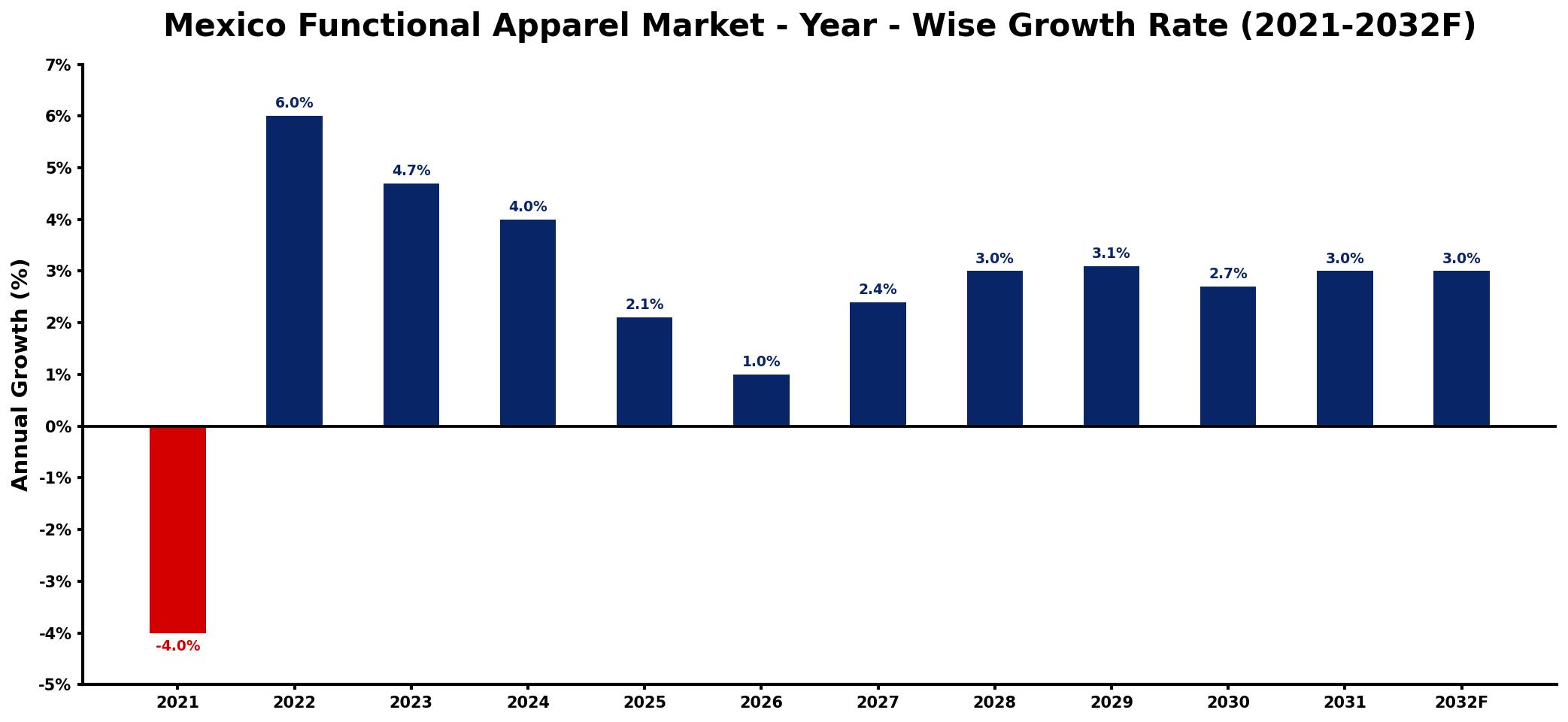
The table below presents the year‑wise growth rates along with the key drivers influencing the market
| Year | Growth Rate | Major Drivers |
| 2021 | -4.0% | Decreased consumer spending on essentials |
| 2022 | 6.0% | Growing health consciousness among consumers |
| 2023 | 4.7% | Rising popularity of outdoor activities |
| 2024 | 4.0% | Increased investment in sports facilities |
| 2025 | 2.1% | Expansion of online retail channels |
| 2026 | 1.0% | Emerging trends in sustainability initiatives |
| 2027 | 2.4% | Greater focus on fitness technology |
| 2028 | 3.0% | Enhanced marketing strategies for engagement |
| 2029 | 3.1% | Rising demand for customized options |
| 2030 | 2.7% | Growth in corporate wellness programs |
| 2031 | 3.0% | Increased collaborations with influencers |
| 2032 | 3.0% | Development of smart textile innovations |
Note: Market size estimations and growth projections presented in this report are based on 6Wresearch's proprietary forecasting methodology, utilizing the latest available industry data, government publications, and primary research inputs.
Mexico Functional Apparel Market Synopsis
In Mexico, the functional apparel segment is witnessing a surge in demand, with sportswear and activewear leading the charge as more individuals engage in fitness and recreational activities. This market is further supported by innovations in fabric technology, enhancing comfort and performance, thus attracting a wider audience.
The rise of athleisure as a fashion statement is pushing consumers towards apparel that combines functionality with style. This shift is prompting brands to develop versatile pieces that not only perform well during physical activities but also fit into everyday life, thereby expanding the target consumer base.
Mexico Functional Apparel Market Key Takeaways
- The increasing health consciousness is a significant driver for the functional apparel market.
- Innovative fabric technology is enhancing the performance attributes of functional apparel.
- Growing popularity of outdoor activities is encouraging the demand for specialized apparel.
- Athleisure trends are influencing consumer preferences, merging comfort with style.
- Consumer education on the benefits of functional apparel remains critical for market expansion.
Evaluation of Restraints in Mexico Functional Apparel Market
While the functional apparel market in Mexico shows promising growth, several restraints could impede its full potential. One of the foremost challenges is the varying levels of consumer awareness regarding the technical benefits of functional apparel. Many potential consumers remain unaware of features such as moisture-wicking, UV protection, and thermal regulation, which may limit their purchasing decisions. Furthermore, established brands in the apparel sector present strong competition, complicating market penetration for new entrants seeking to establish themselves in this dynamic landscape.
Mexico Functional Apparel Market Trends
Recent trends indicate a marked shift towards sustainability within the functional apparel sector. Consumers are increasingly favoring brands that prioritize eco-friendly materials and ethical production practices. Additionally, technological advancements are paving the way for smart textiles, which offer enhanced functionality, such as integrated fitness tracking capabilities. These trends not only appeal to environmentally conscious consumers but also provide exciting opportunities for innovation within the market.
Mexico Functional Apparel Market Opportunities
The Mexico Functional Apparel Market presents several avenues for growth and investment. There is a unique opportunity to cater to niche segments, including specific sports enthusiasts and outdoor adventure seekers, who require specialized apparel. Brands that focus on educating consumers about the advantages of functional apparel can also carve out significant market share. Moreover, the demand for women's activewear continues to rise, suggesting an untapped potential for targeting female consumers with stylish yet functional options.
Government Initiatives in the Mexico Functional Apparel Market
The Mexican government is actively fostering an environment conducive to innovation in the apparel sector. Initiatives that promote research and development in smart textiles, along with performance-enhancing fabrics, are being encouraged. Policies aimed at ensuring safety and performance standards in functional apparel further support market growth, providing a regulatory framework that benefits both manufacturers and consumers.
Future Insights of the Mexico Functional Apparel Market
As we look towards 2026-2032, the Mexico Functional Apparel Market is poised for continued growth. The increasing integration of technology in apparel, alongside a sustained consumer focus on health and wellness, will drive further market penetration. Additionally, as sustainability continues to gain traction, brands that prioritize eco-friendly practices are likely to resonate strongly with consumers. The future is bright for functional apparel, as it evolves to meet the dynamic needs of a health-conscious, style-savvy population.
Mexico Functional Apparel Market Latest Developments (2025 - 2026)
Recent developments in the functional apparel market indicate a trend towards increased collaborations between brands and technology firms. These partnerships aim to create innovative smart textiles that enhance performance during athletic activities. Furthermore, growing consumer engagement through social media is influencing brand strategies, driving a focus on personalization and consumer connection. Brands are also ramping up their efforts in sustainability, with initiatives aimed at reducing environmental impact becoming increasingly prominent.
Mexico Functional Apparel Market - Key Attractiveness of the Report
- 10 Years of Market Numbers
- Historical Data Starting from 2022 to 2025
- Base Year: 2025
- Forecast Data until 2032
- Key Performance Indicators Impacting the Market
- Major Upcoming Developments and Projects
Key Highlights of the Report:
- Mexico Functional Apparel Market Outlook
- Market Size of Mexico Functional Apparel Market, 2025
- Forecast of Mexico Functional Apparel Market, 2032
- Historical Data and Forecast of Mexico Functional Apparel Revenues & Volume for the Period 2022-2032F
- Mexico Functional Apparel Market Trend Evolution
- Mexico Functional Apparel Market Drivers and Challenges
- Mexico Functional Apparel Price Trends
- Mexico Functional Apparel Porter's Five Forces
- Mexico Functional Apparel Industry Life Cycle
- Historical Data and Forecast of Mexico Functional Apparel Market Revenues & Volume By Product Type for the Period 2022-2032F
- Historical Data and Forecast of Mexico Functional Apparel Market Revenues & Volume By Sportswear for the Period 2022-2032F
- Historical Data and Forecast of Mexico Functional Apparel Market Revenues & Volume By Activewear for the Period 2022-2032F
- Historical Data and Forecast of Mexico Functional Apparel Market Revenues & Volume By Protective Clothing for the Period 2022-2032F
- Historical Data and Forecast of Mexico Functional Apparel Market Revenues & Volume By Others for the Period 2022-2032F
- Historical Data and Forecast of Mexico Functional Apparel Market Revenues & Volume By Application for the Period 2022-2032F
- Historical Data and Forecast of Mexico Functional Apparel Market Revenues & Volume By Sports Industry for the Period 2022-2032F
- Historical Data and Forecast of Mexico Functional Apparel Market Revenues & Volume By Outdoor Clothing for the Period 2022-2032F
- Historical Data and Forecast of Mexico Functional Apparel Market Revenues & Volume By Healthcare sector for the Period 2022-2032F
- Historical Data and Forecast of Mexico Functional Apparel Market Revenues & Volume By Distribution Channel for the Period 2022-2032F
- Historical Data and Forecast of Mexico Functional Apparel Market Revenues & Volume By Offline Store for the Period 2022-2032F
- Historical Data and Forecast of Mexico Functional Apparel Market Revenues & Volume By Online Store for the Period 2022-2032F
- Mexico Functional Apparel Import Export Trade Statistics
- Market Opportunity Assessment By Product Type
- Market Opportunity Assessment By Application
- Market Opportunity Assessment By Distribution Channel
- Mexico Functional Apparel Top Companies Market Share
- Mexico Functional Apparel Competitive Benchmarking By Technical and Operational Parameters
- Mexico Functional Apparel Company Profiles
- Mexico Functional Apparel Key Strategic Recommendations






































