United Arab Emirates (UAE) Functional Apparel Market Size, Share & Growth Rate
The United Arab Emirates (UAE) Functional Apparel Market was estimated at USD 226 Million in 2025 and is projected to reach USD 299 Million by 2032, growing at a CAGR of 4.1% from 2026 to 2032. This growth trajectory is bolstered by a robust rise in health and fitness consciousness among the population, driving demand for specialized apparel that enhances performance. With the popularity of athleisure and the integration of technology in clothing, the sector is poised for a period of substantial advancement.
United Arab Emirates (UAE) Functional Apparel Market Year-wise Growth Rate and Key Drivers
This graph highlights how the United Arab Emirates (UAE) Functional Apparel Market has steadily grown over the years, supported by major growth factors.
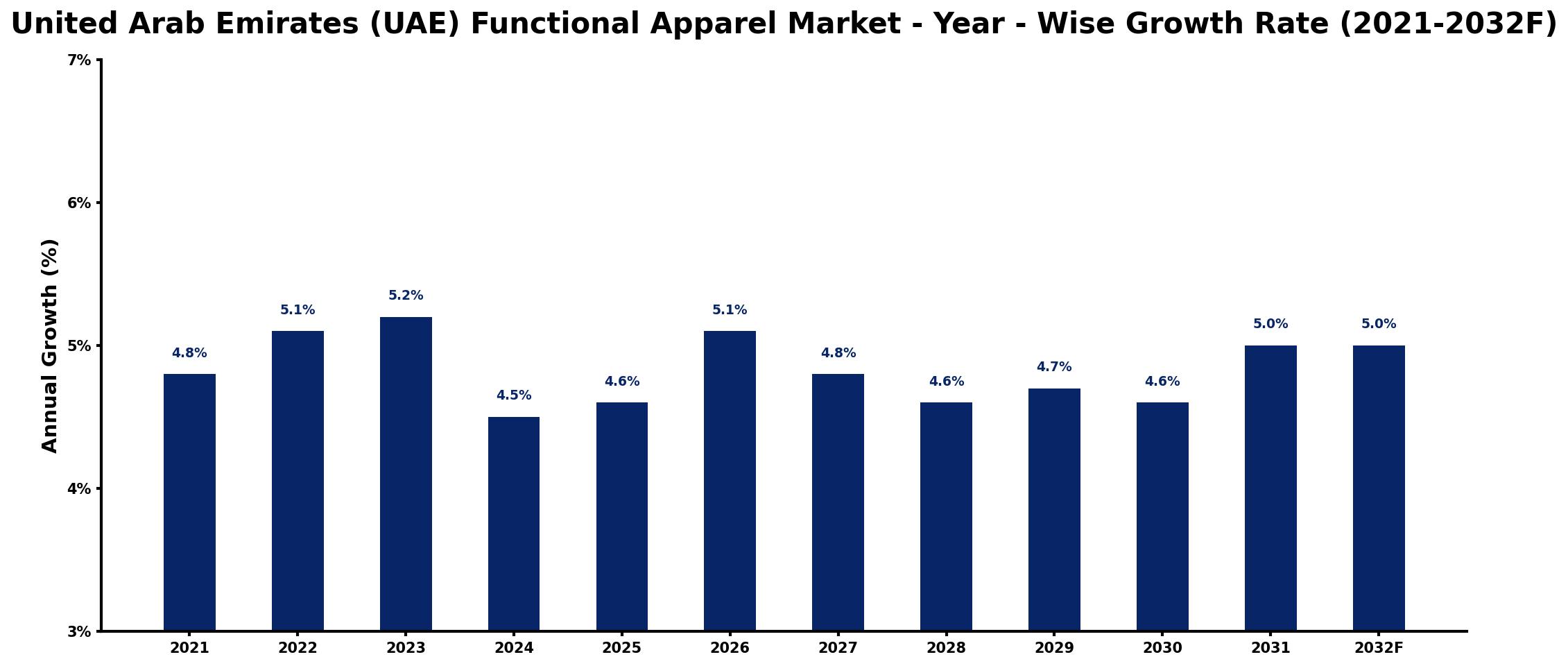
The table below presents the year‑wise growth rates along with the key drivers influencing the market
| Year | Growth Rate | Major Drivers |
| 2021 | 4.8% | Growing health and fitness trends |
| 2022 | 5.1% | Increase in outdoor activities participation |
| 2023 | 5.2% | Rise in eco-friendly materials demand |
| 2024 | 4.5% | Expansion of online retail platforms |
| 2025 | 4.6% | Surge in corporate wellness programs |
| 2026 | 5.1% | Investment in technological innovations |
| 2027 | 4.8% | Growing interest in athleisure lifestyle |
| 2028 | 4.6% | growing regional consumption patterns |
| 2029 | 4.7% | stronger distribution network expansion |
| 2030 | 4.6% | rising export shipment volumes |
| 2031 | 5.0% | Growing focus on sustainable production |
| 2032 | 5.0% | strengthening international trade flows |
Note: Market size estimations and growth projections presented in this report are based on 6Wresearch's proprietary forecasting methodology, utilizing the latest available industry data, government publications, and primary research inputs.
United Arab Emirates (UAE) Functional Apparel Market Synopsis
In the UAE, the increasing participation in sports and fitness activities is reshaping consumer preferences towards functional apparel. There is a notable demand for clothing that not only performs well in various environmental conditions but also fits seamlessly into daily life, blurring the lines between workout gear and everyday wear.
Furthermore, the UAEs harsh climate necessitates garments that provide UV protection and moisture management. As more consumers prioritize their health and physical activity, brands are innovating to offer products that meet these specific requirements while promoting a lifestyle of wellness.
United Arab Emirates (UAE) Functional Apparel Market Key Takeaways
- The market is driven by heightened health consciousness and fitness participation among UAE residents.
- Consumers are increasingly looking for apparel that combines performance and versatility.
- Technological innovations in fabric and design are influencing consumer choices.
- The growth of athleisure is supporting the functional apparel segment's expansion.
- Understanding consumer education and product benefits is vital for market players.
Evaluation of Restraints in United Arab Emirates (UAE) Functional Apparel Market
Despite the promising outlook, the UAE functional apparel market faces certain constraints. One significant hurdle is the need for consumer education regarding the advantages of performance-enhancing clothing. Effectively communicating these benefits requires strategic marketing initiatives that may demand considerable investment. Additionally, brands must continuously innovate to keep pace with rapid technological advancements in materials and design, balancing quality and durability with production costs to maintain competitiveness.
United Arab Emirates (UAE) Functional Apparel Market Trends
Current trends highlight a shift towards sustainability and eco-friendly materials within the functional apparel sector. Consumers are becoming more conscious of their environmental footprint and are increasingly opting for products made from recycled or organic materials. The incorporation of smart textiles, which offer enhanced performance through technology, is also gaining traction, aligning with the growing consumer demand for high-functioning apparel.
United Arab Emirates (UAE) Functional Apparel Market Opportunities
There are substantial opportunities for growth in niche segments of the functional apparel market in the UAE. Products tailored for specific outdoor activities, such as hiking and water sports, are gaining interest as residents explore more recreational options. Furthermore, the rising popularity of fitness events and sports competitions in the region presents avenues for brands to engage with health-focused consumers and showcase innovative products.
Government Initiatives in the United Arab Emirates (UAE) Functional Apparel Market
The UAE government has recognized the importance of promoting a healthy lifestyle among its citizens, which is reflected in various initiatives aimed at enhancing public health. Investments in sports infrastructure and funding for fitness-related events are aimed at fostering community engagement in physical activity. Additionally, policies supporting sustainability may encourage brands to innovate with eco-friendly functional apparel, aligning with national goals for environmental stewardship.
Future Insights of the United Arab Emirates (UAE) Functional Apparel Market
Looking ahead to 2026-2032, the UAE functional apparel market is likely to continue its upward trajectory as health and fitness become integral to lifestyle choices. The increasing prevalence of digital health tracking and fitness applications will further drive the demand for performance-oriented apparel. With technology enhancing clothing functionality, brands that prioritize innovation and sustainability will be well-positioned to capture the growing consumer interest.
United Arab Emirates (UAE) Functional Apparel Market Latest Developments (2025 - 2026)
Recently, the functional apparel market in the UAE has seen a surge in brands launching products that cater specifically to local climate conditions and consumer preferences. Innovations around moisture-wicking fabrics and UV-resistant materials are gaining prominence. Furthermore, collaborations between fitness influencers and brands are driving awareness and interest in functional apparel, signaling a dynamic shift towards more personalized marketing strategies in the region.
United Arab Emirates (UAE) Functional Apparel Market - Key Attractiveness of the Report
- 10 Years of Market Numbers
- Historical Data Starting from 2022 to 2025
- Base Year: 2025
- Forecast Data until 2032
- Key Performance Indicators Impacting the Market
- Major Upcoming Developments and Projects
Key Highlights of the Report:
- United Arab Emirates (UAE) Functional Apparel Market Outlook
- Market Size of United Arab Emirates (UAE) Functional Apparel Market, 2025
- Forecast of United Arab Emirates (UAE) Functional Apparel Market, 2032
- Historical Data and Forecast of United Arab Emirates (UAE) Functional Apparel Revenues & Volume for the Period 2022-2032F
- United Arab Emirates (UAE) Functional Apparel Market Trend Evolution
- United Arab Emirates (UAE) Functional Apparel Market Drivers and Challenges
- United Arab Emirates (UAE) Functional Apparel Price Trends
- United Arab Emirates (UAE) Functional Apparel Porter's Five Forces
- United Arab Emirates (UAE) Functional Apparel Industry Life Cycle
- Historical Data and Forecast of United Arab Emirates (UAE) Functional Apparel Market Revenues & Volume By Product Type for the Period 2022-2032F
- Historical Data and Forecast of United Arab Emirates (UAE) Functional Apparel Market Revenues & Volume By Sportswear for the Period 2022-2032F
- Historical Data and Forecast of United Arab Emirates (UAE) Functional Apparel Market Revenues & Volume By Activewear for the Period 2022-2032F
- Historical Data and Forecast of United Arab Emirates (UAE) Functional Apparel Market Revenues & Volume By Protective Clothing for the Period 2022-2032F
- Historical Data and Forecast of United Arab Emirates (UAE) Functional Apparel Market Revenues & Volume By Others for the Period 2022-2032F
- Historical Data and Forecast of United Arab Emirates (UAE) Functional Apparel Market Revenues & Volume By Application for the Period 2022-2032F
- Historical Data and Forecast of United Arab Emirates (UAE) Functional Apparel Market Revenues & Volume By Sports Industry for the Period 2022-2032F
- Historical Data and Forecast of United Arab Emirates (UAE) Functional Apparel Market Revenues & Volume By Outdoor Clothing for the Period 2022-2032F
- Historical Data and Forecast of United Arab Emirates (UAE) Functional Apparel Market Revenues & Volume By Healthcare sector for the Period 2022-2032F
- Historical Data and Forecast of United Arab Emirates (UAE) Functional Apparel Market Revenues & Volume By Distribution Channel for the Period 2022-2032F
- Historical Data and Forecast of United Arab Emirates (UAE) Functional Apparel Market Revenues & Volume By Offline Store for the Period 2022-2032F
- Historical Data and Forecast of United Arab Emirates (UAE) Functional Apparel Market Revenues & Volume By Online Store for the Period 2022-2032F
- United Arab Emirates (UAE) Functional Apparel Import Export Trade Statistics
- Market Opportunity Assessment By Product Type
- Market Opportunity Assessment By Application
- Market Opportunity Assessment By Distribution Channel
- United Arab Emirates (UAE) Functional Apparel Top Companies Market Share
- United Arab Emirates (UAE) Functional Apparel Competitive Benchmarking By Technical and Operational Parameters
- United Arab Emirates (UAE) Functional Apparel Company Profiles
- United Arab Emirates (UAE) Functional Apparel Key Strategic Recommendations






































