Pakistan Functional Apparel Market Size, Share & Growth Rate
The Pakistan Functional Apparel Market was estimated at USD 856 Million in 2025 and is projected to reach USD 1235 Million by 2032, growing at a CAGR of 5.4% from 2026 to 2032. This robust growth trajectory is primarily fueled by a significant shift in consumer behavior towards health and fitness, coupled with rising disposable incomes that empower consumers to invest in high-quality, performance-oriented apparel. Moreover, advancements in fabric technologies are contributing to the appeal of functional apparel, particularly among the younger demographic increasingly participating in sports and outdoor activities.
Pakistan Functional Apparel Market Year-wise Growth Rate and Key Drivers
This graph highlights how the Pakistan Functional Apparel Market has steadily grown over the years, supported by major growth factors.
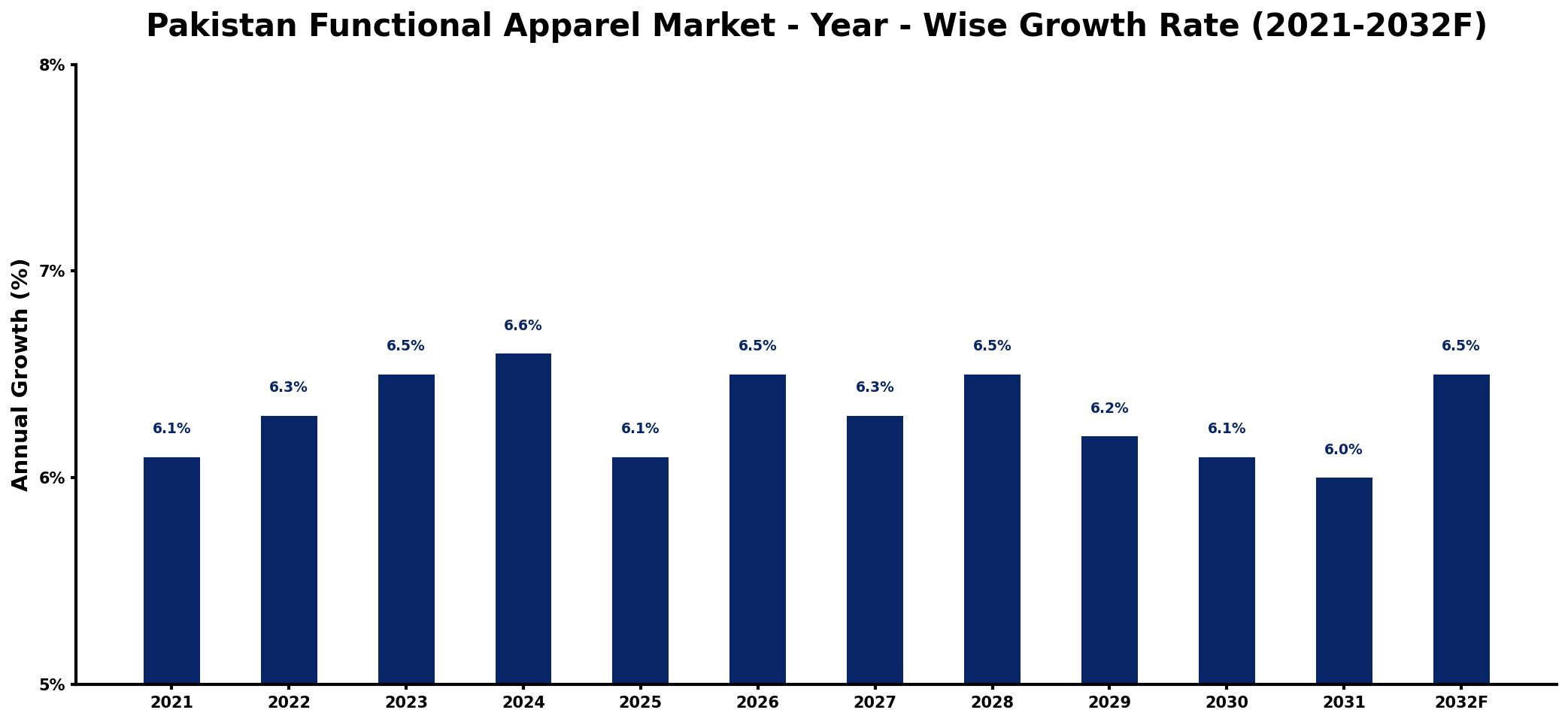
The table below presents the year‑wise growth rates along with the key drivers influencing the market
| Year | Growth Rate | Major Drivers |
| 2021 | 6.1% | Rising health consciousness among consumers |
| 2022 | 6.3% | Increased outdoor activities participation |
| 2023 | 6.5% | Growth in e-commerce platforms |
| 2024 | 6.6% | Expansion of fitness industry services |
| 2025 | 6.1% | Surge in urban lifestyle trends |
| 2026 | 6.5% | Enhanced technological innovations integration |
| 2027 | 6.3% | Growing influence of social media |
| 2028 | 6.5% | Increase in eco-friendly materials |
| 2029 | 6.2% | Rise in personalized consumer experiences |
| 2030 | 6.1% | stronger distribution network expansion |
| 2031 | 6.0% | Increased investment in local production |
| 2032 | 6.5% | Growth of sports events sponsorships |
Note: Market size estimations and growth projections presented in this report are based on 6Wresearch's proprietary forecasting methodology, utilizing the latest available industry data, government publications, and primary research inputs.
Pakistan Functional Apparel Market Synopsis
A prominent force shaping the Pakistan Functional Apparel Market is the growing health awareness among consumers. This awareness has prompted a surge in sports participation and demand for specialized clothing designed to enhance performance and comfort. As lifestyle trends evolve, consumers are more inclined to seek apparel that not only serves a functional purpose but also aligns with their active lifestyles.
Additionally, the expanding sports and fitness industry in Pakistan is a significant catalyst for market growth. As gyms, sports clubs, and recreational facilities proliferate, so does the demand for high-performance apparel. This growth signifies a substantial opportunity for manufacturers to innovate and cater to the evolving needs of a dynamic consumer base.
Pakistan Functional Apparel Market Key Takeaways
- The market is projected to grow from USD 856 Million in 2025 to USD 1235 Million by 2032.
- Health consciousness and fitness trends are key drivers of demand for functional apparel.
- Advancements in fabric technologies are enhancing product offerings in the market.
- Government initiatives are playing a supportive role in promoting the functional apparel sector.
- There is a growing inclination among consumers for specialized apparel with performance features.
Evaluation of Restraints in Pakistan Functional Apparel Market
Despite the promising growth outlook, the Pakistan Functional Apparel Market faces significant constraints. High production costs associated with advanced material and technology requirements pose challenges for manufacturers. The competition from traditional apparel, which is often more affordable, further complicates market penetration for functional apparel. As companies strive to balance quality with cost-effectiveness, these factors can inhibit their ability to capture a larger market share.
Pakistan Functional Apparel Market Trends
The functional apparel market is witnessing a notable trend towards eco-friendly and sustainable fabrics. As environmental awareness grows, consumers are increasingly favoring products that align with their values. Moreover, the introduction of smart textiles, which incorporate technology into clothing for added functionality, is gaining traction. These innovations not only enhance performance but also create a unique selling proposition for brands looking to differentiate themselves in a competitive landscape.
Pakistan Functional Apparel Market Opportunities
Opportunities for growth in the Pakistan Functional Apparel Market are manifold. With the increasing emphasis on health and fitness, there is a growing segment of consumers actively seeking specialized apparel tailored to their needs. Investing in research and development to create innovative products can lead to significant returns. Furthermore, penetrating the industrial sector with protective workwear presents an untapped market that can bolster overall growth.
Government Initiatives in the Pakistan Functional Apparel Market
The Pakistani government has initiated various policies to support the functional apparel market. These include subsidies for manufacturers, funding for research into advanced textile technologies, and the establishment of quality standards that enhance product performance. Additionally, programs promoting functional apparel usage in sports, healthcare, and industrial applications are further facilitating market expansion and encouraging manufacturers to innovate.
Future Insights of the Pakistan Functional Apparel Market
Looking ahead to 2026-2032, the Pakistan Functional Apparel Market is poised for considerable evolution. The convergence of health trends, technology advancements, and governmental support indicates a promising landscape for manufacturers and investors. As consumer preferences continue to shift towards performance-oriented and sustainable products, brands that adapt to these changes will likely capture a larger share of the market. Strategic collaborations and technological investments will be key to navigating this evolving terrain.
Pakistan Functional Apparel Market Latest Developments (2025 - 2026)
In recent months, the functional apparel market in Pakistan has experienced dynamic shifts, with increased collaborations between manufacturers and tech companies to incorporate smart textiles into functional apparel lines. Additionally, a surge in local brands emphasizing sustainability has been noted, reflecting changing consumer preferences. Trade fairs and exhibitions have also become platforms for showcasing innovative products, underscoring the market's potential for growth and development.
Pakistan Functional Apparel Market - Key Attractiveness of the Report
- 10 Years of Market Numbers
- Historical Data Starting from 2022 to 2025
- Base Year: 2025
- Forecast Data until 2032
- Key Performance Indicators Impacting the Market
- Major Upcoming Developments and Projects
Key Highlights of the Report:
- Pakistan Functional Apparel Market Outlook
- Market Size of Pakistan Functional Apparel Market, 2025
- Forecast of Pakistan Functional Apparel Market, 2032
- Historical Data and Forecast of Pakistan Functional Apparel Revenues & Volume for the Period 2022-2032F
- Pakistan Functional Apparel Market Trend Evolution
- Pakistan Functional Apparel Market Drivers and Challenges
- Pakistan Functional Apparel Price Trends
- Pakistan Functional Apparel Porter's Five Forces
- Pakistan Functional Apparel Industry Life Cycle
- Historical Data and Forecast of Pakistan Functional Apparel Market Revenues & Volume By Product Type for the Period 2022-2032F
- Historical Data and Forecast of Pakistan Functional Apparel Market Revenues & Volume By Sportswear for the Period 2022-2032F
- Historical Data and Forecast of Pakistan Functional Apparel Market Revenues & Volume By Activewear for the Period 2022-2032F
- Historical Data and Forecast of Pakistan Functional Apparel Market Revenues & Volume By Protective Clothing for the Period 2022-2032F
- Historical Data and Forecast of Pakistan Functional Apparel Market Revenues & Volume By Others for the Period 2022-2032F
- Historical Data and Forecast of Pakistan Functional Apparel Market Revenues & Volume By Application for the Period 2022-2032F
- Historical Data and Forecast of Pakistan Functional Apparel Market Revenues & Volume By Sports Industry for the Period 2022-2032F
- Historical Data and Forecast of Pakistan Functional Apparel Market Revenues & Volume By Outdoor Clothing for the Period 2022-2032F
- Historical Data and Forecast of Pakistan Functional Apparel Market Revenues & Volume By Healthcare sector for the Period 2022-2032F
- Historical Data and Forecast of Pakistan Functional Apparel Market Revenues & Volume By Distribution Channel for the Period 2022-2032F
- Historical Data and Forecast of Pakistan Functional Apparel Market Revenues & Volume By Offline Store for the Period 2022-2032F
- Historical Data and Forecast of Pakistan Functional Apparel Market Revenues & Volume By Online Store for the Period 2022-2032F
- Pakistan Functional Apparel Import Export Trade Statistics
- Market Opportunity Assessment By Product Type
- Market Opportunity Assessment By Application
- Market Opportunity Assessment By Distribution Channel
- Pakistan Functional Apparel Top Companies Market Share
- Pakistan Functional Apparel Competitive Benchmarking By Technical and Operational Parameters
- Pakistan Functional Apparel Company Profiles
- Pakistan Functional Apparel Key Strategic Recommendations






































