Italy Functional Apparel Market Size, Share & Growth Rate
The Italy Functional Apparel Market was estimated at USD 223 Million in 2025 and is projected to reach USD 247 Million by 2032, growing at a CAGR of 1.5% from 2026 to 2032. This steady growth trajectory is fueled by a robust consumer inclination towards active lifestyles and a notable rise in outdoor activities. As fitness becomes a lifestyle for many, the demand for performance-driven clothing that offers moisture-wicking properties, thermal regulation, and UV protection is surging.
Italy Functional Apparel Market Year-wise Growth Rate and Key Drivers
This graph highlights how the Italy Functional Apparel Market has steadily grown over the years, supported by major growth factors.
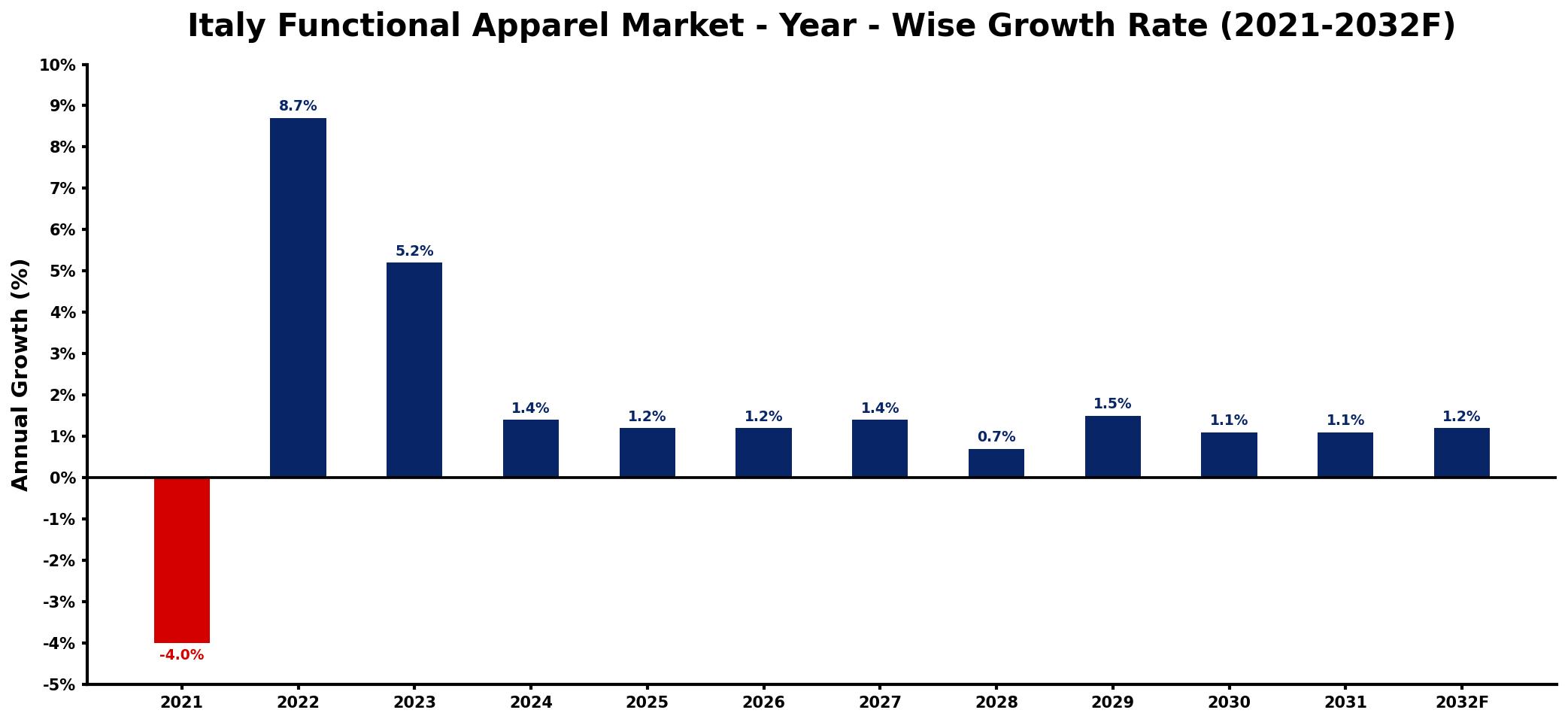
The table below presents the year‑wise growth rates along with the key drivers influencing the market
| Year | Growth Rate | Major Drivers |
| 2021 | -4.0% | Consumer spending on fitness declines |
| 2022 | 8.7% | Health consciousness drives market expansion |
| 2023 | 5.2% | Sustainable materials gain popularity |
| 2024 | 1.4% | E-commerce platforms enhance accessibility |
| 2025 | 1.2% | Athleisure trend attracts new consumers |
| 2026 | 1.2% | Technological innovations improve performance |
| 2027 | 1.4% | Collaborations with influencers increase visibility |
| 2028 | 0.7% | Diverse demographics drive product variety |
| 2029 | 1.5% | Investment in research and development |
| 2030 | 1.1% | Customization options attract loyal customers |
| 2031 | 1.1% | rising infrastructure development spending |
| 2032 | 1.2% | Retail partnerships expand distribution channels |
Note: Market size estimations and growth projections presented in this report are based on 6Wresearch's proprietary forecasting methodology, utilizing the latest available industry data, government publications, and primary research inputs.
Italy Functional Apparel Market Synopsis
In Italy, the trend of combining fashion with functionality is transforming the apparel landscape. Consumers are increasingly seeking versatile clothing that seamlessly transitions from athletic pursuits to everyday wear, making functional apparel not just a choice for athletes but a lifestyle statement.
This growing affinity for active living is further supported by innovations in fabric technology. Brands are leveraging advanced materials to enhance the functionality of apparel, ensuring that consumers enjoy both comfort and performance, whether they're at the gym, on a hiking trail, or navigating urban life.
Italy Functional Apparel Market Key Takeaways
- The market is gaining momentum due to an increasing focus on health and fitness among Italian consumers.
- Technological advancements in textile manufacturing are facilitating the production of high-performance functional apparel.
- There is a rising demand for sustainable and ethically produced functional clothing.
- Fashion-conscious consumers are integrating functional apparel into their daily wardrobes.
- Government initiatives are bolstering research and development in functional textile technologies.
Evaluation of Restraints in Italy Functional Apparel Market
Despite its growth, the Italy Functional Apparel Market faces significant challenges that hinder its full potential. One major restraint is the relentless pace of innovation required to stay ahead of consumer preferences. Brands must continuously invest in research and development to create apparel that meets diverse functional requirements, which can be costly and time-consuming. Additionally, the variable nature of consumer demand, often influenced by fleeting fashion trends and lifestyle changes, complicates inventory management and market forecasting. Lastly, the growing emphasis on sustainability requires brands to rethink their sourcing and production methods, further pressuring profit margins.
Italy Functional Apparel Market Trends
The functional apparel landscape in Italy is witnessing several transformative trends. First, the intersection of fashion and function is becoming increasingly pronounced, with more brands adopting aesthetic appeal alongside technical benefits. Another notable trend is the emphasis on eco-friendly materials as consumers prioritize sustainability, pushing brands to innovate with recycled and biodegradable fabrics. Furthermore, the integration of technology in clothing, such as smart fabrics that monitor health metrics, is gaining traction, appealing to tech-savvy consumers. Lastly, personalized apparel solutions, driven by advancements in manufacturing technology, are emerging as a sought-after offering.
Italy Functional Apparel Market Opportunities
With rising consumer expectations for performance and sustainability, a plethora of opportunities exist within the Italy Functional Apparel Market. Companies that focus on sustainable sourcing, paired with innovative functional features, can capture a growing demographic that values eco-conscious choices. Additionally, the expanding online retail landscape presents avenues for brands to reach niche markets, particularly among younger consumers who prioritize both convenience and unique product offerings. Collaborations with fitness influencers and local athletes can also enhance brand visibility and credibility, further unlocking market potential.
Government Initiatives in the Italy Functional Apparel Market
The Italian government is actively promoting innovation and sustainability within the functional apparel sector through various initiatives. Programs that encourage research and development in textile technologies, along with quality standards for performance claims, are being introduced. Furthermore, regulations around eco-friendly manufacturing practices and textile labeling enhance transparency and consumer trust. By supporting sustainable fashion initiatives, the government is not only fostering market growth but also positioning Italy as a leader in sustainable functional apparel.
Future Insights of the Italy Functional Apparel Market
Looking ahead to 2026-2032, the Italy Functional Apparel Market is expected to evolve significantly. As health and fitness continue to permeate everyday lifestyles, demand for functional clothing is likely to grow, supported by advancements in technology and material science. The push towards sustainability will remain a key driver, necessitating a shift in production methods. Brands that can adeptly navigate these trends and respond to consumer preferences will be positioned for success in this dynamic market. Moreover, collaborations across sectors, such as technology and fashion, may create innovative solutions that enhance consumer experiences.
Italy Functional Apparel Market Latest Developments (2025 - 2026)
In the recent months, the Italy Functional Apparel Market has seen a surge in brand collaborations that focus on merging technology with performance wear. Initiatives aimed at creating sustainable fabrics have gained momentum, with several brands committing to eco-friendly sourcing practices. Additionally, the popularity of outdoor activities, bolstered by tourism initiatives, has further driven the demand for versatile functional apparel. Consumers are increasingly engaging with brands through social media campaigns, highlighting the importance of digital presence in today's market.
Italy Functional Apparel Market - Key Attractiveness of the Report
- 10 Years of Market Numbers
- Historical Data Starting from 2022 to 2025
- Base Year: 2025
- Forecast Data until 2032
- Key Performance Indicators Impacting the Market
- Major Upcoming Developments and Projects
Key Highlights of the Report:
- Italy Functional Apparel Market Outlook
- Market Size of Italy Functional Apparel Market, 2025
- Forecast of Italy Functional Apparel Market, 2032
- Historical Data and Forecast of Italy Functional Apparel Revenues & Volume for the Period 2022-2032F
- Italy Functional Apparel Market Trend Evolution
- Italy Functional Apparel Market Drivers and Challenges
- Italy Functional Apparel Price Trends
- Italy Functional Apparel Porter's Five Forces
- Italy Functional Apparel Industry Life Cycle
- Historical Data and Forecast of Italy Functional Apparel Market Revenues & Volume By Product Type for the Period 2022-2032F
- Historical Data and Forecast of Italy Functional Apparel Market Revenues & Volume By Sportswear for the Period 2022-2032F
- Historical Data and Forecast of Italy Functional Apparel Market Revenues & Volume By Activewear for the Period 2022-2032F
- Historical Data and Forecast of Italy Functional Apparel Market Revenues & Volume By Protective Clothing for the Period 2022-2032F
- Historical Data and Forecast of Italy Functional Apparel Market Revenues & Volume By Others for the Period 2022-2032F
- Historical Data and Forecast of Italy Functional Apparel Market Revenues & Volume By Application for the Period 2022-2032F
- Historical Data and Forecast of Italy Functional Apparel Market Revenues & Volume By Sports Industry for the Period 2022-2032F
- Historical Data and Forecast of Italy Functional Apparel Market Revenues & Volume By Outdoor Clothing for the Period 2022-2032F
- Historical Data and Forecast of Italy Functional Apparel Market Revenues & Volume By Healthcare sector for the Period 2022-2032F
- Historical Data and Forecast of Italy Functional Apparel Market Revenues & Volume By Distribution Channel for the Period 2022-2032F
- Historical Data and Forecast of Italy Functional Apparel Market Revenues & Volume By Offline Store for the Period 2022-2032F
- Historical Data and Forecast of Italy Functional Apparel Market Revenues & Volume By Online Store for the Period 2022-2032F
- Italy Functional Apparel Import Export Trade Statistics
- Market Opportunity Assessment By Product Type
- Market Opportunity Assessment By Application
- Market Opportunity Assessment By Distribution Channel
- Italy Functional Apparel Top Companies Market Share
- Italy Functional Apparel Competitive Benchmarking By Technical and Operational Parameters
- Italy Functional Apparel Company Profiles
- Italy Functional Apparel Key Strategic Recommendations






































