India Baby Care Products Market Size & Growth Rate
According to 6Wresearch internal database and industry insights, the India Baby Care Products Market was valued at USD 6.1 billion in 2025 and is projected to reach USD 13.07 billion by 2032, growing at a CAGR of approximately 11.5% during the forecast period (2026–2032).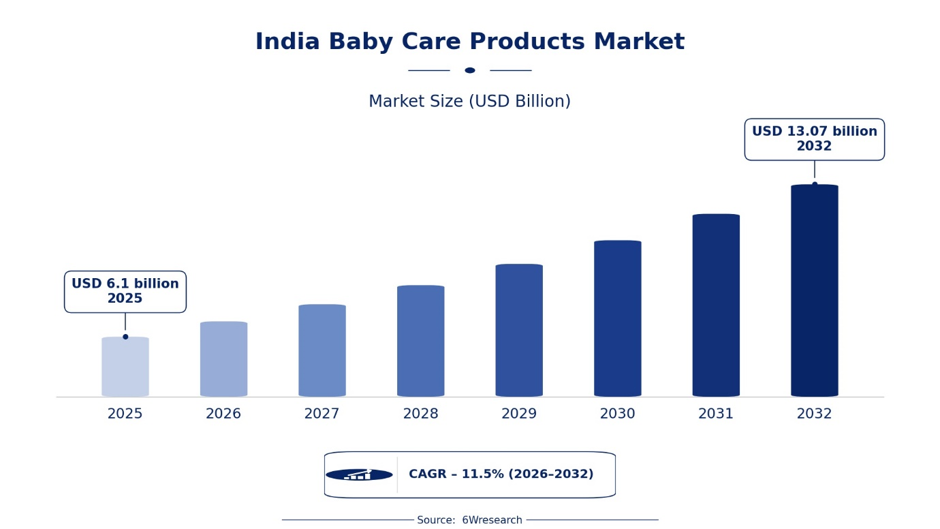
India Baby Care Products Market Highlights
| Report Metric | Details |
| Report Name | India Baby Care Products Market |
| Market Size 2025 | USD 6.1 billion |
| Market Size 2032 | USD 13.07 billion |
| Absolute Growth 2025–2032 | USD 6.97 billion |
| CAGR 2026–2032 | 11.5% |
| Peak Annual Growth | 13.2% in 2029 |
| Forecast Period (2026–2032) | 2026–2032 |
| Historical Data (2022–2025) | 2022–2025 |
| Base Year (2025) | 2025 |
| Leading Product Segments, 2025 | Baby Food Market (41% share) |
| Fastest-Growing Product Segments | Baby Diaper Market (12.8% CAGR) |
| Leading Distribution Channels, 2025 | Super/Hyper Market (33% share) |
| Fastest-Growing Distribution Channels | Online Store (15.2% CAGR) |
| Leading Regions, 2025 | Western (29% share) |
| Fastest-Growing Regions | Eastern (12.9% CAGR) |
| Growing Sector | Online retail and rapid-delivery platforms for baby care products |
| Key End Users | Households with infants and toddlers, maternity hospitals and nursing homes, paediatric clinics, creches and day-care centres, and institutional nutrition programmes |
India Baby Care Products Market Year-wise Growth Rate and Key Drivers (2022–2032)
This graph illustrates the annual growth rates of the market from 2022 to 2032, highlighting a steady upward trajectory and projected market expansion over the forecast period.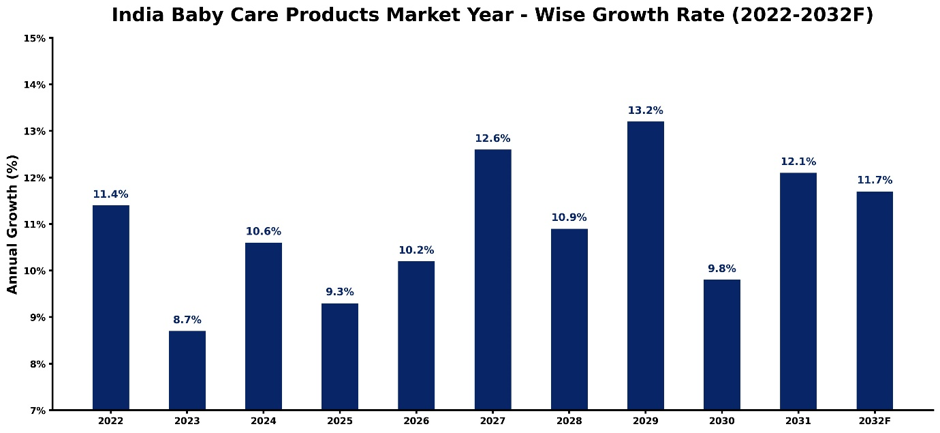 The following table presents the estimated annual growth rate for each year together with the principal factor influencing market performance.
| Year | Estimated Annual Growth (%) | Market Rationale |
| 2022 | 11.4% | The reopening of retail outlets and maternity services after pandemic restrictions restored household purchases and produced a strong rebound. |
| 2023 | 8.7% | Elevated dairy and packaging costs led companies to raise prices, which moderated volume growth despite steady birth numbers. |
| 2024 | 10.6% | The August 2024 listing of FirstCry increased investment in specialised baby retail and widened product choice for urban parents. |
| 2025 | 9.3% | Slower urban consumption during 2025 tempered discretionary spending and led some parents to trade down to value packs. |
| 2026 | 10.2% | The full-year effect of the September 2025 GST cut on diapers is expected to lower prices and lift purchases. |
| 2027 | 12.6% | Wider distributor networks and small pack sizes are expected to extend branded products into rural and tier-two households. |
| 2028 | 10.9% | Higher imported pulp and polymer costs are expected to raise diaper prices and temper volume growth. |
| 2029 | 13.2% | Rising incomes and premium range launches are expected to lift average spending per child to the strongest level. |
| 2030 | 9.8% | A shrinking annual birth cohort as fertility stays below replacement level is expected to reduce the inflow of new buyers. |
| 2031 | 12.1% | Growth in subscription and repeat-delivery models is expected to raise purchase frequency among urban parents and revive growth. |
| 2032 | 11.7% | Higher base values and approaching maturity in metropolitan markets are expected to ease growth towards a stable level. |
Note: Market size estimations and growth projections presented in this report are based on 6Wresearch’s proprietary forecasting methodology, utilizing the latest available industry data, government publications, and primary research inputs.
India Baby Care Products Market Synopsis
The India Baby Care Products Market is projected to expand in the coming years, supported by roughly 23 million annual births, rising incomes in nuclear families, expanding delivery networks in tier-two cities and wider acceptance of branded infant nutrition among working mothers. Greater use of paediatrician-recommended skincare also supports repeat purchases. The baby care products encompass infant food, diapers, and skin, hair and bathing products used for newborns and toddlers
Market Dynamics Impact Analysis (2026–2032)
| Factor | Type | Impact | Primary Segment Affected |
| Rising incomes among urban nuclear families | Driver | High | Baby Skin & Hair Care Products Market |
| Expansion of online and rapid-delivery retail | Driver | High | Online Store |
| Premium, organic and clean-label product demand | Opportunity | High | Baby Skin & Hair Care Products Market |
| Wider diaper adoption in tier-two and tier-three cities | Opportunity | Medium | Baby Diaper Market |
| Price sensitivity in rural households | Restraint | High | Baby Diaper Market |
| Declining fertility rate | Restraint | Medium | Baby Food Market |
| Split regulatory oversight for food and cosmetics | Challenge | Medium | Baby Food Market |
| Discount-led competition on digital platforms | Challenge | Medium | Online Store |
Evaluation of Drivers in India Baby Care Products Market (2026–2032)
Below mentioned are some major drivers and their influence on market dynamics:
| Drivers | Primary Segment Affected | Why It Matters (Evidence) |
| Large and steady birth volumes | Baby Food Market | About 23 million births each year create a continuous base of first-time parents who buy diapers, food and skincare repeatedly during the first three years. |
| Growth of quick commerce and online retail | Online Store | Quick commerce platforms such as Blinkit, Zepto and Swiggy Instamart deliver diapers and formula within minutes, which raises purchase frequency among time-pressed urban parents. |
| Lower GST on baby diapers | Baby Diaper Market | The September 2025 cut in GST on baby diapers from 12 percent to 5 percent lowers shelf prices and widens affordability for price-sensitive households. |
| Ingredient awareness and premium preference | Baby Skin & Hair Care Products Market | Higher ingredient awareness among millennial parents has lifted demand for toxin-free and ayurvedic products, a gap addressed by Mamaearth and Himalaya ranges. |
| Focus on child nutrition | Baby Food Market | Inhibiting affecting 35.5 percent of children under five keeps fortified complementary foods in focus, encouraging parents to buy branded infant cereals and formula. |
In India, the growth of market is supported by rising household incomes and steady urbanisation, with around 36 percent of the population now living in towns and cities where branded childcare products are easier to access. Higher female workforce participation, now above 40 percent, increases reliance on convenient, ready-to-use childcare solutions.
Apart from this, expanding smartphone use and digital payments are widening awareness of product choices and brand information among young parents. Further, growing private investment in local manufacturing and packaging capacity by multinational and domestic companies is improving supply reliability, while stronger cold-chain and last-mile logistics infrastructure is extending the reach of products to smaller cities.
Evaluation of Restraints in India Baby Care Products Market
Below mentioned are some major restraints and their influence on market dynamics:
| Market Restraint | Primary Segment Affected | Why It Matters (Evidence) |
| Price sensitivity in rural households | Baby Diaper Market | With about 64 percent of Indians living in rural areas, high per-diaper cost against cloth alternatives keeps usage occasional and restricts volume growth outside cities. |
| Declining fertility rate | Baby Food Market | Fertility of about 2.0 births per woman sits below the replacement level, gradually shrinking the number of new infants entering the customer base. |
| Limits on infant formula promotion | Baby Food Market | Infant formula makers must follow the 1992 infant milk substitutes law, which bars advertising of formula, so brand building relies on costlier channels. |
| Dependence on imported raw materials | Baby Diaper Market | Diaper makers import much of their fluff pulp and superabsorbent polymer, so currency swings and global pulp price changes erode margins and force price increases. |
| Thin organised retail beyond major cities | Super/Hyper Market | Thin organised retail presence beyond major cities keeps buyers reliant on kirana stores with narrow ranges, limiting access to branded infant products and premium baby care lines. |
India Baby Care Products Market Challenges
Several structural challenges affect the expansion of the India Baby Care Products Industry. Scrutiny of added sugar in infant cereals in April 2024 showed how rapidly safety concerns can erode parental trust, forcing brands to reformulate and fund transparent testing that slows product launches. Moreover, heavy discounting on quick commerce platforms, where 10-minute delivery has become the benchmark, compresses margins and weakens loyalty among price-aware parents. The regulatory oversight is also divided between two authorities, one for infant nutrition and one for baby cosmetics; therefore, multi-category brands manage parallel approvals, labelling formats and audits that lengthen go-to-market timelines.
India Baby Care Products Market Trends
Below mentioned are some of the trends shaping the India Baby Care Products Market growth:
- Natural and Ayurvedic Formulations Emerging as the Mainstream Choice: Parents increasingly read ingredient labels and prefer paraben-free, plant-based products, so brands are reformulating existing lines and launching ayurvedic variants, favouring suppliers of certified natural ingredients.
- Shift from Cloth and Tape-Style Nappies to Pant-Style Diapers: Parents are adopting pull-up diapers for easier changing and better fit, and manufacturers are adding value-priced pant packs, which favours producers with flexible, high-speed converting lines.
- Moving From Homemade to Fortified Packaged Weaning Foods: Working parents have been selecting fortified cereals and purees, and there are millet-based options after the 2023 International Year of Millets, meaning that manufacturers need dependable fortification and clear labeling.
- Omnichannel Retailers of Digital-First Brands: There are now digital-first brands like FirstCry establishing offline stores and presence at chemists to gain customers’ trust through sampling, thus benefiting those that provide shelf space and field support.
Investment Opportunities in the India Baby Care Products Market
Key opportunities in the India Baby Care Products Market are mentioned below:
- Contract Manufacturing of Diapers and Wipes: Rising private-label and digital-first brand demand needs outsourced capacity; investors can set up pant-style diaper and wipe lines near Gujarat or Tamil Nadu ports, supplying brands under multi-year contracts.
- Fortified and Millet-Based Infant Nutrition: Parents want clean-label weaning foods, so investors can fund spray-drying and extrusion facilities for fortified cereals and purees, entering through FSSAI-licensed co-packers or by acquiring regional dairy and cereal processors.
- Clinically Positioned Baby Skincare Brands: Paediatrician endorsement is becoming a purchase trigger, creating room for dermatologically tested lotion, shampoo and wash ranges; investors can partner with Indian dermatology labs and pharmacy distributors to build credibility.
- Eco-Friendly Diaper Materials and Biodegradable Wipes: Growing waste concerns around disposable diapers create space for bamboo-fibre and plant-based absorbent materials; investors can set up pilot lines with university research partners and sell through premium online channels.
Leading Players in India Baby Care Products Market
Below is a detailed list of major companies active in the India Baby Care Products Market:
1. Nestle India Limited
| Company Name | Nestle India Limited |
|---|---|
| Established Year | 1959 |
| Headquarters | Gurugram, India |
| Official Website | Click Here |
Nestlé India Limited is the Indian arm of the global food company and supplies infant formula and infant cereals through a well-established national distribution network.
2. Johnson & Johnson
| Company Name | Johnson & Johnson |
|---|---|
| Established Year | 1886 |
| Headquarters | New Brunswick, United States |
| Official Website | Click Here |
Johnson & Johnson markets baby skincare, bathing, and haircare products in India through its consumer health operations and is among the long-established brands trusted by parents.
3. Procter & Gamble
| Company Name | Procter & Gamble |
|---|---|
| Established Year | 1837 |
| Headquarters | Cincinnati, United States |
| Official Website | Click Here |
Procter & Gamble sells Pampers diapers and related hygiene products through its Indian subsidiary, contributing to the wider use of branded diapers in urban households.
4. Kimberly-Clark
| Company Name | Kimberly-Clark |
|---|---|
| Established Year | 1872 |
| Headquarters | Irving, United States |
| Official Website | Click Here |
Kimberly-Clark offers Huggies diapers and wipes in India through its business operations and plays a role in the premium segment of the diaper category.
5. Himalaya Wellness Company
| Company Name | Himalaya Wellness Company |
|---|---|
| Established Year | 1930 |
| Headquarters | Bengaluru, India |
| Official Website | Click Here |
Himalaya Wellness Company is an Indian herbal healthcare firm whose baby care range includes lotions, shampoos, and powders distributed through pharmacies, retail outlets, and online channels.
Government Initiatives in the India Baby Care Products Market
Government policy influences the market through maternal health support, child nutrition programs and product safety rules. The Pradhan Mantri Matru Vandana Yojana was launched in 2017 and provides Rs 5,000 cash assistance to eligible first-time mothers for expenses related to newborn essentials. The Poshan Abhiyaan, launched in 2018, aims at reducing stunting by 2 percentage points every year, while sustaining nutrition awareness.
Further, the Food Safety and Standards (Foods for Specialized Infant Nutrition) Regulations, 2020 set out the composition and labeling requirements for infant foods. Further, the Food Safety and Standards Authority of India licenses and inspects manufacturers of infant food and the Central Drugs Standard Control Organization oversees baby cosmetics under the Cosmetics Rules, 2020.
Future Insight of the India Baby Care Products Market
In the future, the India Baby Care Products Market Growth will be shaped by rising parental awareness of hygiene, nutrition and early childhood development, which will encourage higher-quality purchases. Investment in maternity and paediatric healthcare facilities will widen professional guidance on infant care.
In addition, planning under the Viksit Bharat 2047 vision and the early childhood priorities of the 2020 national education policy is expected to raise household spending on child development. Advances in material science, safer preservatives and traceable supply chains will give manufacturers new ways to differentiate their offerings and build lasting trust with parents.
Market Segmentation Analysis
The report offers a comprehensive study of the market across its key segments. The chart below highlights the leading segment by market share in 2025 and the fastest-growing segment by CAGR over 2026–2032, followed by a detailed analysis of each segment.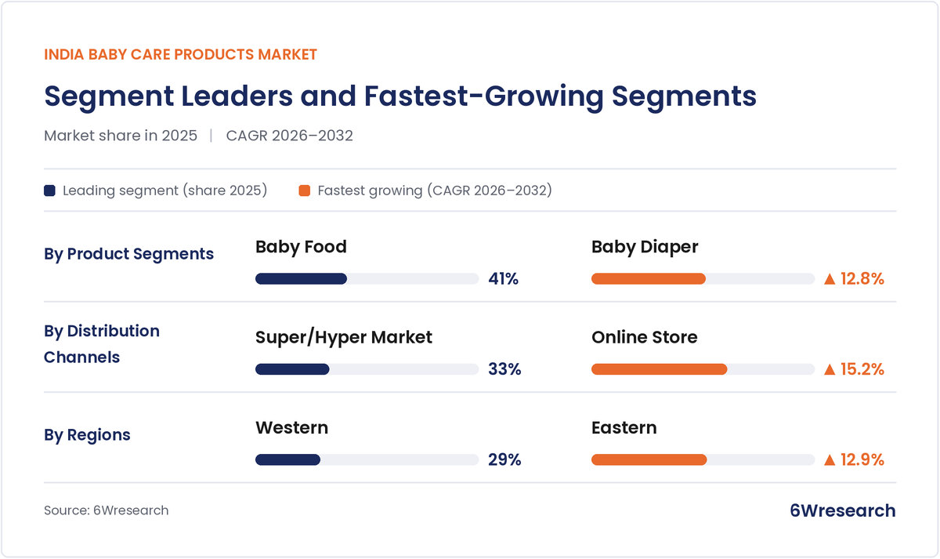
By Product Segments – Baby Food Market Leads, Baby Diaper Market Expected to Grow Fastest
According to Ravi Bhandari, Research Head, 6Wresearch, the Baby Food Market accounted for 41% of the market share in 2025, supported by India’s large infant population and the early adoption of branded formula and cereals among working mothers.
Meanwhile, the Baby Diaper Market is expected to record the fastest CAGR of 12.8% during 2026–2032, driven by rising pant-style adoption, wider distribution in tier-two cities and lower GST rates.
By Distribution Channels – Super/Hyper Market Leads, Online Store Expected to Grow Fastest
Among distribution channels, Super/Hyper Market held the largest share of the market with nearly 33% in 2025, backed by growing organised retail chains, in-store promotions and monthly family shopping habits in metropolitan areas.
In parallel, the Online Store is projected to expand at the fastest CAGR of 15.2% during 2026–2032, fuelled by rapid delivery networks, wider smartphone uses and the preference for doorstep delivery of repeat-purchase items.
By Regions – Western Leads, Eastern Expected to Grow Fastest
The Western region accounted for 29% of the India Baby Care Products Market Share in 2025, owing to higher household incomes and dense retail and hospital networks in Maharashtra and Gujarat.
On the other hand, the Eastern is expected to register the fastest CAGR of 12.9% during 2026–2032 due to rising urban incomes in West Bengal and Odisha, expanding organised retail and improving maternity services.
Key Attractiveness of the Report
- 10 Years of Market Numbers
- Historical Data Starting from 2022 to 2025
- Base Year 2025
- Forecast Data until 2032
- Key Performance Indicators Impacting the Market
- Major Upcoming Developments and Projects
Key Highlights of the Report:
- India Baby Care Products Market Outlook
- Market Size of India Baby Care Products Market, 2025
- Forecast of India Baby Care Products Market, 2032
- Historical Data and Forecast of India Baby Care Products Revenues & Volume for the Period 2022-2032
- India Baby Care Products Market Trend Evolution
- India Baby Care Products Market Drivers and Challenges
- India Baby Care Products Price Trends
- India Baby Care Products Porter’s Five Forces
- India Baby Care Products Industry Life Cycle
- Historical Data and Forecast of India Baby Care Products Market Revenues & Volume by Product Segment for the Period 2022–2032
- Historical Data and Forecast of India Baby Care Products Market Revenues & Volume by Baby Food for the Period 2022–2032
- Historical Data and Forecast of India Baby Care Products Market Revenues & Volume by Baby Diapers for the Period 2022–2032
- Historical Data and Forecast of India Baby Care Products Market Revenues & Volume by Baby Skin & Hair Care Products for the Period 2022–2032
- Historical Data and Forecast of India Baby Care Products Market Revenues & Volume by Distribution Channel for the Period 2022–2032
- Historical Data and Forecast of India Baby Care Products Market Revenues & Volume by Supermarkets/Hypermarkets for the Period 2022–2032
- Historical Data and Forecast of India Baby Care Products Market Revenues & Volume by Online Stores for the Period 2022–2032
- Historical Data and Forecast of India Baby Care Products Market Revenues & Volume by Exclusive Stores for the Period 2022–2032
- Historical Data and Forecast of India Baby Care Products Market Revenues & Volume by Pharmacy Stores for the Period 2022–2032
- Historical Data and Forecast of India Baby Care Products Market Revenues & Volume by Door-to-Door Selling for the Period 2022–2032
- Historical Data and Forecast of India Baby Care Products Market Revenues & Volume by Region for the Period 2022–2032
- Historical Data and Forecast of India Baby Care Products Market Revenues & Volume by Northern for the Period 2022–2032
- Historical Data and Forecast of India Baby Care Products Market Revenues & Volume by Eastern for the Period 2022–2032
- Historical Data and Forecast of India Baby Care Products Market Revenues & Volume by Western for the Period 2022–2032
- Historical Data and Forecast of India Baby Care Products Market Revenues & Volume by Southern for the Period 2022–2032
- India Baby Care Products Import-Export Trade Statistics
- Market Opportunity Assessment by Product Segment
- Market Opportunity Assessment by Distribution Channel
- Market Opportunity Assessment by Region
- India Baby Care Products Top Companies Market Share
- India Baby Care Products Competitive Benchmarking by Technical and Operational Parameters
- India Baby Care Products Company Profiles
- India Baby Care Products Key Strategic Recommendations
Market Covered
The report offers an extensive study of the following market segments:
By Product Segments
- Baby Food Market
- Baby Diaper Market
- Baby Skin & Hair Care Products Market
By Distribution Channels
- Super/Hyper Market
- Online Store
- Exclusive Stores
- Pharmacy Stores
- Door to Door Selling
By Regions
- Northern
- Eastern
- Western
- Southern
































