India Advanced Driving Assistance Systems (ADAS) Market Size & Growth Rate
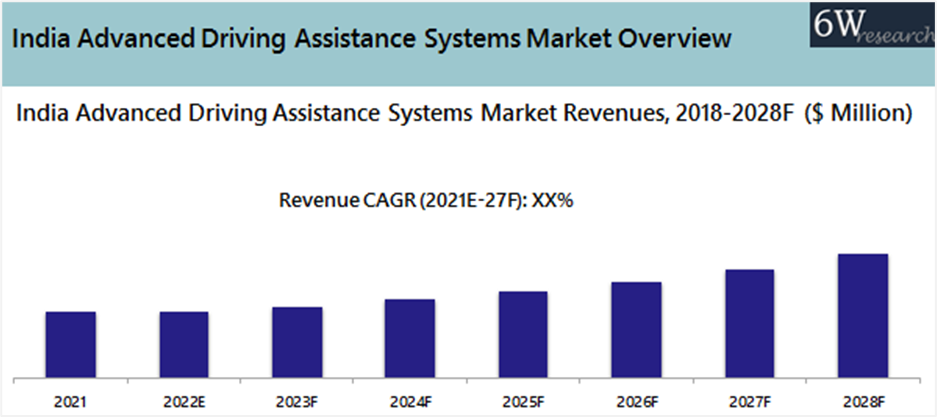
According to 6Wresearch internal database and industry insights, the India Advanced Driving Assistance Systems (ADAS) Market was valued at USD 1.15 Billion in 2025 and is projected to reach USD 3.48 Billion by 2032, growing at a CAGR of approximately 17.12% during 2026–2032.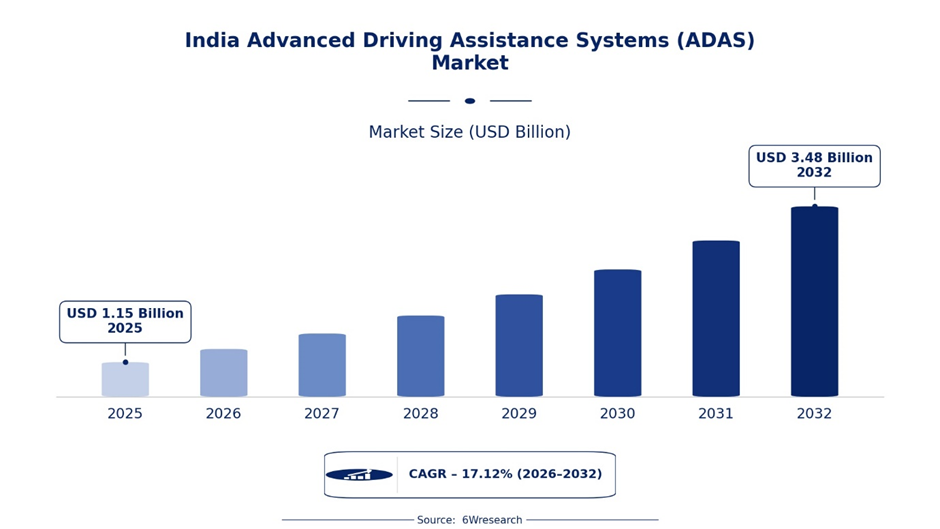
India Advanced Driving Assistance Systems (ADAS) Market Highlights
|
Report Metric |
Details |
|
Report Name |
India Advanced Driving Assistance Systems (ADAS) Market (2026-2032) |
|
Market Size 2025 |
USD 1.15 Billion |
|
Market Size 2032 |
USD 3.48 Billion |
|
Absolute Growth 2025–2032 |
USD 2.33 Billion |
|
CAGR 2026–2032 |
17.12% |
|
Peak Annual Growth |
19.1% in 2028 |
|
Forecast Period |
2026–2032 |
|
Historical Data |
2022–2025 |
|
Base Year |
2025 |
|
Leading Product Types, 2025 |
Adaptive Cruise Control (27% share) |
|
Leading Sensor Types, 2025 |
Camera (42% share) |
|
Leading Products, 2025 |
Passenger Vehicles (78% share) |
|
Fastest-Growing Product Types |
Autonomous Emergency Braking (21.3% CAGR) |
|
Fastest-Growing Sensor Types |
LiDAR (28.0% CAGR) |
|
Fastest-Growing Products |
Heavy Commercial vehicles (24.0% CAGR) |
|
Growing Sector |
Mid-priced and compact sport utility vehicles |
|
Key End Users |
Passenger car manufacturers, commercial vehicle manufacturers, fleet operators, logistics companies, insurers and aftermarket service providers |
India Advanced Driving Assistance Systems (ADAS) Market Year-wise Growth Rate and Key Drivers (2022–2032)
This graph illustrates the annual growth rates of the market from 2022 to 2032, highlighting gradual market development in the historical period and stronger expansion during the forecast period.
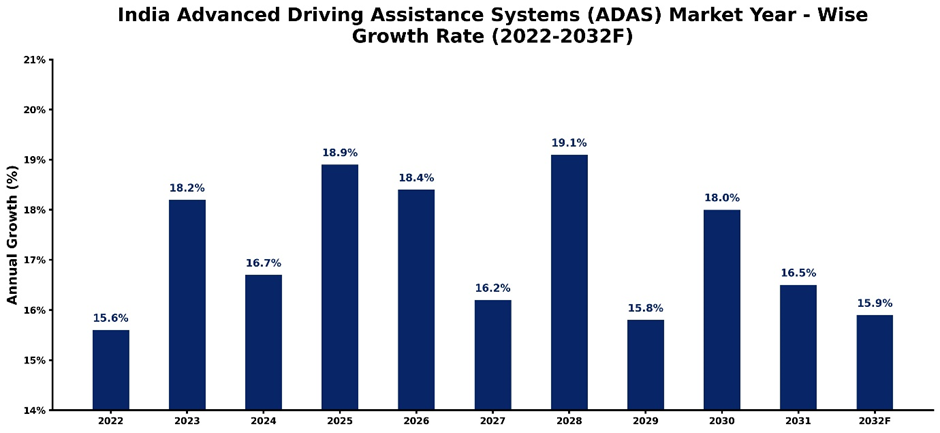
The following table presents the estimated annual growth rate for each year together with the principal factor influencing market performance.
|
Year |
Estimated Annual Growth (%) |
Market Rationale |
|
2022 |
15.6% |
Semiconductor shortages limited vehicle output and delayed the fitment of sensor-based features, though recovering demand kept growth moderate. |
|
2023 |
18.2% |
Bharat NCAP began in October 2023 and easing chip supply helped manufacturers add driver assistance features to more variants. |
|
2024 |
16.7% |
Higher input costs and inventory build-up at dealerships slowed passenger vehicle growth, moderating fitment gains across mid-range models. |
|
2025 |
18.9% |
Maruti Suzuki’s introduction of ADAS in the Victoris extended availability into mass-market compact SUV price bands, lifting sensor demand. |
|
2026 |
18.4% |
Growth is expected to normalise as the base expands after the 2025 launch cycle and fitment turns incremental. |
|
2027 |
16.2% |
Price-sensitive buyers in entry-level segments are expected to limit fitment of costlier sensor packages on lower trims. |
|
2028 |
19.1% |
Tighter Bharat NCAP star thresholds and fleet safety upgrades are expected to lift fitment to the forecast peak. |
|
2029 |
15.8% |
Normalisation after the peak is expected as one-time upgrades of existing model lines are completed. |
|
2030 |
18% |
Rising electric vehicle penetration is expected to place sensor-rich platforms on a larger share of new launches. |
|
2031 |
16.5% |
Price competition among suppliers is expected to reduce average system prices, tempering value growth despite higher unit volumes. |
|
2032 |
15.9% |
Growth is expected to stabilise in a mature adoption phase as ADAS becomes standard across most new passenger cars. |
Note: Market size estimations and growth projections presented in this report are based on 6Wresearch’s proprietary forecasting methodology, utilizing the latest available industry data, government publications, and primary research inputs.
India Advanced Driving Assistance Systems (ADAS) Market Synopsis
The India Advanced Driving Assistance Systems (ADAS) Market growth is driven by Bharat NCAP safety ratings effective from October 2023, the introduction of ADAS in mainstream SUVs such as the Mahindra XUV700 from 2021, expressway expansion including the 1,386 km Delhi–Mumbai Expressway, and rising fleet safety awareness. An Advanced Driver Assistance System (ADAS) is a collection of electronic safety and convenience technologies designed to reduce human error and improve road safety. However, high system cost and imported semiconductor dependence restrain wider penetration.
Market Dynamics Impact Analysis (2026–2032)
|
Factor |
Type |
Impact |
Primary Segment Affected |
|
Bharat NCAP Safety Ratings |
Driver |
High |
Autonomous Emergency Braking |
|
Entry of ADAS into Mainstream SUVs |
Driver |
High |
Adaptive Cruise Control |
|
Localised Sensor and Module Manufacturing |
Opportunity |
High |
Camera |
|
Fleet Safety Retrofit Demand |
Opportunity |
Medium |
Heavy Commercial vehicles |
|
High System Cost on Lower Trims |
Restraint |
High |
Passenger Vehicles |
|
Imported Semiconductor and Sensor Dependence |
Restraint |
Medium |
RADAR |
|
Local Validation for Mixed Traffic |
Challenge |
High |
Blindspot Detection |
|
Shortage of Functional-Safety Engineers |
Challenge |
Medium |
Intelligent Headlights & Others |
Evaluation of Drivers in India Advanced Driving Assistance Systems (ADAS) Market (2026–2032)
Below mentioned are some major drivers and their influence on market dynamics.
|
Drivers |
Primary Segment Affected |
Why It Matters (Evidence) |
|
Bharat NCAP Star Ratings Encouraging Safety Fitment |
Autonomous Emergency Braking |
Star ratings under Bharat NCAP, effective from October 2023, reward crash-avoidance and assist technologies, so manufacturers add autonomous braking to secure higher ratings that buyers use as a purchase reference. |
|
Introduction of ADAS in Mainstream SUVs |
Adaptive Cruise Control |
The Mahindra XUV700 launched in 2021 with a driver assistance suite and normalised ADAS in the mid-priced SUV bracket, prompting rivals to match features and raising demand for cruise control modules. |
|
Expressway and Highway Expansion |
RADAR |
Long, high-speed corridors such as the 1,386 km Delhi–Mumbai Expressway increase use of adaptive cruise and collision warning, which depend on forward radar, so new corridors raise both fitment and sensor demand. |
|
Growing Share of Utility Vehicles |
Passenger Vehicles |
Utility vehicles accounted for more than 60% of passenger vehicle sales in FY2025, and their higher price points give manufacturers room to add camera-based assistance packages without breaching buyer budgets. |
|
Road Safety Pressure on Fleets |
Heavy Commercial vehicles |
India recorded over 1.7 lakh road deaths in 2023, and fleet operators facing accident costs, insurance claims and driver fatigue are adopting collision warning and drowsiness monitoring in trucks. |
Market growth is supported by rising household incomes and a steady shift towards higher-value vehicles, which widen the pool of buyers willing to pay for safety technology. India’s automotive engineering base is deepening as roughly 1,700 global capability centres expand software, validation and simulation work, shortening development cycles for locally launched models. Cumulative foreign investment in the automobile sector exceeding USD 36 billion has funded electronics and software capacity within the country. Wider availability of vehicle financing improves access to feature-rich variants, and growing familiarity with connected and software-defined features is reshaping purchase decisions among urban buyers.
Evaluation of Restraints in India Advanced Driving Assistance Systems (ADAS) Market
Below mentioned are some major restraints and their influence on market dynamics.
|
Market Restraint |
Primary Segment Affected |
Why It Matters (Evidence) |
|
High Cost of ADAS Packages |
Passenger Vehicles |
Sensor suites add material cost that manufacturers pass to buyers, so ADAS has been confined to top variants priced well above entry trims, limiting volumes in price-sensitive segments. |
|
Road Infrastructure Gaps |
Camera |
Camera-based lane functions need clear markings, yet national highways form only about 2% of the road network, so performance outside well-maintained corridors is inconsistent and weakens user trust. |
|
Semiconductor and Sensor Import Dependence |
RADAR |
Radar chips, processors and LiDAR units are largely imported, so supply disruptions such as the 2021–22 chip shortage delay vehicle output and feature fitment. |
|
Voluntary Safety Framework |
Autonomous Emergency Braking |
Bharat NCAP participation is voluntary, so the fitment of braking and assist systems depends on manufacturer choice rather than regulation, slowing adoption in budget models. |
|
Limited Service and Recalibration Capability |
Ultrasonic |
Assist systems depend on calibrated sensor alignment and even a windscreen replacement requires recalibration, yet specialist equipment is concentrated in authorised workshops in major cities. |
India Advanced Driving Assistance Systems (ADAS) Market Challenges
In terms of challenges, Perception software built on structured Western roads struggles where two-wheelers form roughly 75% of the registered fleet and weave unpredictably, forcing costly local retraining that delays supplier launches. A limited pool of engineers experienced in ISO 26262 functional safety slows validation, thus programmes queue behind scarce specialists. Manufacturers also demand sharp price points on advanced features, which pushes suppliers to redesign systems for lower cost without losing certification. Integrating radar, camera and braking software from different vendors lengthens development cycles, and evolving Bharat NCAP test protocols after 2023 add repeated rework.
Trends in the India Advanced Driving Assistance Systems (ADAS) Market
Below mentioned are some of the trends shaping the India Advanced Driving Assistance Systems (ADAS) Market growth.
- Shift from Passive Warnings to Active Intervention: Manufacturers are moving beyond parking sensors and blind-spot alerts towards systems that brake and steer the vehicle. Mid-priced SUVs from Hyundai, Mahindra and Tata now offer Level 2 packages with emergency braking and lane centring. Suppliers gain higher content per vehicle, while buyers increasingly expect automated assistance rather than alerts alone.
- Transition from Single-Sensor Systems to Fused Camera and Radar Architectures: Newer vehicles combine forward cameras with radar to detect pedestrians, two-wheelers and stationary objects in dense mixed traffic, and a few premium and electric models are beginning to add LiDAR. This favours suppliers able to deliver calibrated hardware with fusion software as a package, and it raises technical entry barriers for sensor-only vendors.
- ADAS Emerging as a Mainstream Feature from a Luxury Option: Driver assistance has moved from luxury imports to compact and mid-size SUVs, with the Maruti Suzuki Victoris introduced in 2025 extending availability to mass-market price bands. Domestic volume leaders now treat ADAS as a trim differentiator, which encourages suppliers to design lower-cost, localised sensor packages for high-volume programmes.
Investment Opportunities in the India Advanced Driving Assistance Systems (ADAS) Market
Some of the investment opportunities in the India Advanced Driving Assistance Systems (ADAS) Market are mentioned below.
- Localised Radar and Camera Module Manufacturing: Import dependence and manufacturers’ localisation targets create room for domestic assembly of forward radar and windscreen camera modules. Investors can set up assembly and test lines in automotive clusters such as Chennai, Pune–Chakan and Gurugram–Manesar, entering through joint ventures with global Tier-1 suppliers and securing homologation through the Automotive Research Association of India.
- ADAS Calibration and Aftersales Service Networks: Rising fitment means a growing parc of vehicles that need recalibration after windscreen, bumper and collision repairs, yet capable workshops remain scarce. Investors can establish calibration centres with target boards and diagnostic tooling in metropolitan and tier-two cities, partnering with multi-brand workshop chains, insurers and OEM dealer networks for steady job flow.
- Commercial Vehicle Safety Retrofit Kits: Large truck and bus fleets operate older vehicles without factory-fitted assistance, while operators face rising accident and insurance costs. Investors can develop and supply collision warning, driver drowsiness monitoring and camera-based blind-spot kits, certified to applicable Automotive Industry Standards and sold through fleet operators, logistics companies and telematics providers in freight corridors.
Leading Players in India Advanced Driving Assistance Systems (ADAS) Market
Stated below are some of the leading companies contributing significantly to the India Advanced Driving Assistance Systems (ADAS) Market share.
1. Robert Bosch GmbH
| Company Name | Company Name |
|---|---|
| Established Year | 1886 |
| Headquarters | Gerlingen, Germany |
| Official Website | Click Here |
Robert Bosch GmbH is a global technology and engineering supplier offering radar, camera, and braking systems for driver assistance. It serves vehicle manufacturers in India through its local group entities and engineering centres.
2. Continental AG
| Company Name | Company Name |
|---|---|
| Established Year | 1871 |
| Headquarters | Hanover, Germany |
| Official Website | Click Here |
Continental AG is an automotive technology supplier providing sensors, electronic control units, and safety systems. It supports Indian vehicle manufacturers with driver assistance components and related engineering services.
3. Valeo
| Company Name | Company Name |
|---|---|
| Established Year | 1923 |
| Headquarters | Paris, France |
| Official Website | Click Here |
Valeo is an automotive supplier focused on driving assistance, lighting, and ultrasonic- and camera-based systems. It maintains manufacturing and engineering operations in India to serve domestic and global vehicle manufacturers.
4. Denso Corporation
| Company Name | Company Name |
|---|---|
| Established Year | 1949 |
| Headquarters | Kariya, Japan |
| Official Website | Click Here |
Denso Corporation is a mobility component supplier offering vision sensors, radar, and electronic safety systems. It supports Japanese and domestic vehicle manufacturers in India through local production and engineering facilities.
Government Initiatives in the India Advanced Driving Assistance Systems (ADAS) Market
The policy framework combines industrial incentives with safety regulation. The Production Linked Incentive scheme for Automobile and Auto Components, approved in September 2021 with an outlay of INR 25,938 crore, supports domestic manufacture of advanced automotive technology products. The Ministry of Road Transport and Highways introduced Bharat NCAP, effective October 2023, which awards star ratings of up to five to new cars and rewards the fitment of safety assist technologies.
Implementation is led by the Ministry of Road Transport and Highways, the National Highways Authority of India and the Automotive Research Association of India, which supports vehicle testing and homologation. The Bharatmala Pariyojana, launched in 2017 for about 34,800 km of highways in its first phase, and a national highway network of roughly 1.46 lakh km provide the road infrastructure on which driver assistance functions are used.
Future Insight of the India Advanced Driving Assistance Systems (ADAS) Market
The future of the India Advanced Driver Assistance Systems (ADAS) market is expected to be shaped by increasing vehicle safety awareness, the integration of advanced automotive technologies, and the gradual expansion of ADAS features from premium vehicles to mid-range and mass-market passenger cars. Public support through the PM E-DRIVE scheme, with an outlay of INR 10,900 crore, and a national ambition of 30% electric share in new vehicle sales by 2030 will accelerate this platform shift. Expected tightening of vehicle safety regulation will encourage manufacturers to fit collision-avoidance functions across more models. Expanding domestic testing and validation facilities and deeper localisation by suppliers will also broaden the supply base for locally developed systems.
Market Segmentation Analysis
The report offers a comprehensive study of the market across its key segments. The chart below highlights the leading segment by market share in 2025 and the fastest-growing segment by CAGR over 2026–2032, followed by a detailed analysis of each segment.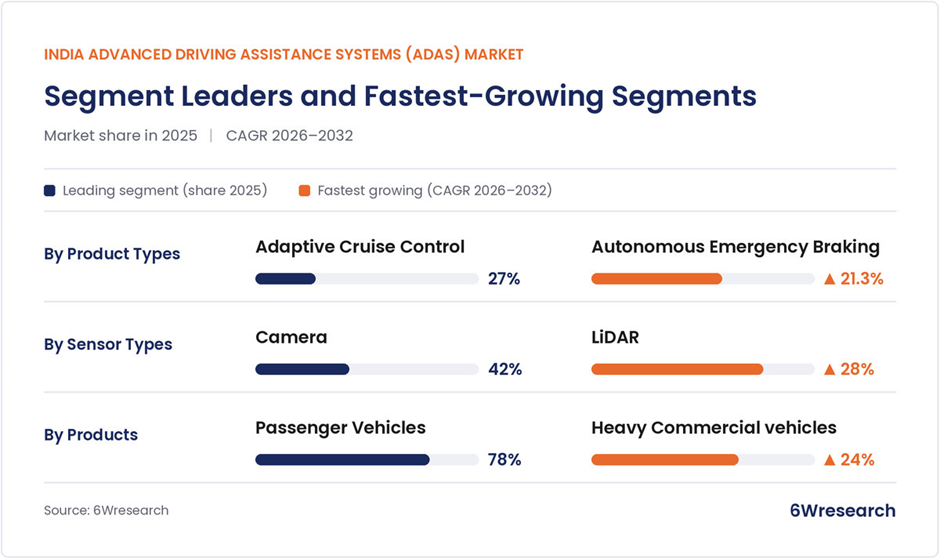
By Product Types – Adaptive Cruise Control Leads, Autonomous Emergency Braking Expected to Grow Fastest
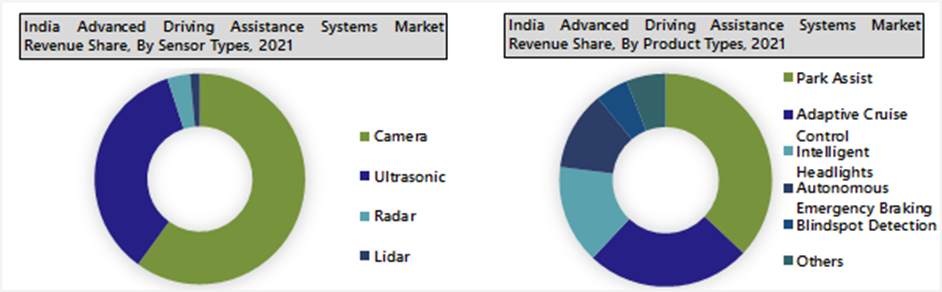
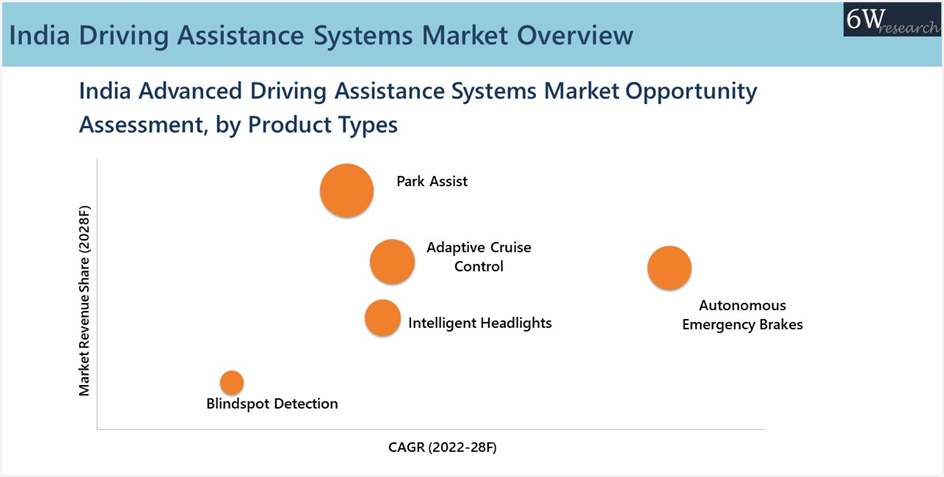
According to Ravi Bhandari, Research Head at 6Wresearch, Adaptive Cruise Control led the market in 2025 with a 27% share, supported by long-distance travel on India’s expanding expressway corridors and its inclusion in mid-priced SUV feature packs. Autonomous Emergency Braking is expected to record the fastest growth at a CAGR of 21.3% during 2026–2032, as Bharat NCAP star ratings reward crash-avoidance performance.
By Sensor Types – Camera Leads, LiDAR Expected to Grow Fastest
Camera held the largest share at 42% in 2025 because forward windscreen cameras underpin lane keeping, traffic sign recognition and emergency braking in most ADAS-equipped Indian models. LiDAR is projected to grow fastest at a CAGR of 28.0% over 2026–2032 from a small base, as premium and electric vehicle makers begin to adopt it for higher levels of automation.
By Products – Passenger Vehicles Lead, Heavy Commercial vehicles Expected to Grow Fastest
Passenger Vehicles dominated 2025 with a 78% share, since about 4.3 million units were sold in FY2025 and manufacturers now offer ADAS across mid-priced SUV variants. Heavy Commercial vehicles are projected to expand at the quickest rate, with a CAGR of 24.0% during 2026–2032, as long-haul fleet operators adopt collision warning and driver monitoring from a low base.
Key Attractiveness of the Report
- 10 Years of Market Numbers
- Historical Data Starting from 2022 to 2025
- Base Year 2025
- Forecast Data until 2032
- Key Performance Indicators Impacting the Market
- Major Upcoming Developments and Projects
Key Highlights of the Report:
- India Advanced Driving Assistance Systems (ADAS) Market Outlook
- Market Size of India Advanced Driving Assistance Systems (ADAS) Market, 2025
- Forecast of India Advanced Driving Assistance Systems (ADAS) Market, 2032
- Historical Data and Forecast of Advanced Driving Assistance Systems (ADAS) Revenues & Volume for the Period 2022-2032
- India Advanced Driving Assistance Systems (ADAS) Market Trend Evolution
- India Advanced Driving Assistance Systems (ADAS) Market Drivers and Challenges
- Advanced Driving Assistance Systems (ADAS) Price Trends
- Advanced Driving Assistance Systems (ADAS) Porter’s Five Forces
- Advanced Driving Assistance Systems (ADAS) Industry Life Cycle
- Historical Data and Forecast of India Advanced Driving Assistance Systems (ADAS) Market Revenues & Volume By Product Types for the Period 2022-2032
- Historical Data and Forecast of India Advanced Driving Assistance Systems (ADAS) Market Revenues & Volume By Adaptive Cruise Control for the Period 2022-2032
- Historical Data and Forecast of India Advanced Driving Assistance Systems (ADAS) Market Revenues & Volume By Blindspot Detection for the Period 2022-2032
- Historical Data and Forecast of India Advanced Driving Assistance Systems (ADAS) Market Revenues & Volume By Park Assist for the Period 2022-2032
- Historical Data and Forecast of India Advanced Driving Assistance Systems (ADAS) Market Revenues & Volume By Autonomous Emergency Braking for the Period 2022-2032
- Historical Data and Forecast of India Advanced Driving Assistance Systems (ADAS) Market Revenues & Volume By Intelligent Headlights & Others for the Period 2022-2032
- Historical Data and Forecast of India Advanced Driving Assistance Systems (ADAS) Market Revenues & Volume By Sensor Types for the Period 2022-2032
- Historical Data and Forecast of India Advanced Driving Assistance Systems (ADAS) Market Revenues & Volume By LiDAR for the Period 2022-2032
- Historical Data and Forecast of India Advanced Driving Assistance Systems (ADAS) Market Revenues & Volume By RADAR for the Period 2022-2032
- Historical Data and Forecast of India Advanced Driving Assistance Systems (ADAS) Market Revenues & Volume By Camera for the Period 2022-2032
- Historical Data and Forecast of India Advanced Driving Assistance Systems (ADAS) Market Revenues & Volume By Ultrasonic for the Period 2022-2032
- Historical Data and Forecast of India Advanced Driving Assistance Systems (ADAS) Market Revenues & Volume By Products for the Period 2022-2032
- Historical Data and Forecast of India Advanced Driving Assistance Systems (ADAS) Market Revenues & Volume By Passenger Vehicles for the Period 2022-2032
- Historical Data and Forecast of India Advanced Driving Assistance Systems (ADAS) Market Revenues & Volume By Light Commercial Vehicles for the Period 2022-2032
- Historical Data and Forecast of India Advanced Driving Assistance Systems (ADAS) Market Revenues & Volume By Heavy Commercial vehicles for the Period 2022-2032
- Advanced Driving Assistance Systems (ADAS) Import Export Trade Statistics
- Market Opportunity Assessment By Product Types
- Market Opportunity Assessment By Sensor Types
- Market Opportunity Assessment By Products
- Advanced Driving Assistance Systems (ADAS) Top Companies Market Share
- Advanced Driving Assistance Systems (ADAS) Competitive Benchmarking By Technical and Operational Parameters
- Advanced Driving Assistance Systems (ADAS) Company Profiles
- Advanced Driving Assistance Systems (ADAS) Key Strategic Recommendations
Market Covered
The report offers an extensive study of the following market segments.
By Product Types
- Adaptive Cruise Control
- Blindspot Detection
- Park Assist
- Autonomous Emergency Braking
- Intelligent Headlights & Others
By Sensor Types
- LiDAR
- RADAR
- Camera
- Ultrasonic
By Products
- Passenger Vehicles
- Light Commercial Vehicles
- Heavy Commercial vehicles