China Elderly Care Automation Market Size & Growth Rate
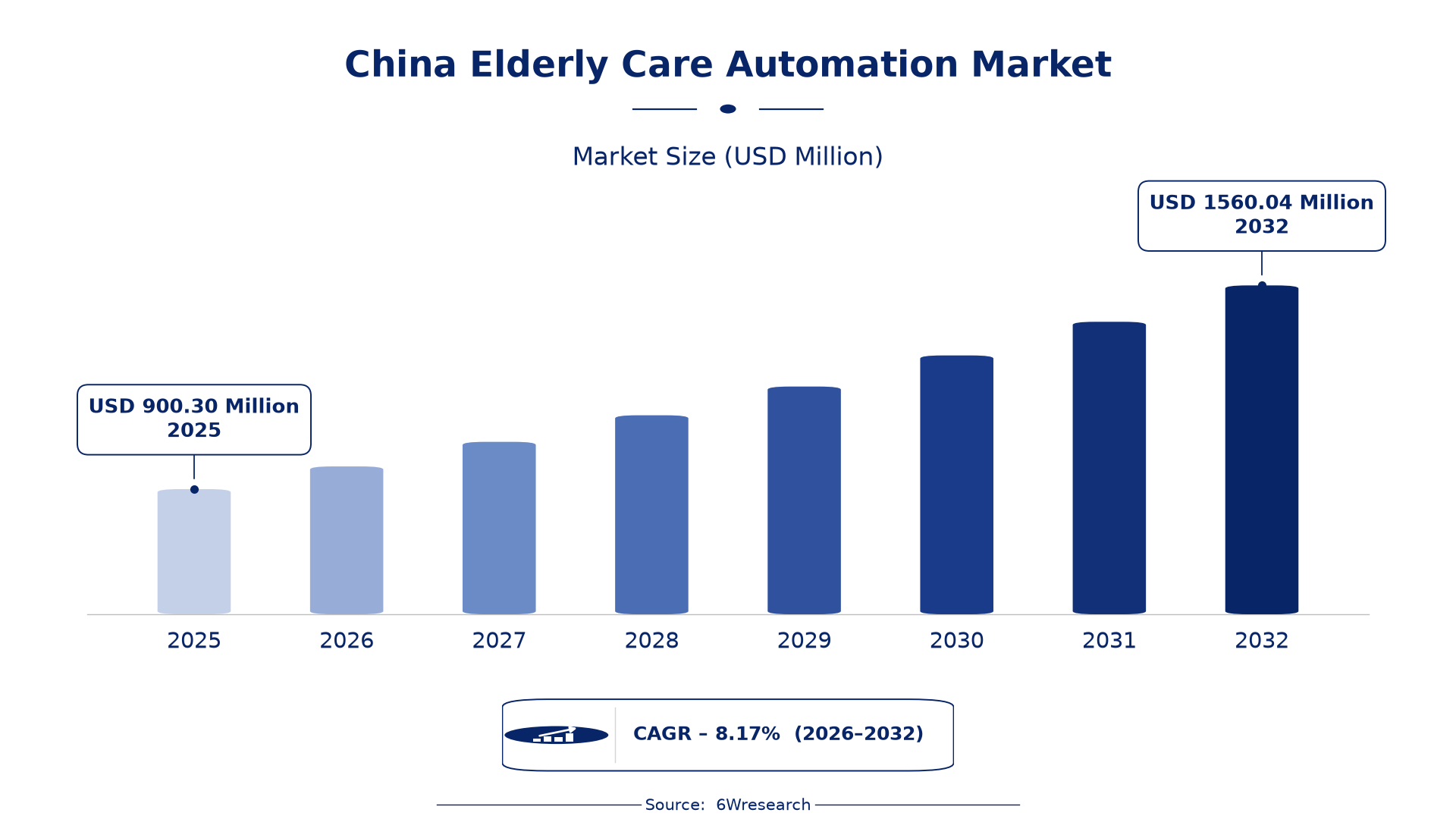
According to 6Wresearch internal database and industry insights, the China Elderly Care Automation Market was valued at USD 900.30 million in 2025 and is projected to reach USD 1,560.04 million by 2032, growing at a CAGR of approximately 8.17% during 2026–2032.
China Elderly Care Automation Market Highlights
| Report Metric | Details |
| Report Name | China Elderly Care Automation Market |
| Market Size 2025 | USD 900.30 million |
| Market Size 2032 | USD 1,560.04 million |
| Absolute Growth 2025–2032 | USD 659.74 million |
| CAGR 2026–2032 | 8.17% |
| Peak Annual Growth | 9.7% in 2029 |
| Forecast Period | 2026–2032 |
| Historical Data | 2022–2025 |
| Base Year | 2025 |
| Leading Automation Type, 2025 | Robotic Care (35% share) |
| Leading Technology Used, 2025 | AI & Robotics (43% share) |
| Leading Use Case, 2025 | Assistance Tasks (41% share) |
| Leading End User, 2025 | Senior Homes (43% share) |
| Fastest-Growing Automation Type | Medication Robots (9.2% CAGR) |
| Fastest-Growing Technology Used | IoT Sensors (10.6% CAGR) |
| Fastest-Growing End User | In-Home Patients (9.2% CAGR) |
| Growing Sector | In-Home Patients |
| Key End Users | 3-4 buyer categories, comma separated, no company names (never empty) |
China Elderly Care Automation Market Year-wise Growth Rate and Key Drivers (2022–2032)
This graph illustrates the annual growth rates of the market from 2022 to 2032, highlighting a steady upward trajectory and projected market expansion over the forecast period.
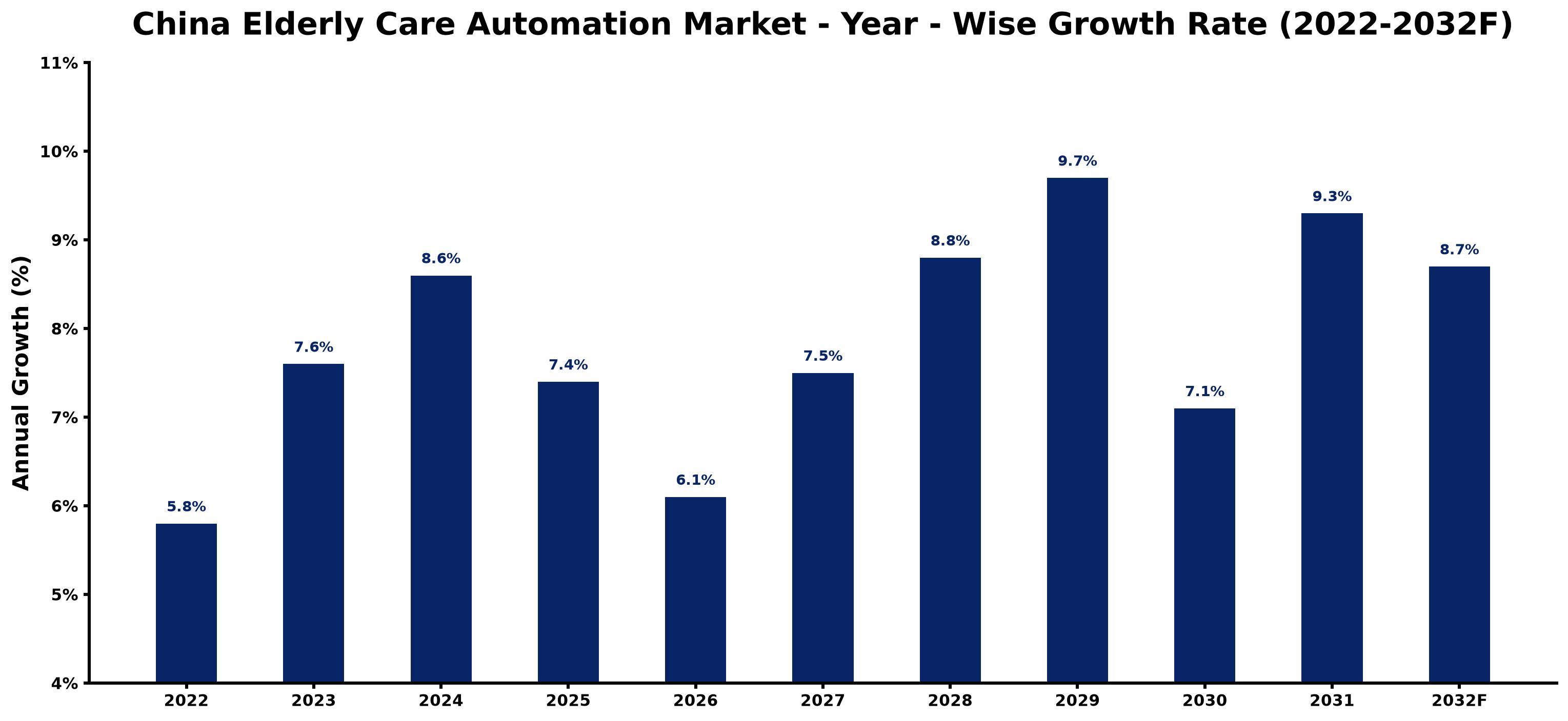
Each row of the following table gives one year's estimated growth and the event or demand shift that explains it.
| Year | Estimated Annual Growth (%) | Market Rationale |
| 2022 | 5.8 | The aging population's needs prompted increased automation adoption in elderly care facilities. |
| 2023 | 7.6 | The implementation of the 'Smart Elderly Care Pilot Program' accelerated technology integration in rural areas. |
| 2024 | 8.6 | Growing urban senior homes adopted automation technologies to improve resident care quality. |
| 2025 | 7.4 | Implementation of the 'National Standard for Elderly Care Equipment' moderated growth as compliance costs rose. |
| 2026 | 6.1 | Budget constraints impacted technology investments in elderly care, slowing market growth. |
| 2027 | 7.5 | Increased demand for in-home patient care drove higher automation adoption rates among families. |
| 2028 | 8.8 | Rising life expectancy led to greater investments in automation for health monitoring. |
| 2029 | 9.7 | The 'Healthy China 2030' plan spurred significant growth in automation solutions for elderly care. |
| 2030 | 7.1 | Budgetary pressures faced by hospitals moderated market growth as they adopted automation. |
| 2031 | 9.3 | The demand for medication robots surged as hospitals expanded their automation capabilities. |
| 2032 | 8.7 | Growth slowed as the 'Elderly Care Equipment Standardization Program' established norms for automation technologies. |
Note: Market size estimations and growth projections presented in this report are based on 6Wresearch's proprietary forecasting methodology, utilizing the latest available industry data, government publications, and primary research inputs.
China Elderly Care Automation Market Synopsis
Elderly Care Automation in China utilises advanced technologies such as robotics and AI to assist the ageing population. These solutions facilitate daily living activities, medication management, and health monitoring. The China Elderly Care Automation Market is growing rapidly, driven by an elderly population projected to reach 264 million in 2023 and supportive initiatives like the 'Healthy China 2030' plan. The demand for enhanced care solutions from senior homes and hospitals further propels growth in this sector.
Market Dynamics Impact Analysis (2026–2032)
| Factor | Type | Impact | Primary Segment Affected |
| Aging Population | Driver | High | Senior Homes |
| AI & Robotics Technology | Driver | High | Robotic Care |
| Increased Government Funding | Opportunity | High | Medication Robots |
| Growing In-Home Care Demand | Opportunity | High | In-Home Patients |
| High Compliance Costs | Restraint | Medium | Smart Beds |
| Budget Constraints in Hospitals | Restraint | Medium | Hospitals |
| Supply Chain Disruptions | Challenge | High | Elderly Residents |
| Technological Adoption Barriers | Challenge | Medium | Voice Assistants |
Evaluation of Drivers in China Elderly Care Automation Market (2026–2032)
The factors lifting demand, and the evidence behind each, are summarised below.
| Drivers | Primary Segment Affected | Why It Matters (Evidence) |
| Expanding elderly population | Senior Homes | In 2023, 264 million elderly individuals in China increased the demand for automation solutions in care facilities. |
| Advancements in AI & Robotics | Robotic Care | The integration of AI & Robotics technologies is transforming care delivery, improving patient support and safety. |
| Government funding for automation | Medication Robots | In 2023, the government allocated $50 million to support automation technology research for elderly care. |
| Rising life expectancy | In-Home Patients | With an average life expectancy of 78.2 years in 2023, families are investing more in home automation solutions. |
| Smart Elderly Care Pilot Program | Voice Assistants | This initiative, started in 2021, promotes technology adoption in rural areas, increasing the use of voice assistants. |
Growth in the Elderly Care Automation market in China stems from increasing end-use demand, technological progress, and heightened investment in healthcare infrastructure. With the elderly population at 264 million in 2023, there is a rising need for automation solutions that improve daily living and health monitoring. By 2022, over 30% of senior homes in urban areas had adopted automation technologies, indicating a trend towards better care solutions. Furthermore, the integration of IoT Sensors has become standard in more than 1,000 senior care facilities, enabling real-time health monitoring and data collection. Consequently, hospitals are anticipated to implement automation in 70% of cases by 2025, improving patient care efficiency.
Evaluation of Restraints in China Elderly Care Automation Market
The key brakes on demand, and where they bite hardest, are shown below.
| Market Restraint | Primary Segment Affected | Why It Matters (Evidence) |
| High compliance costs for automation technologies | Smart Beds | Compliance with the 'National Standard for Elderly Care Equipment' increases costs for producers, affecting pricing for buyers. |
| Budget constraints in hospitals | Hospitals | Limited budgets hinder hospitals' ability to invest in advanced automation technologies for elderly care. |
| Supply chain disruptions | Elderly Residents | Ongoing supply chain issues delay the delivery of automation products, impacting care quality for elderly residents. |
| Technological adoption barriers | Voice Assistants | Resistance to change among caregivers limits the integration of voice assistants in elderly care settings. |
| Market maturity leading to standardisation | Medication Robots | As technologies become standard, innovation slows, reducing the introduction of new products in the market. |
China Elderly Care Automation Market Challenges
High implementation costs for elderly care automation in China pose challenges for producers, leading to delays in adopting crucial technologies and restricting service improvements for buyers. Increased competition among suppliers arises from the need to meet the demands of a rapidly ageing population, currently estimated at 264 million, resulting in price fluctuations that complicate budgeting for buyers. A shortage of skilled workers hampers producers' ability to install and maintain automation systems effectively, resulting in inconsistent service quality in care facilities. Regulatory hurdles related to the 'National Standard for Elderly Care Equipment' established in 2021 slow the approval process for new technologies, limiting timely access to advanced solutions for buyers in the market.
Trends in the China Elderly Care Automation Market
Several trends are reshaping the China Elderly Care Automation Market; the most important are set out below.
- Shift towards AI Integration in Elderly Care: In 2021, the 'Digital Health Strategy' initiated a focus on integrating AI technologies in elderly care, with a target of 50% adoption by 2025. This shift improves care delivery and monitoring capabilities.
- Increase in Smart Bed Adoption: Smart Beds are now standard in 40% of new senior living developments in major cities, reflecting a growing trend towards comfort and health monitoring for elderly residents.
- Rise in Medication Robot Utilisation: In 2023, 200 hospitals across China implemented Medication Robots, improving efficiency in patient care and medication management.
- Expansion of Voice Assistants in Smart Homes: By 2023, Voice Assistants were integrated into 15% of smart homes catering to elderly residents, facilitating communication and control of home devices.
Investment Opportunities in the China Elderly Care Automation Market
Several openings in the China Elderly Care Automation Market merit attention from investors.
- Demand for in-home care solutions: With a notable rise in the elderly population, there is a pressing need for in-home automation solutions. Families are increasingly investing in these technologies, especially in urban areas where convenience is crucial.
- Funding for automation technology research: The government's allocation of $50 million for elderly care automation research provides an opportunity for startups and innovators in this sector to develop new solutions.
- Expansion of automation in rural areas: The 'Smart Elderly Care Pilot Program' promotes technology adoption in rural regions, creating opportunities for suppliers to access untapped markets.
- Increased automation in hospitals: By 2025, 70% of hospitals are expected to embrace automation technologies, offering suppliers opportunities to meet the rising demand for efficient patient care solutions.
Government Initiatives in the China Elderly Care Automation Market
The 'Healthy China 2030' initiative, launched by the National Health Commission in 2020, aims to improve elderly care services through technology integration. This initiative encourages the adoption of automation technologies in care settings, enhancing service delivery and quality. The government also established the 'National Standard for Elderly Care Equipment' in 2021 to regulate product quality and safety, ensuring that automation technologies meet necessary standards for elderly care.
The Ministry of Civil Affairs oversees the 'Smart Elderly Care Pilot Program', which promotes technology adoption in rural areas with a budget of $30 million. This program supports the integration of automation technologies, improving the quality of care in underserved regions.
Future Insight of the China Elderly Care Automation Market
The elderly care automation market in China will experience transformative changes by 2032, primarily driven by the 'Healthy China 2030' plan aimed at enhancing care services. By 2025, 70% of hospitals are projected to adopt automation for elderly patient care, improving operational efficiency and patient outcomes. The integration of advanced technologies will become commonplace in senior living developments, with smart beds featured in a majority of new projects. The establishment of the 'Smart Elderly Care Technology Innovation Fund' in 2023 will stimulate innovation, broadening the range of solutions available for buyers.
Market Segmentation Analysis
Each segment group is reviewed below, with the leader by share and the fastest grower by CAGR.
By Automation Type – Robotic Care Dominated, Medication Robots Expected to Grow Fastest
According to Vasudha, AM at 6Wresearch, with a 35% revenue share in 2025, Robotic Care was the largest automation type category. Robotic Care captures the largest share as it is extensively used in senior homes, providing vital physical assistance and mobility support for elderly residents. The integration of these technologies in over 30% of urban senior homes highlights the increasing reliance on robotic solutions. Medication Robots are projected to grow fastest, at a CAGR of 9.2% during 2026–2032. Medication Robots are experiencing remarkable growth due to their ability to automate medication dispensing, which addresses the pressing need for efficient patient care in hospitals. With 200 hospitals already utilising these robots, the trend indicates a strong future demand. Suppliers should prioritise the development of robotic solutions to satisfy the rising needs of senior care facilities.
By Technology Used – AI & Robotics Dominated, IoT Sensors Expected to Grow Fastest
AI & Robotics held a 43% share of the China Elderly Care Automation Market by technology used in 2025. The largest share in the Technology Used segment is held by Robotics due to their integral role in providing automation solutions for elderly care. Their application in the 'National Standard for Elderly Care Equipment' underscores their importance in enhancing care delivery. The quickest growth will come from IoT Sensors, forecast to expand at a CAGR of 10.6% between 2026 and 2032. IoT Sensors are experiencing rapid growth as they are vital for real-time health monitoring and data collection in senior care facilities. The deployment of these sensors in over 1,000 facilities illustrates their increasing acceptance and potential for further expansion. Suppliers should prioritise the development of IoT Sensor technologies to meet the rising demand for effective monitoring solutions in elderly care.
By Use Case – Assistance Tasks Dominated and Is Expected to Record the Fastest Growth
The largest use case category in 2025 was Assistance Tasks, with a 41% share of total revenue. Assistance Tasks lead the market share as they encompass a wide range of supportive functions that significantly enhance daily living for the elderly. This comprehensive approach ensures consistent demand for automation solutions across various care settings. Assistance Tasks are also forecast to expand faster than any other category, at a CAGR of 9.9% over 2026–2032. Assistance Tasks also represent the fastest-growing segment because they are essential for improving the quality of life for seniors through various supportive activities. The ongoing need for assistance in daily tasks reinforces this segment's growth trajectory, solidifying its market position. Buyers should focus on integrating advanced solutions for assistance tasks to address the increasing need for comprehensive elderly care.
By End User – Senior Homes Dominated, In-Home Patients Expected to Grow Fastest
Senior Homes took a 43% share of end user in 2025, more than any other category. Senior Homes capture the largest market share as they are the primary users of automation technologies, focusing on resident care and comfort. The increasing number of senior homes implementing automation technologies highlights their critical role in the elderly care sector. In-Home Patients are set to record the highest CAGR in this split, 9.2% over 2026–2032. In-Home Patients represent the fastest-growing segment, as more families seek personalised care solutions for their elderly members at home. This shift towards in-home care is reflected in the rising adoption of automation technologies tailored for individual needs. Suppliers should tailor their products to meet the specific needs of in-home patients, capitalising on this growing market segment.
Key Attractiveness of the Report
- 10 Years of Market Numbers
- Historical Data Starting from 2022 to 2025
- Base Year 2025
- Forecast Data until 2032
- Key Performance Indicators Impacting the Market
- Major Upcoming Developments and Projects
Key Highlights of the Report:
- China Elderly Care Automation Market Outlook
- Market Size of China Elderly Care Automation Market, 2025
- Forecast of China Elderly Care Automation Market, 2032
- Historical Data and Forecast of China Elderly Care Automation Revenues & Volume for the Period 2022 - 2032F
- China Elderly Care Automation Market Trend Evolution
- China Elderly Care Automation Market Drivers and Challenges
- China Elderly Care Automation Price Trends
- China Elderly Care Automation Porter's Five Forces
- China Elderly Care Automation Industry Life Cycle
- Historical Data and Forecast of China Elderly Care Automation Market Revenues & Volume By Automation Type for the Period 2022 - 2032F
- Historical Data and Forecast of China Elderly Care Automation Market Revenues & Volume By Robotic Care for the Period 2022 - 2032F
- Historical Data and Forecast of China Elderly Care Automation Market Revenues & Volume By Medication Robots for the Period 2022 - 2032F
- Historical Data and Forecast of China Elderly Care Automation Market Revenues & Volume By Smart Beds for the Period 2022 - 2032F
- Historical Data and Forecast of China Elderly Care Automation Market Revenues & Volume By Voice Assistants for the Period 2022 - 2032F
- Historical Data and Forecast of China Elderly Care Automation Market Revenues & Volume By Technology Used for the Period 2022 - 2032F
- Historical Data and Forecast of China Elderly Care Automation Market Revenues & Volume By AI & Robotics for the Period 2022 - 2032F
- Historical Data and Forecast of China Elderly Care Automation Market Revenues & Volume By Timers + Sensors for the Period 2022 - 2032F
- Historical Data and Forecast of China Elderly Care Automation Market Revenues & Volume By IoT Sensors for the Period 2022 - 2032F
- Historical Data and Forecast of China Elderly Care Automation Market Revenues & Volume By NLP for the Period 2022 - 2032F
- Historical Data and Forecast of China Elderly Care Automation Market Revenues & Volume By Use Case for the Period 2022 - 2032F
- Historical Data and Forecast of China Elderly Care Automation Market Revenues & Volume By Assistance Tasks for the Period 2022 - 2032F
- Historical Data and Forecast of China Elderly Care Automation Market Revenues & Volume By Dosing Reminders for the Period 2022 - 2032F
- Historical Data and Forecast of China Elderly Care Automation Market Revenues & Volume By Sleep Monitoring for the Period 2022 - 2032F
- Historical Data and Forecast of China Elderly Care Automation Market Revenues & Volume By Emergency Calling for the Period 2022 - 2032F
- Historical Data and Forecast of China Elderly Care Automation Market Revenues & Volume By End User for the Period 2022 - 2032F
- Historical Data and Forecast of China Elderly Care Automation Market Revenues & Volume By Senior Homes for the Period 2022 - 2032F
- Historical Data and Forecast of China Elderly Care Automation Market Revenues & Volume By In-Home Patients for the Period 2022 - 2032F
- Historical Data and Forecast of China Elderly Care Automation Market Revenues & Volume By Hospitals for the Period 2022 - 2032F
- Historical Data and Forecast of China Elderly Care Automation Market Revenues & Volume By Elderly Residents for the Period 2022 - 2032F
- China Elderly Care Automation Import Export Trade Statistics
- Market Opportunity Assessment By Automation Type
- Market Opportunity Assessment By Technology Used
- Market Opportunity Assessment By Use Case
- Market Opportunity Assessment By End User
- China Elderly Care Automation Top Companies Market Share
- China Elderly Care Automation Competitive Benchmarking By Technical and Operational Parameters
- China Elderly Care Automation Company Profiles
- China Elderly Care Automation Key Strategic Recommendations
Market Covered
Segments analysed in this report are listed below.
By Automation Type
- Robotic Care
- Medication Robots
- Smart Beds
- Voice Assistants
By Technology Used
- AI & Robotics
- Timers + Sensors
- IoT Sensors
- NLP
By Use Case
- Assistance Tasks
- Dosing Reminders
- Sleep Monitoring
- Emergency Calling
By End User
- Senior Homes
- In-Home Patients
- Hospitals
- Elderly Residents






































