India Elderly Care Automation Market Size & Growth Rate
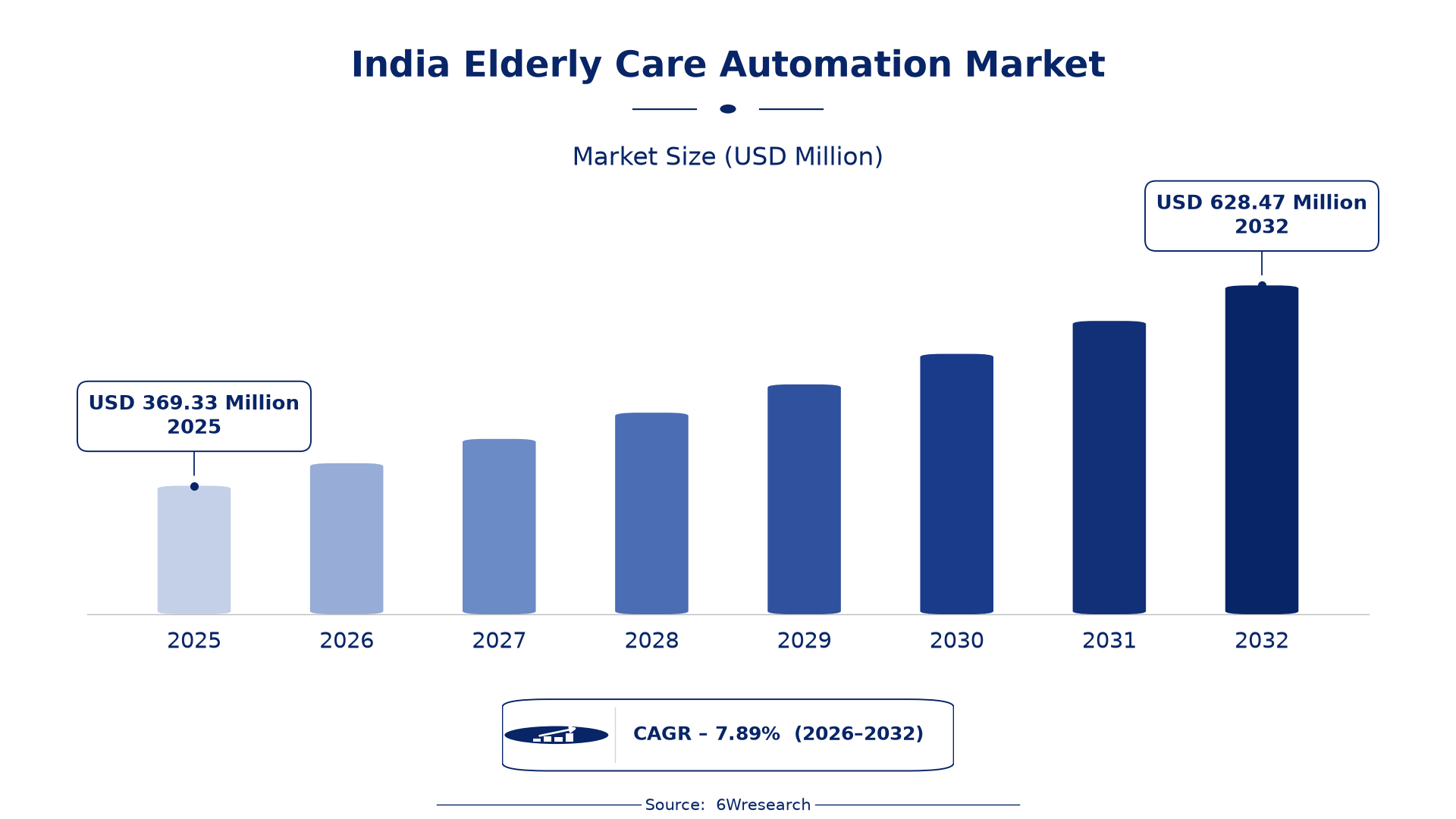
According to 6Wresearch internal database and industry insights, the India Elderly Care Automation Market was valued at USD 369.33 million in 2025 and is projected to reach USD 628.47 million by 2032, growing at a CAGR of approximately 7.89% during 2026–2032.
India Elderly Care Automation Market Highlights
| Report Metric | Details |
| Report Name | India Elderly Care Automation Market |
| Market Size 2025 | USD 369.33 million |
| Market Size 2032 | USD 628.47 million |
| Absolute Growth 2025–2032 | USD 259.14 million |
| CAGR 2026–2032 | 7.89% |
| Peak Annual Growth | 10.4% in 2027 |
| Forecast Period | 2026–2032 |
| Historical Data | 2022–2025 |
| Base Year | 2025 |
| Leading Automation Type, 2025 | Robotic Care (40% share) |
| Leading Technology Used, 2025 | AI & Robotics (40% share) |
| Leading Use Case, 2025 | Assistance Tasks (45% share) |
| Leading End User, 2025 | Senior Homes (44% share) |
| Fastest-Growing Automation Type | Medication Robots (9.3% CAGR) |
| Fastest-Growing Technology Used | IoT Sensors (9.0% CAGR) |
| Fastest-Growing Use Case | Dosing Reminders (9.6% CAGR) |
| Fastest-Growing End User | In-Home Patients (9.2% CAGR) |
| Growing Sector | Elderly Care Automation |
| Key End Users | Senior Homes, In-Home Patients, Hospitals, Elderly Residents |
India Elderly Care Automation Market Year-wise Growth Rate and Key Drivers (2022–2032)
This graph illustrates the annual growth rates of the market from 2022 to 2032, highlighting a steady upward trajectory and projected market expansion over the forecast period.
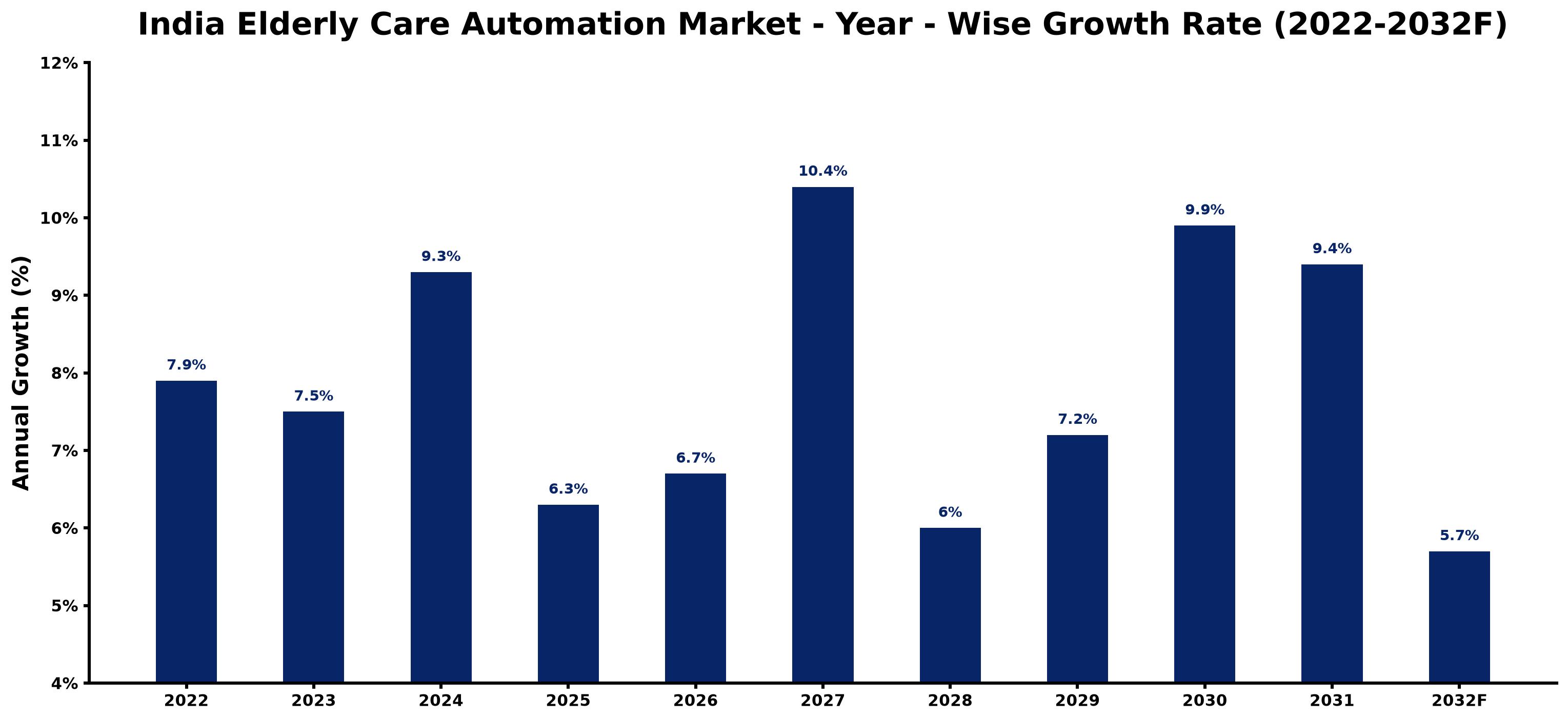
The following table presents the estimated annual growth rate for each year together with the principal factor influencing market performance.
| Year | Estimated Annual Growth (%) | Market Rationale |
| 2022 | 7.9 | The National Programme for Health Care of the Elderly provided essential healthcare access for seniors. |
| 2023 | 7.5 | Funding for elderly care initiatives saw a reduction, leading to slower growth than in 2022. |
| 2024 | 9.3 | Increased adoption of AI and robotics in 70% of new elderly care facilities boosted growth. |
| 2025 | 6.3 | The Smart Cities Mission's focus on elderly care automation led to a slowdown in growth compared to 2024. |
| 2026 | 6.7 | New smart healthcare solutions are expected to boost growth, responding to the rising elderly population. |
| 2027 | 10.4 | Demand surged for elderly care technologies and services, leading to peak growth. |
| 2028 | 6.0 | Growth slowed as the market adjusted to the peak demand levels of the previous year. |
| 2029 | 7.2 | Increased telemedicine services for the elderly drove demand higher again in 2029. |
| 2030 | 9.9 | The elderly population's rapid increase will support market growth in 2030. |
| 2031 | 9.4 | Growth moderated as the sector faced challenges in scaling up services to meet demand. |
| 2032 | 5.7 | The market is expected to slow further as maturation sets in after several years of rapid growth. |
Note: Market size estimations and growth projections presented in this report are based on 6Wresearch's proprietary forecasting methodology, utilizing the latest available industry data, government publications, and primary research inputs.
India Elderly Care Automation Market Synopsis
Elderly Care Automation in India involves using advanced technologies like AI and robotics to assist elderly individuals. This includes solutions for monitoring health, improving safety, and ensuring medication adherence. The India Elderly Care Automation Market is expanding due to a rapidly aging population, projected to reach 300 million by 2050, and increasing demand for home care services. Key drivers include the National Programme for Health Care of the Elderly and the Elderly Care Policy, promoting substantial investment in automation solutions.
Market Dynamics Impact Analysis (2026–2032)
| Factor | Type | Impact | Primary Segment Affected |
| Growing elderly population | Driver | High | Robotic Care |
| Increasing adoption of AI technologies | Driver | High | Medication Robots |
| Rising demand for home care services | Opportunity | High | Smart Beds |
| Government initiatives for elderly welfare | Opportunity | Medium | Voice Assistants |
| Limited awareness of automation benefits | Restraint | High | Robotic Care |
| High initial investment costs | Restraint | Medium | Medication Robots |
| Shortage of skilled professionals | Challenge | High | Smart Beds |
| Regulatory hurdles in technology adoption | Challenge | Medium | Voice Assistants |
Evaluation of Drivers in India Elderly Care Automation Market (2026–2032)
The table below links each growth driver to the segment it affects and the evidence for it.
| Drivers | Primary Segment Affected | Why It Matters (Evidence) |
| India's aging population | Robotic Care | India's elderly population is projected to reach 300 million by 2050, increasing demand for care solutions. |
| AI integration in facilities | Medication Robots | AI and robotics are now used in 70% of new elderly care facilities, improving operational efficiency. |
| Demand for home care solutions | Smart Beds | Over 50% of elderly individuals live alone, necessitating automation solutions for safety and monitoring. |
| Government support for elderly care | Voice Assistants | The Elderly Care Policy launched in 2021 aims to enhance care services, driving demand for automation. |
| Surge in telemedicine services | Robotic Care | Telemedicine services for the elderly have increased by 40% since 2020, boosting the need for automation. |
Growth in the Elderly Care Automation market in India stems from rising end-use demand and a responsive supply chain. The elderly population is expected to reach 300 million by 2050, creating a substantial need for automation solutions. Approximately 70% of new elderly care facilities now incorporate AI and robotics, improving service delivery and efficiency. The Smart Cities Mission, which includes provisions for elderly care automation, is driving investments, with ₹500 crores allocated in 2023 for related initiatives. Furthermore, over 50% of elderly individuals live alone, increasing the demand for automation technologies that provide companionship and safety. This trend encourages facilities to invest in smart beds and robotic care solutions to enhance the quality of life for seniors.
Evaluation of Restraints in India Elderly Care Automation Market
The table below lists the restraints and the evidence behind each.
| Market Restraint | Primary Segment Affected | Why It Matters (Evidence) |
| Limited awareness of automation benefits | Robotic Care | Many elderly individuals and their families remain unaware of the advantages of automation solutions, hindering adoption. |
| High initial investment costs | Medication Robots | The upfront costs associated with implementing automation technologies deter potential buyers. |
| Shortage of skilled professionals | Smart Beds | A lack of trained personnel to manage and operate elderly care automation systems constrains market growth. |
| Regulatory hurdles in technology adoption | Voice Assistants | Complex regulatory requirements can delay the implementation of new technologies in elderly care. |
| Limited integration with existing systems | Robotic Care | Challenges in integrating automation solutions with current healthcare systems can slow down market penetration. |
India Elderly Care Automation Market Challenges
India's elderly care automation market still has to solve a few problems, starting with a skills shortage. The absence of trained professionals in elderly care technology hampers effective service delivery, costing facilities valuable time and leading to higher operational expenses. Regulatory hurdles present another challenge; compliance with standards like ISO 13485 can delay product launches, impacting suppliers' ability to meet the growing demand. Technological integration is also a concern, as many existing facilities lack the necessary infrastructure, limiting automation adoption and efficiency for buyers. Lastly, fierce competition among service providers drives down prices, squeezing profit margins for producers.
Trends in the India Elderly Care Automation Market
The trends below show where the India Elderly Care Automation Market is heading.
- Shift Towards Smart Home Integration: There is a growing trend towards integrating elderly care automation into smart home systems, improving convenience and safety. The Smart Cities Mission includes provisions for such technologies, with 40% of new homes adopting these solutions.
- Increased Use of Telemedicine: The elderly population is increasingly using telemedicine services, which have surged by 40% since 2020. This shift is particularly evident in urban areas, where access to healthcare is being redefined.
- Growing Demand for Medication Management Solutions: There is a notable increase in the use of medication robots, driven by the need for better adherence to medication schedules. This trend is supported by the Elderly Care Policy, which aims to improve healthcare outcomes.
- Expansion of AI in Elderly Care Facilities: The adoption of AI technologies in elderly care facilities has become prevalent, with 70% of new facilities incorporating these systems. This trend is reshaping how care is delivered and monitored.
Investment Opportunities in the India Elderly Care Automation Market
Several openings in the India Elderly Care Automation Market merit attention from investors.
- Increasing Demand for Automation Solutions: With India's elderly population projected to reach 300 million by 2050, the demand for automation solutions is set to rise. Senior homes are particularly in need of these technologies to improve care.
- Collaborative Technology Development: There is a gap in the market for advanced elderly care automation technologies, presenting opportunities for partnerships. Collaborating with local healthcare providers can facilitate entry into this growing sector.
- Investment in Smart Healthcare Solutions: The Ministry of Health and Family Welfare allocated ₹500 crores for elderly care initiatives in 2023, creating opportunities for investment in smart healthcare solutions. This funding can support the development of innovative products.
- Focus on In-Home Care Services: The increasing number of elderly individuals living alone highlights the need for in-home care automation solutions. Targeting this segment can lead to significant market opportunities.
Government Initiatives in the India Elderly Care Automation Market
The Elderly Care Policy was launched in 2021 by the Ministry of Social Justice and Empowerment to improve the quality of life for elderly citizens. This initiative focuses on enhancing care services and support systems for the elderly population. Additionally, the National Programme for Health Care of the Elderly was updated in 2021 to provide comprehensive healthcare services, ensuring better access for seniors. These measures are vital for fostering a supportive environment for elderly care automation.
The Ministry of Health and Family Welfare has allocated funds for the development of smart healthcare solutions for the elderly in 2023, supporting innovative approaches to elderly care. The Ministry of Electronics and Information Technology introduced a scheme in 2022 to promote the use of AI in elderly care technologies, aiming to improve the efficiency and effectiveness of care solutions. Furthermore, the Ministry of Housing and Urban Affairs is implementing the Smart Cities Mission, which includes elderly care automation initiatives, further driving investment in this sector.
Future Insight of the India Elderly Care Automation Market
Several forward-looking factors should support the elderly care automation market in India over the coming years. The National Programme for Health Care of the Elderly aims to enhance service delivery, while the Smart Cities Mission will integrate advanced automation technologies into urban planning. By 2032, telemedicine services for the elderly are expected to grow by 40%, reflecting a shift towards more accessible healthcare solutions. The government's ₹500 crores allocation for elderly care initiatives will stimulate market growth and drive the development of new technologies.
Market Segmentation Analysis
Each segment group is reviewed below, with the leader by share and the fastest grower by CAGR.
By Automation Type – Robotic Care Dominated, Medication Robots Expected to Grow Fastest
According to Vasudha, AM at 6Wresearch, Robotic Care accounted for a 40% market share by automation type in 2025. Robotic Care commands the largest market share in India as it is vital for providing physical assistance and mobility support to elderly individuals. The increasing elderly population, projected to reach 300 million by 2050, will drive demand for these robotic solutions. Medication Robots are projected to grow fastest, at a CAGR of 9.3% during 2026–2032. Medication Robots are experiencing rapid growth due to their essential role in managing medication schedules and adherence for the elderly. With around 10 million senior homes currently in India, the adoption of these robots is expected to rise significantly. This trend indicates that suppliers should focus on developing advanced robotic solutions to meet the growing needs of elderly care facilities.
By Technology Used – AI & Robotics Dominated, IoT Sensors Expected to Grow Fastest
AI & Robotics took a 40% share of technology used in 2025, more than any other category. AI & Robotics hold the largest market share as they are essential for creating effective elderly care automation solutions. Their integration in 70% of new elderly care facilities underscores their importance in enhancing care services. Over 2026–2032, IoT Sensors are expected to post the fastest growth, at a CAGR of 9.0%. IoT Sensors are witnessing the fastest growth due to their capability to provide real-time monitoring and assistance for elderly individuals. The increasing demand for home care services is accelerating the adoption of IoT technologies in this sector. Suppliers should prioritise IoT solutions to capitalise on the growing demand for connected elderly care technologies.
By Use Case – Assistance Tasks Dominated, Dosing Reminders Expected to Grow Fastest
In 2025, Assistance Tasks led the use case split with a 45% share. Assistance Tasks represent the largest share of the market as they encompass a wide range of essential services for elderly individuals. The growing aging population and the need for comprehensive care solutions are driving the demand for assistance technologies. The quickest growth will come from Dosing Reminders, forecast to expand at a CAGR of 9.6% between 2026 and 2032. Dosing Reminders are rapidly gaining traction as they address a critical need for medication adherence among the elderly. The rise in telemedicine services, which have increased by 40% since 2020, further highlights the importance of such solutions. This signals to suppliers the necessity of focusing on developing effective dosing reminder systems to meet the needs of elderly patients.
By End User – Senior Homes Dominated, In-Home Patients Expected to Grow Fastest
Senior Homes held a 44% share of the India Elderly Care Automation Market by end user in 2025. Senior Homes account for the largest market share as they provide dedicated care facilities for the elderly. With approximately 10 million senior homes in India, the demand for automation solutions in these settings is substantial. In-Home Patients are set to record the highest CAGR in this split, 9.2% over 2026–2032. In-Home Patients are the fastest-growing segment as more elderly individuals prefer to receive care in their own homes. The trend of over 50% of elderly individuals living alone underscores the urgent need for automation solutions tailored to in-home care. This suggests that suppliers should enhance their offerings for in-home automation solutions to cater to this growing demographic.
Key Attractiveness of the Report
- 10 Years of Market Numbers
- Historical Data Starting from 2022 to 2025
- Base Year 2025
- Forecast Data until 2032
- Key Performance Indicators Impacting the Market
- Major Upcoming Developments and Projects
Key Highlights of the Report:
- India Elderly Care Automation Market Outlook
- Market Size of India Elderly Care Automation Market, 2025
- Forecast of India Elderly Care Automation Market, 2032
- Historical Data and Forecast of India Elderly Care Automation Revenues & Volume for the Period 2022 - 2032F
- India Elderly Care Automation Market Trend Evolution
- India Elderly Care Automation Market Drivers and Challenges
- India Elderly Care Automation Price Trends
- India Elderly Care Automation Porter's Five Forces
- India Elderly Care Automation Industry Life Cycle
- Historical Data and Forecast of India Elderly Care Automation Market Revenues & Volume By Automation Type for the Period 2022 - 2032F
- Historical Data and Forecast of India Elderly Care Automation Market Revenues & Volume By Robotic Care for the Period 2022 - 2032F
- Historical Data and Forecast of India Elderly Care Automation Market Revenues & Volume By Medication Robots for the Period 2022 - 2032F
- Historical Data and Forecast of India Elderly Care Automation Market Revenues & Volume By Smart Beds for the Period 2022 - 2032F
- Historical Data and Forecast of India Elderly Care Automation Market Revenues & Volume By Voice Assistants for the Period 2022 - 2032F
- Historical Data and Forecast of India Elderly Care Automation Market Revenues & Volume By Technology Used for the Period 2022 - 2032F
- Historical Data and Forecast of India Elderly Care Automation Market Revenues & Volume By AI & Robotics for the Period 2022 - 2032F
- Historical Data and Forecast of India Elderly Care Automation Market Revenues & Volume By Timers + Sensors for the Period 2022 - 2032F
- Historical Data and Forecast of India Elderly Care Automation Market Revenues & Volume By IoT Sensors for the Period 2022 - 2032F
- Historical Data and Forecast of India Elderly Care Automation Market Revenues & Volume By NLP for the Period 2022 - 2032F
- Historical Data and Forecast of India Elderly Care Automation Market Revenues & Volume By Use Case for the Period 2022 - 2032F
- Historical Data and Forecast of India Elderly Care Automation Market Revenues & Volume By Assistance Tasks for the Period 2022 - 2032F
- Historical Data and Forecast of India Elderly Care Automation Market Revenues & Volume By Dosing Reminders for the Period 2022 - 2032F
- Historical Data and Forecast of India Elderly Care Automation Market Revenues & Volume By Sleep Monitoring for the Period 2022 - 2032F
- Historical Data and Forecast of India Elderly Care Automation Market Revenues & Volume By Emergency Calling for the Period 2022 - 2032F
- Historical Data and Forecast of India Elderly Care Automation Market Revenues & Volume By End User for the Period 2022 - 2032F
- Historical Data and Forecast of India Elderly Care Automation Market Revenues & Volume By Senior Homes for the Period 2022 - 2032F
- Historical Data and Forecast of India Elderly Care Automation Market Revenues & Volume By In-Home Patients for the Period 2022 - 2032F
- Historical Data and Forecast of India Elderly Care Automation Market Revenues & Volume By Hospitals for the Period 2022 - 2032F
- Historical Data and Forecast of India Elderly Care Automation Market Revenues & Volume By Elderly Residents for the Period 2022 - 2032F
- India Elderly Care Automation Import Export Trade Statistics
- Market Opportunity Assessment By Automation Type
- Market Opportunity Assessment By Technology Used
- Market Opportunity Assessment By Use Case
- Market Opportunity Assessment By End User
- India Elderly Care Automation Top Companies Market Share
- India Elderly Care Automation Competitive Benchmarking By Technical and Operational Parameters
- India Elderly Care Automation Company Profiles
- India Elderly Care Automation Key Strategic Recommendations
Market Covered
The report offers an extensive study of the following market segments.
By Automation Type
- Robotic Care
- Medication Robots
- Smart Beds
- Voice Assistants
By Technology Used
- AI & Robotics
- Timers + Sensors
- IoT Sensors
- NLP
By Use Case
- Assistance Tasks
- Dosing Reminders
- Sleep Monitoring
- Emergency Calling
By End User
- Senior Homes
- In-Home Patients
- Hospitals
- Elderly Residents






































