France Functional Apparel Market Size, Share & Growth Rate
The France Functional Apparel Market was estimated at USD 181 Million in 2025 and is projected to reach USD 202 Million by 2032, growing at a CAGR of 1.6% from 2026 to 2032. This growth trajectory is largely driven by an increasing emphasis on performance-oriented clothing that combines comfort, protection, and functionality, particularly in outdoor and sports contexts. As consumers become more health-conscious and engaged in fitness activities, the demand for apparel that meets their dynamic lifestyles is set to rise significantly.
France Functional Apparel Market Year-wise Growth Rate and Key Drivers
This graph highlights how the France Functional Apparel Market has steadily grown over the years, supported by major growth factors.
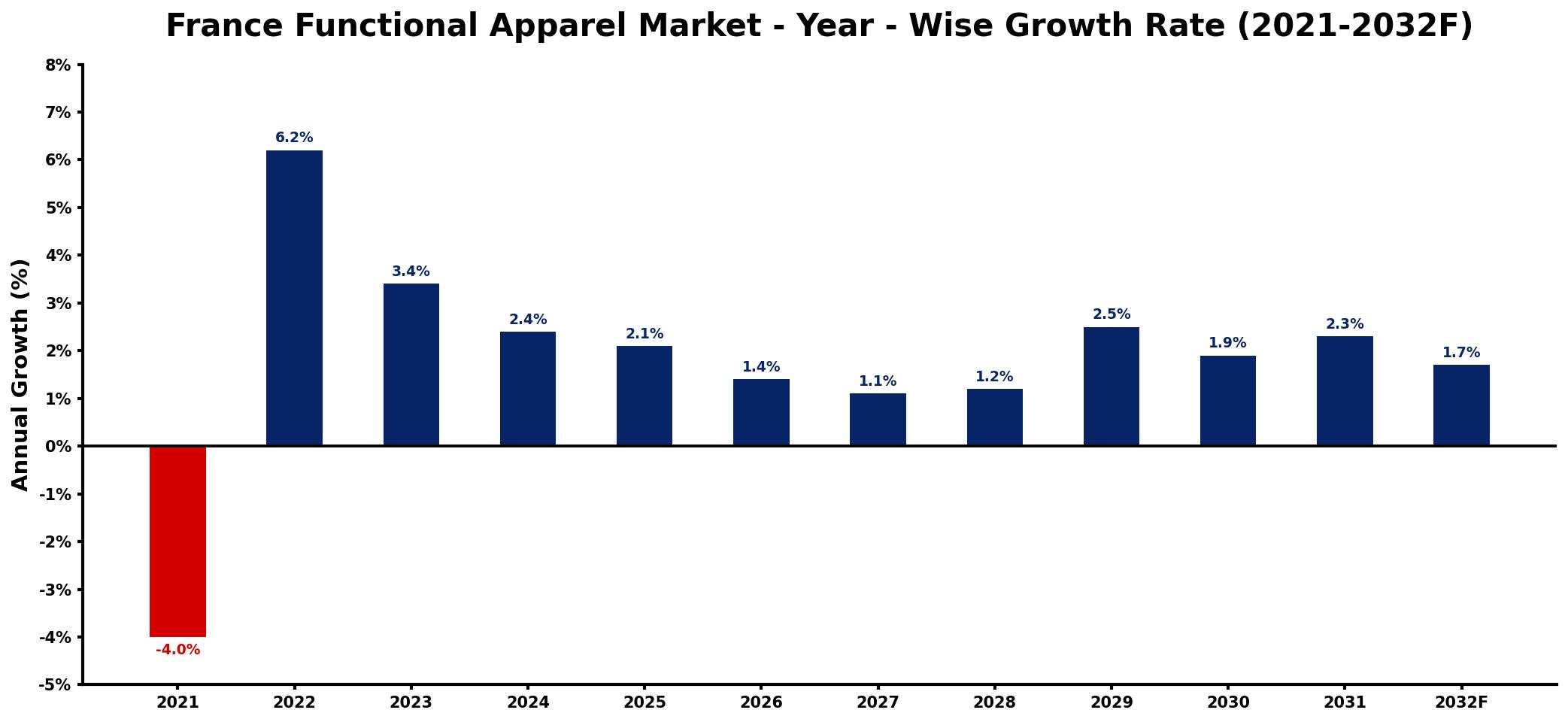
The table below presents the year‑wise growth rates along with the key drivers influencing the market
| Year | Growth Rate | Major Drivers |
| 2021 | -4.0% | decreased consumer disposable income |
| 2022 | 6.2% | growing health consciousness trend |
| 2023 | 3.4% | increased outdoor activity participation |
| 2024 | 2.4% | rising interest in sustainability |
| 2025 | 2.1% | expansion of e-commerce platforms |
| 2026 | 1.4% | growing demand for innovation |
| 2027 | 1.1% | increased investment in technology |
| 2028 | 1.2% | surge in fitness community engagement |
| 2029 | 2.5% | enhanced marketing strategies effectiveness |
| 2030 | 1.9% | rising popularity of athleisure wear |
| 2031 | 2.3% | increased collaboration with influencers |
| 2032 | 1.7% | growing focus on performance enhancement |
Note: Market size estimations and growth projections presented in this report are based on 6Wresearch's proprietary forecasting methodology, utilizing the latest available industry data, government publications, and primary research inputs.
France Functional Apparel Market Synopsis
The strongest force shaping the France Functional Apparel Market is the growing consumer demand for sustainable and high-performance textiles. As environmental awareness rises, many consumers are opting for apparel that not only performs well in various activities but also adheres to eco-friendly manufacturing practices.
Additionally, advancements in fabric technology, including moisture-wicking, thermal insulation, and UV protection, are attracting outdoor enthusiasts and fitness aficionados alike. This trend towards multifunctional apparel is becoming a staple in both casual and active wardrobes, highlighting the market's potential for innovation and growth.
France Functional Apparel Market Key Takeaways
- Rising interest in health and wellness is significantly increasing demand for functional apparel.
- Advanced textile technologies are enhancing the performance characteristics of apparel, driving consumer preference.
- Sustainable manufacturing practices are becoming crucial for brand loyalty in the functional apparel market.
- The athleisure trend is reshaping market dynamics, creating new consumer segments.
- Innovative collaborations among brands, manufacturers, and technology companies are fostering market growth.
Evaluation of Restraints in France Functional Apparel Market
Despite its promising growth, the France Functional Apparel Market faces notable restraints. One key issue lies in the challenge of balancing performance features with aesthetic appeal, as consumers increasingly seek garments that are not just functional but also stylish. Moreover, manufacturers encounter difficulties in sourcing sustainable materials that meet consumer expectations without inflating production costs. In a competitive landscape crowded with both functional and traditional apparel brands, maintaining market share requires ongoing innovation and strategic differentiation.
France Functional Apparel Market Trends
Current trends indicate a rising consumer preference for athleisure wear, which blurs the lines between activewear and everyday clothing. This trend is coupled with the demand for smart textiles—apparel embedded with technology that enhances user experience, such as fitness tracking. Furthermore, sustainability continues to take center stage as consumers actively seek brands that prioritize eco-friendly practices in their production processes, from material sourcing to waste reduction.
France Functional Apparel Market Opportunities
The market holds significant opportunities for growth through innovation in textile technology and sustainable practices. Companies that invest in research and development to produce advanced, eco-friendly materials are likely to capture the attention of environmentally conscious consumers. Additionally, expanding the range of functional apparel to include niche segments—such as clothing designed for specific outdoor activities or specialized workwear—can also drive new revenue streams.
Government Initiatives in the France Functional Apparel Market
Government initiatives in France are increasingly aimed at regulating textile labeling, safety standards, and environmental compliance. Policies that incentivize sustainable manufacturing processes are becoming more prevalent, encouraging companies to adopt greener practices. Additionally, various public programs may support innovation within the sector, facilitating collaboration between apparel brands and technology partners to enhance performance and sustainability in functional apparel.
Future Insights of the France Functional Apparel Market
Looking ahead to the period from 2026 to 2032, the France Functional Apparel Market is poised for steady growth driven by consumer demands for both performance and sustainability. As innovations in fabric technologies continue to evolve, the market will likely see an influx of multifunctional garments that cater to diverse activities and lifestyles. The increasing integration of smart textile technology will also redefine consumer interactions with clothing, setting the stage for a new era of functional apparel.
France Functional Apparel Market Latest Developments (2025 - 2026)
Recent developments in the France Functional Apparel Market indicate a shift towards more personalized consumer experiences, with brands leveraging data analytics to enhance product offerings. Collaborations between apparel brands and technology firms are also on the rise, aiming to embed advanced functionalities within garments. Moreover, theres a noticeable increase in initiatives promoting transparency in supply chains, as consumers demand to know the origin and sustainability of their apparel.
France Functional Apparel Market - Key Attractiveness of the Report
- 10 Years of Market Numbers
- Historical Data Starting from 2022 to 2025
- Base Year: 2025
- Forecast Data until 2032
- Key Performance Indicators Impacting the Market
- Major Upcoming Developments and Projects
Key Highlights of the Report:
- France Functional Apparel Market Outlook
- Market Size of France Functional Apparel Market, 2025
- Forecast of France Functional Apparel Market, 2032
- Historical Data and Forecast of France Functional Apparel Revenues & Volume for the Period 2022-2032F
- France Functional Apparel Market Trend Evolution
- France Functional Apparel Market Drivers and Challenges
- France Functional Apparel Price Trends
- France Functional Apparel Porter's Five Forces
- France Functional Apparel Industry Life Cycle
- Historical Data and Forecast of France Functional Apparel Market Revenues & Volume By Product Type for the Period 2022-2032F
- Historical Data and Forecast of France Functional Apparel Market Revenues & Volume By Sportswear for the Period 2022-2032F
- Historical Data and Forecast of France Functional Apparel Market Revenues & Volume By Activewear for the Period 2022-2032F
- Historical Data and Forecast of France Functional Apparel Market Revenues & Volume By Protective Clothing for the Period 2022-2032F
- Historical Data and Forecast of France Functional Apparel Market Revenues & Volume By Others for the Period 2022-2032F
- Historical Data and Forecast of France Functional Apparel Market Revenues & Volume By Application for the Period 2022-2032F
- Historical Data and Forecast of France Functional Apparel Market Revenues & Volume By Sports Industry for the Period 2022-2032F
- Historical Data and Forecast of France Functional Apparel Market Revenues & Volume By Outdoor Clothing for the Period 2022-2032F
- Historical Data and Forecast of France Functional Apparel Market Revenues & Volume By Healthcare sector for the Period 2022-2032F
- Historical Data and Forecast of France Functional Apparel Market Revenues & Volume By Distribution Channel for the Period 2022-2032F
- Historical Data and Forecast of France Functional Apparel Market Revenues & Volume By Offline Store for the Period 2022-2032F
- Historical Data and Forecast of France Functional Apparel Market Revenues & Volume By Online Store for the Period 2022-2032F
- France Functional Apparel Import Export Trade Statistics
- Market Opportunity Assessment By Product Type
- Market Opportunity Assessment By Application
- Market Opportunity Assessment By Distribution Channel
- France Functional Apparel Top Companies Market Share
- France Functional Apparel Competitive Benchmarking By Technical and Operational Parameters
- France Functional Apparel Company Profiles
- France Functional Apparel Key Strategic Recommendations






































