India Functional Apparel Market Size, Share & Growth Rate
The India Functional Apparel Market was estimated at USD 907 Million in 2025 and is projected to reach USD 1304 Million by 2032, growing at a CAGR of 5.3% from 2026 to 2032. This growth trajectory is underpinned by an increasingly health-conscious population that prioritizes physical activity, coupled with the burgeoning trend of athleisure that blends functionality with fashion. Furthermore, the rising interest in outdoor activities, such as trekking and yoga, is propelling demand for specialized apparel that enhances performance and comfort.
India Functional Apparel Market Year-wise Growth Rate and Key Drivers
This graph highlights how the India Functional Apparel Market has steadily grown over the years, supported by major growth factors.
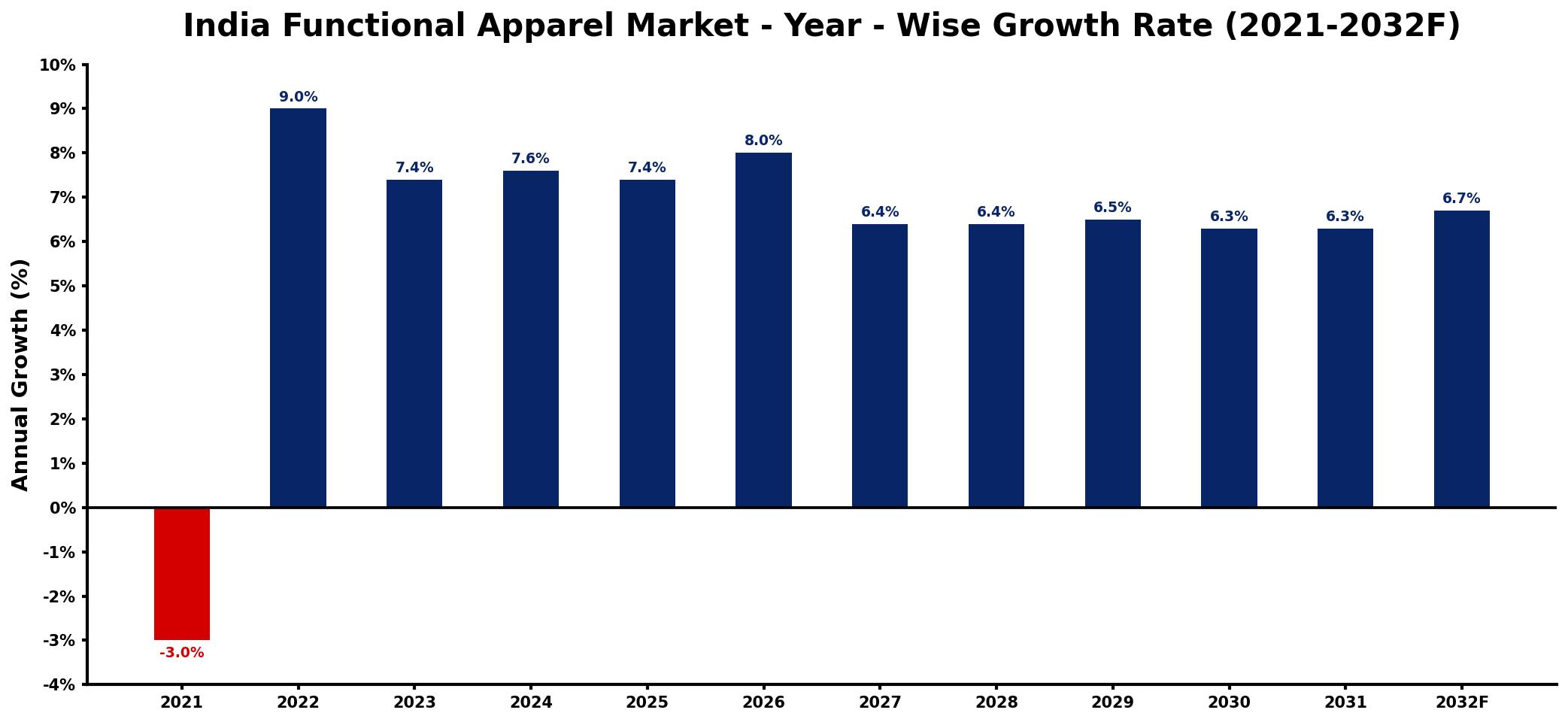
The table below presents the year‑wise growth rates along with the key drivers influencing the market
| Year | Growth Rate | Major Drivers |
| 2021 | -3.0% | reduced consumer spending on leisure |
| 2022 | 9.0% | increased investment in health trends |
| 2023 | 7.4% | growing demand for active lifestyles |
| 2024 | 7.6% | expansion of online retail platforms |
| 2025 | 7.4% | rising popularity of fitness activities |
| 2026 | 8.0% | enhanced consumer awareness of wellness |
| 2027 | 6.4% | growing interest in sustainable sourcing |
| 2028 | 6.4% | increased participation in sports events |
| 2029 | 6.5% | rising demand from electronics |
| 2030 | 6.3% | growing influence of social media |
| 2031 | 6.3% | increased pharmaceutical industry usage |
| 2032 | 6.7% | increased focus on performance technologies |
Note: Market size estimations and growth projections presented in this report are based on 6Wresearch's proprietary forecasting methodology, utilizing the latest available industry data, government publications, and primary research inputs.
India Functional Apparel Market Synopsis
In recent years, the India functional apparel market has witnessed significant transformations, propelled by changing consumer lifestyles and preferences. As more individuals gravitate toward fitness-oriented activities, clothing that marries performance with style has gained immense popularity, creating a vibrant market landscape.
Additionally, the professional sector is increasingly adopting functional apparel, which offers practical features such as moisture-wicking and anti-bacterial properties. This blend of utility and comfort caters to diverse consumer segments, from athletes to busy professionals, further driving market expansion.
India Functional Apparel Market Key Takeaways
- The market is experiencing robust growth due to increased health and fitness consciousness among Indian consumers.
- Advancements in fabric technology and innovative design approaches enhance product appeal and functionality.
- Versatility and multipurpose capabilities of functional apparel are key factors influencing purchasing decisions.
- The pandemic highlighted the demand for comfortable and functional clothing, further boosting market growth.
- E-commerce has become a vital channel for reaching consumers, reshaping retail dynamics in the functional apparel sector.
Evaluation of Restraints in India Functional Apparel Market
While the India functional apparel market is on an upward trajectory, several constraints need to be addressed for sustainable growth. A significant barrier is consumer education; many potential buyers remain unaware of the technical advantages offered by functional apparel. This gap in understanding can hinder product adoption. Moreover, sourcing high-quality fabrics locally poses challenges, as many specialized materials still require imports, which can drive up prices. Additionally, balancing the demand for stylish designs alongside functional attributes remains critical in appealing to the fashion-forward Indian consumer.
India Functional Apparel Market Trends
Several trends are currently shaping the India functional apparel market. The rise of eco-conscious consumerism is influencing brands to explore sustainable materials and production processes. There is also a noticeable shift towards smart textiles that integrate technology into functional clothing, enhancing user experience through features like temperature regulation and fitness tracking. The athleisure trend continues to thrive, blurring the lines between activewear and everyday fashion, while customization and personalization options are becoming increasingly popular among consumers.
India Functional Apparel Market Opportunities
The India functional apparel market presents numerous opportunities for growth and investment. With the rise in disposable incomes and an expanding middle class, there is a vast consumer base eager for high-quality functional clothing. Brands that focus on niche segments, such as adaptive apparel for diverse body types or specific sports, can capture untapped markets. Moreover, investments in local manufacturing capabilities can reduce dependency on imports, making products more affordable and appealing to the price-sensitive Indian consumer.
Government Initiatives in the India Functional Apparel Market
The Indian government is increasingly recognizing the potential of the apparel sector, including functional apparel, as a significant contributor to economic growth. Various initiatives aimed at promoting the 'Make in India' campaign are encouraging domestic production. Furthermore, policies focused on skill development in textile manufacturing and design are expected to bolster the market by enhancing local capabilities and innovation. Public spending on sports infrastructure and health awareness campaigns also supports the growing interest in fitness and functional apparel.
Future Insights of the India Functional Apparel Market
Looking ahead to 2026-2032, the India functional apparel market is poised for dynamic growth. As fitness becomes more integrated into daily life, the demand for versatile and functional clothing will likely rise. Innovations in materials and technology will further enhance the functionality of apparel, appealing to a broad spectrum of consumers. Additionally, as e-commerce continues to evolve, brands will need to enhance their online presence to capitalize on this growing trend and meet the shifting purchasing behaviors of consumers.
India Functional Apparel Market Latest Developments (2025 - 2026)
Recent industry trends indicate a notable shift towards integrating health-focused features in functional apparel. Brands are increasingly incorporating antimicrobial and moisture-wicking properties to meet consumer demands for hygiene and comfort. Additionally, collaborations between technology companies and apparel manufacturers are emerging, focusing on wearable tech that provides performance analytics. The role of online retail continues to expand, with brands enhancing their digital marketing strategies to better connect with consumers and adapt to their evolving shopping preferences.
India Functional Apparel Market - Key Attractiveness of the Report
- 10 Years of Market Numbers
- Historical Data Starting from 2022 to 2025
- Base Year: 2025
- Forecast Data until 2032
- Key Performance Indicators Impacting the Market
- Major Upcoming Developments and Projects
Key Highlights of the Report:
- India Functional Apparel Market Outlook
- Market Size of India Functional Apparel Market, 2025
- Forecast of India Functional Apparel Market, 2032
- Historical Data and Forecast of India Functional Apparel Revenues & Volume for the Period 2022-2032F
- India Functional Apparel Market Trend Evolution
- India Functional Apparel Market Drivers and Challenges
- India Functional Apparel Price Trends
- India Functional Apparel Porter's Five Forces
- India Functional Apparel Industry Life Cycle
- Historical Data and Forecast of India Functional Apparel Market Revenues & Volume By Product Type for the Period 2022-2032F
- Historical Data and Forecast of India Functional Apparel Market Revenues & Volume By Sportswear for the Period 2022-2032F
- Historical Data and Forecast of India Functional Apparel Market Revenues & Volume By Activewear for the Period 2022-2032F
- Historical Data and Forecast of India Functional Apparel Market Revenues & Volume By Protective Clothing for the Period 2022-2032F
- Historical Data and Forecast of India Functional Apparel Market Revenues & Volume By Others for the Period 2022-2032F
- Historical Data and Forecast of India Functional Apparel Market Revenues & Volume By Application for the Period 2022-2032F
- Historical Data and Forecast of India Functional Apparel Market Revenues & Volume By Sports Industry for the Period 2022-2032F
- Historical Data and Forecast of India Functional Apparel Market Revenues & Volume By Outdoor Clothing for the Period 2022-2032F
- Historical Data and Forecast of India Functional Apparel Market Revenues & Volume By Healthcare sector for the Period 2022-2032F
- Historical Data and Forecast of India Functional Apparel Market Revenues & Volume By Distribution Channel for the Period 2022-2032F
- Historical Data and Forecast of India Functional Apparel Market Revenues & Volume By Offline Store for the Period 2022-2032F
- Historical Data and Forecast of India Functional Apparel Market Revenues & Volume By Online Store for the Period 2022-2032F
- India Functional Apparel Import Export Trade Statistics
- Market Opportunity Assessment By Product Type
- Market Opportunity Assessment By Application
- Market Opportunity Assessment By Distribution Channel
- India Functional Apparel Top Companies Market Share
- India Functional Apparel Competitive Benchmarking By Technical and Operational Parameters
- India Functional Apparel Company Profiles
- India Functional Apparel Key Strategic Recommendations






































