China Functional Apparel Market Size, Share & Growth Rate
The China Functional Apparel Market was estimated at USD 221 Million in 2025 and is projected to reach USD 255 Million by 2032, growing at a CAGR of 2.1% from 2026 to 2032. This steady growth is driven primarily by an increasing consumer focus on health and wellness, alongside a surge in outdoor and fitness activities. The growing athleisure trend and advancements in textile technology, which provide enhanced comfort and performance, further contribute to the robust market trajectory.
China Functional Apparel Market Year-wise Growth Rate and Key Drivers
This graph highlights how the China Functional Apparel Market has steadily grown over the years, supported by major growth factors.
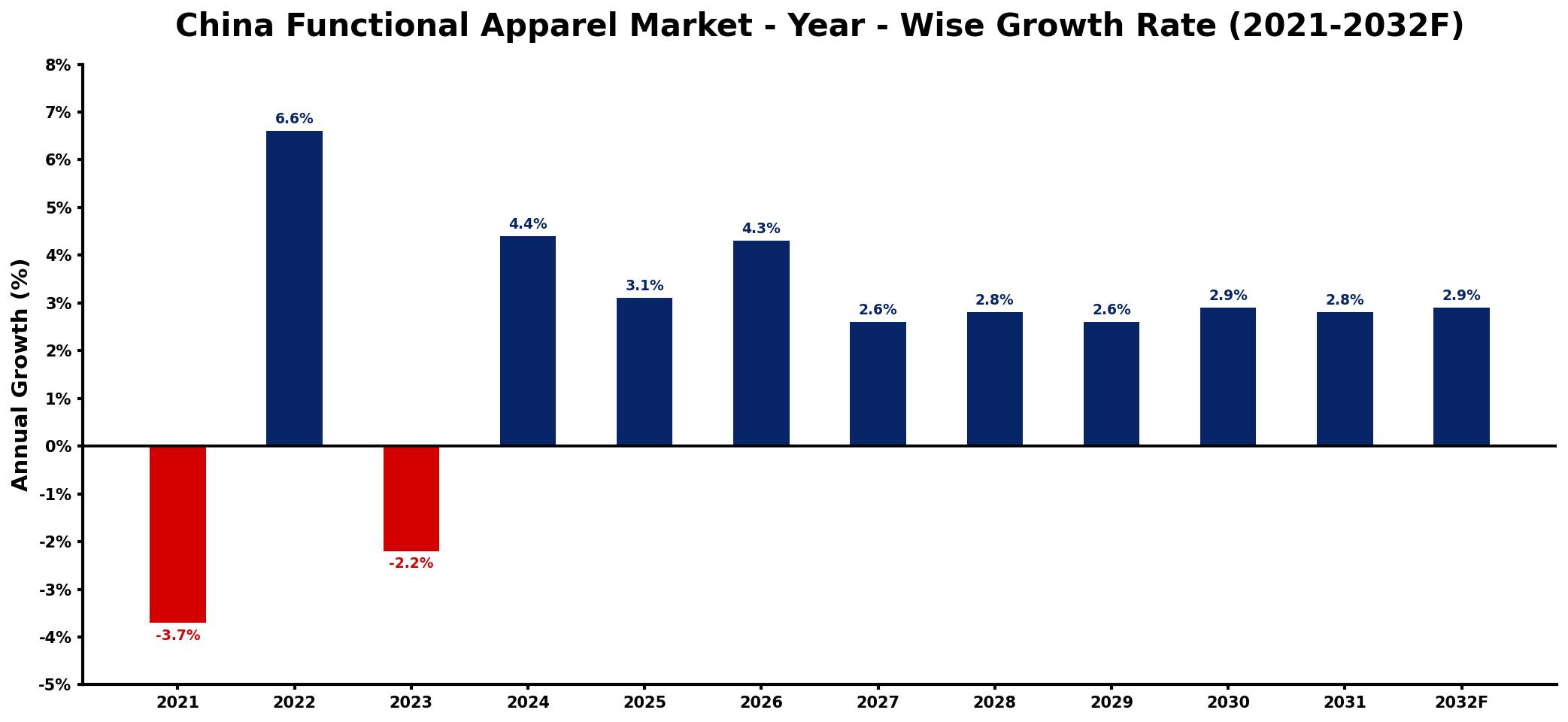
The table below presents the year‑wise growth rates along with the key drivers influencing the market
| Year | Growth Rate | Major Drivers |
| 2021 | -3.7% | Consumer spending levels decreased significantly |
| 2022 | 6.6% | improved processing technologies adoption |
| 2023 | -2.2% | Retail sector faced significant challenges |
| 2024 | 4.4% | E-commerce platforms expanded rapidly |
| 2025 | 3.1% | Sustainability initiatives gained traction |
| 2026 | 4.3% | Technological advancements drove innovation |
| 2027 | 2.6% | Fitness culture continued to thrive |
| 2028 | 2.8% | Global supply chains stabilized effectively |
| 2029 | 2.6% | Investment in local production increased |
| 2030 | 2.9% | Customization options attracted more customers |
| 2031 | 2.8% | Collaborations with influencers enhanced visibility |
| 2032 | 2.9% | Emerging markets showed strong interest |
Note: Market size estimations and growth projections presented in this report are based on 6Wresearch's proprietary forecasting methodology, utilizing the latest available industry data, government publications, and primary research inputs.
China Functional Apparel Market Synopsis
In China, the landscape of functional apparel is rapidly evolving as consumers seek clothing that not only enhances performance but also aligns with their lifestyle preferences. The popularity of sports and outdoor activities is prompting consumers to invest in specialized apparel, leading to a significant demand for clothing that offers moisture-wicking, breathability, and UV protection.
As the market expands, technological advancements in fabric and manufacturing processes are reshaping consumer expectations. From high-performance outdoor gear to stylish athleisure wear, the functional apparel market caters to a diverse range of activities and preferences, positioning itself as a critical segment of the broader apparel industry.
China Functional Apparel Market Key Takeaways
- Rising consumer interest in fitness and outdoor activities is significantly boosting the demand for functional apparel.
- Technological innovations in textile materials enhance performance features like moisture management and temperature regulation.
- The athleisure trend continues to merge style with functionality, increasing the appeal of functional apparel.
- Competitive pressures necessitate constant innovation and adaptation to rapidly changing consumer preferences.
- Government initiatives support advancements in textile technology and promote functional apparel across various sectors.
Evaluation of Restraints in China Functional Apparel Market
Despite its growth potential, the China Functional Apparel Market faces certain restraints that could limit expansion. Intense competition creates a challenging environment where brands must continually innovate to maintain market share. Moreover, rapid shifts in consumer preferences demand constant adaptation and investment in high-quality, stylish apparel. Additionally, the costs associated with sourcing advanced materials and implementing cutting-edge manufacturing processes can impact profitability, compelling companies to balance quality with price sensitivity in a diverse market landscape.
China Functional Apparel Market Trends
A notable trend in the China Functional Apparel Market is the integration of sustainability into product development. Consumers are increasingly prioritizing eco-friendly materials and ethical manufacturing practices, prompting brands to innovate in this area. Furthermore, the rise of smart textiles, which incorporate technology to monitor fitness metrics or enhance comfort, is reshaping the functional apparel landscape. As digital engagement rises, brands are also leveraging social media and e-commerce platforms to connect with health-conscious consumers and boost sales.
China Functional Apparel Market Opportunities
The market holds promising opportunities in niche segments such as adaptive apparel for individuals with disabilities and performance wear tailored for specific sports. Additionally, as urbanization continues and lifestyles become more active, there is potential for growth in urban functional apparel designed for commuting. Investment in research and development can lead to breakthroughs in fabric technology, creating products that enhance user experience and broaden market appeal. Businesses that can successfully navigate these opportunities stand to gain a significant competitive advantage.
Government Initiatives in the China Functional Apparel Market
The Chinese government plays a pivotal role in supporting the functional apparel market through various initiatives aimed at enhancing textile technology and promoting health-oriented apparel. Policies encouraging the development of high-performance clothing are evident in public funding for innovative textile solutions. Moreover, government campaigns advocating physical activity and outdoor engagement indirectly stimulate demand for functional apparel, as consumers seek gear that aligns with these initiatives. Such supportive measures are integral to fostering industry growth and innovation.
Future Insights of the China Functional Apparel Market
Looking ahead to the 2026-2032 period, the China Functional Apparel Market is expected to continue its upward trajectory, driven by ongoing health trends and technological advancements. The demand for stylish yet functional clothing will likely spur further innovation in fabric technologies, ensuring that consumer needs are met. Additionally, as the market becomes increasingly saturated, brands that successfully differentiate themselves through unique value propositions and sustainable practices will likely thrive, setting the stage for a dynamic and competitive market environment.
China Functional Apparel Market Latest Developments (2025 - 2026)
Recent developments in the China Functional Apparel Market indicate a growing emphasis on sustainability and innovation. Brands are increasingly launching collections that incorporate recycled materials and environmentally friendly production processes. Additionally, collaborations between tech companies and apparel brands are on the rise, resulting in the introduction of smart apparel equipped with performance-monitoring features. Such trends suggest a market poised for transformation as consumer expectations evolve and technology integration becomes more prevalent.
China Functional Apparel Market - Key Attractiveness of the Report
- 10 Years of Market Numbers
- Historical Data Starting from 2022 to 2025
- Base Year: 2025
- Forecast Data until 2032
- Key Performance Indicators Impacting the Market
- Major Upcoming Developments and Projects
Key Highlights of the Report:
- China Functional Apparel Market Outlook
- Market Size of China Functional Apparel Market, 2025
- Forecast of China Functional Apparel Market, 2032
- Historical Data and Forecast of China Functional Apparel Revenues & Volume for the Period 2022-2032F
- China Functional Apparel Market Trend Evolution
- China Functional Apparel Market Drivers and Challenges
- China Functional Apparel Price Trends
- China Functional Apparel Porter's Five Forces
- China Functional Apparel Industry Life Cycle
- Historical Data and Forecast of China Functional Apparel Market Revenues & Volume By Product Type for the Period 2022-2032F
- Historical Data and Forecast of China Functional Apparel Market Revenues & Volume By Sportswear for the Period 2022-2032F
- Historical Data and Forecast of China Functional Apparel Market Revenues & Volume By Activewear for the Period 2022-2032F
- Historical Data and Forecast of China Functional Apparel Market Revenues & Volume By Protective Clothing for the Period 2022-2032F
- Historical Data and Forecast of China Functional Apparel Market Revenues & Volume By Others for the Period 2022-2032F
- Historical Data and Forecast of China Functional Apparel Market Revenues & Volume By Application for the Period 2022-2032F
- Historical Data and Forecast of China Functional Apparel Market Revenues & Volume By Sports Industry for the Period 2022-2032F
- Historical Data and Forecast of China Functional Apparel Market Revenues & Volume By Outdoor Clothing for the Period 2022-2032F
- Historical Data and Forecast of China Functional Apparel Market Revenues & Volume By Healthcare sector for the Period 2022-2032F
- Historical Data and Forecast of China Functional Apparel Market Revenues & Volume By Distribution Channel for the Period 2022-2032F
- Historical Data and Forecast of China Functional Apparel Market Revenues & Volume By Offline Store for the Period 2022-2032F
- Historical Data and Forecast of China Functional Apparel Market Revenues & Volume By Online Store for the Period 2022-2032F
- China Functional Apparel Import Export Trade Statistics
- Market Opportunity Assessment By Product Type
- Market Opportunity Assessment By Application
- Market Opportunity Assessment By Distribution Channel
- China Functional Apparel Top Companies Market Share
- China Functional Apparel Competitive Benchmarking By Technical and Operational Parameters
- China Functional Apparel Company Profiles
- China Functional Apparel Key Strategic Recommendations






































