Kenya Galvanized Steel Market Growth Rate Analysis (2025 - 2031)
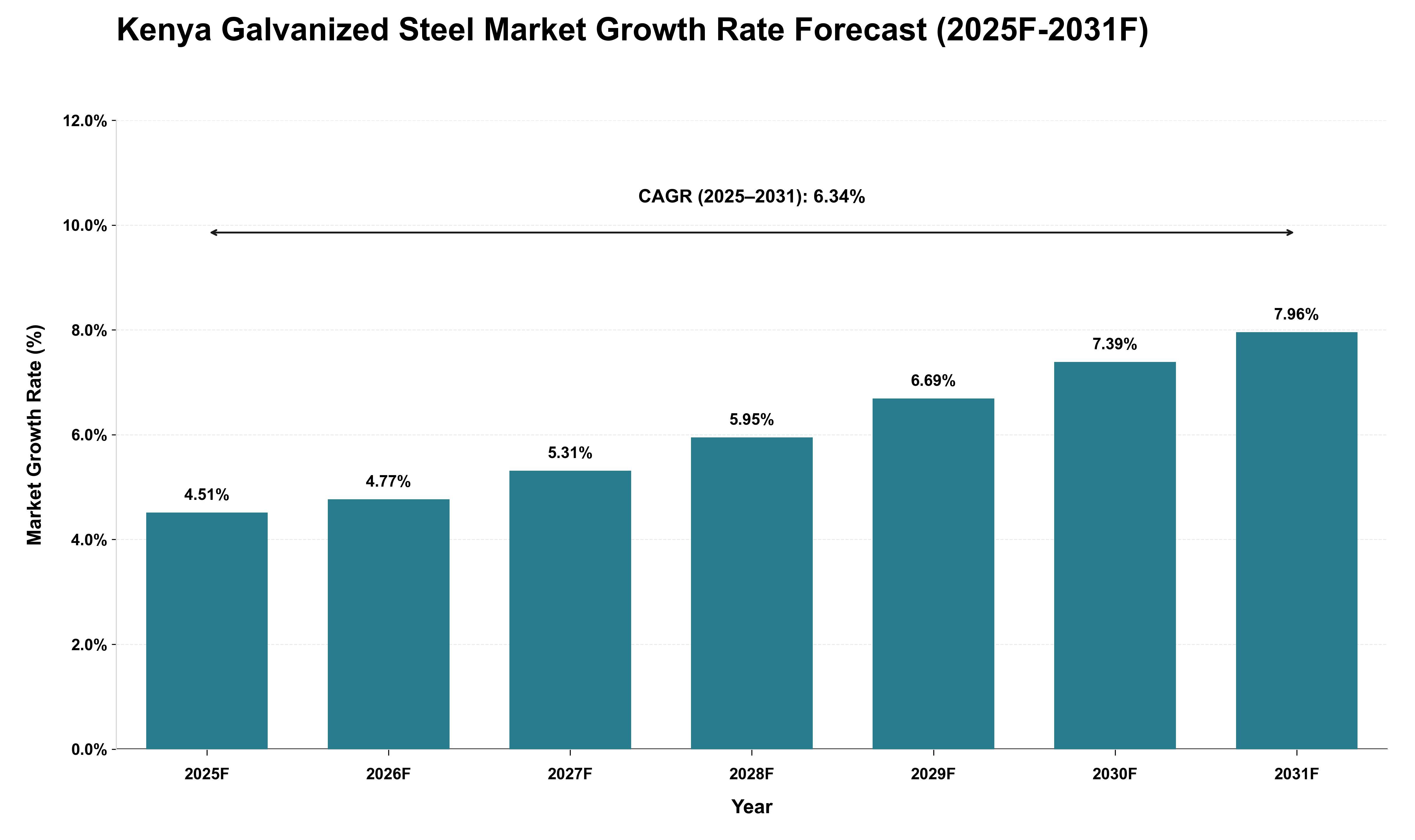
From 2025 onward, the Kenyan galvanized steel market will experience a robust growth trajectory, driven by increasing demand in construction and infrastructure development. The projected CAGR of 6.34% reflects a significant upward trend in annual growth rates, starting at 4.51% in 2025 and escalating to 7.96% by 2031. This acceleration can be attributed to anticipated improvements in supply chain efficiencies and a gradual reduction in input costs as global steel production stabilizes post-pandemic disruptions. Furthermore, Kenya's reliance on imported raw materials will likely influence pricing dynamics; as international supply chains normalize, import costs may decrease, enhancing local manufacturers' competitiveness. Additionally, cyclical trends associated with urbanization and industrialization will further bolster demand for galvanized steel products, positioning the market favorably within the broader economic landscape of East Africa during this period.
Key Highlights of the Report:
- Kenya Galvanized Steel Market Outlook
- Market Size of Kenya Galvanized Steel Market, 2024
- Forecast of Kenya Galvanized Steel Market, 2031
- Historical Data and Forecast of Kenya Galvanized Steel Revenues & Volume for the Period 2021 - 2031
- Kenya Galvanized Steel Market Trend Evolution
- Kenya Galvanized Steel Market Drivers and Challenges
- Kenya Galvanized Steel Price Trends
- Kenya Galvanized Steel Porter's Five Forces
- Kenya Galvanized Steel Industry Life Cycle
- Historical Data and Forecast of Kenya Galvanized Steel Market Revenues & Volume By Product Type for the Period 2021 - 2031
- Historical Data and Forecast of Kenya Galvanized Steel Market Revenues & Volume By Galvanized Steel Coils for the Period 2021 - 2031
- Historical Data and Forecast of Kenya Galvanized Steel Market Revenues & Volume By Galvanized Steel Strips for the Period 2021 - 2031
- Historical Data and Forecast of Kenya Galvanized Steel Market Revenues & Volume By Others for the Period 2021 - 2031
- Historical Data and Forecast of Kenya Galvanized Steel Market Revenues & Volume By Application for the Period 2021 - 2031
- Historical Data and Forecast of Kenya Galvanized Steel Market Revenues & Volume By Construction for the Period 2021 - 2031
- Historical Data and Forecast of Kenya Galvanized Steel Market Revenues & Volume By Automobile for the Period 2021 - 2031
- Historical Data and Forecast of Kenya Galvanized Steel Market Revenues & Volume By Home Appliances for the Period 2021 - 2031
- Historical Data and Forecast of Kenya Galvanized Steel Market Revenues & Volume By Others for the Period 2021 - 2031
- Kenya Galvanized Steel Import Export Trade Statistics
- Market Opportunity Assessment By Product Type
- Market Opportunity Assessment By Application
- Kenya Galvanized Steel Top Companies Market Share
- Kenya Galvanized Steel Competitive Benchmarking By Technical and Operational Parameters
- Kenya Galvanized Steel Company Profiles
- Kenya Galvanized Steel Key Strategic Recommendations






































