Kenya Groceries Market Summary
The kenya groceries market was estimated at USD 1075 Million in 2025 and is projected to reach USD 1535 Million by 2032, growing at a CAGR of 6.2% from 2026 to 2032.
Kenya Groceries Market Year-wise Growth Rate and Key Drivers
This graph highlights how the Kenya Groceries Market has steadily grown over the past five years, supported by major growth factors.
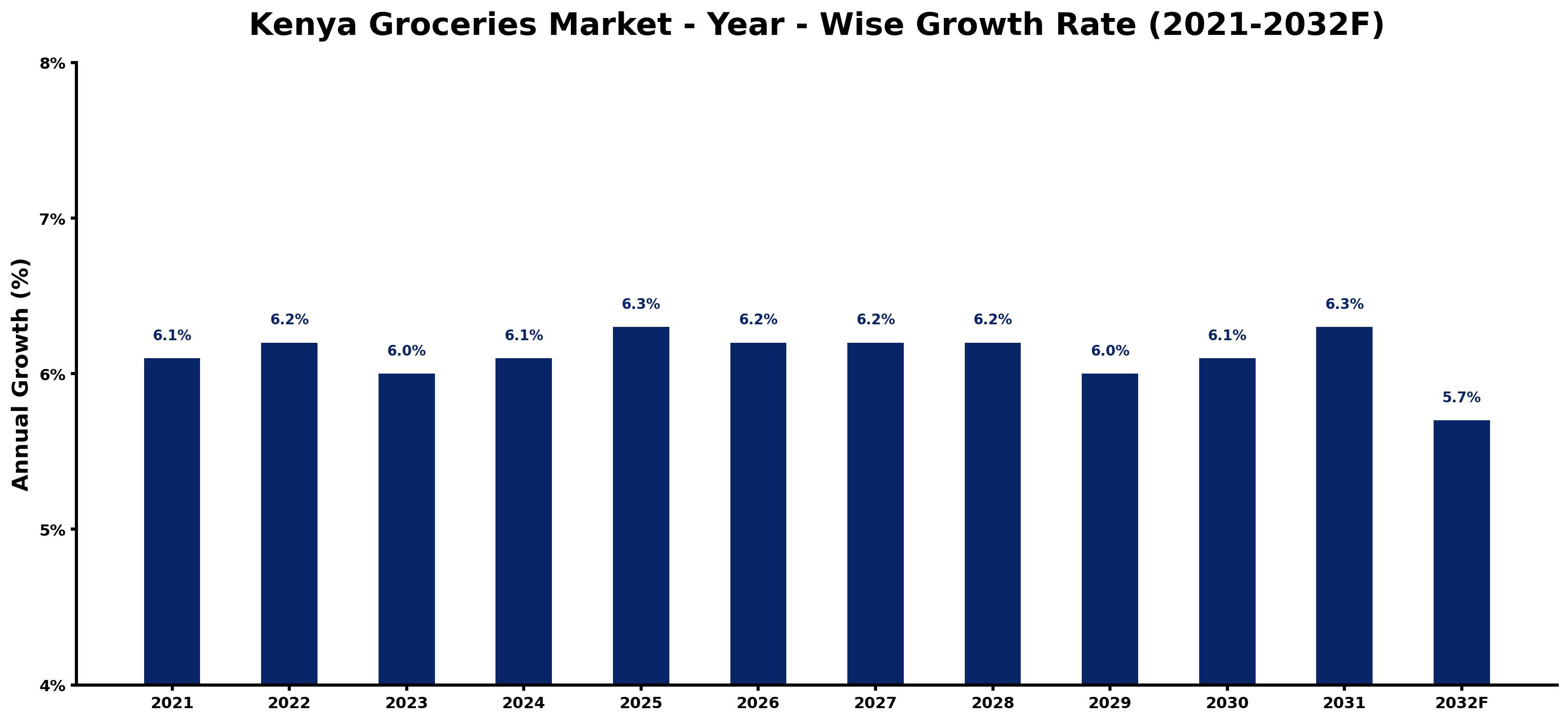
The table below presents the year wise growth rates along with the key drivers influencing the market
| Year | Growth Rate | Major Drivers |
| 2021 | 6.1% | Local smallholder farmers increasingly supply supermarkets, enhancing fresh produce availability. |
| 2022 | 6.2% | Urbanization trends motivate traditional markets to modernize their service offerings. |
| 2023 | 6.0% | E-commerce platforms expand, allowing groceries to reach previously underserved regions. |
| 2024 | 6.1% | Consumer preferences shift toward organic products, evolving retailer inventory strategies. |
| 2025 | 6.3% | Payment system innovations facilitate smoother transactions, boosting customer confidence. |
| 2026 | 6.2% | International brands enter the market, increasing competition and product diversity. |
| 2027 | 6.2% | Health awareness campaigns promote nutritious food, influencing purchasing behavior significantly. |
| 2028 | 6.2% | Sustainability concerns lead to demand for eco-friendly packaging among retailers. |
| 2029 | 6.0% | Mobile technology enhances supply chain efficiency, reducing costs for retailers. |
| 2030 | 6.1% | Investment in logistics infrastructure improves distribution channels across urban centers. |
| 2031 | 6.3% | Local partnerships with tech startups drive innovative grocery delivery solutions. |
| 2032 | 5.7% | Changing demographics favor convenience shopping, prompting store layout transformations. |
Note - Market size estimations and growth projections presented in this report are based on 6Wresearch's advanced forecasting approach, validated with industry datasets as of June 2026.
Kenya Groceries Market Synopsis
The Kenya Groceries Market is projected to reach 6.2% and witness significant growth during the forecast period (2026-2032). This market is distinguished by its expansive product range that includes local and international brands, catering to an increasingly diverse consumer base. The competitive landscape is marked by a blend of traditional retail formats—such as local stores and informal markets—and the burgeoning online grocery shopping platforms. This duality of retailing reflects the evolving shopping habits, especially as convenience and quality become paramount for consumers.
Kenya Groceries Market Growth Drivers
Several key factors are driving the growth of the Kenya Groceries Market. First, the rising disposable incomes of a youthful, urban population are increasing demand for quality grocery products. Second, the trend toward health consciousness among consumers is fostering interest in organic and locally sourced foods. Third, the rapid growth of internet penetration enables a shift towards e-commerce, making online grocery shopping more accessible and appealing.
- The expansion of middle-class demographics enhances market demand for diverse grocery options.
- Health and sustainability trends are increasingly influencing consumer purchasing behaviors.
- Technological advancements are facilitating improvements in supply chain management and online retailing.
- Urbanization is leading to higher demand for convenient shopping solutions, including delivery services.
- Government initiatives aimed at boosting local agriculture support the supply of fresh produce, enhancing market robustness.
Kenya Groceries Market Trends and Opportunities
The Kenya Groceries Market is witnessing transformative trends that present numerous opportunities. Consumers are gravitating towards online shopping platforms for groceries, driven by convenience and safety considerations heightened during the pandemic. Retailers are adapting to these shifts by expanding their online offerings and enhancing customer service through improved delivery mechanisms.
- The rise of health-conscious consumers is prompting grocery retailers to stock a wider range of organic products.
- Increased focus on e-commerce capabilities is resulting in better user experiences and faster delivery times.
- Promotion of locally sourced products is becoming a key strategy for retailers looking to differentiate themselves.
- Innovative food technology solutions are being developed to cater to changing consumer preferences.
- Strategic partnerships between retailers and local producers are increasingly common, bolstering market resilience.
Kenya Groceries Market Challenges and Restraints
Despite its growth potential, the Kenya Groceries Market faces several challenges that could hinder progress. Price volatility remains a significant concern, affected by inflation and fluctuating currency values. Moreover, infrastructural inadequacies pose challenges in distribution efficiency, particularly in rural areas.
- Distribution inefficiencies can lead to delays and increased costs for groceries, impacting retailers' competitiveness.
- The fragmented nature of the market complicates efforts for larger retailers to scale effectively.
- Access to financing remains limited, constraining growth opportunities for businesses and consumers alike.
- Regulatory challenges, including complex licensing procedures, can deter potential market entrants.
- Changes in consumer preferences can outpace retailers' ability to adapt, necessitating agile business strategies.
Kenya Groceries Market Investment Opportunities
The Kenya Groceries Market offers a wealth of investment opportunities, driven by an expanding middle class and heightened urban consumer demand for convenience and quality. Investors may find potential in modern retail formats, such as supermarkets and convenience stores, which cater to the evolving shopping preferences.
- Investing in e-commerce platforms is critical to capitalizing on the rising trend of online grocery shopping.
- Opportunities in supply chain logistics, particularly cold storage facilities, address the need for perishable goods management.
- Retail space modernization initiatives can attract consumers seeking diverse and high-quality grocery options.
- Sector development in food technology can yield innovative products that respond to consumer demands for health and sustainability.
- Collaborations with local farmers will be crucial for ensuring a steady supply of quality groceries while promoting local economic development.
Kenya Groceries Market Government Investment and Initiatives
Government policies significantly influence the Kenya Groceries Market by establishing a framework that ensures food safety and quality standards. The Kenya Bureau of Standards (KEBS) plays a critical role in regulating these aspects, thereby protecting consumer interests. Local businesses benefit from initiatives like the "Buy Kenya, Build Kenya" campaign, which encourages the purchase of domestically produced goods to bolster local industry and agriculture.
Furthermore, government investment in agricultural development and infrastructure aims to improve supply chains, thereby enhancing the availability of fresh products across markets. Taxation policies relating to food importation are regularly reviewed to maintain fair pricing structures and support local producers. Overall, these governmental strategies create a conducive environment for growth in the Kenya Groceries Market.
Kenya Groceries Market Latest Developments (May 2025 - June 2026)
Recent developments within the Kenya Groceries Market indicate a strong inclination towards digital transformation and e-commerce expansion. Firms are increasingly investing in technology to enhance consumer engagement and improve distribution efficiency. Innovations in delivery services, including partnerships with logistics companies, are becoming prevalent as retailers seek to improve service speed and reliability. The growth of social media marketing is also reshaping how grocery retailers reach and interact with consumers.
Additionally, there is a marked increase in the promotion of health-focused products, aligning with the global trend toward wellness. Retailers are responding to this shift by diversifying their product offerings to include organic and specialty items. Collectively, these trends underscore a transformative period for the Kenya Groceries Market as stakeholders adapt to changing consumer dynamics.
Kenya Groceries Market - Key Attractiveness of the Report
- 10 Years of Market Numbers
- Historical Data Starting from 2022 to 2025
- Base Year: 2025
- Forecast Data until 2032
- Key Performance Indicators Impacting the Market
- Major Upcoming Developments and Projects
Key Highlights of the Report:
- Kenya Groceries Market Outlook
- Market Size of Kenya Groceries Market, 2025
- Forecast of Kenya Groceries Market, 2032F
- Historical Data and Forecast of Kenya Groceries Revenues & Volume for the Period 2022-2032F
- Kenya Groceries Market Trend Evolution
- Kenya Groceries Market Drivers and Challenges
- Kenya Groceries Price Trends
- Kenya Groceries Porter's Five Forces
- Kenya Groceries Industry Life Cycle
- Historical Data and Forecast of Kenya Groceries Market Revenues & Volume By Product Types for the Period 2022-2032F
- Historical Data and Forecast of Kenya Groceries Market Revenues & Volume By Packaged Food for the Period 2022-2032F
- Historical Data and Forecast of Kenya Groceries Market Revenues & Volume By Unpackaged Food for the Period 2022-2032F
- Historical Data and Forecast of Kenya Groceries Market Revenues & Volume By Drinks for the Period 2022-2032F
- Historical Data and Forecast of Kenya Groceries Market Revenues & Volume By Tobacco for the Period 2022-2032F
- Historical Data and Forecast of Kenya Groceries Market Revenues & Volume By Household Products for the Period 2022-2032F
- Historical Data and Forecast of Kenya Groceries Market Revenues & Volume By Others for the Period 2022-2032F
- Historical Data and Forecast of Kenya Groceries Market Revenues & Volume By Distribution Channel for the Period 2022-2032F
- Historical Data and Forecast of Kenya Groceries Market Revenues & Volume By Supermarkets & Hypermarkets for the Period 2022-2032F
- Historical Data and Forecast of Kenya Groceries Market Revenues & Volume By Convenience Store for the Period 2022-2032F
- Historical Data and Forecast of Kenya Groceries Market Revenues & Volume By Online for the Period 2022-2032F
- Kenya Groceries Import Export Trade Statistics
- Market Opportunity Assessment By Product Types
- Market Opportunity Assessment By Distribution Channel
- Kenya Groceries Top Companies Market Share
- Kenya Groceries Competitive Benchmarking By Technical and Operational Parameters
- Kenya Groceries Company Profiles
- Kenya Groceries Key Strategic Recommendations






































