Kenya Hospital Equipment And Supplies Market Size, Share & Growth Rate
The Kenya Hospital Equipment And Supplies Market was estimated at USD 425 Million in 2025 and is projected to reach USD 577 Million by 2032, growing at a CAGR of 4.5% from 2026 to 2032. This growth trajectory is primarily driven by increasing healthcare investments from both the government and private sector, aimed at modernizing facilities to meet the escalating demand for advanced medical technology. The expansion of health services, coupled with a rising population that is more health-conscious than ever, is compelling hospitals to acquire a diverse array of medical devices and consumables.
Kenya Hospital Equipment And Supplies Market Year-wise Growth Rate and Key Drivers
This graph highlights how the Kenya Hospital Equipment And Supplies Market has steadily grown over the years, supported by major growth factors.
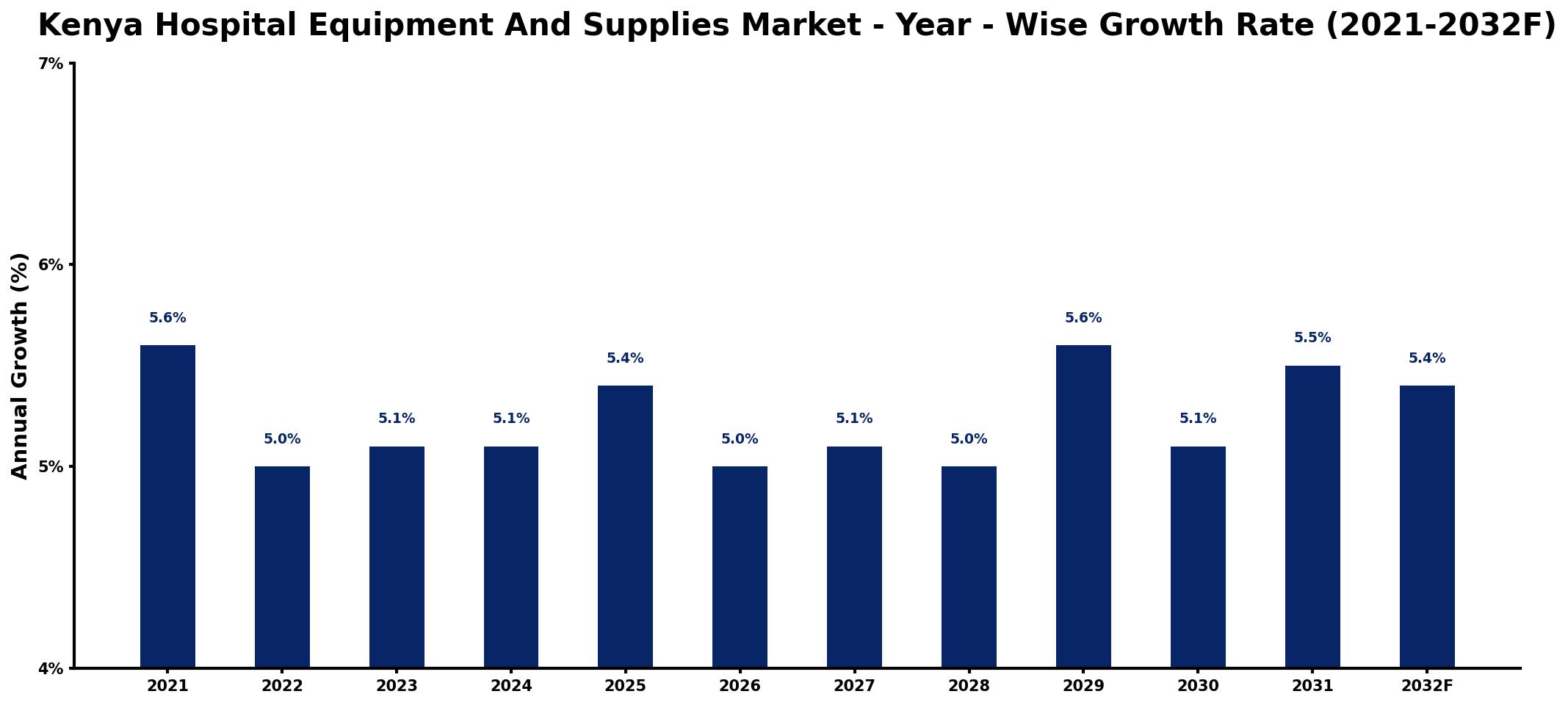
The table below presents the year‑wise growth rates along with the key drivers influencing the market
| Year | Growth Rate | Major Drivers |
| 2021 | 5.6% | Rising healthcare infrastructure investments |
| 2022 | 5.0% | Increased demand for medical technologies |
| 2023 | 5.1% | Expansion of telehealth services |
| 2024 | 5.1% | Growing prevalence of chronic diseases |
| 2025 | 5.4% | Enhanced government health initiatives |
| 2026 | 5.0% | Surge in private sector partnerships |
| 2027 | 5.1% | Advancements in medical research funding |
| 2028 | 5.0% | Emergence of new healthcare startups |
| 2029 | 5.6% | Strengthened public health policies |
| 2030 | 5.1% | Rising consumer health awareness |
| 2031 | 5.5% | Boosted international healthcare collaborations |
| 2032 | 5.4% | Growing emphasis on preventive care |
Note: Market size estimations and growth projections presented in this report are based on 6Wresearch's proprietary forecasting methodology, utilizing the latest available industry data, government publications, and primary research inputs.
Kenya Hospital Equipment And Supplies Market Synopsis
The surge in healthcare service demand is propelling hospitals across Kenya to update their medical equipment and supplies. Notably, the need for diagnostic tools and patient monitoring devices is intensifying, as healthcare providers aim to enhance the quality of care. This shift towards modernization is not just limited to urban centers; rural hospitals are also striving to elevate their service capabilities.
Public health initiatives are fostering an environment conducive to growth within the market. The Kenyan government is increasingly prioritizing healthcare infrastructure investments, which inherently demands a wide range of medical supplies and equipment. As a result, both local and international suppliers are seizing opportunities to fill these gaps, driving robust market dynamics.
Kenya Hospital Equipment And Supplies Market Key Takeaways
- The market is set for steady growth due to heightened healthcare service demand and modernization efforts.
- Government investments are critical in facilitating advancements in healthcare infrastructure.
- Diagnostic and monitoring equipment are experiencing particularly strong demand across the sector.
- Healthcare facilities are increasingly focusing on ensuring the affordability and quality of medical supplies.
- Logistical constraints and regulatory hurdles remain key challenges for effective market operation.
Evaluation of Restraints in Kenya Hospital Equipment And Supplies Market
Despite the positive outlook, several restraints hinder the full potential of the Kenya Hospital Equipment And Supplies Market. One primary concern is affordability; many healthcare facilities, particularly those in rural areas, struggle to procure essential medical devices due to high costs. Quality assurance also poses a significant challenge, as there is a continuous need for stringent oversight to ensure that equipment meets established health standards. Moreover, logistical issues—such as inadequate supply chains and distribution networks—along with complex regulatory compliance processes, can obstruct timely access to medical supplies and equipment.
Kenya Hospital Equipment And Supplies Market Trends
The market is currently witnessing an increase in digital health solutions, such as telemedicine and mobile health applications. These technologies are reshaping how healthcare is delivered and monitored, highlighting the importance of digital-ready medical equipment. Additionally, there is a trend towards sustainability, with hospitals seeking eco-friendly equipment and supplies, which is becoming a significant factor in purchasing decisions.
Another notable trend is the rise of local manufacturing capabilities, driven by government policies encouraging domestic production. This shift not only aims to enhance supply chain resilience but also to reduce dependency on imports, ultimately improving affordability and accessibility for healthcare providers.
Kenya Hospital Equipment And Supplies Market Opportunities
There are significant growth opportunities within the Kenya Hospital Equipment And Supplies Market. The increasing focus on preventive care and early diagnostics presents avenues for investments in advanced diagnostic tools and imaging equipment. Furthermore, as the government pushes for universal health coverage, there will be an escalating need for essential medical supplies in both public and private healthcare facilities. Collaborative partnerships between local manufacturers and international suppliers can also foster innovation and expand market access.
Government Initiatives in the Kenya Hospital Equipment And Supplies Market
The Kenyan government is actively implementing policies aimed at improving healthcare infrastructure and access. Initiatives such as the Health Sector Strategic Plan are designed to bolster investments in medical facilities, thereby creating a conducive environment for the hospital equipment market. Furthermore, regulations concerning medical device registration and procurement practices are being streamlined to encourage compliance and enhance the availability of quality medical supplies across the nation.
Future Insights of the Kenya Hospital Equipment And Supplies Market
As we look ahead to 2026-2032, the Kenya Hospital Equipment And Supplies Market is poised for remarkable growth. With continued government focus on healthcare system strengthening and increasing public-private partnerships, the demand for innovative medical technology is expected to surge. Additionally, the integration of artificial intelligence in diagnostics and patient care will likely play a pivotal role in the evolution of the market, enhancing operational efficiencies and patient outcomes.
Kenya Hospital Equipment And Supplies Market Latest Developments (2025 - 2026)
Recent trends indicate a pivot towards adopting advanced telehealth solutions as hospitals adapt to the evolving needs of patients. Furthermore, there is a marked increase in collaborations between local manufacturers and international firms, aimed at enhancing the quality and range of available medical supplies. Regulatory updates have also been made to simplify the approval processes for new medical devices, which could further stimulate market growth.
Kenya Hospital Equipment And Supplies Market - Key Attractiveness of the Report
- 10 Years of Market Numbers
- Historical Data Starting from 2022 to 2025
- Base Year: 2025
- Forecast Data until 2032
- Key Performance Indicators Impacting the Market
- Major Upcoming Developments and Projects
Key Highlights of the Report:
- Kenya Hospital Equipment And Supplies Market Outlook
- Market Size of Kenya Hospital Equipment And Supplies Market, 2025
- Forecast of Kenya Hospital Equipment And Supplies Market, 2032
- Historical Data and Forecast of Kenya Hospital Equipment And Supplies Revenues & Volume for the Period 2022-2032F
- Kenya Hospital Equipment And Supplies Market Trend Evolution
- Kenya Hospital Equipment And Supplies Market Drivers and Challenges
- Kenya Hospital Equipment And Supplies Price Trends
- Kenya Hospital Equipment And Supplies Porter's Five Forces
- Kenya Hospital Equipment And Supplies Industry Life Cycle
- Historical Data and Forecast of Kenya Hospital Equipment And Supplies Market Revenues & Volume By Product for the Period 2022-2032F
- Historical Data and Forecast of Kenya Hospital Equipment And Supplies Market Revenues & Volume By Sterilization And Disinfectant Equipment for the Period 2022-2032F
- Historical Data and Forecast of Kenya Hospital Equipment And Supplies Market Revenues & Volume By Disposable Hospital Supplies Patient Examination Devices for the Period 2022-2032F
- Historical Data and Forecast of Kenya Hospital Equipment And Supplies Market Revenues & Volume By Syringes And Needles for the Period 2022-2032F
- Historical Data and Forecast of Kenya Hospital Equipment And Supplies Market Revenues & Volume By Application for the Period 2022-2032F
- Historical Data and Forecast of Kenya Hospital Equipment And Supplies Market Revenues & Volume By OEMs for the Period 2022-2032F
- Historical Data and Forecast of Kenya Hospital Equipment And Supplies Market Revenues & Volume By Aftermarket for the Period 2022-2032F
- Kenya Hospital Equipment And Supplies Import Export Trade Statistics
- Market Opportunity Assessment By Product
- Market Opportunity Assessment By Application
- Kenya Hospital Equipment And Supplies Top Companies Market Share
- Kenya Hospital Equipment And Supplies Competitive Benchmarking By Technical and Operational Parameters
- Kenya Hospital Equipment And Supplies Company Profiles
- Kenya Hospital Equipment And Supplies Key Strategic Recommendations






































