Kenya IoT Security Market Size & Growth Rate (2026-2032)
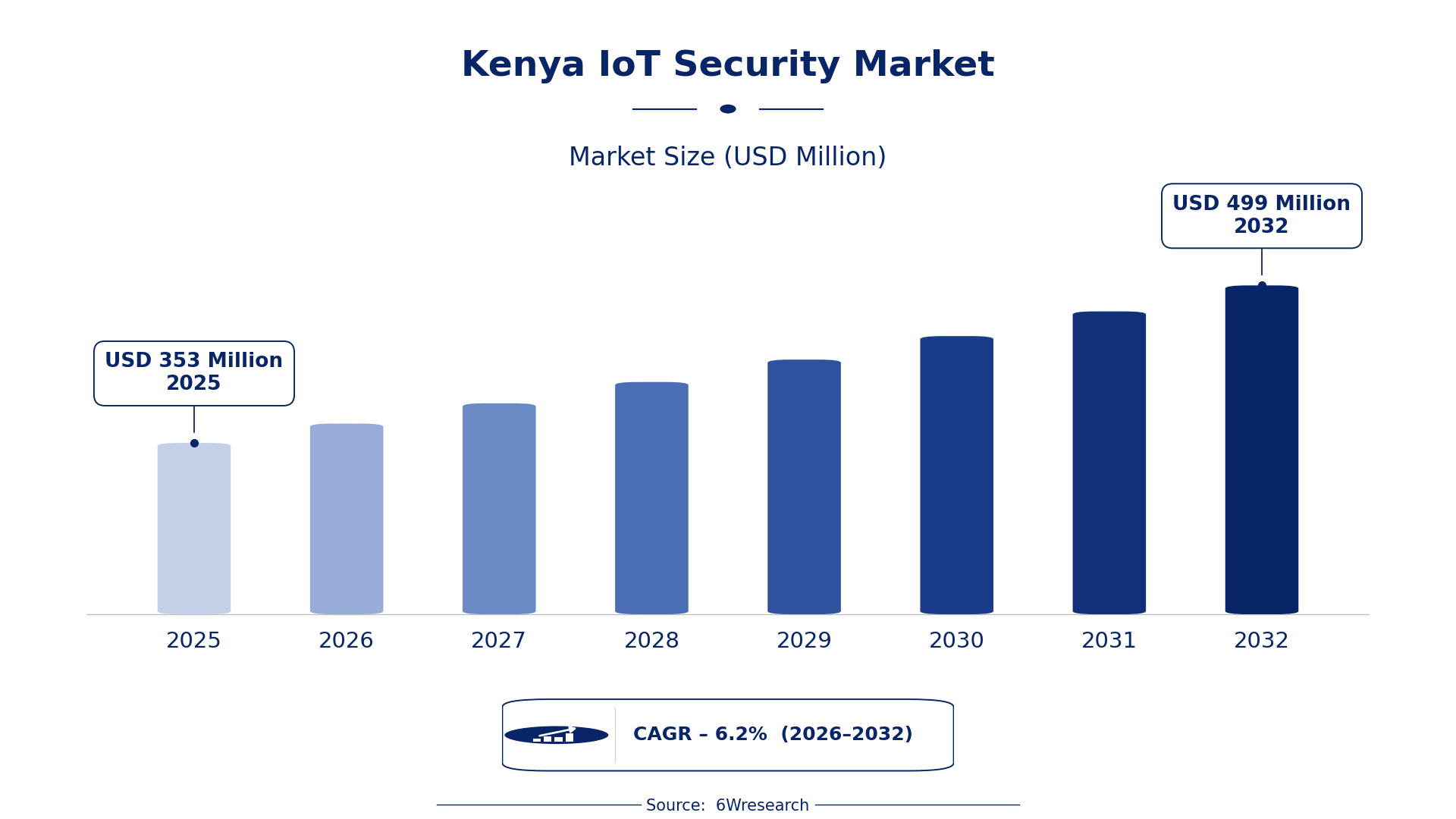
The Kenya IoT Security Market was estimated at USD 353 Million in 2025 and is projected to reach USD 499 Million by 2032, growing at a CAGR of 6.2% from 2026 to 2032.
Kenya IoT Security Market Synopsis
The Kenya IoT Security Market is witnessing a surge as organizations become increasingly aware of the threats facing their interconnected devices and systems. This growth is not just a reaction to current trends; it's driven by a clear necessity to safeguard sensitive data across various sectors, particularly in healthcare, finance, and urban development.
As IoT deployments multiply, so do the vulnerabilities associated with them. Companies are investing in comprehensive security solutions that encompass device authentication, encryption, and intrusion detection systems. The combination of regulatory pressures and an uptick in cyber threats continues to propel demand for robust IoT security measures across the region.
Kenya IoT Security Market Year-wise Growth Rate and Key Drivers
This graph illustrates the annual growth rates of the Kenya IoT Security Market from 2021 to 2032, highlighting a steady upward trajectory and projected expansion over the forecast period.
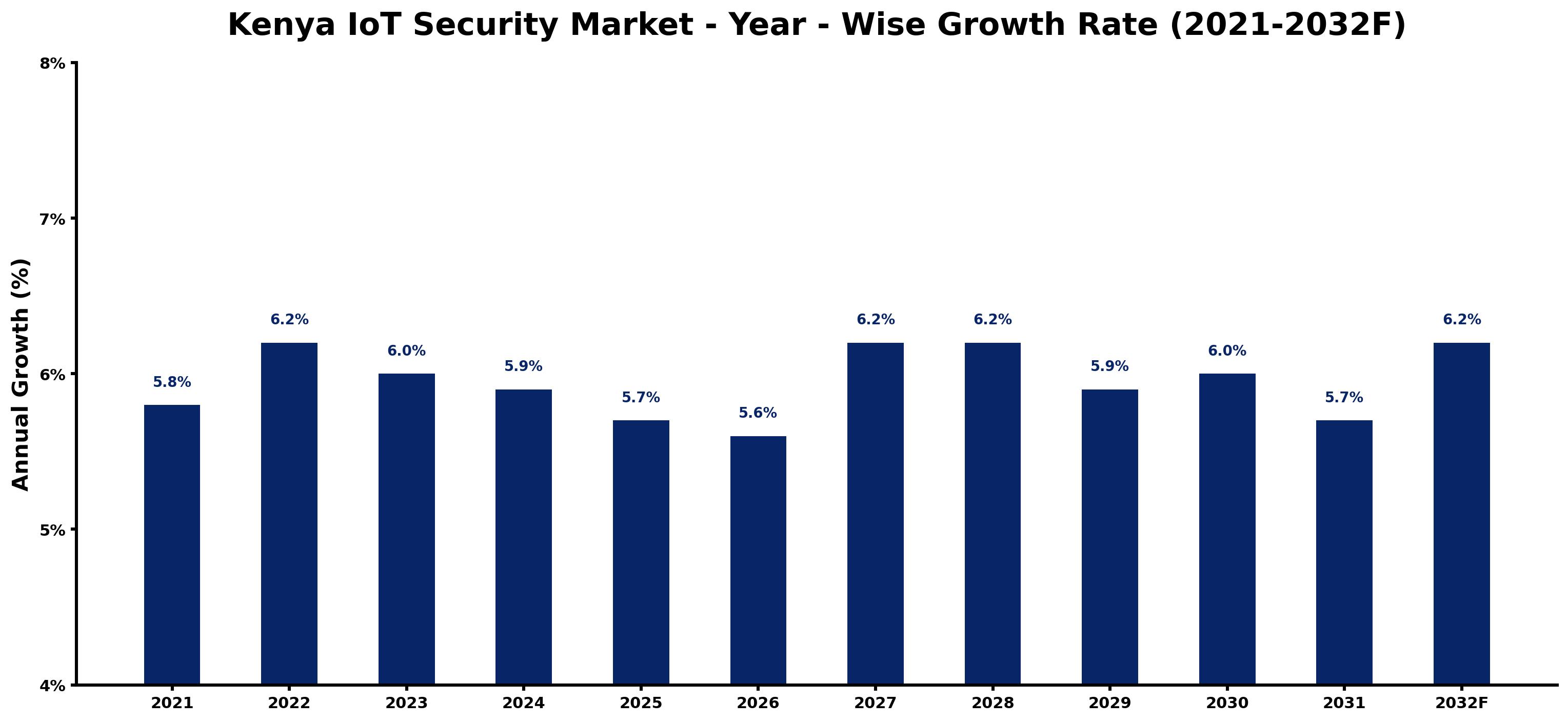
The table below presents the year‑wise growth rates along with the key drivers influencing the market
| Year | Growth Rate | Major Drivers |
| 2021 | 5.8% | Cybersecurity legislation promotes IoT security standards compliance. |
| 2022 | 6.2% | Rise in mobile payment solutions drives IoT security needs. |
| 2023 | 6.0% | Increased urbanization creates demand for smart infrastructure security. |
| 2024 | 5.9% | Government initiatives support agricultural IoT device security enhancements. |
| 2025 | 5.7% | Regulatory focus on data privacy boosts IoT security compliance. |
| 2026 | 5.6% | Telecom sector growth necessitates stronger IoT security frameworks. |
| 2027 | 6.2% | Growing fintech sector raises IoT security investment demand. |
| 2028 | 6.2% | Digital transformation in companies enhances IoT security adoption. |
| 2029 | 5.9% | Rising cybersecurity awareness among consumers drives market expansion. |
| 2030 | 6.0% | Smart logistics initiatives increase focus on IoT security solutions. |
| 2031 | 5.7% | Surge in remote work necessitates enhanced IoT security protocols. |
| 2032 | 6.2% | Local tech startup ecosystem fosters innovative IoT security solutions. |
Note: Market size estimations and growth projections presented in this report are based on 6Wresearch's proprietary forecasting methodology, utilizing the latest available industry data, government publications, and primary research inputs.
Kenya IoT Security Market Key Takeaways
Below are some of the specific key takeaways from the market, including:
- Healthcare, finance, and smart cities are leading adopters of IoT security solutions in Kenya.
- The rise in cybersecurity threats is a primary driver for investment in IoT security technologies.
- Regulatory compliance requirements are pushing organizations to enhance their security measures.
- Data privacy concerns are becoming a critical consideration for businesses leveraging IoT.
- Providers are focusing on developing integrated solutions to address complex security challenges.
Evaluation of Restraints in Kenya IoT Security Market
Several factors are limiting the full potential of the Kenya IoT Security Market. One major restraint is the complexity of ensuring end-to-end security for devices and networks. As IoT systems become increasingly sophisticated, vulnerabilities in device firmware and software remain a persistent challenge. on top of that, managing effective access control and authentication processes is often complicated, leaving gaps that cybercriminals can exploit. The landscape of cyber threats is evolving rapidly, making it difficult for providers to keep pace with the necessary security measures.
Kenya IoT Security Market Trends
Several trends are shaping the Kenya IoT Security Market. The emphasis on data encryption and device authentication is rising, as organizations strive to meet both customer expectations and regulatory requirements. Another trend is the increased adoption of artificial intelligence and machine learning technologies, which are being integrated into security systems to enhance threat detection and response capabilities. Additionally, there’s a noticeable shift towards multi-layered security approaches that combine various protective measures to create a more resilient infrastructure.
Kenya IoT Security Market Opportunities
The Kenya IoT Security Market presents numerous growth opportunities for stakeholders. With the ongoing digital transformation across various industries, there is a heightened demand for advanced security solutions tailored to meet specific sector needs. Companies focusing on developing innovative security technologies and services are well-positioned to capture market share. on top of that, partnerships between tech firms and government bodies could lead to new initiatives aimed at bolstering national cybersecurity efforts.
Government Initiatives in the Kenya IoT Security Market
Government policy is playing a crucial role in shaping the IoT Security Market in Kenya. With increasing concerns about data protection and cybersecurity, regulatory frameworks are being established to guide organizations on best practices. Public-sector initiatives are also focusing on enhancing the country’s digital infrastructure, which will subsequently impact IoT security measures.
- A national cybersecurity strategy launched in 2023 aims to strengthen protections for IoT systems across all sectors.
- Current efforts include a comprehensive review of data privacy regulations to ensure they align with emerging IoT technologies.
- A public-private partnership initiative is underway to develop guidelines for securing critical infrastructure against cyber threats.
- Plans for a regulatory framework mandating device authentication and encryption standards are expected to be introduced by 2025.
Future Insights of the Kenya IoT Security Market
Looking ahead to 2026-2032, the Kenya IoT Security Market is set to expand significantly. As more organizations adopt IoT technologies, the necessity for robust security frameworks will only intensify. Advances in technology will drive innovation in security solutions, making them more effective and accessible. The interplay between regulatory compliance and technological evolution will shape strategic investments, ultimately fostering a safer digital ecosystem in Kenya.
Kenya IoT Security Market Latest Developments
Recent activity in the Kenya IoT Security Market reflects a proactive approach by organizations to enhance their security postures. In the past year, numerous initiatives have been launched to address escalating cybersecurity threats and to bolster defenses across sectors.
- A new cloud-based IoT security service was launched in Q1 2024, providing organizations with advanced threat detection capabilities.
- A major technology vendor initiated a collaboration with local universities in early 2024 to develop IoT security education programs.
- Current projects include the ongoing rollout of a national IoT security awareness campaign aimed at businesses and consumers.
- Upcoming in 2025 is a comprehensive certification program for IoT security professionals to enhance skillsets in the market.
Kenya IoT Security Market - Key Attractiveness of the Report
- 10 Years of Market Numbers
- Historical Data Starting from 2022 to 2025
- Base Year: 2025
- Forecast Data until 2032
- Key Performance Indicators Impacting the Market
- Major Upcoming Developments and Projects
Key Highlights of the Report:
- Kenya IoT Security Market Outlook
- Market Size of Kenya IoT Security Market, 2025
- Forecast of Kenya IoT Security Market, 2032
- Historical Data and Forecast of Kenya IoT Security Revenues & Volume for the Period 2022-2032F
- Kenya IoT Security Market Trend Evolution
- Kenya IoT Security Market Drivers and Challenges
- Kenya IoT Security Price Trends
- Kenya IoT Security Porter's Five Forces
- Kenya IoT Security Industry Life Cycle
- Historical Data and Forecast of Kenya IoT Security Market Revenues & Volume By Type for the Period 2022-2032F
- Historical Data and Forecast of Kenya IoT Security Market Revenues & Volume By Network Security for the Period 2022-2032F
- Historical Data and Forecast of Kenya IoT Security Market Revenues & Volume By Endpoint Security for the Period 2022-2032F
- Historical Data and Forecast of Kenya IoT Security Market Revenues & Volume By Application Security for the Period 2022-2032F
- Historical Data and Forecast of Kenya IoT Security Market Revenues & Volume By Cloud Security for the Period 2022-2032F
- Historical Data and Forecast of Kenya IoT Security Market Revenues & Volume By Other Security Types for the Period 2022-2032F
- Historical Data and Forecast of Kenya IoT Security Market Revenues & Volume By Deployment Mode for the Period 2022-2032F
- Historical Data and Forecast of Kenya IoT Security Market Revenues & Volume By Small and Medium Enterprises for the Period 2022-2032F
- Historical Data and Forecast of Kenya IoT Security Market Revenues & Volume By Large Enterprises for the Period 2022-2032F
- Historical Data and Forecast of Kenya IoT Security Market Revenues & Volume By Component for the Period 2022-2032F
- Historical Data and Forecast of Kenya IoT Security Market Revenues & Volume By Solutions for the Period 2022-2032F
- Historical Data and Forecast of Kenya IoT Security Market Revenues & Volume By Services for the Period 2022-2032F
- Historical Data and Forecast of Kenya IoT Security Market Revenues & Volume By Solution for the Period 2022-2032F
- Historical Data and Forecast of Kenya IoT Security Market Revenues & Volume By Identity and Access Management for the Period 2022-2032F
- Historical Data and Forecast of Kenya IoT Security Market Revenues & Volume By Data Encryption and Tokenization for the Period 2022-2032F
- Historical Data and Forecast of Kenya IoT Security Market Revenues & Volume By Intrusion Detection System/Intrusion Prevention System for the Period 2022-2032F
- Historical Data and Forecast of Kenya IoT Security Market Revenues & Volume By Device Authentication and Management for the Period 2022-2032F
- Historical Data and Forecast of Kenya IoT Security Market Revenues & Volume By Secure Communications for the Period 2022-2032F
- Historical Data and Forecast of Kenya IoT Security Market Revenues & Volume By PKI Lifecycle Management for the Period 2022-2032F
- Historical Data and Forecast of Kenya IoT Security Market Revenues & Volume By Distributed Denial of Service Protection for the Period 2022-2032F
- Historical Data and Forecast of Kenya IoT Security Market Revenues & Volume By Security Analytics for the Period 2022-2032F
- Historical Data and Forecast of Kenya IoT Security Market Revenues & Volume By Application Area for the Period 2022-2032F
- Historical Data and Forecast of Kenya IoT Security Market Revenues & Volume By Smart Manufacturing for the Period 2022-2032F
- Historical Data and Forecast of Kenya IoT Security Market Revenues & Volume By Smart Energy and Utilities for the Period 2022-2032F
- Historical Data and Forecast of Kenya IoT Security Market Revenues & Volume By Connected Logistics for the Period 2022-2032F
- Historical Data and Forecast of Kenya IoT Security Market Revenues & Volume By Smart Home and Consumer Electronics for the Period 2022-2032F
- Historical Data and Forecast of Kenya IoT Security Market Revenues & Volume By Connected Healthcare for the Period 2022-2032F
- Historical Data and Forecast of Kenya IoT Security Market Revenues & Volume By Smart Government and Defense for the Period 2022-2032F
- Historical Data and Forecast of Kenya IoT Security Market Revenues & Volume By Smart Retail for the Period 2022-2032F
- Historical Data and Forecast of Kenya IoT Security Market Revenues & Volume By Other Application Areas for the Period 2022-2032F
- Historical Data and Forecast of Kenya IoT Security Market Revenues & Volume By Organization Size for the Period 2022-2032F
- Historical Data and Forecast of Kenya IoT Security Market Revenues & Volume By Small and Medium-sized Enterprises for the Period 2022-2032F
- Historical Data and Forecast of Kenya IoT Security Market Revenues & Volume By Large Enterprises for the Period 2022-2032F
- Historical Data and Forecast of Kenya IoT Security Market Revenues & Volume By Service for the Period 2022-2032F
- Historical Data and Forecast of Kenya IoT Security Market Revenues & Volume By Professional Services for the Period 2022-2032F
- Historical Data and Forecast of Kenya IoT Security Market Revenues & Volume By Managed Services for the Period 2022-2032F
- Kenya IoT Security Import Export Trade Statistics
- Market Opportunity Assessment By Type
- Market Opportunity Assessment By Deployment Mode
- Market Opportunity Assessment By Component
- Market Opportunity Assessment By Solution
- Market Opportunity Assessment By Application Area
- Market Opportunity Assessment By Organization Size
- Market Opportunity Assessment By Service
- Kenya IoT Security Top Companies Market Share
- Kenya IoT Security Competitive Benchmarking By Technical and Operational Parameters
- Kenya IoT Security Company Profiles
- Kenya IoT Security Key Strategic Recommendations






































