Kenya Kosher Food Market Size, Share & Growth Rate
The Kenya Kosher Food Market was estimated at USD 390 Million in 2025 and is projected to reach USD 546 Million by 2032, growing at a CAGR of 4.9% from 2026 to 2032. This growth trajectory is fueled by a notable increase in the demand for kosher-certified products, driven not only by the local Jewish community but also by health-conscious consumers of diverse backgrounds. As more people recognize the perceived quality and safety associated with kosher foods, the market is poised for significant expansion.
Kenya Kosher Food Market Year-wise Growth Rate and Key Drivers
This graph highlights how the Kenya Kosher Food Market has steadily grown over the years, supported by major growth factors.
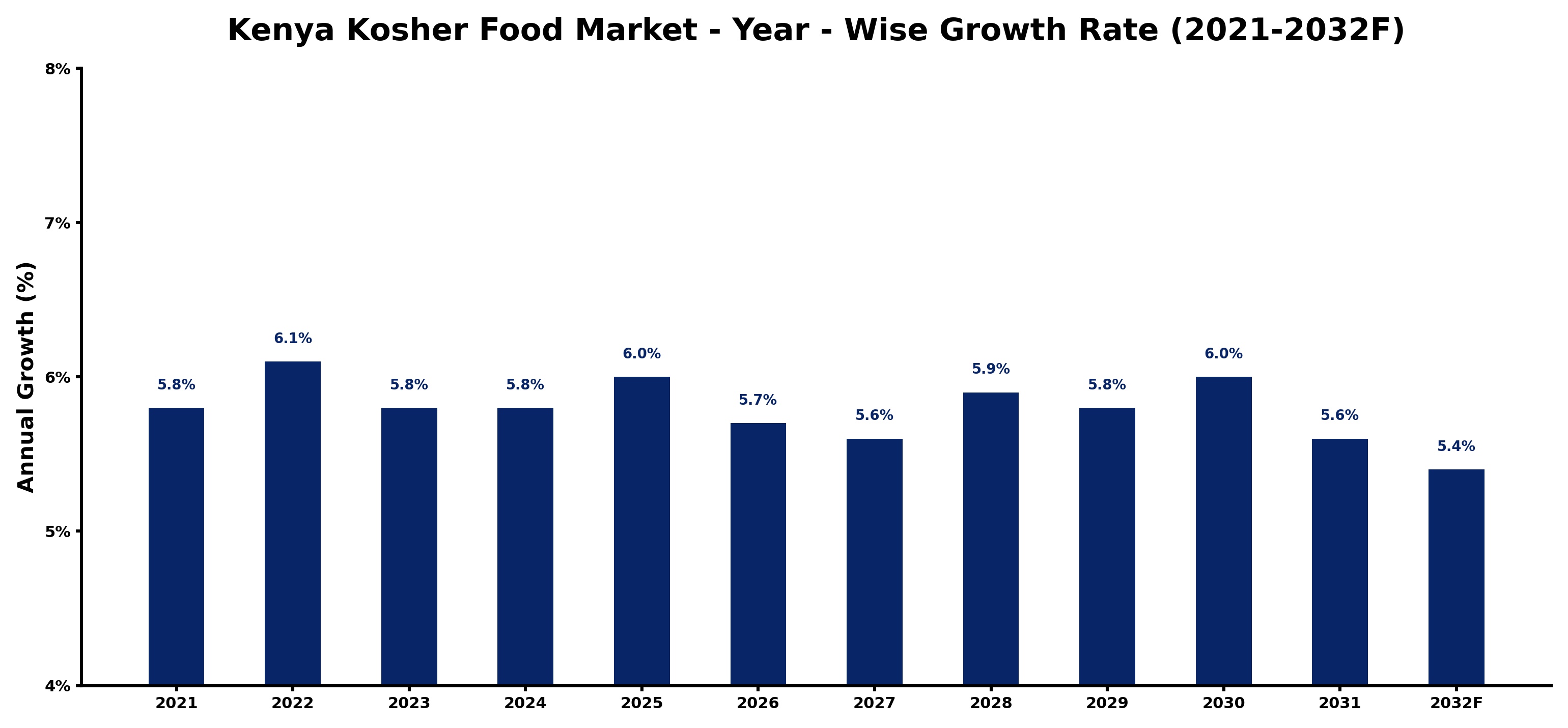
The table below presents the year‑wise growth rates along with the key drivers influencing the market
| Year | Growth Rate | Major Drivers |
| 2021 | 5.8% | Retail demand recovery bolstered local kosher food production efforts |
| 2022 | 6.1% | Strengthened supply chain technologies improved kosher food traceability systems |
| 2023 | 5.8% | Kosher certification process streamlines production in local food processing |
| 2024 | 5.8% | Domestic food processing facilities adopt advanced certification technologies for efficiency |
| 2025 | 6.0% | New food processing facilities boost local kosher product availability |
| 2026 | 5.7% | Export driven demand boosts local kosher food processing investments |
| 2027 | 5.6% | Local manufacturers invest in kosher packaging technology upgrades |
| 2028 | 5.9% | Local kosher food processing facilities boost raw material sourcing efficiency |
| 2029 | 5.8% | Technology adoption in kosher food processing boosted production efficiency |
| 2030 | 6.0% | Local kosher certification enhancements boosted demand for quality ingredients |
| 2031 | 5.6% | Export driven demand for kosher products boosts local manufacturing capabilities |
| 2032 | 5.4% | Upgraded food processing equipment boosts kosher meat production capacity |
Note - Market size estimations and growth projections presented in this report are based on 6Wresearch’s advanced forecasting approach, validated with industry datasets as of June 2026.
Kenya Kosher Food Market Synopsis
In recent years, the Kenya kosher food market has gained momentum, attributed primarily to rising awareness and accessibility of kosher products. This upward trend contrasts with earlier periods when availability was limited and awareness of kosher standards was low. As the market matures, it is witnessing an increasing influx of kosher options in mainstream retail, aligning with the broader shift towards multicultural food preferences.
Looking ahead, the landscape of the Kenya kosher food market appears promising. With an emphasis on quality and ethical sourcing becoming more prevalent among consumers, kosher products are finding favor across various demographic segments. This growth, however, will require ongoing adaptation to meet both certification demands and consumer expectations in a dynamic environment.
Kenya Kosher Food Market Key Takeaways
- The market is supported by a significant Jewish population that consistently seeks kosher options.
- Health awareness has led to non-Jewish consumers also gravitating towards kosher-certified products.
- Accessibility has improved due to the presence of kosher products in mainstream supermarkets and specialty stores.
- Consumer perceptions of quality and safety play a critical role in driving demand for kosher foods.
- Compliance with rigorous certification standards remains a priority for ensuring consumer trust and market growth.
Evaluation of Restraints in Kenya Kosher Food Market
Despite the positive growth prospects, several challenges are limiting the full potential of the Kenya kosher food market. Certification requirements can be stringent, often complicating the sourcing of kosher ingredients for manufacturers. Furthermore, consumer trust in certification standards is paramount; any misstep can erode confidence in the entire sector. Additionally, adapting products to suit local tastes while maintaining kosher standards poses ongoing dilemmas for market players. Enhanced distribution channels are needed to ensure that kosher products reach all interested consumers efficiently.
Kenya Kosher Food Market Trends
Current trends indicate a rising consumer preference for organic and ethically sourced ingredients within the kosher market. There is also an increasing intersection of health and dietary needs, where kosher foods are seen as compliant with various dietary restrictions, including gluten-free and vegan lifestyles. As technology advances, the digitalization of supply chains and e-commerce platforms is enabling a more seamless purchasing experience for consumers, further solidifying the market's foundation.
Kenya Kosher Food Market Opportunities
Investment opportunities are emerging in local manufacturing and distribution, as domestic producers look to cater to the expanding kosher consumer base. The growth of e-commerce presents a significant avenue for market penetration, allowing consumers to access a wider range of products with convenience. Additionally, partnerships with local supermarkets can help increase visibility and foster trust in kosher offerings, thereby expanding market reach and profitability.
Government Initiatives in the Kenya Kosher Food Market
Government policies play an essential role in shaping the Kenyan kosher food market. Regulatory frameworks are focused on food safety standards and certification protocols to ensure that kosher products meet both local and international quality requirements. Additionally, initiatives aimed at improving agricultural practices contribute to the availability of kosher-compliant ingredients, ultimately supporting the local kosher food industry's growth.
Future Insights of the Kenya Kosher Food Market
From 2026 to 2032, the Kenya kosher food market is expected to evolve significantly, propelled by changing consumer attitudes and continued globalization of food preferences. The integration of innovative technologies in food processing and distribution will likely enhance product offerings and accessibility. As the local population becomes increasingly diverse, kosher foods will likely see integration into various culinary traditions, reinforcing their relevance and driving growth across multiple consumer segments.
Kenya Kosher Food Market Latest Developments (May 2025 - June 2026)
Recent developments in the Kenya kosher food market show a growing trend of established retailers expanding their product lines to include more kosher-certified options. This trend reflects a proactive approach to meet the rising demand while ensuring adherence to quality standards. In tandem, community awareness campaigns are being launched to educate consumers on the benefits of kosher foods, further promoting acceptance and adoption.
Kenya Kosher Food Market - Key Attractiveness of the Report
- 10 Years of Market Numbers
- Historical Data Starting from 2022 to 2025
- Base Year: 2025
- Forecast Data until 2032
- Key Performance Indicators Impacting the Market
- Major Upcoming Developments and Projects
Key Highlights of the Report:
- Kenya Kosher Food Market Outlook
- Market Size of Kenya Kosher Food Market, 2025
- Forecast of Kenya Kosher Food Market, 2032
- Historical Data and Forecast of Kenya Kosher Food Revenues & Volume for the Period 2022-2032F
- Kenya Kosher Food Market Trend Evolution
- Kenya Kosher Food Market Drivers and Challenges
- Kenya Kosher Food Price Trends
- Kenya Kosher Food Porter's Five Forces
- Kenya Kosher Food Industry Life Cycle
- Historical Data and Forecast of Kenya Kosher Food Market Revenues & Volume By Type for the Period 2022-2032F
- Historical Data and Forecast of Kenya Kosher Food Market Revenues & Volume By Meat for the Period 2022-2032F
- Historical Data and Forecast of Kenya Kosher Food Market Revenues & Volume By Dairy for the Period 2022-2032F
- Historical Data and Forecast of Kenya Kosher Food Market Revenues & Volume By Pareve for the Period 2022-2032F
- Historical Data and Forecast of Kenya Kosher Food Market Revenues & Volume By Application for the Period 2022-2032F
- Historical Data and Forecast of Kenya Kosher Food Market Revenues & Volume By Seafood for the Period 2022-2032F
- Historical Data and Forecast of Kenya Kosher Food Market Revenues & Volume By Processed Meat and Poultry for the Period 2022-2032F
- Historical Data and Forecast of Kenya Kosher Food Market Revenues & Volume By Beverages for the Period 2022-2032F
- Historical Data and Forecast of Kenya Kosher Food Market Revenues & Volume By Staples for the Period 2022-2032F
- Historical Data and Forecast of Kenya Kosher Food Market Revenues & Volume By Snacks & Savoury for the Period 2022-2032F
- Historical Data and Forecast of Kenya Kosher Food Market Revenues & Volume By Bakery and Confectionery for the Period 2022-2032F
- Historical Data and Forecast of Kenya Kosher Food Market Revenues & Volume By Others for the Period 2022-2032F
- Historical Data and Forecast of Kenya Kosher Food Market Revenues & Volume By Distribution Channel for the Period 2022-2032F
- Historical Data and Forecast of Kenya Kosher Food Market Revenues & Volume By Supermarkets and Hypermarkets for the Period 2022-2032F
- Historical Data and Forecast of Kenya Kosher Food Market Revenues & Volume By Grocery Stores for the Period 2022-2032F
- Historical Data and Forecast of Kenya Kosher Food Market Revenues & Volume By Online Stores for the Period 2022-2032F
- Kenya Kosher Food Import Export Trade Statistics
- Market Opportunity Assessment By Type
- Market Opportunity Assessment By Application
- Market Opportunity Assessment By Distribution Channel
- Kenya Kosher Food Top Companies Market Share
- Kenya Kosher Food Competitive Benchmarking By Technical and Operational Parameters
- Kenya Kosher Food Company Profiles
- Kenya Kosher Food Key Strategic Recommendations






































