Kenya Low Fat Dairy Products Market Size, Share & Growth Rate
The Kenya Low Fat Dairy Products Market was estimated at USD 1495 Million in 2025 and is projected to reach USD 2721 Million by 2032, growing at a CAGR of 8.9% from 2026 to 2032. This growth trajectory is significantly influenced by rising health consciousness among consumers who are increasingly inclined towards low-fat alternatives. Additionally, urbanization and the adoption of Western dietary habits further amplify the demand for nutritious yet convenient dairy options.
Kenya Low Fat Dairy Products Market Year-wise Growth Rate and Key Drivers
This graph highlights how the Kenya Low Fat Dairy Products Market has steadily grown over the years, supported by major growth factors.
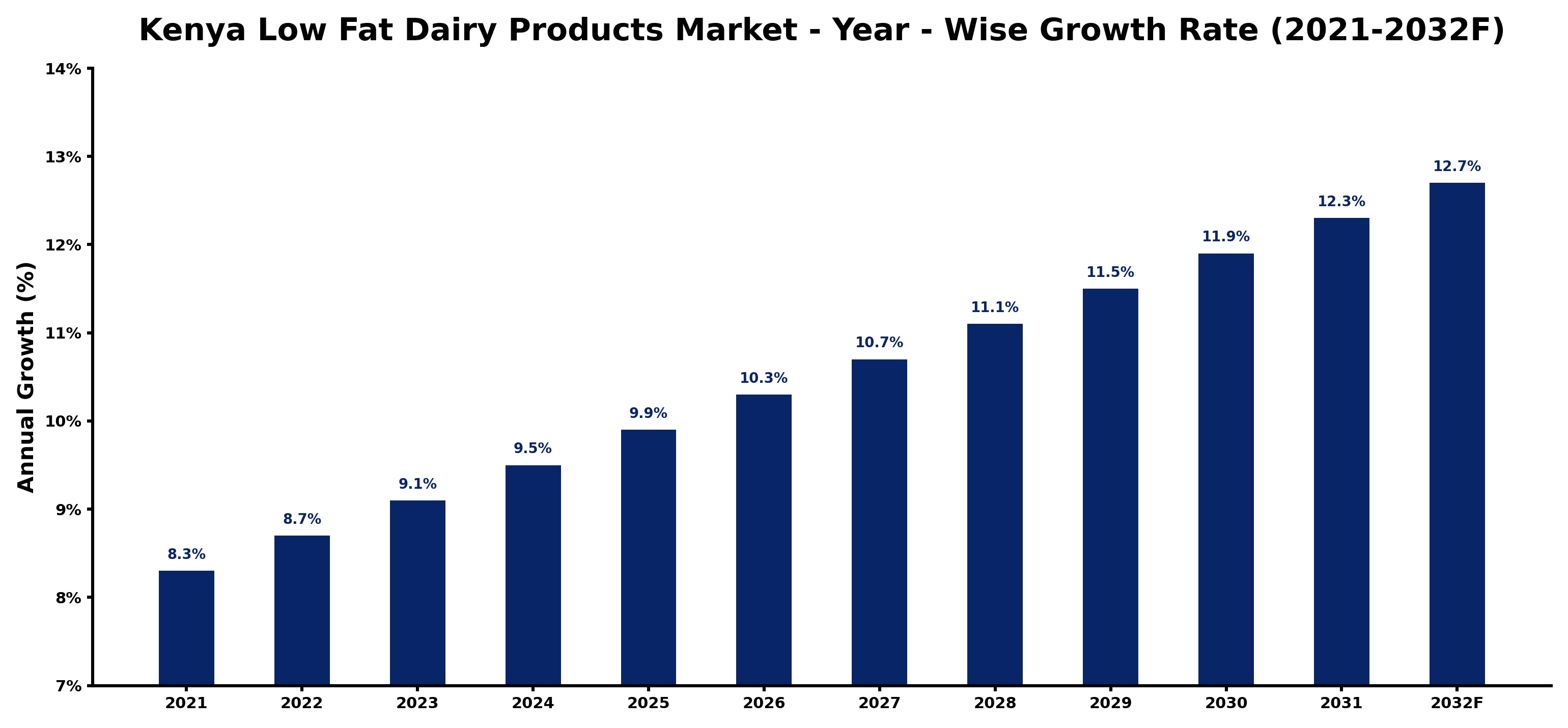
The table below presents the year‑wise growth rates along with the key drivers influencing the market
| Year | Growth Rate | Major Drivers |
| 2021 | 8.3% | Health consciousness among consumers |
| 2022 | 8.7% | Increased demand for low fat |
| 2023 | 9.1% | Rising awareness of nutrition |
| 2024 | 9.5% | Dairy alternatives gaining popularity |
| 2025 | 9.9% | Innovative product offerings emerging |
| 2026 | 10.3% | Sustainability trends influencing choices |
| 2027 | 10.7% | Growing urban population drives demand |
| 2028 | 11.1% | Fitness culture promoting dairy intake |
| 2029 | 11.5% | E-commerce growth enhancing accessibility |
| 2030 | 11.9% | Brand loyalty strengthening consumer base |
| 2031 | 12.3% | Government initiatives supporting health |
| 2032 | 12.7% | Youth demographic prioritizing wellness |
Note - Market size estimations and growth projections presented in this report are based on 6Wresearch’s advanced forecasting approach, validated with industry datasets as of June 2026.
Kenya Low Fat Dairy Products Market Synopsis
In recent years, Kenya has witnessed a remarkable shift towards low-fat dairy products, driven by changing lifestyles and health concerns such as obesity and cardiovascular diseases. Products like low-fat milk, yogurt, and cheese have become staples for many households seeking to maintain a balanced diet without compromising on taste or nutritional value.
As consumers become more aware of the health benefits associated with low-fat dairy, the market landscape is evolving. This transformation is further supported by government initiatives aimed at promoting healthier dietary choices and the production of quality dairy products, making low-fat options more accessible across the country.
Kenya Low Fat Dairy Products Market Key Takeaways
- The demand for low-fat dairy products is primarily driven by rising health awareness and changing consumer preferences.
- Urbanization and Western dietary influences are reshaping food consumption patterns in Kenya.
- Low-fat dairy products retain essential nutrients while offering lower calories and fat content.
- Government policies are increasingly supportive of the low-fat dairy segment, promoting public health initiatives.
- Product formulation and maintaining taste while reducing fat content remain key challenges for manufacturers.
Evaluation of Restraints in Kenya Low Fat Dairy Products Market
Despite the promising growth, several limitations hinder the market's potential. Consumer preferences for full-fat dairy options, often rooted in traditional dietary habits, can pose challenges for manufacturers attempting to promote low-fat alternatives. Additionally, achieving an optimal balance in product formulation that maintains flavor and texture while reducing fat content remains complex. As competition intensifies, companies must innovate continuously to meet evolving consumer expectations without sacrificing quality.
Kenya Low Fat Dairy Products Market Trends
Current trends indicate a rising inclination towards fortified low-fat dairy options enriched with vitamins and minerals, catering to health-conscious consumers. The increasing popularity of yogurt, particularly with probiotic benefits, is also noteworthy. Social media and health influencers play a significant role in shaping consumer perceptions and driving demand for low-fat dairy products. Moreover, eco-friendly packaging and sustainable production practices are becoming essential components of market strategies.
Kenya Low Fat Dairy Products Market Opportunities
The low-fat dairy products segment offers considerable growth opportunities for new entrants and established brands alike. Innovations in product development, such as lactose-free and plant-based alternatives, present untapped markets that align with the health and wellness trends gaining momentum among consumers. Moreover, expanding distribution networks, particularly in rural areas, can significantly enhance market penetration and accessibility, driving further demand for low-fat options.
Government Initiatives in the Kenya Low Fat Dairy Products Market
The Kenyan government is actively promoting the production and consumption of low-fat dairy products through various initiatives. Policies aimed at enhancing nutritional guidelines, along with public awareness campaigns, emphasize the health benefits of low-fat options. Additionally, quality standards are being established to ensure that low-fat dairy products meet consumer expectations, thereby encouraging both local production and consumption. Such measures are pivotal in fostering a healthier population and supporting the dairy industry's growth.
Future Insights of the Kenya Low Fat Dairy Products Market
Looking ahead to 2026-2032, the Kenya Low Fat Dairy Products Market is poised for robust growth. The increasing focus on health and wellness among consumers will continue to fuel demand, particularly for products that offer convenience alongside nutritional benefits. With ongoing urbanization and the influence of Western diets, market players must remain agile, adapting to emerging consumer preferences while leveraging technological advancements in dairy production to enhance efficiency and product quality.
Kenya Low Fat Dairy Products Market Latest Developments (May 2025 - June 2026)
Recent developments in the Kenya low-fat dairy sector highlight a shift towards innovative product offerings, including flavored low-fat yogurts and fortified milk variants. Companies are also exploring partnerships to enhance distribution channels, particularly in underserved rural markets. Furthermore, there is an observable rise in consumer engagement through social media platforms, where brands are promoting the health benefits of low-fat dairy options and connecting with health-conscious consumers.
Kenya Low Fat Dairy Products Market - Key Attractiveness of the Report
- 10 Years of Market Numbers
- Historical Data Starting from 2022 to 2025
- Base Year: 2025
- Forecast Data until 2032
- Key Performance Indicators Impacting the Market
- Major Upcoming Developments and Projects
Key Highlights of the Report:
- Kenya Low Fat Dairy Products Market Outlook
- Market Size of Kenya Low Fat Dairy Products Market, 2025
- Forecast of Kenya Low Fat Dairy Products Market, 2032
- Historical Data and Forecast of Kenya Low Fat Dairy Products Revenues & Volume for the Period 2022-2032F
- Kenya Low Fat Dairy Products Market Trend Evolution
- Kenya Low Fat Dairy Products Market Drivers and Challenges
- Kenya Low Fat Dairy Products Price Trends
- Kenya Low Fat Dairy Products Porter's Five Forces
- Kenya Low Fat Dairy Products Industry Life Cycle
- Historical Data and Forecast of Kenya Low Fat Dairy Products Market Revenues & Volume By Nature for the Period 2022-2032F
- Historical Data and Forecast of Kenya Low Fat Dairy Products Market Revenues & Volume By Organic for the Period 2022-2032F
- Historical Data and Forecast of Kenya Low Fat Dairy Products Market Revenues & Volume By Conventional for the Period 2022-2032F
- Historical Data and Forecast of Kenya Low Fat Dairy Products Market Revenues & Volume By Type for the Period 2022-2032F
- Historical Data and Forecast of Kenya Low Fat Dairy Products Market Revenues & Volume By Low Fat Butter for the Period 2022-2032F
- Historical Data and Forecast of Kenya Low Fat Dairy Products Market Revenues & Volume By Low Fat Cheese for the Period 2022-2032F
- Historical Data and Forecast of Kenya Low Fat Dairy Products Market Revenues & Volume By Low Fat Yoghurt for the Period 2022-2032F
- Historical Data and Forecast of Kenya Low Fat Dairy Products Market Revenues & Volume By Low Fat Ice Cream for the Period 2022-2032F
- Historical Data and Forecast of Kenya Low Fat Dairy Products Market Revenues & Volume By Reduced Fat Margarine for the Period 2022-2032F
- Historical Data and Forecast of Kenya Low Fat Dairy Products Market Revenues & Volume By Fat Free Condensed Milk for the Period 2022-2032F
- Historical Data and Forecast of Kenya Low Fat Dairy Products Market Revenues & Volume By Skimmed Milk for the Period 2022-2032F
- Historical Data and Forecast of Kenya Low Fat Dairy Products Market Revenues & Volume By Others for the Period 2022-2032F
- Historical Data and Forecast of Kenya Low Fat Dairy Products Market Revenues & Volume By Distribution Channel for the Period 2022-2032F
- Historical Data and Forecast of Kenya Low Fat Dairy Products Market Revenues & Volume By Supermarkets and Hypermarkets for the Period 2022-2032F
- Historical Data and Forecast of Kenya Low Fat Dairy Products Market Revenues & Volume By Convenience Stores for the Period 2022-2032F
- Historical Data and Forecast of Kenya Low Fat Dairy Products Market Revenues & Volume By Dairy Stores for the Period 2022-2032F
- Historical Data and Forecast of Kenya Low Fat Dairy Products Market Revenues & Volume By Online for the Period 2022-2032F
- Historical Data and Forecast of Kenya Low Fat Dairy Products Market Revenues & Volume By Others for the Period 2022-2032F
- Kenya Low Fat Dairy Products Import Export Trade Statistics
- Market Opportunity Assessment By Nature
- Market Opportunity Assessment By Type
- Market Opportunity Assessment By Distribution Channel
- Kenya Low Fat Dairy Products Top Companies Market Share
- Kenya Low Fat Dairy Products Competitive Benchmarking By Technical and Operational Parameters
- Kenya Low Fat Dairy Products Company Profiles
- Kenya Low Fat Dairy Products Key Strategic Recommendations






































